
GAS-240 · Lesson 10 of 12 · 26 min
Vehicle and engine fuel systems
▶ Video coming soon A video version of this lesson is on the way.
On Saturday morning, October 17, Hank took his three apprentices to Mountain Fleet Services in Stoney Creek, a garage run by an old friend, Ray Delorme, that converts and services propane-fuelled vehicles: delivery vans, municipal pickups, a few taxis, and the forklifts of half the warehouses in the area. Bayline does not convert vehicles, and Hank was clear about why. "A gas technician's certificate covers appliances, not engines on wheels. Vehicle work takes its own training and its own certificate, and the people who do it every day are better at it than we would be. But you will meet these systems: a forklift in a plant where you service the unit heaters, a generator on a farm, a food truck that wants its fryer looked at. You need to know what you are looking at and where your work stops." Ray walked them around a pickup on the hoist with its propane tank in the bed and opened its fill door. "First thing," he said. "This is a liquid system. Everything you know about vapour from a tank still applies, but here the engine does the boiling."
This lesson describes how propane is used as an engine fuel: in forklifts and other industrial trucks, in highway vehicles, in stationary engines such as generators, and in mobile food service equipment. It explains the main components, the code that governs each, and the safe handling of the cylinders and systems a gas technician is most likely to meet.
Liquid withdrawal and vaporizing in the engine
An engine uses fuel quickly and steadily, and it does so in every kind of weather. If a forklift or a truck drew vapour from its container, the container would chill and its pressure fall within minutes, exactly as lesson 5 described. Engine fuel systems avoid the problem by drawing liquid from the bottom of the container and vaporizing it in a vaporizer-regulator, sometimes called a converter, that is heated by the engine's coolant. In older and simpler systems the vapour then goes to a mixer on the air intake, like a carburetor; most modern systems meter vapour electronically, and some inject liquid propane directly into the engine. Between the container and the vaporizer is an electrically operated fuel lock-off valve that closes whenever the ignition is off or the engine stops, so that a broken line cannot keep draining the container.
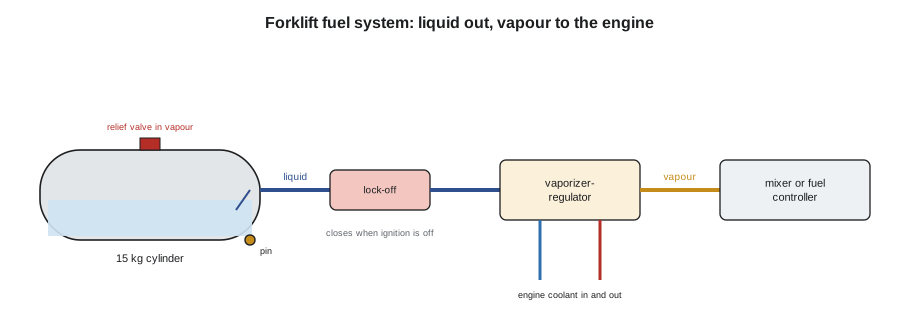
Forklifts and industrial trucks
Propane forklifts are everywhere in warehouses, plants and farms because they can be used indoors with good ventilation, refuel in a minute by swapping cylinders, and keep working in cold storage. Their cylinders are the horizontal liquid-withdrawal type from lesson 2, usually 15 kg in steel or aluminum, exchanged by a supplier who collects empties and leaves full ones in an outdoor storage cage. Changing a cylinder is a job the operators do several times a week, and the codes and employers require them to be trained for it.
| Step | What to do and why |
|---|---|
| 1 | Park in a ventilated area away from ignition sources, lower the forks, set the brake and wear gloves and eye protection |
| 2 | Close the cylinder valve and let the engine run until it stops, emptying the line |
| 3 | Turn off the ignition, then disconnect the coupling, which may release a little liquid |
| 4 | Undo the strap, lift the empty cylinder off with proper lifting technique and return it to the cage, valve closed |
| 5 | Inspect the full cylinder: date, damage, valve, O-ring in the coupling |
| 6 | Mount it with the locating pin in its hole so the relief valve is up, and fasten the strap |
| 7 | Connect the coupling hand-tight, open the valve slowly, and check for leaks by smell, sound, frost and leak detection solution |
| 8 | Start the engine and check for normal operation before returning to work |
Worked problem
How long does a forklift cylinder last?
A forklift's engine burns about 2.3 kg of propane per hour of steady work. How many hours does a full 15 kg cylinder give, and how many cylinders does it use in a week of two 8-hour shifts a day, five days a week, if it works 60 parts in 100 of each shift?
Show solution
- Hours per cylinder:
- \[\frac{15}{2.3} = 6.5 \text{ h}\]
- Working hours per week:
- \[2 \times 8 \times 5 \times 0.60 = 48 \text{ h}\]
- Cylinders per week:
- \[\frac{48}{6.5} = 7.4 \;\to\; \text{about 8}\]
Answer: About eight cylinder changes a week for one truck, which is why the operators must be trained and why the storage cage must hold enough full cylinders between the supplier's visits.
Forklift cylinders are stored the way lesson 2 described for all cylinders: outdoors where possible, in a ventilated cage or rack, valves closed, protected from vehicles, and away from exits and stairways. Where a few must be kept inside, the codes limit the quantity and require a dedicated, ventilated location away from heat and ignition sources. A technician servicing the heaters in a plant should notice where the forklift cylinders live; a cage beside a unit heater, or under a stairway, is something to report.
Highway vehicles
Propane, sold in Canada as autopropane, fuels vans, pickups, taxis, buses and some fleet vehicles. The vehicle carries a permanently mounted container, built and marked for vehicle use, with an automatic stop-fill valve that stops filling at 80 parts in 100, a multivalve combining the service valve with its excess flow valve, the fuel gauge and the relief valve, and a sealed housing that vents any release outside the vehicle. Installation, inspection and repair follow CSA B149.5:25, adopted in Ontario with the propane code adoption document effective June 8, 2026. The work is done at a registered conversion centre by people holding the TSSA certificate for propane internal combustion engine work, and the Ontario amendments require each vehicle's propane fuel system to be inspected every five years by a certificate holder at a registered centre, with a label on the vehicle and a record kept. Vehicles are refuelled at autopropane dispensers by trained attendants.
Worked problem
What range does an 80 parts in 100 fill give?
A pickup's autopropane container has a water capacity of 250 L and its stop-fill valve stops at 80 parts in 100. If the truck uses 20 L of propane per 100 km, how far can it go on a fill, keeping 10 parts in 100 of the container as a reserve?
Show solution
- Usable fuel:
- \[(0.80 - 0.10) \times 250 = 175 \text{ L}\]
- Range:
- \[\frac{175}{20} \times 100 = 875 \text{ km}\]
Answer: About 875 km between fills, which is why fleets that do long daily routes like propane.
Ray pointed out the parts a technician should recognize on any propane vehicle: the fill connection behind its own door, with a back-check valve; the container's relief valve, whose discharge is piped to point away from the vehicle and its occupants; the fuel lines, of materials certified for vehicle use and secured against chafing; the lock-off; and the warning label, often a small diamond decal on the back of the vehicle, that tells firefighters and garages the vehicle runs on propane. Garages that service propane vehicles have rules for bringing them inside, for closing the container's service valve before working on the fuel system, and for never doing fuel system work near ignition sources or over pits where vapour could collect.
Recreational vehicles, trailers and boats
Motorhomes, travel trailers and boats use propane for cooking, water heating, refrigeration and space heating, not usually for the engine. Their containers are cylinders carried in a vented compartment or on the trailer tongue, or a mounted container built for the vehicle. Their appliances are built for the purpose, with sealed combustion where they are inside the living space, and the systems follow their own standards for recreational vehicles and marine craft. Customers sometimes ask a gas technician to look at a trailer furnace or a boat range, and the same principles apply: a leak test at every connection, propane detectors near the floor, carbon monoxide alarms, cylinders and compartments vented to the outside, and appliances used only as their instructions allow. Bayline's policy is to refer recreational vehicle and marine systems to dealers who specialize in them, unless a technician has the training for that work. A homeowner who stores a trailer in an attached garage for the winter should close its cylinder valves, or better, remove the cylinders and store them outdoors.
Propane vehicles in a crash or a fire
A propane vehicle is not more dangerous than a gasoline one, and in some ways it is safer: its container is far stronger than a gasoline tank, it is sealed, and the fuel lock-off and the excess flow valve stop fuel flow if a line is broken. But a crash or a fire brings particular hazards. A container exposed to fire will vent through its relief valve, often as a loud, roaring jet of burning vapour, and must be kept cool by firefighters from a distance; nobody should approach it. A container damaged in a crash may leak liquid, which boils into a heavy cloud that flows along the road and into ditches and drains. And a propane vehicle parked in an enclosed garage with a leak can fill the low parts of the garage with vapour. That is why propane vehicles carry their identifying decal, why garages have rules for bringing them in, and why a gas technician who smells propane around a parked vehicle treats it like any other propane leak: no ignition, ventilation, and a call to the people who are trained to deal with the vehicle.
Stationary engines and generators
Standby generators on farms and houses, irrigation pumps, and some commercial cogeneration units are stationary engines fuelled by propane. Most residential and farm generators draw vapour from the building's tank through the usual first-stage regulator and their own second-stage or demand regulator, so they are connected like a large appliance: sized for the load as lesson 5 showed, with piping sized for the full input, a manual shutoff and union, a sediment trap where required, and a flexible connector rated for outdoor use and vibration. The generator's location must keep its exhaust away from building openings and its intake and exhaust away from the tank's points of discharge. Large engines may draw liquid and vaporize it like a vehicle. On the farm outside Ancaster, the spring 2027 generator will be connected that way by Bayline, after the supplier sets the second tank.
Mobile food service equipment
Food trucks and trailers, often called mobile food service equipment (MFSE), carry propane cylinders or a mounted tank that supply griddles, fryers, ranges and water heaters. The Ontario amendments set rules for them in an annex to B149.2: an MFSE needs a TSSA field approval or certification by an accredited organization, and an annual inspection by a certified gas technician, with a label showing the inspection. Containers must not project beyond the side of the vehicle, must not be on the roof unless accepted, must not be attached to doors, and must be secured to withstand loads of several times their weight; tank brackets need resilient material so there is no metal-to-metal contact; appliances must be mechanically fastened; and a danger label must tell the operator to turn off the appliances while a self-propelled unit is being refuelled. Annual MFSE inspections are work a Bayline technician can do.
Worked problem
How long will a food truck run on its cylinders?
Marigold Kitchen's owner plans a food truck for spring 2027 with two 45 kg cylinders. Its appliances total 59 kW, but on a busy day they average about 30 kW over a 6-hour service. How many service days do two full cylinders give, at 46.4 MJ/kg?
Show solution
- Energy in two cylinders:
- \[2 \times 45 \times 46.4 = 4{,}176 \text{ MJ}\]
- Energy per day:
- \[30 \times 3.6 \times 6 = 648 \text{ MJ}\]
- Days:
- \[\frac{4{,}176}{648} = 6.4\]
Answer: About six busy days per pair of cylinders, so the owner will plan a weekly exchange. The truck will also need its TSSA approval before it opens and an annual inspection, which Luis offered to schedule.
Where a gas technician's work stops
| System | Who installs and inspects | What Bayline does |
|---|---|---|
| Forklift and industrial truck fuel systems | Trained lift truck service technicians; operators change cylinders | Notices cylinder storage and hazards in plants it serves |
| Highway vehicle fuel systems | ICE-P certificate holders at registered conversion centres | Nothing on the vehicle; refers the customer |
| Standby generators on a building's tank | Generator dealer for the unit; gas contractor for the gas connection | Sizes and installs the piping and connection; checks pressure under load |
| Mobile food service equipment | Builder with TSSA approval; annual inspection by a certified gas technician | Annual inspection and appliance service |
Common mistakes
MistakeWorking on a vehicle's propane fuel system with a gas technician's certificate alone.
InsteadVehicle fuel systems need their own training and certificate.
MistakeMounting a forklift cylinder without engaging the locating pin.
InsteadThe pin keeps the relief valve in the vapour space and the withdrawal tube in the liquid.
MistakeDisconnecting a forklift cylinder with the valve open.
InsteadClose the valve and run the engine until it stops first.
MistakePlacing a generator so its exhaust is near the tank's filling connection.
InsteadKeep generator exhaust and intakes clear of openings and the tank's points of discharge.
MistakeMounting food truck cylinders on the roof or a door.
InsteadFollow the mobile unit rules: secured, protected and in accepted locations only.
Summary and key terms
- Engines draw liquid propane and vaporize it with engine coolant heat in a vaporizer-regulator, with an electric lock-off that closes when the engine stops.
- Forklifts use horizontal liquid-withdrawal cylinders mounted by their locating pin, changed by trained operators with the valve closed and the line run dry, and stored outdoors in cages.
- Highway vehicles carry mounted containers with stop-fill valves at 80 parts in 100, multivalves and relief discharge directed away from the vehicle; they follow CSA B149.5, are converted and inspected every five years by ICE-P certificate holders at registered conversion centres.
- Most generators draw vapour from the building's tank and are connected like large appliances.
- Food trucks have their own rules , including TSSA approval and an annual inspection by a certified gas technician.
- A gas technician's work stops at the vehicle's fuel system.
- Liquid withdrawal
- Drawing liquid propane from the bottom of a container, as engines do.
- Vaporizer-regulator
- The engine component that boils liquid propane with coolant heat and regulates the vapour.
- Fuel lock-off
- An electric valve that shuts off fuel when the ignition is off or the engine stops.
- Automatic stop-fill valve
- A valve in a vehicle container that stops filling at 80 parts in 100.
- Multivalve
- A container valve that combines several functions in one body.
- Autopropane or autogas
- Propane sold as a motor fuel for highway vehicles.
- Mobile food service equipment
- A food truck or trailer with propane cooking appliances.
Practice problems
Work each problem on paper first, then reveal the answer to check.
Why do engines draw liquid rather than vapour?
Show answer
Vapour withdrawal at engine flow rates would chill the container and drop its pressure; the engine vaporizes the liquid with coolant heat.
What does a forklift's fuel lock-off do?
Show answer
It closes when the ignition is off or the engine stops so a broken line cannot drain the container.
What is the first step in disconnecting a forklift cylinder?
Show answer
Close the cylinder valve and let the engine run until it stops.
How is most residential standby generator fuel supplied?
Show answer
As vapour from the building's tank, connected like a large appliance.
Where does a gas technician's work stop on a propane vehicle?
Show answer
At the vehicle's fuel system, which needs its own training and certificate.
Lesson quiz · 5 questions
Score 60% or more to complete this lesson.
Create a free account to save your progress, take quizzes and earn a certificate.