
GAS-240 · Lesson 4 of 12 · 25 min
Tank location and separation distances
▶ Video coming soon A video version of this lesson is on the way.
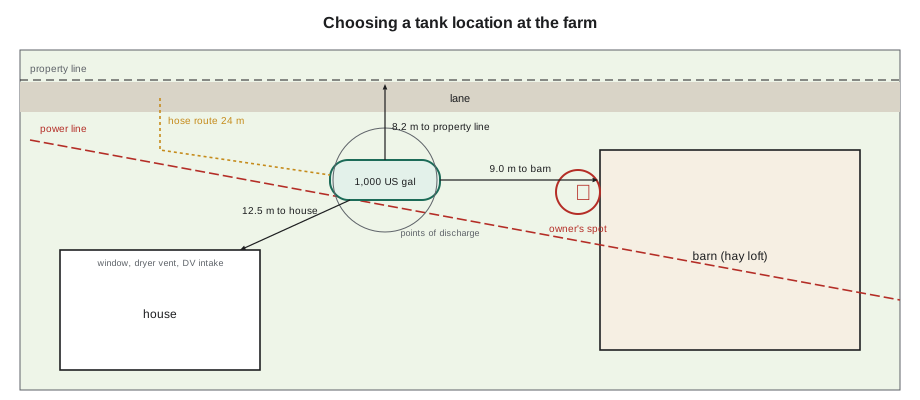
On the afternoon of Wednesday, October 28, Luis took Jonah to a horse farm near Lynden, on the western edge of Hamilton. The owner, Gwen Talbot, heated her barn office and tack room with two 45 kg cylinders and wanted to switch the house, the barn heaters and a new indoor riding arena heater to propane from one large tank. She had already chosen the spot: a neat gravel patch beside the barn door, close to the lane, "where it will be out of the way." Luis looked at it, then up at the power line crossing the yard, then back at the barn's hay loft door. "It will be out of the way," he said. "Everything else will be in its way." He took the measuring wheel out of the truck and handed Jonah the clipboard.
Where a tank may go is decided by the storage code, the supplier's own rules and common sense. This lesson explains what the separation distances protect, how they are measured, the other location rules that apply to tanks and cylinders, and how a site is surveyed before the supplier sets a tank.
What separation distances protect
A tank holds a large amount of fuel under pressure, and two kinds of accidents drive the location rules. In the first, propane escapes from the tank, its fittings or its relief valve and reaches something that can ignite it: a pilot light, a dryer vent, an air conditioner, a vehicle, a window into a room with a furnace. Distances from the tank's points of discharge to openings and ignition sources limit how much vapour can reach them. In the second, a fire nearby, perhaps a barn or house fire or a burning vehicle, heats the tank. The relief valve opens to protect the shell, and if the fire is intense and the tank is not cooled, the steel above the liquid can weaken and fail. Distances from the tank to buildings and to property lines keep a fire in one from reaching the other, and keep neighbours, who never agreed to the tank, out of harm's way. The bigger the tank, the bigger the possible fire, so the required distance grows with water capacity.
Distances to buildings and property lines
B149.2 gives a table of minimum distances from an aboveground or underground tank to the nearest building and to the line of adjoining property that can be built on, with the distance growing in steps as the tank's water capacity increases. The table is read for each tank by its water capacity; notes to the table, and the Ontario amendments, add conditions and allow some reductions. Because this course does not reproduce code tables, the worked examples here use the SAMPLE table below, laid out the same way with invented numbers. Bayline's rule is that the supplier's site sheet and the real table are checked for every tank, and the more restrictive of the two is used.
| Water capacity of each tank (US gallons) | SAMPLE minimum to a building or a property line that can be built on |
|---|---|
| up to 125 | 0 m (other rules still apply) |
| 126 to 500 | 3 m |
| 501 to 2,000 | 7.5 m |
| 2,001 to 30,000 | 15 m |
Distances are measured horizontally, from the nearest point of the tank shell to the nearest point of the building or to the property line, not from the dome or the regulator. A deck, a porch or a carport roof attached to the house is part of the building. A detached garage, shed or barn is a building too, although codes and authorities treat small outbuildings differently, and a farm's barn full of hay is exactly the kind of building the distances exist to protect.
Worked problem
Does the owner's spot work?
The tank Gwen wants is 1,000 US gallons. Her spot is 1.8 m from the barn wall, 14 m from the house and 21 m from the property line along the lane. Using the SAMPLE table, does it work? Luis's alternative spot in the open lawn is 9.0 m from the barn, 12.5 m from the house and 8.2 m from the property line. Does that one work?
Show solution
- SAMPLE requirement for 1,000 US gallons (501 to 2,000 row):
- \[7.5 \text{ m}\]
- Owner's spot to the barn:
- \[1.8 < 7.5 \text{ m} \quad \text{fails}\]
- Alternative spot, smallest distance:
- \[\min(9.0,\ 12.5,\ 8.2) = 8.2 \ge 7.5 \text{ m} \quad \text{passes}\]
Answer: The owner's spot fails by a wide margin, and it is under the power line as well. Luis's alternative spot meets the sample distance to every building and to the property line, with a little to spare at the lane.
Points of discharge: relief valves, filling connections and gauges
Separately from the distance to the building, B149.2 sets distances from a tank's relief valve discharge, its filling connection and its fixed liquid level gauge vent, the places where propane is released during normal operation or an upset, to building openings, air intakes, direct-vent appliance terminals and sources of ignition such as dryer vents, air conditioners, heat pumps, electrical equipment and appliance vents. Openings below the level of the discharge get particular attention, because propane flows down. The Ontario amendments also set distances for regulator vent terminations. These distances are usually the ones that decide where on a wall a small tank or a cylinder can go, and they are measured in every direction, not just across the ground.
Worked problem
Is the filling connection far enough from the dryer vent?
On a cottage job, a 500 US gallon tank's filling connection would sit 2.4 m out from the house wall and 1.8 m along the wall from the dryer vent, measured along the wall from the point opposite the filling connection. Suppose the code's distance from a filling connection to a source of ignition is 3 m. Is the spot far enough?
Show solution
- Straight-line distance:
- \[\sqrt{2.4^2 + 1.8^2} = \sqrt{5.76 + 3.24} = \sqrt{9.00} = 3.0 \text{ m}\]
- Compare:
- \[3.0 \ge 3 \text{ m} \quad \text{just meets it}\]
Answer: The spot just meets the distance, with no margin at all for the tank being set a little off its marks. Luis would move the tank another 0.5 m along the wall so that a crooked placement does not put the filling connection out of compliance.
Other location rules
Beyond the distances, several rules and good practices decide whether a spot is acceptable. They apply to every tank, and most apply to cylinder installations too.
| Rule or practice | Why |
|---|---|
| Not under overhead power lines | The crane truck cannot set the tank safely, and a falling line would land on it |
| Firm, level, non-combustible base, such as concrete pads | Keeps the tank stable and its bottom off wet ground |
| Clear of weeds, long grass and stored combustibles around the tank | A grass or brush fire would heat the tank |
| Separated from fuel oil and other flammable liquid tanks | A spill from one must not flow under the other |
| Not where vapour could flow into a basement window, window well, storm drain or pit | Propane flows downhill and pools |
| Protected from vehicles where they could hit it, with bollards or barriers | An impact could break a fitting and release propane |
| Reachable by the delivery truck's hose, without dragging it across the house or through gates | Safe, practical filling |
| Anchored where flooding is possible | A partly empty tank floats and can tear its piping loose |
| Never inside a building, in a basement, under a deck or in an enclosed space | Leaks would collect; fire exposure would be severe |
Cylinders filled on site, such as the large vertical 420 lb containers, follow the same pattern of distances to points of discharge. Cylinders exchanged rather than filled on site have shorter distances to openings and ignition sources, because no propane is released during filling, but they must still stand outdoors on a firm base, upright, secured against falling, and with their relief valves clear of windows, doors and any opening below them.
Cylinders beside a house
Many rural and cottage customers are served by a pair of 45 kg cylinders standing against an outside wall, and these installations are where the distances to points of discharge are most often broken. The cylinders' relief valves discharge at the top of the collar, about 1.2 m above the ground, so a basement window, a crawl space vent or a foundation opening below and beside them is the first thing to check, followed by the dryer vent, the air conditioner, the direct-vent terminals, the electrical meter and any window or door. B149.2 sets separate, shorter distances for cylinders that are exchanged rather than filled on site, because no propane is vented while filling; Bayline measures both sets on every job, because a supplier may later switch a customer from exchange to filling on site, and then the longer distances apply. The cylinders stand on a firm, level, non-combustible base so they cannot sink or tip, are chained to the wall, and are kept out of the drip line of the roof, where falling ice and snow can damage the valves and regulators.
Larger installations bring in the authority. In Ontario, propane installations above certain sizes, and bulk plants, refill centres and cylinder exchanges, need TSSA licensing or approval under O. Reg. 211/01, and the supplier handles that process; Bayline's part is to give accurate loads, distances and drawings.
Surveying the site
Bayline's site survey follows the same order every time, and Jonah filled in the clipboard as Luis worked through it at the farm. First, the loads: every appliance the tank will serve now and those planned, with their inputs, because the tank size, and so the required distances, follow from the load, as lesson 5 shows. Second, the buildings, property lines, wells, septic beds, driveways, overhead lines and buried services, marked on a sketch. Third, candidate spots, each measured to buildings, property lines and points of discharge, and each checked for ground conditions, drainage, vehicle exposure and the hose reach from where the truck can park. Fourth, the piping route from each spot to the building, with its length, because it decides the pipe size and the cost. Finally, a call to the local utility locate service before anyone digs, and a site visit or a sketch for the supplier, who has the final word on where its tank goes.
Worked problem
Can the truck reach the tank?
The delivery truck can park on the lane at a point 22 m from the alternative tank spot, but the hose must go around the corner of a paddock fence: 14 m along the fence, then 10 m across the lawn to the tank. The truck carries 30 m of hose. Is that enough, with 2 m kept in reserve for slack?
Show solution
- Hose route:
- \[14 + 10 = 24 \text{ m}\]
- With reserve:
- \[24 + 2 = 26 \le 30 \text{ m} \quad \text{enough}\]
Answer: The hose reaches with some to spare. The straight-line distance from the truck is shorter, but the hose cannot go through the paddock fence, so the real route is what counts.
Gwen was not pleased to give up her gravel patch, but she agreed when Luis explained that a barn fire would put a full tank right beside the burning hay, and that the supplier would not set a tank under the power line anyway. Jonah drew up the sketch with the measured distances for the supplier, and the tank was ordered for the lawn spot, with a pair of steel bollards on the side facing the paddock gate where the farm tractor turns.
Common mistakes
MistakeMeasuring the distance from the dome or regulator.
InsteadMeasure from the nearest point of the tank shell to the building or property line.
MistakeForgetting that a barn, garage or deck is a building.
InsteadAttached decks and outbuildings count; a barn full of hay is exactly what the rule protects.
MistakeChecking only the distance to the building.
InsteadAlso check the distances from the relief valve, filling connection and gauge vent to openings, intakes and ignition sources.
MistakeChoosing a spot the truck cannot reach.
InsteadCheck the hose route from where the truck can actually park.
MistakePlacing a tank where vapour could run into a window well or drain.
InsteadPropane flows downhill; keep low openings away from the tank.
Summary and key terms
- Separation distances keep a leak from reaching ignition sources and keep a fire in a building, or next door, from reaching the tank.
- Distances to buildings and property lines grow with water capacity and come from the B149.2 table as adopted in Ontario; the examples here use a SAMPLE table. They are measured from the tank shell.
- Separate distances apply from the relief valve discharge, filling connection and gauge vent to openings, air intakes and ignition sources, measured in every direction.
- Tanks need a firm base, clearance from power lines, weeds and other fuels, protection from vehicles, a reachable filling point, and anchoring where flooding is possible.
- A site survey records loads, buildings, candidate spots and the piping route before the supplier decides.
- Separation distance
- The minimum distance a code requires between a container and a building, property line or other feature.
- Point of discharge
- A place where propane can be released, such as a relief valve, filling connection or gauge vent.
- Line of adjoining property
- The property line next to land that could be built on, from which distances are measured.
- Source of ignition
- Anything that can ignite propane, such as a pilot, dryer vent, air conditioner or engine.
- Bollard
- A steel or concrete post that protects a tank from vehicles.
- Site survey
- The measured sketch of loads, buildings, distances and routes made before a tank is set.
- Hose reach
- The distance from where the delivery truck can park to the filling connection, along the hose route.
Practice problems
Work each problem on paper first, then reveal the answer to check.
From what point is the distance from a tank to a building measured?
Show answer
From the nearest point of the tank shell.
Why do separation distances grow with tank size?
Show answer
A bigger tank holds more fuel and could feed a bigger fire.
Name three points of discharge on a tank.
Show answer
The relief valve, the filling connection and the fixed liquid level gauge vent.
Why should a tank not be placed above a basement window well?
Show answer
Propane flows downhill and could enter the basement.
Why does the supplier need to know the hose route?
Show answer
The truck must be able to reach the filling connection from where it can park.
Lesson quiz · 5 questions
Score 60% or more to complete this lesson.
Create a free account to save your progress, take quizzes and earn a certificate.