
GAS-240 · Lesson 8 of 12 · 25 min
Underground tanks and corrosion protection
▶ Video coming soon A video version of this lesson is on the way.
On Thursday, October 15, Luis went to a golf clubhouse in Copetown, west of Ancaster, where the kitchen, the hot water and the clubhouse heating ran on propane from a 3,785 L (1,000 US gallon) tank buried under the lawn beside the parking lot. Only its green dome showed above the grass. The supplier had asked Bayline, which services the clubhouse appliances, to take the tank's periodic corrosion reading while it was there. Luis knelt by the dome with a voltmeter and a fat plastic tube with a copper rod in it and a porous tip, pushed the tip into the damp lawn a step from the dome, clipped the meter's other lead to a clean spot on the tank's fitting, and read the display: −0.62 volts. He frowned. "When this tank went in, in 2018, it read about −1.6," he said. "Something has stopped protecting it."
Burying a tank hides it, protects it from vehicles and fire and keeps it warmer in winter, but it puts bare steel in contact with wet soil, and steel in wet soil corrodes. This lesson explains how underground tanks are built and installed, how corrosion works, how cathodic protection stops it, and how a protected tank is tested.
Why bury a tank
Customers choose underground tanks mostly for appearance: a lawn with a small dome looks better than a large white tank. There are practical advantages too. A buried tank is protected from vehicles, from most fires and from vandalism. The soil around it changes temperature slowly and stays above the coldest air temperatures in winter, so an underground tank keeps more vapour capacity on a bitter morning, as lesson 5 noted. And the separation distances to buildings can be shorter for underground tanks of the same size, because a fire cannot heat a buried shell. Against those advantages, an underground tank costs more to install, its condition cannot be seen, and it depends entirely on its coating and its cathodic protection to survive in the ground.
How an underground tank is installed
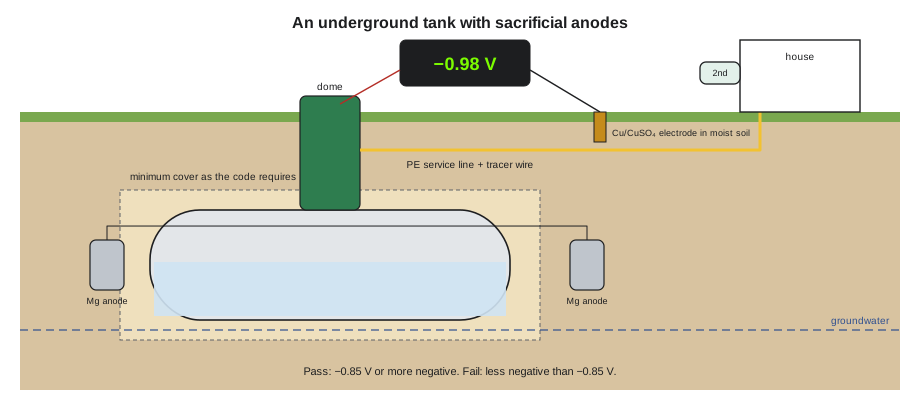
Only tanks built and labelled for underground service may be buried. They have a factory-applied coating, usually epoxy or powder coat, and their fittings are grouped in a dome or fitting housing that rises above the ground so that the valves, gauges, relief valve and regulator are accessible and the relief valve discharges into open air. The supplier, or an excavator working for it, digs a hole somewhat larger than the tank, beds the bottom with clean sand or fine soil free of stones, lowers the tank with slings or lifting lugs, never with chains that would scrape the coating, and inspects the coating for holidays, scratches or gaps, repairing them with the maker's coating kit. The anodes are connected and placed, the hole is backfilled with the same clean material and the topsoil is replaced around the dome. The service line leaves the dome and runs underground to the building, usually as certified polyethylene tubing with a tracer wire.
B149.2 sets the requirements for underground tanks: the tank must be built for underground use, protected against corrosion, covered to a minimum depth, protected where vehicles could drive over it, separated from buildings and property lines by the distances in its tables, and anchored or weighted where it could float. The supplier is responsible for meeting them, and the Ontario amendments' 10-year tank inspection applies to underground tanks too.
Worked problem
Why tanks float
A 3,785 L tank with its fittings has a mass of about 800 kg. If groundwater rises over an empty tank, what upward force does the water exert, and what net uplift is left after the tank's own weight? Water has a density of 1,000 kg/m³.
Show solution
- Volume displaced:
- \[3{,}785 \text{ L} = 3.785 \text{ m}^3\]
- Buoyant force, as an equivalent mass:
- \[3.785 \times 1{,}000 = 3{,}785 \text{ kg}\]
- Net uplift:
- \[3{,}785 - 800 = 2{,}985 \text{ kg} \approx 29.3 \text{ kN}\]
Answer: A nearly empty tank in saturated ground pushes upward with the weight of about three tonnes. Without enough soil over it, or anchors and a concrete deadman, it can rise, tear its service line and break its fittings, which is why tanks in high-water areas are anchored.
How steel corrodes in soil
Corrosion of buried steel is an electrochemical process: a small battery. It needs four things. An anode, an area of metal where iron dissolves into the soil water and gives up electrons; a cathode, another area where those electrons are used up in a reaction with oxygen and water; an electrolyte, the moist soil, that carries ions between them; and a metallic path, the steel itself, that carries the electrons back. Differences in the steel, in the soil's moisture, oxygen and salts, or in contact with other metals decide which areas become anodes. Wherever the coating has a holiday, the bare steel at that spot can become an anode, and because the current concentrates on that tiny area, the steel there can pit through surprisingly fast. A coating with a few small holidays can be worse than no coating at all if there is no cathodic protection.
Connecting steel to a more active metal makes the steel the cathode. That is the idea of galvanic cathodic protection: bags of magnesium or zinc, called sacrificial anodes, are buried near the tank and wired to it. Magnesium is more active than steel, so it becomes the anode of the battery and slowly corrodes away, and the current it gives off flows through the soil to every bare spot on the tank, making the whole tank a cathode where iron does not dissolve. The coating does most of the work by keeping the bare area small; the anodes protect the holidays the coating misses. Anodes are consumed over time, and how long they last depends on their size, the soil and how much bare steel they must protect.
Isolating the tank
Cathodic protection protects whatever metal is electrically connected to it. If a buried, protected tank is connected by metal piping to a house, the anodes try to protect the house piping, the water pipes, the electrical grounding system and everything else bonded to it, and they are used up quickly. For that reason the tank must be electrically isolated from the building, usually by a dielectric union or an insulating fitting at the riser or at the regulator, and by using polyethylene for the buried service line where the code allows. Metallic buried lines, where used, need their own coating and cathodic protection. A technician who replaces a regulator or a riser must not bypass the insulating fitting with a metal connection, and must not bond the tank to the building's electrical system unless the design and the code call for it.
Testing cathodic protection
The test Luis made is a tank-to-soil potential measurement. A copper-copper sulfate reference electrode, a copper rod in a saturated copper sulfate solution behind a porous tip, is placed in moist soil near the tank, and a high-impedance voltmeter measures the voltage between it and the tank. Unprotected steel in soil reads roughly −0.5 to −0.7 V against this electrode. A widely used criterion for adequate cathodic protection is a reading of −0.85 V or more negative, so −0.95 or −1.2 pass and −0.62 does not. Readings are taken with the electrode in moist soil, not on dry gravel or concrete, away from the anodes themselves, and often at more than one place around the tank. If the soil is dry, it is watered first. The reading and the date are recorded.
B149.2 requires corrosion protection for underground tanks, and the supplier sets the testing schedule. Industry practice is to test at installation, again within about 12 to 18 months, and periodically after that, with more frequent tests where readings are close to the criterion.
Worked problem
Reading the clubhouse tank
Luis's reading was −0.62 V. After the supplier dug down, found a broken anode wire, and installed two new magnesium anodes, the reading a week later was −0.98 V. Did the tank pass before and after, and by how much did the potential change?
Show solution
- Criterion: −0.85 V or more negative.
- Before:
- \[-0.62 \text{ V is less negative than } -0.85 \text{ V} \;\to\; \text{fails}\]
- After:
- \[-0.98 \text{ V is more negative than } -0.85 \text{ V} \;\to\; \text{passes}\]
- Change:
- \[-0.98 - (-0.62) = -0.36 \text{ V}\]
Answer: Before the repair the tank was not protected: −0.62 V is close to what bare steel reads by itself. The broken wire had disconnected both original anodes. After the repair the potential moved 0.36 V more negative and passes with a margin of 0.13 V. The supplier booked a recheck for the following autumn.
| Reading against a copper sulfate electrode | Meaning | Action |
|---|---|---|
| −0.85 V or more negative | Protected, by the common criterion | Record; test again on schedule |
| −0.75 to −0.85 V | Marginal; anodes may be weakening or soil dry | Water the soil and retest; tell the supplier |
| Less negative than about −0.75 V | Not protected | Report to the supplier for investigation: anode wires, anodes, isolation |
| Reading jumps or drifts | Poor contact or dry soil | Clean the contact point, wet the soil, reposition the electrode |
The buried service line
The line from an underground tank, or from any tank, to the building is usually the gas contractor's work, and it is buried too. Most are certified polyethylene tubing or pipe, which does not corrode and needs no cathodic protection, but polyethylene has its own rules. It is used only underground and only where the code and its certification allow, normally between the first and second stages; it must never be exposed above ground, where sunlight degrades it and it can be damaged, so it rises to the surface through an approved riser, a factory-made transition to steel or copper with the polyethylene sleeved inside. It is laid in a trench at least as deep as the code requires, on and under clean fill free of stones, with slack so that soil settlement does not pull on the joints, and it is joined only with fittings and methods certified for it. Because polyethylene cannot be found with a metal detector, a tracer wire is laid with it and brought up at each end, and many contractors lay a yellow warning tape a short way above the pipe so that anyone digging later finds the tape before the pipe. Before the trench is backfilled the line is pressure tested, and its route is drawn on the job sketch with measurements from fixed points such as the corner of the house, so the customer and the next contractor know where it runs.
Other underground concerns
Underground tanks bring a few other hazards that a technician on site should watch for. The dome must stay above grade and clear: landscaping that buries a dome under mulch, or a lawn raised around it, can trap water and leaks inside, let the regulator vent and relief valve sit in water and ice, and hide the tank from the driver. Vehicles, including the riding mower and the delivery truck, must not drive over a tank that is not protected for traffic. The service line must be located and marked before anyone digs, and its tracer wire kept intact so it can be found. And when an underground tank is removed, it is emptied and purged by the supplier, not dug up full.
Worked problem
How much shift do new anodes need to give?
A newly buried tank with good coating reads −0.58 V before its anodes are connected. What minimum change in potential must the anodes produce to reach the −0.85 V criterion, and what reading would leave a margin of 0.10 V?
Show solution
- Minimum shift:
- \[-0.85 - (-0.58) = -0.27 \text{ V}\]
- Reading with a 0.10 V margin:
- \[-0.85 - 0.10 = -0.95 \text{ V}\]
Answer: The anodes must move the tank at least 0.27 V more negative. A fresh magnesium installation on a well-coated tank usually gives far more, and the reading at installation, often around −1.5 V, is the baseline against which later tests are compared.
Common mistakes
MistakeLifting a coated underground tank with chains.
InsteadUse slings or the lifting lugs; scratches become corrosion sites.
MistakeConnecting a protected tank to the house with continuous metal piping.
InsteadIsolate the tank with a dielectric union or insulating fitting, and use certified PE underground where allowed.
MistakeTaking a reading with the electrode on dry gravel.
InsteadPlace the electrode in moist soil, watered if needed, away from the anodes.
MistakeReading −0.70 V as a pass because it is negative.
InsteadThe common criterion is −0.85 V or more negative.
MistakeBurying the dome under mulch or raising the lawn around it.
InsteadKeep the dome above grade, clear and draining.
Summary and key terms
- Underground tanks must be built and labelled for burial, factory coated, bedded in clean material, covered to the code's minimum depth, protected where vehicles could cross them, anchored where they could float, and fitted with an above-grade dome so the valves and relief valve stay accessible.
- Buried steel corrodes like a battery, with anodes, cathodes, the soil as electrolyte and the steel as the metallic path; holidays in the coating become anodes and pit.
- Sacrificial magnesium anodes wired to the tank make the whole tank a cathode.
- The tank must be electrically isolated from the building piping.
- Protection is tested with a copper-copper sulfate reference electrode and a high-impedance voltmeter; a common criterion is −0.85 V or more negative.
- Tests are made at installation, within about 12 to 18 months and periodically after that, and results are recorded.
- Underground tank
- An ASME tank built, coated and labelled for burial.
- Holiday
- A gap or scratch in a protective coating that exposes bare metal.
- Sacrificial anode
- A buried piece of more active metal, such as magnesium, wired to a tank to corrode in its place.
- Cathodic protection
- Making buried metal the cathode of a corrosion cell so that it does not corrode.
- Reference electrode
- A copper-copper sulfate cell placed in the soil to measure the tank's potential.
- Tank-to-soil potential
- The voltage between a buried tank and a reference electrode in the soil.
- Dielectric union
- A fitting that joins pipes while electrically insulating them from each other.
Practice problems
Work each problem on paper first, then reveal the answer to check.
Name the four parts of a corrosion cell.
Show answer
Anode, cathode, electrolyte and metallic path.
Why can a coating with small holidays corrode fast without cathodic protection?
Show answer
The corrosion current concentrates on the small bare areas and pits them.
What reading is a common criterion for adequate protection?
Show answer
−0.85 V or more negative against a copper-copper sulfate electrode.
Why must the tank be isolated from the house piping?
Show answer
Otherwise the anodes try to protect the house piping and grounding and are used up quickly.
Why are tanks in high-water areas anchored?
Show answer
A partly empty tank in saturated soil floats with a large upward force.
Lesson quiz · 5 questions
Score 60% or more to complete this lesson.
Create a free account to save your progress, take quizzes and earn a certificate.