
GAS-240 · Lesson 12 of 12 · 30 min
Case study: setting a rural propane system
▶ Video coming soon A video version of this lesson is on the way.
Jonah's second day at Bayline, Wednesday, September 9, 2026, was spent on a lawn. Ben and Teresa Vandermeer had bought a 1990s bungalow on five hectares near Carlisle, in rural north Hamilton, heated by an oil furnace with an electric water heater, and they wanted to switch to propane before winter: a new furnace, a tankless water heater, a gas range, and, the following spring, a standby generator, because the power line along their road went down in every ice storm. Teresa had one firm request. "I don't want a white tank in the front yard," she said. Luis smiled. "Then you'll have a green dome in the side yard," he said, and took out the measuring wheel. Over the next nine days Jonah watched a complete rural propane system go in, from the first measurement to the first flame. This lesson follows that job and draws on every lesson of the course.
Step 1: the load list
Luis began, as always, with what the system would have to supply. He read the rating plates of the appliances the Vandermeers had chosen, took the generator dealer's specification sheet for the unit they planned, and wrote down which loads could run together on a design winter day. The worst combination was a winter power failure: the furnace and the generator running, with someone taking a shower from the tankless water heater. The range would rarely run at the same time on such a day, but Luis included it in the normal-day total.
| Appliance | Input | Design-day combination |
|---|---|---|
| Two-stage condensing furnace | 26 kW | Normal day and outage |
| Tankless water heater | 58 kW | Normal day and outage |
| Range | 18 kW | Normal day |
| Standby generator (spring 2027) | 58 kW at full load | Outage |
Worked problem
Which tank?
Using the load list and lesson 5's SAMPLE chart at −18 °C, find the normal-day and outage loads, and check whether a 500 or a 1,000 US gallon tank can vaporize them.
Show solution
- Normal day:
- \[26 + 58 + 18 = 102 \text{ kW}\]
- Outage:
- \[26 + 58 + 58 = 142 \text{ kW}\]
- 500 US gallon tank:
- \[85 \text{ kW} < 102 \text{ kW} \quad \text{too small}\]
- 1,000 US gallon tank:
- \[147 \text{ kW} \ge 142 \text{ kW} \quad \text{enough}\]
Answer: A 500 US gallon tank would not carry even the normal-day load in deep cold, so the job needed a 1,000 US gallon tank. The margin in an outage is small on the aboveground sample chart, but the supplier pointed out that an underground tank, sitting in soil that stays warmer than the air in a cold snap, would do better than the chart suggested, and that the tankless heater fires at full input only for short periods. The supplier, Escarpment Propane, agreed to a 1,000 US gallon underground tank.
Step 2: the site survey
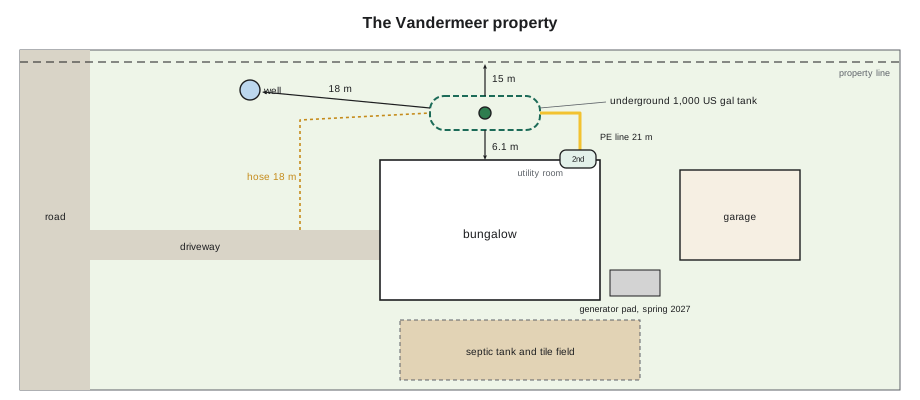
Next came the site. Jonah marked the house, the detached garage, the well, the septic bed and tile field, the driveway, the property lines and the overhead service line on a sketch, and Luis measured three candidate spots. The front yard was out at Teresa's request; the back yard was over the septic tile field, where no tank can go; the side lawn on the north was open, firm and drained away from the house. There the tank's shell would be 6.1 m from the house wall, 15 m from the property line and 18 m from the well, the dome would be well clear of the basement windows, and the delivery truck could park in the driveway with a hose route of 18 m. The service line would run 21 m from the dome to the house wall by the utility room.
Worked problem
Do the distances work?
Suppose the B149.2 table, for an underground tank of this size, gives a minimum of 3 m to a building and to the property line. Check the north-lawn spot. The dome's filling connection would be 6.4 m from the nearest basement window; suppose the code requires 3 m from a filling connection to a building opening. Does the spot work?
Show solution
- To the house:
- \[6.1 \ge 3 \text{ m}\]
- To the property line:
- \[15 \ge 3 \text{ m}\]
- Filling connection to the window:
- \[6.4 \ge 3 \text{ m}\]
Answer: Every distance is met with a comfortable margin. Jonah's sketch, with the measurements, went to the supplier, who confirmed the spot the next week and booked the locate service to mark buried utilities before digging.
Agreeing who does what
Before anything was ordered, Luis and the supplier's service manager agreed the hand-off point in writing, as lesson 3 recommended. The supplier would own, set, protect, purge, fill and test the tank, supply and install the first-stage regulator in the dome, and own everything up to the outlet of that regulator. Bayline would install and test the line between the stages, the second-stage regulator, the house piping, the appliances and their venting, and would carry out the leak check and commissioning on the first fill day. The supplier would arrange the utility locate before digging, and Bayline would dig its own trench only after the locate marks were in place. Each side would give the other its test records. Writing it down took ten minutes and saved an argument later, Luis said, because the most common problems on propane jobs happen at the boundary, where each side assumes the other has done something.
Step 3: setting the tank
On Monday, September 14, the supplier's crew dug the hole and Luis and Jonah were there to see it. The tank arrived with a factory powder coat, and before it went in, the crew checked the coating with a holiday detector, found a small scrape from shipping and repaired it with the maker's kit. Two 7.7 kg magnesium anodes were placed in the hole beside the tank at about the depth of its centre, their wires connected to the tank's anode terminal. The tank was lowered on slings onto a bed of clean sand, levelled, and backfilled with the same sand, leaving the dome a hand's width above the finished lawn. With the anodes connected and the soil watered, the supplier's technician took the first tank-to-soil reading: −1.52 V against the copper sulfate electrode, the baseline for every later test.
That afternoon Bayline dug its own trench from the dome to the house. Luis connected certified polyethylene tubing to the riser at the supplier's first-stage regulator, laid it in the trench on clean fill with a tracer wire and a warning tape above it, brought it up the house wall through a second riser, and capped both ends. The polyethylene also isolated the tank electrically from the house, as lesson 8 explained. Jonah drew the line's route on the job sketch with measurements from the corners of the house.
Step 4: piping and appliances
On Tuesday and Wednesday, September 15 and 16, Luis, Jonah and a second technician removed the old oil furnace, which the oil company had disconnected when it took away the oil tank the week before, set the new condensing furnace, mounted the tankless water heater with its venting and condensate drain, and ran the house piping to the furnace, the water heater, the range and a capped stub for the generator. The piping was sized for the low-pressure side from the second-stage regulator, as GAS-120 taught, using the normal-day and outage loads. On Thursday, September 17, Luis mounted the second-stage regulator on the north wall above the expected snow line, its vent pointing down and clear of the windows and the dryer vent, and checked the size of the line between the stages.
Worked problem
Is the line between the stages big enough?
The polyethylene line between the stages is 1/2 in. and 21 m long. Using the SAMPLE table in lesson 6, at the next listed length up, does it carry the 142 kW outage load?
Show solution
- Next listed length:
- \[21 \text{ m} \;\to\; 30 \text{ m row}\]
- Capacity at 30 m:
- \[270 \text{ kW} \ge 142 \text{ kW}\]
Answer: The line has nearly twice the capacity needed, so the generator will not need a new line in the spring. With the real code tables the result was the same.
Before any propane was introduced, the new house piping received its pressure test with the appliance valves isolated, at the test pressure and for the time the installation code requires, and held with no drop. The underground line between the stages was tested at its own test pressure before the trench was backfilled. Both tests were recorded on the job sheet.
Step 5: first fill and commissioning
On Friday, September 18, the supplier's driver arrived. Because the tank was new, it had to be purged of air before its first fill, and the supplier did that first, following its procedure, then filled it to the fixed liquid level gauge. The float gauge read 80. The driver then stood back while Luis carried out the leak check on the complete system, appliances connected, as lesson 11 describes: appliances off, the system pressurized from the tank, the service valve closed, the pressure bled below lock-up and watched for three minutes. It held. Only then did Luis open the service valve fully and begin lighting the appliances, purging the air from each branch through its burner.
Worked problem
Commissioning readings
With the furnace on high fire, the tankless heater at full input and all four range burners on, Luis read 2.62 kPa at the furnace's inlet tap. With everything off, the pressure rose to 2.92 kPa and held. The appliances call for 2.5 to 3.2 kPa. How much did the tank deliver by the float gauge in its first fill, and are the readings acceptable?
Show solution
- First fill:
- \[0.80 \times 3{,}785 = 3{,}028 \text{ L}\]
- Flowing pressure:
- \[2.5 \le 2.62 \le 3.2 \text{ kPa}\]
- Lock-up:
- \[2.92 - 2.62 = 0.30 \text{ kPa, steady}\]
Answer: The tank took about 3,028 L, and the pressures under full load and at lock-up are both within range. Luis then checked each appliance's own pressures and combustion readings as its instructions require.
Each appliance was then started and checked as GAS-210 to GAS-230 taught: the furnace's manifold pressure on both stages, its combustion readings and its vent and condensate; the tankless heater's gas pressure at full fire, its combustion readings and its condensate drain; the range's burners on high and low and its oven. Jonah installed a carbon monoxide alarm on each floor and a propane gas alarm low in the utility room. Luis showed Ben and Teresa the green dome, how to read the float gauge, how to close the service valve, what propane smells like from the supplier's scratch card, what to do if they smell it, and that the supplier's automatic delivery would watch the tank for them. He left the job sheet, the site sketch with the line route, the test records and the supplier's propane safety sheet in a folder on the furnace.
| Date | Work | Who |
|---|---|---|
| Wed Sept 9 | Load list, site survey, sketch to supplier | Bayline |
| Mon Sept 14 | Underground tank set, anodes, baseline reading −1.52 V; service line trenched, tested and backfilled | Supplier; Bayline |
| Tue Sept 15 to Wed Sept 16 | Furnace, tankless water heater, house piping and generator stub; piping pressure test | Bayline |
| Thu Sept 17 | Second-stage regulator; line checks | Bayline |
| Fri Sept 18 | Tank purged and filled; leak check; appliances lit and commissioned; alarms; customer walkthrough | Supplier; Bayline |
| Tue Nov 10 | Follow-up call: float gauge at 64, no problems | Bayline |
| Winter 2026 to 2027 | Cold-weather check of regulator pressures during the first cold snap | Bayline (planned) |
| Spring 2027 | Generator set and connected to the capped stub | Generator dealer; Bayline (planned) |
| Autumn 2027 | Cathodic protection retest within 12 to 18 months of installation | Supplier (planned) |
Step 6: follow-up
On Tuesday, November 10, Luis phoned the Vandermeers. Everything was working, the house was warm, and the float gauge read 64.
Worked problem
How much propane has the house used?
From the first fill on September 18 to November 10, the float gauge fell from 80 to 64. How many litres were used, and how much energy is that at 25.3 MJ/L?
Show solution
- Litres used:
- \[(0.80 - 0.64) \times 3{,}785 = 0.16 \times 3{,}785 = 606 \text{ L}\]
- Energy:
- \[606 \times 25.3 = 15{,}332 \text{ MJ} \approx 15.3 \text{ GJ}\]
Answer: About 16 parts in 100 of the tank went in the first seven and a half weeks of the heating season, mostly in the colder late October and early November. At that rate, with colder months ahead, the supplier's automatic delivery would probably schedule the first refill in December or early January.
What the job shows
Looking back over the job, Luis made Jonah list what each step depended on. The tank size came from the load list and the vapour capacity in cold weather, including a generator that did not exist yet. The tank's location came from the separation distances, the septic bed, the owner's wishes and the truck's hose reach. Its survival in the ground depends on the coating, the anodes, the electrical isolation that the polyethylene line provides and the supplier's testing. The steady pressure at the appliances comes from two-stage regulation and a correctly sized line. The safety of the first light came from the pressure test, the purge, the leak check and careful commissioning. And the customer's safety from now on depends on alarms, on knowing what to do and on a supplier who keeps the tank full. "Every one of those is a different lesson," Luis said. "The job only works if you do all of them."
Common mistakes
MistakeSizing the tank for today's appliances only.
InsteadInclude planned loads, such as a generator, and the worst winter combination.
MistakePutting an underground tank over a septic tile field.
InsteadSurvey the site for septic systems, wells and buried services before choosing a spot.
MistakeLighting appliances on a new tank before the supplier has purged it.
InsteadThe supplier purges a new tank before its first fill.
MistakeSkipping the leak check because the piping was pressure tested.
InsteadThe pressure test proves the piping; the leak check proves the whole system with appliances connected.
MistakeLeaving without records or a walkthrough.
InsteadLeave test records, the site sketch and safety information, and show the customer the service valve and the gauge.
Summary and key terms
- The Vandermeer job brought the course together.
- A load list with the worst winter combination, including a planned generator, and the SAMPLE vaporization chart led to a 1,000 US gallon tank, which the supplier set underground at the owner's request.
- A site survey chose a spot clear of the septic field and well that met every separation distance and the hose reach.
- The tank was coated, checked for holidays, protected by two magnesium anodes with a baseline reading of −1.52 V, and isolated from the house by the polyethylene line between the stages, which was laid with a tracer wire and tape and tested.
- The house piping was pressure tested, the second stage mounted with its vent down and clear, and the line checked for the outage load.
- The supplier purged and filled the new tank; Bayline leak checked the whole system, lit and commissioned each appliance, installed CO and propane alarms and walked the owners through the system.
- Follow-up and planned checks complete the job.
- Load list
- The list of appliances, inputs and design-day combinations a propane system must supply.
- Site sketch
- A measured drawing of the property, tank location, distances and line routes.
- Baseline reading
- The tank-to-soil potential taken at installation, against which later readings are compared.
- Commissioning
- Starting and checking each appliance and the system before handing it over.
- Automatic delivery
- A supplier service that schedules fills from usage and weather instead of customer calls.
- Hand-off point
- The agreed point where the supplier's installation ends and the contractor's begins.
- Capped stub
- A tested piping outlet left closed for a future appliance.
Practice problems
Work each problem on paper first, then reveal the answer to check.
Why was a 500 US gallon tank rejected?
Show answer
It could not vaporize even the normal-day load in deep cold on the sample chart.
Why was the back yard ruled out?
Show answer
It was over the septic tile field.
What isolates the underground tank electrically from the house?
Show answer
The polyethylene service line between the stages.
What must happen to a new tank before its first fill?
Show answer
The supplier purges it of air.
What two checks prove the system before appliances are lit?
Show answer
The pressure test of the new piping and the leak check of the complete system.
Lesson quiz · 5 questions
Score 60% or more to complete this lesson.
Create a free account to save your progress, take quizzes and earn a certificate.