
GAS-240 · Lesson 3 of 12 · 23 min
ASME tanks and their fittings
▶ Video coming soon A video version of this lesson is on the way.
The morning the supplier set the new tank at the farm outside Ancaster, Luis brought Jonah along to watch. The Escarpment Propane crane truck backed down the lane with a white 1,893 L (500 US gallon) tank on its deck, and the driver, Dale Kucharski, lowered it onto two precast concrete pads Bayline had marked out with paint the week before. Before Dale connected anything, Luis lifted the steel dome on top of the tank and pointed at the cluster of brass fittings underneath. "A cylinder has one valve that does everything," he said. "A tank gives every job its own fitting. If you know what each one does, you can walk up to any tank, from a cottage to a feed mill, and know what you are looking at."
This lesson describes how ASME tanks are built and marked, the fittings they carry and what each one does, how the propane in a tank is measured, and how tanks and their relief valves are inspected and maintained. Where tanks may be placed is the subject of lesson 4, and underground tanks of lesson 8.
How a tank is built
A propane tank is a welded steel pressure vessel built to Section VIII of the ASME Boiler and Pressure Vessel Code. Most residential tanks are horizontal cylinders with rounded heads at each end, standing on welded legs or saddles on a firm base. Smaller vertical containers of about 120 US gallons, often called 420 lb containers, serve homes with small loads and are filled on site like larger tanks; some are ASME tanks and some are large cylinders built to a transport specification, so the markings decide which rules apply. Tanks are rated by water capacity in US gallons in both countries, so the common sizes are 120, 250, 500 and 1,000 US gallons, with larger tanks for farms, businesses and bulk plants. A typical residential tank is designed for a maximum allowable working pressure of about 1,720 kPa, comfortably above the vapour pressure of propane on any day it will see.
Every tank carries a nameplate welded or permanently attached to it. It shows the manufacturer, the serial number, the year built, the ASME code symbol, the maximum allowable working pressure and temperature, the water capacity, the shell and head thickness, whether the tank is for aboveground or underground use, and the Canadian Registration Number (CRN) that shows the design is registered for use in the province. A tank without a legible nameplate cannot be filled until its identity is established, which in practice usually means it is removed from service.
Worked problem
How big is a 500 gallon tank?
A 1,893 L tank is a cylinder with hemispherical heads and an inside diameter of 0.94 m. Treating the two heads together as a sphere, how long is the straight shell, and how long is the tank overall?
Show solution
- Volume in cubic metres:
- \[1{,}893 \text{ L} = 1.893 \text{ m}^3\]
- Volume of the two heads as one sphere, radius 0.47 m:
- \[\tfrac{4}{3}\pi (0.47)^3 = 0.435 \text{ m}^3\]
- Volume left for the shell:
- \[1.893 - 0.435 = 1.458 \text{ m}^3\]
- Shell length:
- \[\frac{1.458}{\pi (0.47)^2} = \frac{1.458}{0.694} = 2.10 \text{ m}\]
- Overall length:
- \[2.10 + 0.94 = 3.04 \text{ m}\]
Answer: The tank is about 3 m long and just under 1 m in diameter, which matches the size Luis paced out for the pads. Real tanks have shallower heads and are a little longer; the maker's drawing gives the exact dimensions.
The fittings under the dome
Residential tanks have their fittings grouped on top, under a hinged steel dome or hood that protects them from weather, damage and tampering, and that can be locked. Each fitting screws into a threaded opening, or coupling, welded into the shell. Openings that reach the liquid have tubes, called dip tubes, that extend down inside the tank; openings meant for vapour end at the top. The fittings found on almost every residential tank are listed below, and the figure shows how they are arranged.
| Fitting | Connects to | What it does |
|---|---|---|
| Filling valve | Liquid space (through a tube that sprays into the vapour space on many designs) | Lets the delivery hose fill the tank; double back-check valves close if the hose is removed or fails |
| Vapour service valve | Vapour space | The main shutoff for vapour to the first-stage regulator; on many tanks combined with an excess flow valve |
| Pressure relief valve | Vapour space | Opens at a set pressure to discharge vapour and protect the tank; has a rain cap |
| Fixed liquid level gauge | Dip tube ending at the maximum fill level | A small bleeder opened during filling; white mist means the liquid has reached the tube |
| Float gauge | Float inside the tank, read through a magnetic dial | Shows the liquid level in parts of 100 of the tank volume |
| Vapour return valve | Vapour space | Lets the delivery truck return vapour during transfer; capped otherwise |
| Liquid withdrawal valve | Liquid space | For emptying the tank or for liquid service; has an excess flow valve and is capped and plugged when not in use |
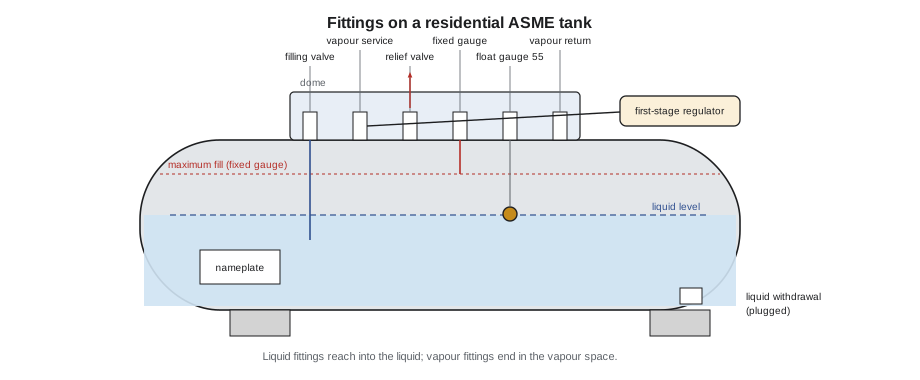
Three of these fittings are safety devices and deserve a closer look. The pressure relief valve is a spring-loaded valve set to open at or near the tank's working pressure. If the tank is heated, by the sun on an unusually hot day or by a fire, the relief valve opens and lets vapour escape until the pressure drops, then closes again. On a tank exposed to fire, the relief valve may open and close repeatedly; it is the only thing preventing the shell from overheating and failing, and its discharge must never be blocked, capped or pointed at a building. The excess flow valves in the vapour and liquid outlets close when the flow through them exceeds a set rate, as it would if a line downstream were broken off; they are not leak stoppers for small leaks and do not close for a slow leak. The back-check valves in the filling valve let propane in but not out, so the tank cannot empty itself through the filling connection if the hose is pulled off.
Measuring the propane in a tank
The float gauge is what the customer reads. A float rides on the liquid surface and turns a magnet; a dial on the outside, sealed from the propane, reads the liquid level in parts of 100 of the tank's volume, from 5 to 95. A reading of 80 means the tank holds about 80 parts in 100 of its volume as liquid, and a reading of 20 is the level at which most suppliers schedule a delivery. Float gauges are convenient but not precise; they can stick or read a few points off. The fixed liquid level gauge is the filling reference. It is a small bleeder valve whose dip tube ends exactly at the maximum permitted level. During filling the driver opens it; it spits vapour until the liquid reaches the end of the tube, then a white mist of liquid propane appears, and the driver stops. Many trucks also meter the delivery, and some tanks have remote monitors that report the float gauge reading to the supplier.
Worked problem
How much fuel is in the tank, and how much will a delivery add?
The farm's 1,893 L tank was filled to 80 parts in 100. Two months later its float gauge reads 35. How many litres of liquid are in the tank, how many litres will the next delivery add if it fills back to 80, and how much energy is that delivery worth at 25.3 MJ/L?
Show solution
- Liquid now:
- \[0.35 \times 1{,}893 = 663 \text{ L}\]
- Delivery to 80:
- \[(0.80 - 0.35) \times 1{,}893 = 0.45 \times 1{,}893 = 852 \text{ L}\]
- Energy delivered:
- \[852 \times 25.3 = 21{,}556 \text{ MJ} \approx 21.6 \text{ GJ}\]
Answer: The tank holds about 663 L, and a fill to 80 adds about 852 L, worth roughly 21.6 GJ. The actual delivery depends on the liquid temperature; the truck meter corrects the volume to a standard temperature.
The first-stage regulator and the service line
The vapour service valve feeds a first-stage regulator, normally mounted under the dome or on the tank's fitting with its vent pointing down. It reduces tank pressure, which can be anywhere from under 100 kPa to well over 1,000 kPa depending on the weather, to a steady intermediate pressure, typically about 70 kPa. A line of copper, steel or, underground between the regulators where the code allows, certified polyethylene carries the gas to a second-stage regulator at the building. On many smaller systems the two stages are combined in an integral two-stage regulator at the tank. Lesson 6 covers regulation in detail. The point for now is that the supplier usually owns and installs the tank, its fittings and the first-stage regulator, and the gas contractor usually starts at the outlet of that regulator, so the hand-off point should be agreed and recorded on every job.
Inspecting and maintaining tanks
Tanks are long-lived, but they are not maintenance-free. The Ontario amendments to B149.2 require an installed tank to have a recorded inspection every 10 years, and set rules for the pressure relief valves: they must be visually inspected periodically with records kept at least every five years, and relief valves on tanks of 2,500 US gallons water capacity or less must be rebuilt and certified, or replaced, every 25 years, with overdue valves to be dealt with by May 1, 2027. Larger tanks have a 10-year interval. Owners, usually the supplier, need a compliance plan and records for each valve. Between those inspections, the supplier's driver looks at the tank at every delivery, and Bayline technicians look whenever they are on site.
What everyone looks for is the same. The tank should stand level and firmly on its supports, with no settling, no contact with soil at the bottom and nothing growing up around it. The paint, usually white or a light colour to reflect the sun, should be intact, with no rust spots, dents, gouges or blisters. The dome should close and lock, and the fittings under it should be free of wasp nests, spiders and debris. The relief valve must have its rain cap, show no corrosion or paint on the spring, and discharge upward and clear. The regulator vent must point down and be clear, and the nameplate must be legible. Anything wrong is reported to the owner and the supplier in writing.
| What you see | What it might mean | Action |
|---|---|---|
| Rust and pitting at the bottom of the shell | The tank sits in wet ground or grass | Report to the supplier; the tank may need lifting, repair or replacement |
| Relief valve without its rain cap, or full of debris | Water and dirt can corrode the spring or block the valve | Report; the valve may need replacement |
| Regulator vent pointing up or blocked by ice | Water can enter and freeze, and the regulator may fail | Report; turn or replace the regulator |
| Wasp nest or spider webs in the dome | Can block the regulator vent or relief valve | Clear carefully and report |
| Frost on a fitting when no gas is being used | Possible liquid leak | Treat as a leak: check with solution or a detector, shut off if needed and call the supplier |
Who owns the tank, and why it matters
Most residential tanks are leased: the supplier owns the tank and its fittings, sets it, fills it and maintains it, and the customer pays a rental fee or agrees to buy propane only from that supplier. Only the owner's supplier may fill a leased tank, and only the owner may move, modify or remove it. Some customers own their tanks outright and may choose any supplier, but they then take on the inspection and maintenance the code requires, and a supplier may decline to fill a tank it has not inspected. For Bayline this has practical consequences. A technician who finds a problem at the tank, such as a leaking fitting, a damaged regulator or a relief valve without its cap, reports it to the tank's owner rather than repairing it, unless the owner has asked Bayline to do the work and the technician holds the certificate the job requires. A customer who wants to switch suppliers, move the tank for a new deck or add a generator must involve the owner. And when a customer says "my tank", the job sheet records whose tank it actually is, the supplier's name and the tank's serial number from the nameplate, so that anyone who comes later knows whom to call.
Common mistakes
MistakeCapping or turning a relief valve to stop it hissing.
InsteadA relief valve that is discharging is protecting the tank; find out why and call the supplier.
MistakeExpecting an excess flow valve to stop a small leak.
InsteadExcess flow valves close only on flows far above normal, such as a broken line.
MistakeReading the float gauge as gallons or litres.
InsteadThe dial reads parts of 100 of the tank's volume; multiply by the water capacity.
MistakeWorking on the tank's fittings because they look like part of your piping.
InsteadThe tank, its fittings and usually the first-stage regulator belong to the supplier; agree on the hand-off point.
MistakeIgnoring a tank whose nameplate cannot be read.
InsteadA tank without a legible nameplate cannot be identified and must not be filled.
Summary and key terms
- Propane tanks are welded ASME pressure vessels rated by water capacity in US gallons, usually 120 to 1,000 for homes, designed for about 1,720 kPa, and carry a nameplate with a CRN.
- Their fittings are grouped under a lockable dome: filling valve with back-checks, vapour service valve with excess flow protection, pressure relief valve, fixed liquid level gauge, float gauge, vapour return and liquid withdrawal valves.
- The relief valve protects the shell and must discharge freely; excess flow valves close only on large flows.
- The float gauge reads parts of 100 of the tank's volume, and the fixed liquid level gauge marks the maximum fill.
- Ontario requires a recorded tank inspection every 10 years and relief valves on small tanks to be rebuilt or replaced every 25 years.
- ASME tank
- A stationary propane container built to the ASME pressure vessel code and filled on site.
- Nameplate
- The permanent plate showing a tank's maker, serial number, pressure rating and capacity.
- Pressure relief valve
- A spring-loaded valve that opens to discharge vapour if container pressure rises too high.
- Excess flow valve
- A valve that closes when flow exceeds a set rate, as when a line is broken.
- Back-check valve
- A valve in a filling connection that lets propane in but not out.
- Float gauge
- A dial gauge showing the liquid level in parts of 100 of the tank volume.
- Dome
- The hinged steel cover that protects a tank's fittings.
Practice problems
Work each problem on paper first, then reveal the answer to check.
What does a float gauge reading of 60 on a 1,000 US gallon tank mean?
Show answer
About 600 US gallons of liquid are in the tank.
Why must a relief valve discharge freely and upward?
Show answer
It protects the shell from overpressure, and its discharge must not be blocked or aimed at a building.
Will an excess flow valve stop a small leak at a fitting?
Show answer
No; it closes only on flows far above normal.
What does white mist from the fixed liquid level gauge tell the driver?
Show answer
The liquid has reached the maximum fill level.
Who usually owns the tank and the first-stage regulator on a residential job?
Show answer
The propane supplier.
Lesson quiz · 5 questions
Score 60% or more to complete this lesson.
Create a free account to save your progress, take quizzes and earn a certificate.