
GAS-240 · Lesson 1 of 12 · 25 min
Propane properties and why storage is different
▶ Video coming soon A video version of this lesson is on the way.
On Monday morning, September 28, before the vans left the yard, Luis Ferreira set a 9 kg barbecue cylinder on the shop bench beside a pressure gauge, a roofing torch and a thermometer. He screwed the gauge onto the valve and opened it. The needle jumped to about 790 kPa. "It's 22 °C in here," he told Jonah. "Now watch." He carried a second cylinder, the same size, out of the walk-in cooler where the shop kept its sealant in summer, and fitted the gauge. About 370 kPa." Same gas, same cylinder, same amount left in it. Only the temperature changed." Then he connected the torch to the warm cylinder and ran it hard for ten minutes against a brick. By the end, a band of frost had formed on the outside of the cylinder, level with the liquid inside, and the gauge had dropped by a third. "Everything you will learn about propane storage," Luis said, "is in these three minutes. It is stored as a liquid, it is used as a vapour, and the pressure depends on temperature."
GAS-110 introduced propane's specific gravity, heating value and flammable range, and GAS-120 showed where the storage code fits beside the installation code. This lesson explains the properties that make propane storage different from natural gas service: why propane is a liquid in the container, what sets the pressure, how much it expands, how a leak behaves and how propane is made to smell. Every later lesson in this course builds on them.
A gas that liquefies under modest pressure
Natural gas arrives at a building through a utility main at a pressure the utility controls, and the building never stores any. Propane is different because it is easy to liquefy. At atmospheric pressure it boils at about −42 °C, so on any day warmer than that, propane left in an open pan would boil away. Put it in a closed container, though, and the liquid boils only until the vapour above it reaches a certain pressure. At that pressure, boiling stops: molecules leave the liquid as fast as others return to it. That balance pressure is the vapour pressure, and it depends only on the temperature of the liquid. It does not depend on how much liquid is left, which is why a nearly empty cylinder on a warm day reads the same pressure as a full one.
Because propane is stored as a liquid, a small container holds a great deal of fuel. One volume of liquid propane boils to about 270 volumes of vapour at atmospheric pressure and normal room temperature. A 9 kg cylinder holds enough fuel to run a 15 kW barbecue burner for about eight hours; the same energy as natural gas at atmospheric pressure would fill a room. That is the great advantage of propane where there are no gas mains: farms, cottages, construction sites, forklifts, food trucks and vehicles. It is also what makes propane storage demanding. A container holds a liquid at a pressure that rises and falls with the weather, and if that liquid escapes it turns into a large, heavy, flammable cloud.
Worked problem
How much vapour does a leak of liquid make?
A fitting on a liquid line leaks 2.0 L of liquid propane before it is shut off. Using an expansion ratio of 270, how much vapour does that make, and how many cubic metres of flammable mixture could it form at the lower flammable limit of about 2.1 parts in 100?
Show solution
- Liquid in cubic metres:
- \[2.0 \text{ L} = 0.0020 \text{ m}^3\]
- Vapour:
- \[0.0020 \times 270 = 0.54 \text{ m}^3\]
- Mixture at the lower flammable limit:
- \[\frac{0.54}{0.021} = 25.7 \text{ m}^3\]
Answer: Two litres of liquid, less than a bottle of pop, make about half a cubic metre of vapour, enough to bring nearly 26 m³ of air to the lower flammable limit. That is the volume of a small basement room, which is why liquid leaks are treated so seriously.
Vapour pressure and temperature
The table below gives the approximate vapour pressure of pure propane at a range of temperatures. Commercial propane is mostly propane with small amounts of propylene, butane and ethane, so a real container may read a little higher or lower, but the pattern is the same. Pressure rises quickly with temperature: from a cold winter morning to a hot summer afternoon, the pressure in a tank can change by a factor of ten. Containers, valves and regulators are built for that range. Tanks are commonly designed for a working pressure of 1,720 kPa and fitted with relief valves set close to it, and cylinders for a service pressure of 1,650 kPa with relief valves set higher, typically around 2,590 kPa. Those are typical values; the nameplate or collar of each container gives its own.
| Liquid temperature | Approximate vapour pressure (gauge) |
|---|---|
| −40 °C | 10 kPa |
| −30 °C | 67 kPa |
| −20 °C | 143 kPa |
| −10 °C | 244 kPa |
| 0 °C | 373 kPa |
| 10 °C | 536 kPa |
| 20 °C | 735 kPa |
| 30 °C | 979 kPa |
| 40 °C | 1,268 kPa |
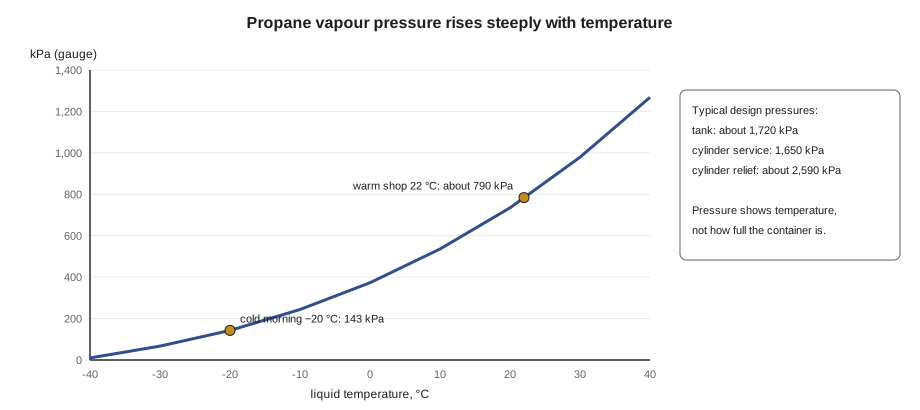
Two practical lessons follow from the table. First, a container in the sun or near a heat source can build pressure quickly, and if the liquid fills the container completely, the pressure rises far faster still, as lesson 7 explains. That is why containers are never filled full, never stored near heat and always fitted with a relief valve. Second, on the coldest days the pressure in a tank falls, and with it the tank's ability to deliver vapour. At −40 °C propane barely boils at all. Lesson 5 shows how tanks are sized so that there is still enough pressure and enough vapour on a design winter day.
Why the container frosts: boiling takes heat
When vapour is drawn from a container, the pressure above the liquid drops slightly, and the liquid boils to replace the vapour. Boiling takes heat: about 428 kJ per kilogram of propane at its boiling point, and a little less at room temperature. That heat comes from the liquid itself, which cools, and from the container wall, which takes heat from the surrounding air. If vapour is drawn faster than heat can flow in through the wetted wall, the liquid cools, its vapour pressure falls and the supply pressure falls with it. Moisture in the air condenses and freezes on the cold steel at the liquid level, giving the frost band Jonah saw on the bench. Frost on a container in use is not a leak; it is a sign that the container is being worked hard. Frost on a fitting or a pipe joint, on the other hand, can mark liquid escaping and boiling at the leak, and must be investigated.
Worked problem
How much heat does the torch draw from the cylinder?
Luis's torch burned 1.10 kg of propane in the ten minutes. How much heat had to flow into the liquid to boil it, and what average rate of heat flow is that in kilowatts?
Show solution
- Heat to boil the propane:
- \[1.10 \times 428 = 471 \text{ kJ}\]
- Time in seconds:
- \[10 \times 60 = 600 \text{ s}\]
- Average rate:
- \[\frac{471}{600} = 0.785 \text{ kW}\]
Answer: Nearly 0.8 kW of heat had to flow through the steel of a small cylinder from the shop air. It could not keep up, so the liquid cooled, the frost formed and the pressure fell. A small cylinder simply cannot supply a large burner for long.
Liquid that expands
Liquid propane expands much more with temperature than water does: roughly 0.3 in 100 for each degree Celsius near ordinary temperatures, and more as it gets warmer. A container filled to the brim on a cool morning would have nowhere for the liquid to go by afternoon. Liquid cannot be compressed, so the pressure in a liquid-full container rises by hundreds of kilopascals per degree, far faster than the vapour pressure curve, until the relief valve opens and discharges liquid, or something fails. For that reason the codes limit how much propane may be put into any container, leaving a vapour space for expansion. For a typical residential tank that limit works out to about 80 parts in 100 of the container's volume at normal filling temperatures, and for a cylinder filled by weight it works out to about 42 parts in 100 of the container's water capacity by weight, because liquid propane weighs only about half as much as water. Lesson 7 covers how containers are filled so that the limit is never exceeded.
Heavier than air, and slow to disperse
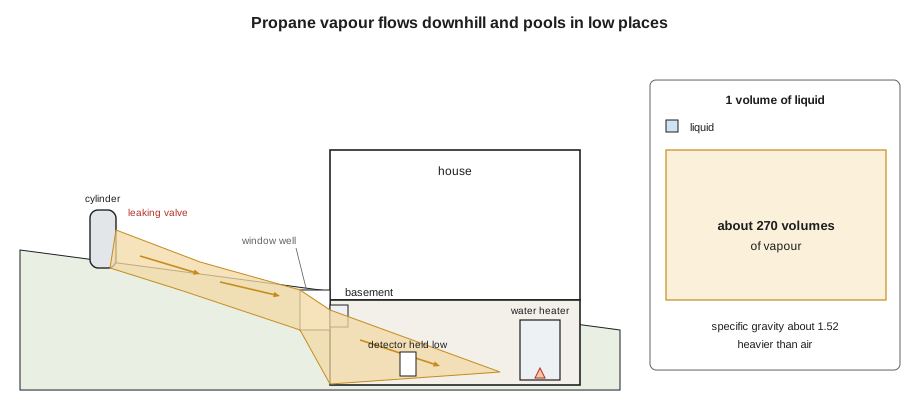
Propane vapour has a specific gravity of about 1.52: it is half again as heavy as air. Natural gas, at about 0.6, rises and usually disperses through a building's upper levels and out. Propane vapour from a leak flows downhill like water. It collects in basements, crawl spaces, sumps, pits, window wells, ditches and low corners of a room, and it can travel along the ground to a pilot light, a water heater burner, a furnace or a running engine well away from the leak. In still air it can lie in a low place for a long time. The farm pit near Ancaster that GAS-110 described is a textbook example: propane leaking from a buried line found its way into the one low, enclosed space on the property.
This changes how propane leaks are searched for and how spaces are tested. A combustible gas detector is held low, near the floor, in drains and in pits, not up by the ceiling. Basements are ventilated from the bottom, by blowing air in low or drawing it out at floor level. Containers are never stored or installed where escaping vapour could flow into a building opening below them, a basement window or a storm drain. And codes generally keep propane containers and propane-burning equipment with standing ignition sources out of basements and pits unless specific conditions are met. These rules all follow from a single number on the property chart.
| Property | Propane (typical) | Natural gas (typical) | What it means |
|---|---|---|---|
| Specific gravity of vapour | 1.52 | 0.60 | Propane sinks and pools; natural gas rises |
| Heating value of vapour | about 93 MJ/m³ | about 37.5 MJ/m³ | Propane needs much smaller orifices for the same input |
| Heating value of liquid | about 25.3 MJ/L | not stored as liquid | Fuel is bought and stored by volume or weight of liquid |
| Air needed to burn one volume | about 24 volumes | about 9.6 volumes | Propane burners need much more air per volume of gas |
| Flammable range in air | 2.1 to 9.5 parts in 100 | 5 to 15 parts in 100 | A small leak reaches the lower limit quickly |
| Boiling point | about −42 °C | about −162 °C | Propane stays liquid under modest pressure |
| Liquid to vapour | about 1 to 270 | not applicable | A small liquid leak makes a large vapour cloud |
The smell of propane, and when it fades
Propane has no smell of its own. Suppliers add an odorant, normally ethyl mercaptan, so that a leak can be smelled well below the lower flammable limit. The codes require propane to be odorized before it is delivered to users, and suppliers test that the odorant is present. Most people recognize the smell at once, but not everyone does: some people have a poor sense of smell, from age, illness, smoking or some medications, and anyone's sense of smell fades after a few minutes in an odour, a process called olfactory fatigue.
The odorant can also be lost before the gas reaches the appliance. This is called odour fade. Mercaptan reacts with rust and is absorbed by the steel inside new containers and pipes, especially a new tank that was not properly purged and conditioned, or a container that was left open to air and moisture and rusted inside. It can also be absorbed by soil around a leaking underground line, so that gas escaping from a buried pipe arrives at the surface with little or no smell. A leak that the homeowner cannot smell is still a leak. For that reason suppliers condition new containers, Bayline carries a combustible gas detector on every propane job and never relies on the nose alone, and both countries' propane safety advice recommends that homes using propane have propane gas detectors as well as carbon monoxide alarms.
Where the rules for storage come from
Because propane is stored on the customer's property in a pressure vessel, storage has its own code. In Ontario, CSA B149.2:25, Propane storage and handling code, is adopted through TSSA's propane code adoption document, effective June 8, 2026, under O. Reg. 211/01, Propane Storage and Handling. It covers cylinders and tanks, their valves and fittings, their location, filling, transfer, cylinder exchange and bulk plants, and the training needed to handle and fill cylinders. Vehicle fuel systems follow CSA B149.5:25, adopted through the same document. CSA B149.1 still covers the piping downstream of the container installation, the appliances and their venting. Cylinders themselves are built and requalified to Transport Canada rules under the Transportation of Dangerous Goods Regulations, and tanks are built to the ASME pressure vessel code and registered under the provincial boiler and pressure vessel rules.
The division of work follows the division of codes. On most residential jobs the propane supplier owns the tank, sets it, fills it and installs the first-stage regulator; the gas contractor installs the piping from there, the second-stage regulator where agreed, the appliances and the venting. The two must agree on where the tank goes, what loads it will serve and who tests what, as the case study in lesson 12 shows.
Common mistakes
MistakeReading a propane pressure gauge to judge how full a container is.
InsteadPressure depends on temperature, not on the amount left; use a float gauge, weight or the fixed liquid level gauge.
MistakeTreating frost on a working container as a leak.
InsteadFrost at the liquid level shows hard vapour draw; frost on a fitting or joint may be a liquid leak and must be checked.
MistakeSearching for a propane leak with the detector held high.
InsteadPropane is heavier than air; test low, in pits, drains and basements.
MistakeTrusting the customer's nose to confirm there is no leak.
InsteadOdour can fade and people's sense of smell varies; use a detector and a leak test.
MistakeFilling or allowing a container to be filled full of liquid.
InsteadLiquid expansion in a full container builds pressure rapidly; the fill limit leaves vapour space.
Summary and key terms
- Propane boils at about −42 °C, so in a closed container it is a liquid with vapour above it at a pressure set only by the liquid's temperature.
- One volume of liquid makes about 270 volumes of vapour, so small containers hold a lot of fuel and small liquid leaks make large clouds.
- Drawing vapour boils liquid, which takes heat from the container wall; drawing too fast cools the liquid, drops the pressure and frosts the container.
- Liquid propane expands strongly with temperature, so containers are never filled full.
- The vapour is about 1.52 times as heavy as air and pools in low places.
- An odorant, normally ethyl mercaptan, is added, but odour can fade through rust, new steel or soil, so detectors are used.
- CSA B149.2 and B149.5, adopted under O. Reg. 211/01 cover storage and vehicle systems, while the installation code covers piping and appliances.
- Vapour pressure
- The pressure of vapour above a liquid in a closed container, set by the liquid temperature.
- Expansion ratio
- The volume of vapour that one volume of liquid propane makes, about 270.
- Wetted surface
- The part of a container wall in contact with liquid, through which heat for boiling flows.
- Odorant
- A chemical, normally ethyl mercaptan, added so that propane can be smelled.
- Odour fade
- Loss of odorant through reaction with rust, new steel or soil, so that a leak smells weak or not at all.
- Olfactory fatigue
- The loss of the ability to smell an odour after being exposed to it for a while.
- Fill limit
- The largest amount of propane a container may hold, leaving vapour space for expansion.
Practice problems
Work each problem on paper first, then reveal the answer to check.
Why does a nearly empty cylinder read the same pressure as a full one on the same day?
Show answer
Vapour pressure depends only on the liquid temperature, not the amount of liquid.
What causes a frost band on a cylinder supplying a large burner?
Show answer
Boiling draws heat from the liquid and wall faster than it flows in, so the wall at the liquid level gets cold enough to freeze moisture.
Where would you test for a propane leak in a basement, and why?
Show answer
Near the floor and in low spots, because propane is heavier than air.
Name two things that can cause odour fade.
Show answer
Rust or new steel inside a container or pipe, and soil around a buried leak.
Why are containers never filled full of liquid?
Show answer
Liquid expands with temperature and a full container's pressure would rise rapidly.
Lesson quiz · 5 questions
Score 60% or more to complete this lesson.
Create a free account to save your progress, take quizzes and earn a certificate.