
ELEC-230 · Lesson 9 of 12 · 24 min
Lighting systems and layout
Lighting is a large part of commercial electrical work: in an office building, luminaires and their controls may account for a third of the electrical labour. Nearly all new commercial lighting now uses LEDs, which changed not only the light sources but also the wiring, the drivers and the controls. Although the lighting design is done by an engineer or lighting designer, the electrician who understands photometrics, luminaire types, drivers and emergency lighting installs it faster, catches errors on the drawings and can answer the owner's questions. This lesson covers lighting quantities, LED luminaires and drivers, the lumen method of layout, emergency and exit lighting, and installation practice. Controls follow in Lesson 10; the code and energy code requirements for commercial lighting are covered in ELEC-220, Lesson 11.
Lighting quantities
- Luminous flux, in lumens (lm): the total visible light emitted by a source.
- Illuminance: the light falling on a surface, in lux (lumens per square metre) or footcandles (lumens per square foot); 1 footcandle ≈ 10.76 lux.
- Efficacy: lumens per watt, the efficiency of a luminaire. Good LED luminaires deliver well over 100 lm/W, compared with about 60 to 90 lm/W for the fluorescent luminaires they replaced.
- Correlated colour temperature (CCT), in kelvins: warm (2,700 to 3,000 K) to neutral (3,500 to 4,000 K) to cool (5,000 K and above). Offices commonly use 3,500 to 4,000 K.
- Colour rendering index (CRI): how faithfully colours appear under the source, out of 100; 80 is typical for offices, 90 or more for retail and healthcare.
- Uniformity and glare: the ratio between maximum and minimum illuminance, and how bright luminaires appear from normal viewing angles, measured by indices such as the unified glare rating (UGR).
Recommended illuminance depends on the task. Typical targets from the Illuminating Engineering Society (IES) are about 300 to 500 lux (30 to 50 fc) for offices, 500 lux or more for detailed work, 100 to 200 lux for corridors and storage, and 50 lux or less for parking areas.
In Canada, lighting design follows IES recommendations, and lighting power and controls are governed by the National Energy Code of Canada for Buildings (NECB) or provincial energy codes (ELEC-220, Lesson 11). Commercial lighting circuits are commonly 347 V single phase from a 600Y/347 V system, and luminaires and drivers must be rated for 347 V.
LED luminaires and drivers
Common commercial luminaires include recessed troffers and flat panels for suspended ceilings, linear pendants and surface fixtures, downlights, high-bay luminaires for warehouses and gymnasiums, and wall packs and area lights outdoors. An LED luminaire contains LED arrays on a heat-sinking body, optics that shape the light, and a driver: the electronic power supply that converts line voltage to the regulated low-voltage DC that LEDs need. Most commercial drivers are constant-current types, matched to the LED array.
Drivers determine how the luminaire is controlled. A 0–10 V dimming driver has two extra low-voltage wires (usually purple and grey or pink) that receive a control voltage between 0 and 10 V from a dimmer or controller; at 10 V the output is full, at 1 V or less it is minimum or off. Digital drivers such as DALI receive addressed commands over a two-wire bus, allowing individual control of each luminaire. Many networked luminaires have sensors and wireless controllers built in (Lesson 10). The electrician must route the control wiring correctly, keep it separate from power wiring or use cable rated for the higher voltage, and follow the manufacturer's wiring diagrams, because a reversed polarity on 0–10 V wiring prevents dimming.
LEDs also change maintenance. They rarely fail suddenly; instead their output slowly falls. Life is rated as L70 (the hours until output falls to 70 % of initial), often 50,000 to 100,000 hours. Drivers, with electrolytic capacitors sensitive to heat, are more often the component that fails first.
The lumen method
The lumen method (zonal cavity method) estimates how many luminaires a room needs to achieve a target average illuminance:
where N is the number of luminaires, E the target illuminance, A the room area, Φ the lumens per luminaire, CU the coefficient of utilization (the fraction of lamp lumens reaching the work plane, from the manufacturer's photometric data for the room's proportions and surface reflectances), and LLF the light loss factor (allowing for lumen depreciation and dirt over time, often 0.8 to 0.9 for LEDs).
Worked problem
Laying out an open office
An open office measures 12 m by 10 m. The target is 400 lux. Each LED troffer emits 4,000 lm, the CU from the photometric table is 0.70, and the LLF is 0.85. How many luminaires are needed, and how might they be arranged?
Show solution
- Area: 12 × 10 = 120 m².
- N = (400 × 120) / (4,000 × 0.70 × 0.85) = 48,000 / 2,380 ≈ 20.2.
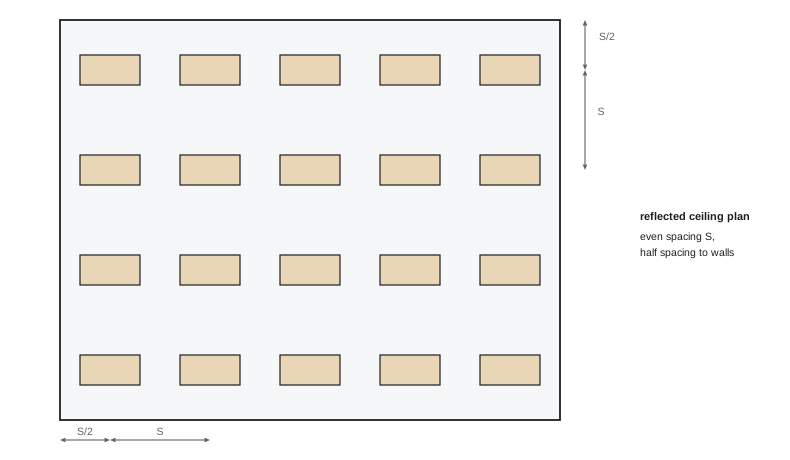
- Round to a layout that fits the ceiling grid: 4 rows of 5 (20 luminaires) gives about 397 lux, or 4 rows of 6 (24) gives about 476 lux.
Answer: About 20 luminaires; a 4 × 5 grid gives about 400 lux. Spacing about 2.4 m by 2.5 m should be checked against the luminaire's maximum spacing-to-mounting-height ratio for uniformity. Lighting software would then confirm the result point by point.
The lumen method gives an average. Uniformity requires that luminaires be spaced no farther apart than a maximum spacing criterion (a multiple of the mounting height above the work plane, given by the manufacturer), and that the outer rows be about half the spacing from the walls. Designers now do most layouts with lighting software that calculates illuminance point by point, but the lumen method remains the quick check an installer can do with a calculator.
Emergency and exit lighting
When normal power fails, emergency lighting must illuminate exit routes so that occupants can leave safely, and exit signs must show the way. Emergency lighting may be supplied by unit equipment (battery packs in or beside luminaires), by central battery or inverter systems, or by a generator through emergency circuits. It must be tested on installation and periodically.
In Canada, the National Building Code requires emergency lighting along exit routes to provide an average of at least 10 lx with a minimum of 1 lx at floor level, for at least 30 minutes in most buildings and longer (1 or 2 hours) in high buildings and some occupancies. Exit signs use the green "running man" pictogram, and unit equipment is certified to CSA C22.2 No. 141. Section 46 of the CEC covers emergency systems and unit equipment.
The installer must connect unit equipment to the normal lighting circuit for the area it serves (so it activates when that circuit fails, not just when the whole building loses power), connect emergency drivers in luminaires as the wiring diagram requires, keep emergency circuits separate from normal wiring where required, and verify operation by switching off the normal supply.
Installation practice
Luminaires in suspended ceilings are supported independently of the ceiling tiles: most codes require them to be fastened to the ceiling grid with clips and, for heavier luminaires or in seismic areas, supported by independent wires to the structure. Connections are commonly made with prefabricated flexible whips from a junction box above the ceiling, which speeds installation and allows luminaires to be moved. Pendants hang from aircraft cable or stems at the specified height, aligned in straight rows with a string line or laser. Exterior luminaires require weatherproof boxes and fittings and correct aiming to avoid light trespass onto neighbouring property. Before energizing, check the driver voltage against the circuit (a 120 V driver on a 347 V or 277 V circuit fails instantly), and keep the luminaire cartons' installation instructions with the turnover documents.
Exterior and specialty lighting
Outside the building, area lighting for parking lots, walkways and facades is mounted on poles, walls or bollards and controlled by photocells, schedules and motion sensors. Poles stand on concrete bases with anchor bolts set to the manufacturer's template, with conduit stubs in the base and a handhole for connections; the pole and luminaire must be rated for the site's wind loads. Voltage drop is a real concern on long site lighting circuits, so conductors are often larger than the minimum. Light trespass and glare onto neighbouring properties and the night sky are increasingly regulated, so luminaires must be aimed and shielded as designed, and many jurisdictions limit colour temperature and require dimming after business hours.
Indoor specialty lighting includes high-bay luminaires in warehouses (often with integral occupancy sensors and mounted with safety cables), linear pendants in offices and schools that must be aligned in long continuous rows, and track and accent lighting in retail. Each has its own mounting details, and the manufacturer's instructions and the reflected ceiling plan must be followed closely, because rows that wander or luminaires at the wrong height are obvious to everyone once the space is finished.
Checking lighting after installation
Once luminaires are installed and the controls programmed, illuminance can be checked with a light meter at the work plane (usually 0.75 m or 30 inches above the floor), at night or with daylight excluded, at a grid of points across the space. The average and the minimum are compared with the design. Measured values above the design are common with new LEDs, which is why high-end trim is used (Lesson 10). Very low readings point to wrong luminaires, wrong lumen packages, failed drivers or controls limiting the output. Recording these measurements gives the owner a baseline for future maintenance and helps resolve occupant complaints.
Lamp and driver substitutions deserve particular care. Contractors sometimes propose substitute luminaires to save cost or time. A substitute must match the specified luminaire's lumen output, distribution, colour temperature, colour rendering, efficacy, dimming protocol and voltage, and its photometric file should be checked by the designer, because a cheaper luminaire with a different distribution can leave dark spots between rows even if its lumen rating is the same.
Lighting retrofits
Much commercial lighting work is not new construction but retrofit: replacing fluorescent and high-intensity discharge luminaires with LED equipment in occupied buildings. Retrofits may replace whole luminaires, install retrofit kits inside existing housings (which must be certified for the purpose and installed exactly as their instructions require, because they change the luminaire's certification), or substitute LED tubes that work with or without the existing ballast. Each approach has trade-offs in cost, efficiency, light quality and long-term maintenance. Retrofits are also an opportunity to add controls, often with wireless sensors that avoid new wiring in finished ceilings. Work in occupied buildings must be scheduled around occupants, with dust control, protection of furnishings and safe handling and recycling of old lamps and ballasts, since fluorescent lamps contain mercury and some older ballasts contain PCBs that require special disposal.
Common mistakes
MistakeInstalling luminaires with drivers rated for the wrong voltage.
InsteadCheck the driver rating against the circuit voltage before energizing.
MistakeReversing 0–10 V dimming leads.
InsteadFollow the wiring diagram and keep polarity consistent.
MistakeRelying on ceiling tiles to support luminaires.
InsteadClip to the grid and add independent support wires where required.
MistakeConnecting emergency units to an unrelated circuit.
InsteadConnect them to the normal lighting circuit for the area they serve.
MistakeSpacing luminaires too far apart for their distribution.
InsteadRespect the spacing criterion and half-spacing to walls.
Summary and key terms
- Key quantities: lumens, illuminance (lux or fc), efficacy, CCT, CRI, uniformity and glare.
- Typical office illuminance is 300 to 500 lux (30 to 50 fc).
- LED luminaires use constant-current drivers; 0–10 V and DALI drivers enable dimming.
- LED life is rated as L70; drivers often fail before LEDs.
- Lumen method: N = E × A / (Φ × CU × LLF), checked against spacing criteria.
- Emergency lighting and exit signs follow building and life safety codes and must be tested.
- Support luminaires properly, use whips, check driver voltage and aim exterior lights carefully.
- Lumen
- The unit of luminous flux.
- Lux
- Illuminance of one lumen per square metre.
- Footcandle
- Illuminance of one lumen per square foot.
- Efficacy
- Lumens produced per watt.
- CCT
- Correlated colour temperature, in kelvins.
- CRI
- Colour rendering index.
- Driver
- The power supply that regulates current to LEDs.
- Coefficient of utilization
- The fraction of luminaire lumens reaching the work plane.
- Light loss factor
- An allowance for lumen depreciation and dirt.
- Unit equipment
- Battery-powered emergency lighting units.
Practice problems
Work each problem on paper first, then reveal the answer to check.
Convert 50 footcandles to lux.
Show answer
About 538 lux.
A luminaire emits 5,000 lm at 40 W. What is its efficacy?
Show answer
125 lm/W.
What CCT range is common in offices?
Show answer
3,500 to 4,000 K.
What does L70 mean?
Show answer
The hours until output falls to 70 % of initial.
What happens at 10 V on a 0–10 V dimming driver?
Show answer
Full output.
A 200 m² area needs 300 lux with 5,000 lm luminaires, CU 0.6 and LLF 0.85. How many?
Show answer
60,000 / 2,550 ≈ 23.5, so 24.
How far should outer rows be from the walls?
Show answer
About half the spacing between rows.
Why connect emergency units to the local lighting circuit?
Show answer
So they operate when that circuit fails, not only on total power loss.
What emergency lighting duration is generally required in your country?
Show answer
At least 30 minutes in most buildings, longer in some.
What check prevents instant driver failure at start-up?
Show answer
Confirming the driver voltage rating matches the circuit.
Lesson quiz · 5 questions
Score 60% or more to complete this lesson.
Create a free account to save your progress, take quizzes and earn a certificate.