
ELEC-230 · Lesson 10 of 12 · 24 min
Lighting controls installation and commissioning
Modern commercial lighting is controlled automatically. Lights turn on when people arrive, dim when daylight is plentiful, switch off when spaces empty, follow schedules, and in many buildings report their status to a central system. Energy codes require much of this, and owners value the savings. But automatic controls are also a frequent source of complaints: lights that switch off on people sitting still, rooms that never get bright enough, sensors that trigger on passing traffic. Most of these problems come from installation and commissioning, the work of the electrician and controls technician. This lesson covers the types of lighting controls, how they are wired, how they interact with emergency lighting, and how they are commissioned so that they save energy without annoying occupants.
Types of control
- Manual controls: wall switches and dimmers, now usually low-voltage keypads connected to a control system rather than line-voltage switches that break the load directly.
- Occupancy sensors: turn lights on automatically when someone enters and off after a time delay when the space is empty.
- Vacancy sensors: require manual switching on but turn lights off automatically; they save more energy because lights are not switched on when daylight is sufficient, and many energy codes require them in certain spaces.
- Daylight-responsive controls (daylight harvesting): photosensors dim or switch luminaires near windows and skylights when daylight provides part of the required light.
- Time-based controls: schedules that switch off lighting outside business hours, with override switches for after-hours occupants.
- High-end trim (task tuning): setting the maximum output of luminaires below 100 % when the design delivers more light than needed, saving energy from day one.
- Networked lighting controls: systems in which luminaires, sensors and switches communicate over wired or wireless networks, allowing zoning to be configured in software, scheduling, reporting and integration with building management systems. In luminaire-level lighting control (LLLC), each luminaire has its own sensor and controller.
Occupancy sensor technologies
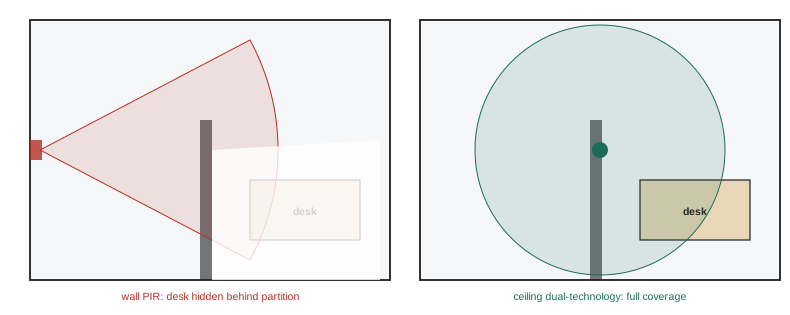
Passive infrared (PIR) sensors detect the movement of warm bodies across zones in their field of view. They work well for large movements and in line of sight, but cannot see around partitions and may miss small movements such as typing. Ultrasonic sensors emit high-frequency sound and detect the Doppler shift of reflections from moving objects; they detect small movements and can "see" around obstacles, but they can be triggered by air movement from HVAC diffusers. Dual-technology sensors combine both, typically requiring both to turn lights on and either to keep them on, reducing false triggers. Microphonic sensors add sound detection. The choice depends on the space: PIR for corridors and open areas with clear sight lines, dual-technology for private offices and washrooms with partitions.
Wiring controls
Control systems separate the power circuits from the control signals. A typical arrangement for a room uses a power pack (a relay with a low-voltage power supply) mounted on a junction box, which switches the line-voltage lighting circuit; sensors and keypads connected to it with low-voltage cable; and 0–10 V or digital dimming wiring to the luminaire drivers (Lesson 9). Larger buildings use lighting relay panels, controlled by a central system, to switch many circuits, or networked systems in which each luminaire is addressed individually and the "wiring" of switches to luminaires is done in software.
Installation points that prevent problems include:
- Keep Class 2 control wiring separated from power conductors, or use cable rated for the higher voltage where they share an enclosure, as the code and manufacturer require.
- Use the cable type the manufacturer specifies for digital buses and observe polarity and maximum lengths; label every control cable.
- Mount sensors where the manufacturer's coverage pattern covers the occupied area and avoids doorways to busy corridors, HVAC diffusers (for ultrasonic) and windows (for photosensors aimed at the wrong place).
- Install photosensors for closed-loop daylight control facing down onto the work area they control, and for open-loop control facing the window, as the design requires.
- For wireless systems, check signal strength and gateway locations before ceilings are closed.
Controls and emergency lighting
Emergency lighting that is also part of the normal lighting (for example, some of the troffers in a corridor) must come on at full output when normal power fails, even if the control system had them dimmed or off at that moment. This is achieved with emergency transfer devices (sometimes called bypass or shunt relays) that sense the loss of normal power and override the control signal, forcing the emergency luminaires to full brightness on the emergency supply. These devices must be listed for the purpose and wired exactly as their diagrams show; a common error is to wire the sensing input to the wrong circuit, so the device never detects the failure of the normal lighting it is supposed to back up.
In Canada, emergency lighting control devices are certified for the purpose (for example to CSA C22.2 No. 141 for unit equipment and related products), and Section 46 of the CEC requires that emergency lighting not be controlled in a way that prevents it operating when needed.
Energy savings
Controls save energy in layers, and the savings multiply rather than add because each acts on what is left. An estimate helps owners understand the value and is useful when checking energy code compliance.
Worked problem
Estimating control savings
An office floor has 12 kW of LED lighting operating 3,000 hours a year without controls. Expected savings are 10 % from high-end trim, 25 % from occupancy and vacancy sensors, and 20 % from daylight harvesting in the perimeter zones, which carry 40 % of the load. Estimate the annual energy use with controls.
Show solution
- Without controls: 12 × 3,000 = 36,000 kWh.
- High-end trim: 36,000 × 0.90 = 32,400 kWh.
- Occupancy and vacancy sensors: 32,400 × 0.75 = 24,300 kWh.
- Daylight harvesting on 40 % of the load: savings 24,300 × 0.40 × 0.20 = 1,944 kWh, leaving about 22,360 kWh.
Answer: About 22,400 kWh a year, a 38 % reduction. Adding the individual percentages (10 + 25 + 8 = 43 %) would overstate the savings because each control acts on a load already reduced by the others. Actual savings depend heavily on commissioning: a sensor with a 30-minute time delay saves far less than one set to 10 to 15 minutes.
Commissioning lighting controls
Energy codes increasingly require functional testing of lighting controls before occupancy, with documentation, and many owners require it regardless. Commissioning includes:
- Verifying that every luminaire is connected to the correct zone and responds to its switch, sensor and schedule as the sequence of operations describes.
- Setting occupancy sensor time delays and sensitivity, and walking the space to confirm coverage, including still activities such as reading at a desk.
- Calibrating daylight sensors: measuring illuminance at the work plane with a light meter, under daylight and at night, and setting the sensor so that the combined light meets the target without visible cycling. This is best done after furniture is in place.
- Setting high-end trim levels by measuring illuminance and reducing output to the design value.
- Programming schedules, holidays and override durations.
- Testing emergency transfer devices by interrupting the normal supply with the lights dimmed or off.
- Documenting settings, providing as-built zoning diagrams and training the owner's staff.
In Canada, the NECB and provincial energy codes specify required lighting controls and, in their newer editions, verification of their operation; many projects also follow commissioning requirements from green building programs.
Troubleshooting common complaints
Lights switching off while people are present usually mean poor sensor coverage (a PIR blocked by a partition), insufficient sensitivity or too short a time delay; the cure is relocating, re-aiming or changing sensor technology, not disabling the sensor. Lights turning on with no one present usually mean an ultrasonic sensor triggered by air movement or a sensor seeing into a corridor. Daylight zones that cycle up and down mean poorly placed or calibrated photosensors, or sensors that see the light from the luminaires they control in the wrong way. Dimming that does not work across a zone often means reversed or missing 0–10 V wiring at one luminaire. Each fix should be documented, because settings changed without records are a common source of later confusion.
Plug load and integrated controls
Some energy codes also require automatic control of a share of receptacles in offices and similar spaces, so that task lights, monitors and other plug loads switch off when spaces are unoccupied. These controlled receptacles are marked with a symbol or a distinct colour and are switched by the same occupancy sensors or schedules as the lighting, through relays in the receptacle circuits. The installer must wire controlled and uncontrolled receptacles exactly as the plans show and mark them correctly, so that occupants plug equipment that must stay on, such as refrigerators or network equipment, into uncontrolled outlets.
Networked lighting systems increasingly connect to the building automation system, sharing occupancy information so that heating, ventilation and air conditioning can set back in empty zones, and to demand response programs that dim lighting during utility peak events. These integrations add interfaces and network connections that must be installed, addressed and tested with the controls contractor and the building automation contractor, with clear responsibility for each part.
Cybersecurity and documentation of networked controls
A networked lighting system is a computer network. Gateways, servers and wireless devices should have default passwords changed, firmware updated as the manufacturer recommends, and network connections segregated from public and tenant networks as the owner's IT policy requires. The installer's role is usually limited to physical installation and commissioning, but leaving devices with default credentials or undocumented settings creates problems for the owner. The final documentation should include device addresses, zone assignments, programming backups, network diagrams and login details handed over securely to the owner.
Owners and occupants also need simple instructions. A short, laminated sheet at each room's control station explaining what the buttons do, how long lights stay on after the room empties, and whom to call with problems prevents many service calls in the first months of occupancy, when occupants are learning how the new system behaves.
For the installer, the lesson of lighting controls is that the work is not finished when the luminaires light. It is finished when every zone, sensor and schedule does what the sequence of operations says and the occupants can live with it.
Common mistakes
MistakeUsing PIR sensors where partitions block their view.
InsteadChoose dual-technology sensors and place them for full coverage.
MistakeMounting ultrasonic sensors next to HVAC diffusers.
InsteadKeep them away from air currents that cause false triggers.
MistakeLeaving factory default time delays and settings.
InsteadCommission every sensor, schedule and daylight zone.
MistakeWiring the emergency transfer device's sense input to the wrong circuit.
InsteadSense the normal circuit that feeds the area's lighting.
MistakeAdding savings percentages from several controls.
InsteadApply them in sequence to the remaining load.
Summary and key terms
- Controls include switches, occupancy and vacancy sensors, daylight harvesting, schedules, trim and networks.
- PIR suits line-of-sight spaces; ultrasonic sees around obstacles; dual-technology reduces false triggers.
- Power packs, relay panels and networked systems separate power switching from low-voltage control.
- Emergency transfer devices force emergency luminaires to full output on loss of normal power.
- Control savings multiply in sequence rather than add.
- Commissioning sets and verifies coverage, delays, daylight levels, trim, schedules and emergency operation.
- Most complaints trace to placement and settings and are fixed by adjustment, not by disabling controls.
- Occupancy sensor
- A sensor that turns lights on and off automatically with presence.
- Vacancy sensor
- A sensor that turns lights off automatically but requires manual on.
- PIR
- Passive infrared detection of moving warm bodies.
- Ultrasonic sensor
- A sensor detecting motion by the Doppler shift of ultrasound.
- Daylight harvesting
- Dimming electric light in response to available daylight.
- High-end trim
- Limiting maximum luminaire output to the needed level.
- Power pack
- A relay and low-voltage supply that switches a lighting circuit.
- LLLC
- Luminaire-level lighting control with a sensor in each luminaire.
- Emergency transfer device
- A listed device forcing emergency luminaires to full output on power loss.
- Functional testing
- Verifying that controls operate as specified.
Practice problems
Work each problem on paper first, then reveal the answer to check.
Why do vacancy sensors save more energy than occupancy sensors?
Show answer
Lights are not switched on automatically when they may not be needed.
Which sensor technology suits a washroom with stalls?
Show answer
Ultrasonic or dual-technology, which can detect around partitions.
What can cause an ultrasonic sensor to false-trigger?
Show answer
Air movement from HVAC diffusers.
What does a power pack do?
Show answer
It switches the line-voltage lighting circuit and powers low-voltage sensors.
What must happen to dimmed emergency luminaires on power failure?
Show answer
They must go to full output on the emergency supply.
In the example, why is the saving not 43 %?
Show answer
Each control acts on the load already reduced by the others.
Recalculate the example with 30 % sensor savings instead of 25 %.
Show answer
32,400 × 0.70 = 22,680; minus 22,680 × 0.08 ≈ 1,814; about 20,870 kWh.
When should daylight sensors be calibrated?
Show answer
After furniture is in place, with measurements under daylight and at night.
What usually causes lights to switch off on seated occupants?
Show answer
Poor coverage, low sensitivity or too short a time delay.
What documentation follows commissioning?
Show answer
Settings, as-built zoning diagrams, test results and owner training records.
Lesson quiz · 5 questions
Score 60% or more to complete this lesson.
Create a free account to save your progress, take quizzes and earn a certificate.