
ELEC-230 · Lesson 2 of 12 · 25 min
Raceway systems and fittings
A raceway is an enclosed channel designed to hold conductors. In commercial buildings, raceways do several jobs at once: they protect conductors from physical damage, provide a path for fault current when they are metal, allow conductors to be pulled out and replaced as the building changes, and keep wiring organized and identifiable. This lesson surveys the raceway types an electrician meets on commercial jobs, how each is cut, joined and terminated, the fittings that connect them to boxes and equipment, and how to choose the right raceway for each location. The code rules on conduit fill, bends between pull points and box fill were covered in ELEC-220, Lesson 2; here the focus is on the materials and how to work with them.
Sizes and designations
Raceways are sold by trade size, a nominal designation that does not equal any actual dimension. North American trade sizes are expressed in inches (½, ¾, 1, 1¼, 1½, 2, 2½, 3, 3½ and 4 for common work) or by the equivalent metric designators (16, 21, 27, 35, 41, 53, 63, 78, 91 and 103). The actual inside diameter differs by raceway type: ½-inch EMT and ½-inch rigid conduit have different walls and slightly different internal areas, which is why fill tables are specific to each type.
The Canadian Electrical Code and Canadian product standards use the metric designators (trade size 16, 21, 27 and so on), and drawings in Canada usually show them, although many electricians still speak of ½-inch and ¾-inch conduit. Raceway installation rules are in Section 12 of the CEC.
Metal raceways
- Electrical metallic tubing (EMT): thin-walled, unthreaded steel tubing joined with set-screw or compression couplings and connectors. Light, cheap and easy to bend, it is the workhorse of commercial interiors. It is not threaded, and it is not suitable where severe physical damage is likely.
- Rigid metal conduit (RMC, often called rigid or GRC for galvanized rigid conduit): heavy-walled, threaded steel (or aluminum) conduit. It provides the greatest mechanical protection and is used in exposed locations subject to damage, outdoors, in some hazardous locations, and where specifications require it. It is heavy and slower to install.
- Intermediate metal conduit (IMC): a threaded steel conduit with a thinner wall than rigid, lighter and cheaper but approved for most of the same uses; common in the United States, rare in Canada.
- Flexible metal conduit (FMC): helically wound metal strip, used for short connections to equipment that vibrates or must be moved, such as motors, and to luminaires in suspended ceilings (often as manufactured "whips").
- Liquidtight flexible metal conduit (LFMC): flexible metal conduit with a PVC jacket, used for flexible connections in wet or oily locations, such as outdoor HVAC equipment.
Non-metallic raceways
- Rigid PVC conduit: light, corrosion-proof and non-conducting, joined with solvent cement. Used underground, encased in concrete, in corrosive areas and outdoors. It needs a separate bonding conductor, expansion fittings on long exposed runs because it expands far more than steel with temperature (ELEC-220, Lesson 2), and protection where exposed to damage. It is bent with heat (Lesson 5).
- Electrical non-metallic tubing (ENT): flexible corrugated plastic tubing, used concealed in walls and poured into concrete slabs. Quick to install but limited in where it may be used.
- Liquidtight flexible non-metallic conduit (LFNC): flexible plastic conduit for wet locations and short connections.
- High-density polyethylene (HDPE) duct: supplied on reels for underground and directional bored installations, for power and communications.
| Raceway | Joined by | Typical commercial uses | Limitations |
|---|---|---|---|
| EMT | Set-screw or compression fittings | Dry interiors, exposed and concealed | Not for severe damage; compression fittings in damp areas |
| Rigid metal conduit | Threaded couplings | Exposed areas subject to damage, outdoors, hazardous locations | Heavy, slow, needs threading |
| IMC | Threaded couplings | Similar to rigid | Less common in Canada |
| Rigid PVC | Solvent cement | Underground, concrete, corrosive areas | Expansion, damage, needs bonding conductor |
| ENT | Snap or cement fittings | Concealed in walls and slabs | Restricted uses |
| FMC | Clamp connectors | Short flexible connections, luminaire whips | Length and grounding limits |
| LFMC / LFNC | Liquidtight connectors | Flexible connections in wet locations | Length limits |
Cutting, reaming and threading
Raceways must be cut square and the cut ends reamed to remove burrs, because a sharp edge can strip insulation during pulling, a fault that may not appear until years later. EMT is cut with a hacksaw, a portable band saw or a tubing cutter (which leaves an internal burr that must be reamed), then deburred with a reamer or a screwdriver shank used as a scraper. Rigid conduit is cut with a band saw or pipe cutter, reamed, and threaded with a die: a hand ratchet threader for small sizes and occasional work, or a power threading machine for production. Threads must be cut to the correct length (a standard taper of 1 in 16, with about five threads engaged in the fitting), lubricated with cutting oil during threading, and protected afterwards with a zinc-rich coating where the galvanizing has been cut away. PVC is cut with a fine-tooth saw or a PVC cutter, chamfered lightly, and joined by applying solvent cement to both surfaces and twisting a quarter turn as the joint is pushed home.
Fittings
Fittings connect raceways to each other and to boxes, change direction, and provide access for pulling:
- Couplings join two lengths; connectors join a raceway to a box or enclosure, secured with a locknut inside the box. Set-screw types are acceptable in dry locations; compression (gland) types are used where moisture is present, and raintight or concrete-tight types where required.
- Bushings protect conductors where they enter a box from a raceway; insulated bushings are required for larger conductors, and grounding (bonding) bushings with a lug are used where a bonding jumper must be attached, for example at service equipment or across concentric knockouts.
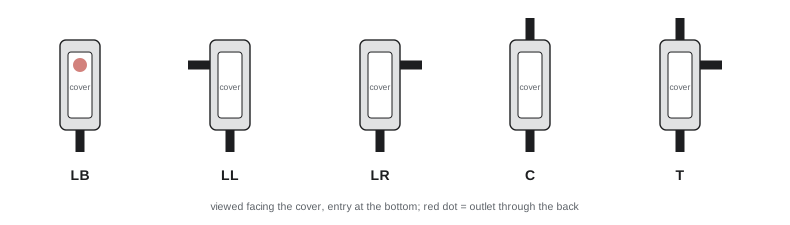
- Conduit bodies (often called condulets or by the brand LB) provide a change of direction or a pull point in a run. Their letter codes describe the opening: LB (outlet in the back), LL and LR (outlet to the left or right when looking at the body with the opening facing you), C (straight through), T (three openings) and X (four). Conduit bodies count as pull points, but they have limited volume, so splices are allowed only in bodies marked for them.
- Expansion fittings allow for thermal movement in PVC and for building expansion joints; deflection fittings allow movement in several directions.
- Sealing fittings prevent gases or vapours from passing through conduit between areas, required in hazardous locations (ELEC-220, Lesson 5) and where conduits pass between areas of very different temperature to prevent condensation.
Metal raceways and bonding
Properly joined metal raceways form a continuous metallic path that can carry fault current back to the source, which is why every fitting must be tight and every connector locknut must bite into the enclosure. The codes permit EMT, rigid metal conduit and IMC to serve as the equipment bonding (grounding) conductor, but many specifications require a separate insulated green bonding conductor in every raceway, because a single loose set-screw coupling can open the fault path without anyone noticing. Flexible metal conduit is permitted as a bonding path only in short lengths with listed fittings and limited circuit ratings; beyond those limits a separate bonding conductor is required. Non-metallic raceways always need a separate bonding conductor.
In Canada, Section 10 of the CEC sets out which raceways may serve as bonding conductors and when a separate bonding conductor is needed, including for flexible conduit and for non-metallic raceways.
Choosing the right raceway
Raceway selection follows from the location and the specification. Questions to ask include: Is the location dry, damp, wet or corrosive? Is the raceway exposed to damage from vehicles, carts or equipment? Is it concealed in walls, above ceilings, in concrete or underground? Are there special requirements for hazardous locations, health care facilities, plenums or fire-rated assemblies? Does the specification restrict types or require a minimum size? What will be easiest to install and modify?
Worked problem
Selecting raceways for a building
A new two-storey office building has (a) branch circuits above suspended ceilings and in steel stud walls, (b) a parking garage with exposed conduit at 1.5 m above the floor, (c) a feeder buried under the parking lot to a sign, and (d) a connection to a rooftop air-conditioning unit. Suggest suitable raceway types.
Show solution
- (a) Dry, concealed interior: EMT with set-screw fittings, with flexible metal whips to luminaires in the ceiling.
- (b) Garage, exposed and subject to vehicle damage: rigid metal conduit (or IMC), with compression or threaded fittings because the area is damp.
- (c) Underground: rigid PVC at the required burial depth, with a bonding conductor and transitions to rigid metal conduit where it rises above grade if exposed to damage.
- (d) Rooftop unit: rigid or EMT with raintight fittings to a disconnect, then a short length of liquidtight flexible conduit to the unit to allow for vibration.
Answer: Each choice follows from the location: EMT where conditions are mild, rigid where damage is likely, PVC underground and liquidtight flexible conduit for vibrating outdoor equipment. The specification may impose stricter choices, such as rigid conduit for all exposed work below a certain height.
Material handling and storage
Conduit arrives in 10-foot (3 m) lengths, bundled; PVC may come in longer lengths. Store it off the ground and covered, with ends capped to keep out dirt and water. Keep fittings sorted by type and size, because mixing set-screw and compression fittings in a damp area is a common inspection failure. Rigid conduit is heavy (a 10-foot length of 2-inch rigid weighs about 36 lb, or 16 kg), so plan lifting and use racks or carts. On large jobs, material is delivered to each floor as it is needed, following a plan agreed with the general contractor.
Corrosion and special environments
Some locations attack raceways. Outdoors and in parking garages, salt and moisture corrode steel, so hot-dip galvanized rigid conduit, PVC-coated rigid conduit or stainless steel may be specified. In food processing, chemical plants and wastewater treatment, washdown chemicals and corrosive atmospheres call for PVC, PVC-coated rigid or stainless systems with matching fittings and supports. Aluminum conduit resists many atmospheres but must not be embedded in concrete without protection, because the alkaline concrete attacks it. Where dissimilar metals meet, such as aluminum conduit in steel supports, galvanic corrosion can occur in damp conditions unless the metals are isolated. The specification usually defines these requirements area by area, and the installer must keep the right materials, fittings and supports together for each area.
Whatever the raceway, keep it clean inside: cap open ends during construction so that concrete, plaster, water and debris do not enter, and swab or blow out runs before pulling if there is any doubt. Debris left in a raceway raises pulling tension and can damage insulation as surely as a burr.
Common mistakes
MistakeLeaving cut ends unreamed.
InsteadReam every cut end to protect insulation during pulling.
MistakeUsing set-screw fittings in damp or wet locations.
InsteadUse compression or raintight fittings where moisture is present.
MistakeRelying on a loose coupling for the fault path.
InsteadTighten every fitting, and install a bonding conductor where specified.
MistakeInstalling long exposed PVC runs without expansion fittings.
InsteadCalculate expansion and install fittings as required.
MistakeSplicing in conduit bodies not marked for splices.
InsteadSplice only in boxes or in bodies marked with their volume.
Summary and key terms
- Raceways protect conductors, provide fault paths and allow rewiring.
- Trade sizes are nominal; inside dimensions differ by raceway type.
- EMT suits dry interiors; rigid and IMC resist damage; PVC suits underground and corrosive areas.
- Flexible and liquidtight conduits make short connections to vibrating or movable equipment.
- Cut square, ream every end, thread rigid correctly and cement PVC properly.
- Fittings include couplings, connectors, bushings, conduit bodies, expansion and sealing fittings.
- Choose raceways from the location, damage risk, specification and code.
- Raceway
- An enclosed channel designed to hold conductors.
- Trade size
- The nominal size designation of a raceway.
- EMT
- Electrical metallic tubing: thin-walled, unthreaded steel raceway.
- Rigid metal conduit
- Heavy-walled threaded steel or aluminum conduit.
- FMC
- Flexible metal conduit.
- LFMC
- Liquidtight flexible metal conduit.
- Reaming
- Removing burrs from the inside of a cut raceway end.
- Conduit body
- A fitting with a removable cover providing a pull point or change in direction.
- Bonding bushing
- A bushing with a lug for attaching a bonding jumper.
- Sealing fitting
- A fitting filled with compound to block gases or vapours.
Practice problems
Work each problem on paper first, then reveal the answer to check.
What is the metric designator for ¾-inch conduit?
Show answer
21.
Why are conduit fill tables specific to each raceway type?
Show answer
Inside diameters differ between types of the same trade size.
Where is rigid metal conduit preferred over EMT?
Show answer
Where it is exposed to physical damage, outdoors, and in some hazardous locations.
Why must cut ends be reamed?
Show answer
Burrs can strip insulation during pulling.
What does an LB conduit body's name indicate?
Show answer
An L-shaped body with the outlet on the back, the same side as the cover.
When is a grounding bushing used?
Show answer
Where a bonding jumper must be attached, for example at service equipment or across concentric knockouts.
Why do many specifications require a green bonding conductor in EMT?
Show answer
A loose fitting could open the metallic fault path unnoticed.
What raceway suits a direct buried run under a parking lot?
Show answer
Rigid PVC with a bonding conductor.
What connects a vibrating rooftop unit?
Show answer
A short length of liquidtight flexible conduit.
Name two purposes of sealing fittings.
Show answer
Blocking gases in hazardous locations and preventing condensation between areas of different temperature.
Lesson quiz · 5 questions
Score 60% or more to complete this lesson.
Create a free account to save your progress, take quizzes and earn a certificate.