
DCT-110 · Lesson 5 of 12 · 20 min
Power at a glance
Every rack in the building depends on a chain of electrical equipment that starts at a power line kilometres away and ends at a plug in the back of a server. A data centre technician does not operate most of that chain; the critical facilities team and qualified electricians do. But a technician who understands the chain knows why the rules are what they are, recognizes an alarm for what it is and can tell a customer which of their two power feeds is affected by tonight's maintenance. Roz calls this lesson following the electrons, and she walks it with Jamal from the substation fence to a server in Hall A.
From the utility to the building
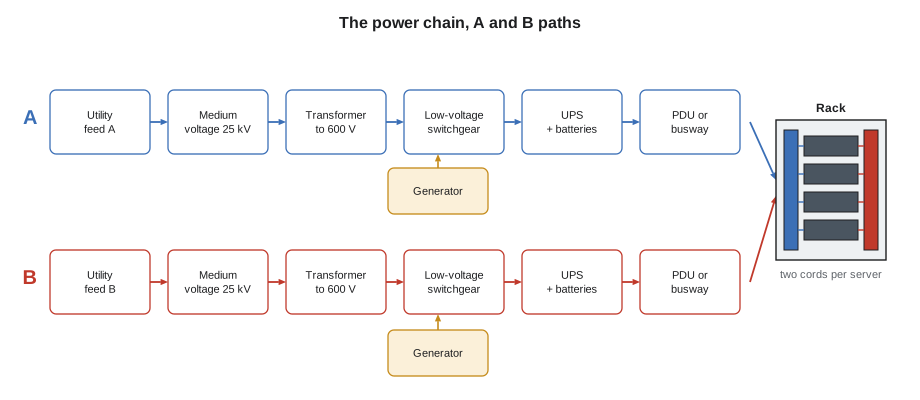
YUL-2 is fed by two separate lines from Hydro-Québec's high-voltage network, which arrive at the campus switching station at 120 kV. Transformers in the switching station step the voltage down to 25 kV, the medium voltage that the campus distributes to each building. Two feeds, from two directions, mean that one line can fail or be taken out for maintenance without the campus losing utility power.
Inside each building, medium-voltage switchgear sends power to unit substations: transformers that step it down again, to 600 V, the low-voltage level used for most distribution in Canadian buildings. Low-voltage switchgear and switchboards then distribute it to the UPS systems, the cooling plant and the building's other loads.
Uninterruptible power supplies
The UPS is the heart of the critical power system. It sits between the switchgear and the IT equipment and does two jobs. It conditions the power, removing spikes, dips and noise so that the servers see a clean supply. And it carries the load from batteries when the utility fails, for the seconds or minutes until the generators start and take over. Most large data centre UPS systems are double conversion: they convert incoming alternating current to direct current, which charges the batteries, then convert it back to clean alternating current for the load. If the utility fails, the batteries feed the inverter with no break at all.
UPS batteries are either lead-acid or, increasingly, lithium-ion. They are sized to carry the full load for a few minutes, typically five to fifteen, which is ample time for generators that start in seconds. Battery rooms have their own ventilation and fire protection, and lithium-ion batteries need careful monitoring because a failing cell can overheat and set off its neighbours.
A UPS also has a bypass: a path that lets power flow around the UPS electronics, straight from the switchgear to the load. Maintenance bypass lets technicians service the UPS without shutting down the load. Static bypass switches automatically if the UPS electronics fail. While a UPS is on bypass the load still has power, but it has lost its protection against a utility failure, which is why bypass operations are scheduled, announced and done under a method of procedure.
Generators and transfer switches
Standby generators are large diesel or natural-gas engines driving alternators, each producing one to three megawatts. They sit in the generator yard in weatherproof enclosures with their own fuel tanks, and many sites keep enough fuel on site for one to three days at full load, with contracts for fuel delivery during a long outage. When the utility fails, the generators start automatically, reach speed in about ten seconds and the transfer switches move the load from the utility to the generators. The UPS batteries carry the load during that gap. When the utility returns and is stable, the system transfers back.
Generators are tested regularly, often monthly with load, and the tests are scheduled with the community in mind because generators are loud and produce exhaust. Lesson 8 explains why there are usually more generators than the load needs.
Distribution in the white space
From the UPS output, power travels to the white space. In Hall A it goes to power distribution units, PDUs, large cabinets at the end of each row that hold a transformer stepping 600 V down to 208Y/120 V and a panel of breakers feeding the racks. In Halls B, C and D it goes to busway above each row, and tap-off boxes plug into the busway above each rack. Hall D distributes at 415 V to save copper and losses at its very high rack power.
Inside each rack, power reaches the equipment through rack power strips, often called rack PDUs. A typical cabinet has two of them, one fed from the A side and one from the B side. Each server has two power supplies, one plugged into each strip. If one side loses power, for maintenance or a fault, the server keeps running on the other. This dual-cord arrangement is the reason technicians must always check which strip a cable goes to before they plug or unplug anything.
Rack power strips may be basic, with only outlets, or intelligent, with metering of each outlet and the ability to switch outlets on and off remotely. Customers use the metering to see how much power their equipment draws, and the site uses it to check that no strip is overloaded.
A and B: keeping both sides alive
The single most important power rule for a data centre technician is to protect the redundancy of every rack. If both power supplies of a server are plugged into the same strip, that server has lost its protection without anyone noticing. If a strip is loaded so heavily that it would trip when its partner fails and the full load shifts to it, the whole rack is at risk. Roz gives Jamal the rules she was given on her first day:
- Every dual-corded device gets one cord to the A strip and one to the B strip, never both to one side.
- Each strip's load stays low enough that it can carry the whole rack if the other side fails. In practice that means each side is loaded to well under half of its rating, and many sites set a limit such as 40 % per side.
- Single-corded devices are plugged into a transfer switch that can feed them from either side, or the customer accepts the risk in writing.
- Strips and cords are labelled A and B, usually with colours, and labels are checked before any work.
# Check A/B loading in one rack: can either side carry the whole rack?
strip_rating_a = 30     # rated current of each rack strip, amperes
limit = 0.80 * strip_rating_a  # continuous limit used for planning
voltage = 208
servers = [  # name, measured current on side A, side B (amperes)
    ("web-01", 1.6, 1.5), ("web-02", 1.7, 1.6), ("db-01", 2.9, 2.8),
    ("db-02", 3.1, 2.7), ("storage-1", 3.4, 3.3), ("switch-1", 0.6, 0.6),
]
side_a = sum(a for _, a, _ in servers)
side_b = sum(b for _, _, b in servers)
total = side_a + side_b
print(f"Side A {side_a:.1f} A, side B {side_b:.1f} A, total {total:.1f} A")
print(f"Rack load about {total * voltage / 1000:.1f} kW")
print(f"If side B fails, side A carries {total:.1f} A against a {limit:.1f} A limit:",
"OK" if total <= limit else "OVERLOAD")Side A 13.3 A, side B 12.5 A, total 25.8 A Rack load about 5.4 kW If side B fails, side A carries 25.8 A against a 24.0 A limit: OVERLOAD
The rack in the example looks comfortable when both sides are working, at about 13 A per side. If one side fails, the other must carry about 26 A, which is over the 24 A planning limit for a 30 A strip. A technician who adds one more server to this rack without checking would make an outage on one side trip the other. The customer needs to know before anything else is added.
Power quantities a technician should know
Power in a data centre is described in a few units that a technician meets every day:
- Volts (V): the electrical pressure. Common values in the white space are 120 V, 208 V, 230 V and 415 V; in the grey space, hundreds of volts up to tens of thousands.
- Amperes (A): the current flowing. Breakers and power strips are rated in amperes.
- Kilowatts (kW): real power, the rate at which energy is used. Rack loads, UPS capacity and IT load are given in kilowatts.
- Kilovolt-amperes (kVA): apparent power, which includes current that does not do useful work. Transformers and older UPS ratings are often in kVA.
- Kilowatt-hours (kWh) and megawatt-hours (MWh): energy, power multiplied by time. Electricity bills and PUE calculations use energy.
For a single-phase circuit, power in watts is roughly volts times amperes times the power factor, which for modern server power supplies is close to 1. A 208 V, 30 A circuit loaded to its 24 A planning limit delivers about 5 kW. Three-phase circuits carry more: a 415 V, 32 A three-phase feed can deliver about 23 kW.
Power usage effectiveness
Not all the power that enters the building reaches the IT equipment. Some is lost in transformers, UPS systems and cables; much more goes to cooling; a little goes to lighting and offices. Power usage effectiveness, PUE, is the measure the industry uses for this overhead. It is the total energy the facility uses divided by the energy the IT equipment uses, measured over the same period, usually a year or a month. A PUE of 1.0 would mean no overhead at all. Uptime Institute's 2025 survey put the industry average at about 1.54; efficient modern sites in cool climates run well below 1.3.
# PUE and WUE from one month of meter readings
facility_kwh = 13_870_000     # utility meters, whole building
it_kwh = 11_100_000            # UPS output meters, sum of all halls
water_l = 2_400_000        # make-up water meter, litres
pue = facility_kwh / it_kwh
overhead = facility_kwh - it_kwh
print(f"PUE  = {facility_kwh:,} / {it_kwh:,} = {pue:.2f}")
print(f"Overhead energy this month: {overhead:,} kWh ({100 * overhead / facility_kwh:.0f} % of the total)")
wue = water_l / it_kwh
print(f"WUE = {wue:.2f} litres per kWh of IT energy")PUE = 13,870,000 / 11,100,000 = 1.25 Overhead energy this month: 2,770,000 kWh (20 % of the total) WUE = 0.22 litres per kWh of IT energy
The campus's PUE of 1.25 reflects the Quebec climate: outside air or cold water from the dry coolers does much of the cooling for most of the year. Its water use is low because the cooling is mostly dry.
PUE has limits. It says nothing about how efficiently the IT equipment itself uses its power, and a site can lower its PUE by moving fans from the facility side into the servers. But it is the number customers ask about, and technicians help keep it low by keeping airflow tight, as Lesson 6 explains.
What the technician does, and does not, do
Data centre technicians at Stonebridge do not operate switchgear, UPS systems, transfer switches or generators. Those are operated by the critical facilities team under written procedures, often with a second person checking each step. Technicians do plug and unplug equipment at the rack, read and report power strip loads, check that cords go to the right side, label new power cords, report alarms and help customers plan power for new equipment. They also need to know which maintenance is planned: when the B side of a row is being worked on, every rack in that row is running on A alone, and any work that might disturb the A side must wait.
Worked problem
Telling a customer about maintenance
The facilities team plans to put UPS B2 on maintenance bypass on Thursday night from 22:00 to 02:00. The Bayview Credit Union has four cabinets in Hall A fed from UPS B2 on their B side. Jamal is asked to help draft the customer notice.
Show solution
- Identify what changes: the B side stays powered during the work but has no battery protection, so a utility failure during the window could drop it until generators take over.
- Identify what does not change: the A side is unaffected and keeps full protection.
- State what the customer should check: that every dual-corded device in the four cabinets has a cord on the A side and that single-corded devices are on transfer switches.
- Give the times, the contact for questions and the change ticket number.
Answer: The notice is short and factual. It tells the customer which side is affected, what the risk is and what to check. Two days later the customer finds one storage shelf with both cords on B and moves one cord before the work, which is exactly the point of the notice.
Common mistakes
MistakePlugging both cords of a server into the same strip.
InsteadOne cord goes to A, one to B, every time.
MistakeLoading each side to near its rating.
InsteadEach side must be able to carry the whole rack if the other fails; keep each side well under half its rating.
MistakeTreating a UPS on bypass as fully protected.
InsteadOn bypass the load has power but no battery protection; avoid any risky work on that side.
MistakeConfusing kVA with kW.
InsteadkW is real power; kVA includes current that does no work. Check which a rating uses.
MistakeOperating switchgear or a UPS without authorization.
InsteadOnly the authorized facilities team operates the power plant, under a written procedure.
Summary and key terms
- Power runs from the utility through substations, switchgear and transformers to the UPS, then through PDUs or busway to rack power strips.
- The UPS conditions power and carries the load from batteries until generators take over.
- Generators start in about ten seconds; transfer switches move the load to them.
- Most racks have A and B strips; dual-corded equipment has one cord on each.
- Each side must be able to carry the whole rack if the other side fails.
- PUE is total facility energy divided by IT energy; the 2025 industry average was about 1.54.
- Medium voltage
- The distribution voltage between the utility and the building transformers, typically tens of kilovolts.
- UPS bypass
- A path that feeds the load around the UPS electronics, without battery protection.
- Transfer switch
- A switch that moves a load between two sources, such as the utility and a generator.
- Busway
- An overhead duct of conductors with plug-in tap-off boxes.
- Rack power strip
- The power distribution strip inside a rack, often called a rack PDU.
- Dual-corded
- Equipment with two power supplies, fed from separate A and B sources.
Practice problems
Work each problem on paper first, then reveal the answer to check.
What two jobs does a UPS do?
Show answer
It conditions the power and carries the load from batteries during an outage until generators take over.
A server has both cords on the B strip. What is wrong?
Show answer
It has lost its redundancy; one cord should be moved to the A strip under a ticket.
A facility uses 2,600 MWh in a month while the IT uses 2,000 MWh. What is the PUE?
Show answer
1.30.
Why must each side of a rack stay well under half its rating?
Show answer
So that it can carry the whole rack if the other side fails.
Lesson quiz · 5 questions
Score 60% or more to complete this lesson.
Create a free account to save your progress, take quizzes and earn a certificate.