
DCT-110 · Lesson 10 of 12 · 19 min
Roles on the data centre floor and career paths
By his third week, Jamal has met dozens of people at the campus, and he is starting to see how their jobs fit together. Some wear badges with the Stonebridge logo, some wear contractor vests, some are customers' own engineers flown in for a weekend install. A few he sees only on video calls from the operations centre in another city. This lesson maps the people who work in and around a data centre, what each does, how the shifts are organized and how a technician's career can grow from where Jamal stands now.
Two teams in one building
At a colocation site like Stonebridge, the operations staff divide into two broad teams that share the building and the shifts.
- The IT operations or data centre operations team works mainly in the white space. Its data centre technicians install and remove equipment, run and patch cables, build cross-connects, handle shipping and receiving, carry out remote hands requests for customers, walk the halls on inspection rounds and keep records accurate.
- The critical facilities team runs the building systems. Its critical facilities technicians and engineers operate and maintain the electrical plant, the generators, the UPS systems, the cooling plant and the fire and life safety systems, respond to facility alarms and manage the specialist contractors who service large equipment.
The line between them varies from company to company. At a small edge site, one technician may do both. At a hyperscale campus, there may be separate teams for servers, network, logistics, electrical and mechanical, each with its own leads. What stays the same is that both teams work together on every change that touches both sides, such as installing a new high-power rack, which needs a power circuit, cooling capacity and floor space all at once.
Roles on the floor
| Role | Main work | Typical background |
|---|---|---|
| Data centre technician | Installs, cables and maintains IT equipment; remote hands; rounds; shipping and receiving | Technical diploma or certificate, IT support, military, trades |
| Senior technician or lead | Plans larger jobs, trains new technicians, handles difficult tickets | Several years as a technician |
| Critical facilities technician | Operates and maintains power and cooling plant, responds to facility alarms | Electrician, HVAC or stationary engineering trades |
| Critical facilities engineer or chief engineer | Leads the facility team, writes procedures, manages contractors | Senior trades or engineering degree |
| Shift lead or shift manager | Runs the shift, assigns work, handles escalations and incidents | Experienced technician or engineer |
| Network or deployment engineer | Builds and configures network and server systems, often for a customer | Networking certifications and experience |
| Security officer and supervisor | Controls access, watches cameras and alarms, escorts visitors | Security licensing and training |
| Operations centre analyst | Watches monitoring systems remotely, opens and routes tickets | IT or facilities operations |
| Site or facility manager | Responsible for the whole site, its staff, budget, customers and safety | Many years in operations |
At YUL-2 the people Jamal works with most are Roz Kerr, his mentor in critical facilities; Dmitri Volkov, the shift lead; Anjali Desai, the site manager; Ike Adeyemi, the security supervisor; and Carmen Ortiz, Corvid AI's site engineer, who manages the AI tenant's equipment in Hall D. Most of the site's daily work is in French and English, and the safety signs and procedures are in both languages.
People who are not on the payroll
Many of the people in the building on a given day do not work for the operator. Customers' own engineers come to install and fix their equipment. Carrier engineers install equipment in the meet-me room. Specialist contractors maintain the generators, UPS systems, switchgear, chillers, fire suppression and building controls, usually under service contracts with the equipment makers. Construction crews build new halls, often in a part of the campus fenced off from the live buildings. Each group follows the site's access, safety and change rules, and Stonebridge staff are responsible for making sure they do: escorting, issuing permits, checking that methods of procedure are approved and watching work that touches live systems.
Shifts and coverage
A data centre is staffed every hour of every day, including holidays and storms. Most sites cover the week with rotating twelve-hour shifts, day and night, so that a team of four crews covers all 168 hours of the week. A common pattern is the 2-2-3 or Panama schedule, in which each crew works two days, has two off, works three, has two off, works two, has three off, and so on over a two-week cycle, averaging 42 hours a week. Others use four days on, four off. Weekends and nights are part of the job, as is staying late when an incident is running.
# How many technicians does round-the-clock coverage need?
hours_per_week = 168
on_shift = 6        # technicians needed on the floor at all times
avg_hours = 42          # average weekly hours on a 12-hour rotation
leave_factor = 1.15     # vacation, training and sick leave, illustrative
crews = hours_per_week / avg_hours
staff = on_shift * crews * leave_factor
print(f"Crews needed for 24/7 coverage: {crews:.0f}")
print(f"Technicians on payroll for {on_shift} on shift at all times: about {staff:.0f}")
pattern = "2-2-3 cycle"
days = [1, 1, 0, 0, 1, 1, 1, 0, 0, 1, 1, 0, 0, 0]  # one crew over 14 days
print(f"{pattern}: works {sum(days)} of 14 days, {sum(days) * 12 / 2:.0f} hours a week on average")Crews needed for 24/7 coverage: 4 Technicians on payroll for 6 on shift at all times: about 28 2-2-3 cycle: works 7 of 14 days, 42 hours a week on average
The arithmetic explains a common surprise for new staff: keeping six technicians on the floor at all times needs more than four times that many on the payroll. It also explains why handovers matter so much. With four crews passing work to each other, a job started on Monday night may be finished by a different crew on Wednesday, and only good notes make that safe. Lesson 11 covers handovers.
What makes a good technician
Roz has trained many technicians, and the ones who succeed share habits more than backgrounds:
- They follow procedures exactly, and stop and ask when a procedure does not match what they see.
- They check before they act: the label, the ticket, the side, the port.
- They write clear records, so that the next crew and the customer know exactly what was done.
- They notice small changes: sounds, smells, temperatures, lights.
- They stay calm during incidents and communicate clearly.
- They keep learning: new equipment, new systems, new rules.
Technical knowledge can be taught. These habits are harder to teach, and they are what customers are really paying for.
Getting started
People come into data centre work from many directions: technical diplomas in computer systems, networking or electronics; IT help desk jobs; the Canadian Armed Forces; the electrical, instrumentation and refrigeration trades; and programs such as this one. Data centre technician is not a regulated trade in Quebec or anywhere else in Canada, so there is no certificate of qualification for the IT side. Work on the electrical and mechanical plant, however, falls under regulated trades: in Quebec, construction electricians need a competency certificate from the Commission de la construction du Québec, electrical contractors are licensed by the Régie du bâtiment du Québec, and refrigeration work is done by certified refrigeration mechanics. Critical facilities technicians often hold such trade qualifications.
Many technicians earn industry certifications as they progress. The Certification Preparation course at the end of this program reviews for some of them. Common ones include:
- General IT: CompTIA A+, Network+ and Server+, which cover hardware, networking and servers.
- Data centre specific: the Certified Data Centre Technician Professional and Certified Data Centre Professional from EPI, and the Accredited Operations Specialist and other credentials from Uptime Institute.
- Cabling: BICSI Installer and Technician credentials, and BICSI's Data Center Design Consultant for those who move toward design.
- Safety: electrical safety training to CSA Z462 or NFPA 70E, first aid, working at heights and other site-required courses.
Career paths
From the technician role, careers branch in several directions:
- Up the operations ladder: senior technician, lead, shift manager, operations manager, site manager, regional director.
- Into critical facilities: with trade training, toward critical facilities technician, engineer and chief engineer.
- Into network and systems: toward network engineer, deployment engineer, systems administrator or cloud engineer.
- Into specialist areas: commissioning, quality and compliance, security, capacity planning, energy and sustainability, or liquid cooling.
- Into design and construction: with further study, toward data centre design, project management or engineering.
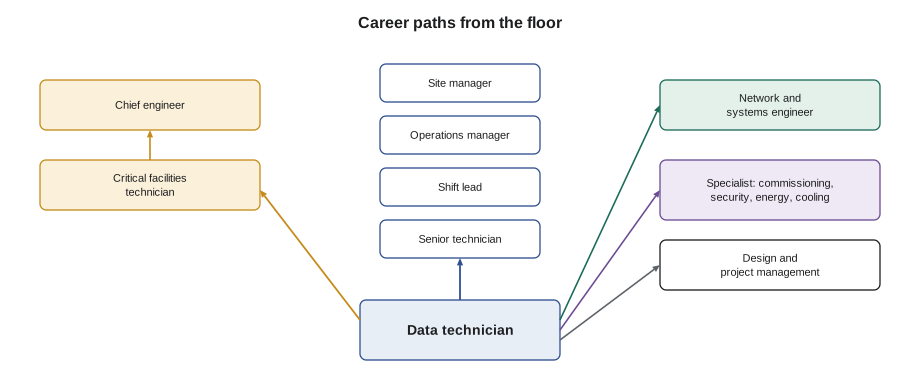
The growth described in Lesson 2 means that people who start as technicians now can move up quickly. Operators also value people who have worked in older halls and newer ones, on air and liquid cooling, and on both IT and facilities tasks, because they understand the whole building.
Working conditions
The work is physical and the environment is unusual. Technicians are on their feet most of the shift, walk long distances, lift equipment, work on ladders and kneel at the bottom of racks. Halls are loud: hearing protection is often required near cooling units and in high-density halls, and long exposure in loud spaces is measured and limited. Hot aisles can be very warm, sometimes above 40 °C, and work there is limited in duration. The air is dry and the lighting is artificial. Many sites forbid personal phones with cameras in some spaces. The rewards are steady, well-paid, skilled work in a growing industry, with clear paths to advance.
Worked problem
Who do I call?
At 03:10 on a night shift, Jamal sees three things during his rounds: a customer's server with a red fault light, a cooling unit in Hall B showing a filter alarm, and a contractor working in the battery room without a visible work permit.
Show solution
- The server fault light belongs to a customer. Jamal records it and checks whether the customer has asked to be told about faults; if so, he opens a notification through the ticket system. He does not touch the server.
- The cooling unit filter alarm belongs to the critical facilities team. Jamal radios the facilities technician on shift, who checks it and schedules a filter change.
- The contractor without a visible permit is a safety and security issue. Jamal calls the shift lead at once, who checks the permit log and goes to the battery room.
Answer: Knowing which team owns which problem gets each one to the right person quickly, and keeps Jamal from acting outside his role.
A day on shift
A typical day shift for Jamal starts at 06:45 with the handover briefing: redundancy status, open incidents, alarms being watched, planned changes, deliveries and visitors expected. He then takes his first round of the assigned halls, checking containment, blanking, floor tiles, temperatures, cabinets left open and anything unusual, and records it on the round sheet. The morning brings tickets: two remote hands requests, a delivery for a customer moving into Hall A and a cross-connect to install and test. After lunch he joins a facilities technician to watch a monthly generator test from the control room, then escorts a carrier engineer to the meet-me room. A second round, record updates and the handover notes fill the end of the shift, which finishes at 19:00 with a briefing for the night crew.
Night shifts are quieter for visitors but not for work. Many customers schedule changes overnight, when their own users are fewer, so remote hands requests and maintenance windows often fall between midnight and 05:00. The night crew is smaller, so each person covers more ground, and the shift lead keeps a closer eye on who is where.
Over a year, Jamal will work every hall, many kinds of ticket and dozens of planned changes. Roz keeps a training record for him, signing off each task once he has done it correctly under supervision, until he can work on his own.
Good relationships between the teams matter as much as skills. A technician who tells the facilities team early about a noisy fan, or who warns security that a large delivery is coming, makes everyone's shift easier, and the same people return the favour on the busy nights.
Common mistakes
MistakeThinking the technician's job is only plugging in servers.
InsteadThe job includes rounds, records, customer requests, shipping, security habits and incident response.
MistakeWorking on building plant without the qualification.
InsteadElectrical and mechanical plant work belongs to qualified, authorized facilities staff and contractors.
MistakeLeaving work for the next shift without notes.
InsteadWrite a handover note for every open job.
MistakeAssuming contractors know the site's rules.
InsteadBrief them, check their permits and watch work that touches live systems.
MistakeTreating certifications as the whole of the job.
InsteadCertifications help, but careful habits are what customers depend on.
Summary and key terms
- Operations divide into IT or data centre operations and critical facilities, working side by side.
- Common roles include technician, lead, critical facilities technician and engineer, shift lead, security, operations centre analyst and site manager.
- Customers' engineers, carriers, specialist contractors and construction crews also work in the building under site rules.
- Round-the-clock coverage needs four or more crews on rotating twelve-hour shifts.
- Data centre technician is not a regulated trade, but electrical and mechanical plant work is.
- Careers can grow toward operations management, critical facilities, network and systems, specialist roles or design.
- Critical facilities
- The power, cooling and life safety systems that keep a data centre running, and the team that runs them.
- Remote hands
- Work a technician does on customer equipment at the customer's request.
- Shift lead
- The person who runs a shift, assigns work and handles escalations.
- 2-2-3 schedule
- A rotating twelve-hour shift pattern over a two-week cycle.
- Operations centre
- A room, on site or remote, where monitoring systems are watched around the clock.
- Specialist contractor
- A company that maintains large building equipment under a service contract.
Practice problems
Work each problem on paper first, then reveal the answer to check.
Which team operates the UPS systems at a site like Stonebridge?
Show answer
The critical facilities team.
About how many crews does round-the-clock coverage with twelve-hour shifts need?
Show answer
Four.
Is data centre technician a regulated trade?
Show answer
No, though electrical and mechanical plant work falls under regulated trades.
Name two directions a technician's career can take.
Show answer
Any two of operations management, critical facilities, network and systems, specialist roles and design.
Lesson quiz · 5 questions
Score 60% or more to complete this lesson.
Create a free account to save your progress, take quizzes and earn a certificate.