
DCT-110 · Lesson 12 of 12 · 21 min
Capstone: a guided walk through a colocation facility
At the end of his first month, Jamal's probation review includes a practical test. Anjali Desai has asked a new customer, the IT director of a regional insurer, to tour Hall A before signing a contract, and she wants Jamal to lead the tour with Roz watching. He must take the visitor through the building from the gate to a cage and back, explain what each space does and why, follow every rule on the way, and keep a list of anything he notices that needs attention. The visitor is Hélène Brassard, and she has toured a dozen data centres. She will ask hard questions. This lesson follows the tour and brings together everything in the course.
Before the visitor arrives
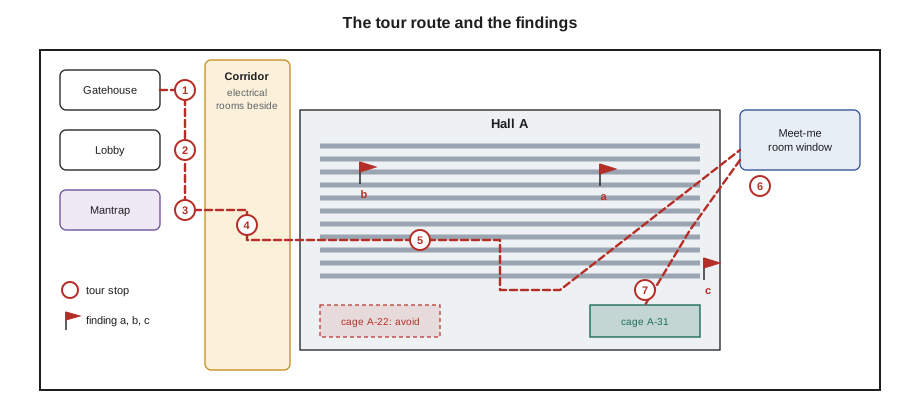
Jamal prepares the way a technician prepares any job. He checks that the visit is registered in the access system with Hélène's name and the spaces she may enter: the lobby, the corridors, Hall A's main aisle, the meet-me room viewing window and an empty cage that is available to rent. He confirms with security that she will be escorted by him for the whole visit. He checks the shift board for the redundancy status of Hall A, which is at full redundancy, and for any work planned in the hall that afternoon: a customer is installing two servers in cage A-22, so the tour will avoid that aisle. He collects a visitor safety briefing card, two sets of hearing protection and a tablet with the hall's floor plan. And he reviews the facts he will need: the hall's power, its cooling, its tier design, its carriers.
| Check | Result |
|---|---|
| Visit registered with the spaces allowed | Lobby, corridors, Hall A main aisle, meet-me room window, cage A-31 |
| Escort confirmed | Jamal, for the whole visit |
| Redundancy status | Hall A at full redundancy |
| Work in the hall | Customer install in cage A-22; route avoids it |
| Safety items | Briefing card, hearing protection, visitor vest |
| Facts to hand | Design power, cooling, tier design, carriers, certifications |
The gate and the lobby
Hélène arrives at the gatehouse at 14:00. The officer checks her identification against the visit list and opens the gate. In the lobby she signs in, receives a visitor badge marked ESCORT REQUIRED and reads the safety card, which explains the alarms, the exits and the house rules. Jamal explains the security layers she will pass through, as in Lesson 9: fence, gate, staffed lobby, mantrap, badge-controlled corridors, the hall, the cage and the locked cabinet. Her first question is how long video is kept. Jamal knows the answer from the site policy: at least ninety days, longer where a customer's contract requires it. Her second is who decides which of her own staff may enter. The customer's own access administrator, Jamal says, who adds and removes people through the portal; the site checks identities and enforces the list.
At the mantrap, Jamal badges and presents his palm, steps through, and waits on the far side while security admits Hélène through the portal separately. He explains why: only one person may pass at a time, and he never holds a door for anyone, even a visitor in his care.
The corridors and the grey space
The corridor from the lobby to Hall A runs past the electrical rooms. Through the window in one door Hélène can see the low-voltage switchboards and, beyond, the UPS room. Jamal explains the power chain from Lesson 5: two utility feeds, medium-voltage switchgear, transformers, low-voltage switchboards, two separate UPS systems, then distribution to the A and B sides of every rack. He explains that each rack's two power strips come from different UPS systems on different paths, that each side is sized to carry the whole rack, and that the UPS batteries carry the load until the generators take over if the utility fails. Hélène asks how often the generators are tested. Monthly, under load, Jamal says, with a full transfer test at least once a year.
She asks whether she can go into the UPS room. Jamal says no: electrical rooms are restricted to qualified, authorized staff because of arc flash and shock hazards, and he himself enters only with Roz. Hélène says that is the right answer; at another site she was walked straight into a switchgear room, and it worried her.
Hall A
Before entering the hall Jamal hands Hélène hearing protection, reminds her that no food, drink or photos are allowed and badges them in, one at a time. Inside, he stops in the main aisle and lets her take in the space: long rows of cabinets and cages, the overhead trays with yellow fibre and grey copper, the cooling units along the walls and the raised floor with its perforated tiles.
He walks her to the end of a cold aisle and explains the airflow from Lesson 6. Cold air rises from the perforated tiles in the cold aisle, servers draw it in at the front and exhaust hot air at the back into the hot aisle, and the cooling units draw the hot air back, cool it on chilled-water coils and push it under the floor again. The cold aisles have doors and roofs, so the cold air stays where the servers need it. Blanking panels fill every empty slot. Hélène holds her hand at a rack's front and then walks around to its back to feel the difference.
She asks about efficiency. Jamal explains PUE and gives the campus's annual figure of about 1.25, well below the industry average of about 1.54, mostly because the Quebec climate lets the dry coolers do the cooling for much of the year. He explains that the electricity comes from Hydro-Québec's mostly hydroelectric grid, which has very low carbon emissions per kilowatt-hour.
As they walk, Jamal watches the hall as he has been taught. He notices three things and notes them on his tablet without breaking off the tour: a containment door at the end of aisle 9 that does not close fully on its own, two empty slots without blanking panels in the top of cabinet A-17-04, and a short length of cardboard tucked behind a cable manager in an empty cabinet at the end of row 12.
Redundancy and tiers
Hélène asks the question every customer asks: what tier is the hall? Jamal explains, as in Lesson 8, that Hall A is designed to the Tier III level: concurrently maintainable, with N+1 cooling units, N+1 generators and 2N UPS and distribution. Any single component can be taken out for maintenance without shutting down her equipment. He adds what Roz taught him: the design is only half of reliability; the other half is how the site is run, which is why every change goes through approval, high-risk work follows a written method of procedure with two people, and maintenance on the A and B sides is never done at the same time. Hélène says that is the answer she was looking for.
The meet-me room window
From the corridor outside the meet-me room, a window lets visitors see the carrier racks and cross-connect frames without entering. Jamal explains connectivity from Lesson 7: carrier fibre enters through two entrance rooms on opposite sides of the building, by separate routes, and reaches the meet-me room, where carriers have their equipment. Her company would order cross-connects from its cage to its chosen carriers and cloud on-ramps, and Stonebridge's technicians would install, label and test each one. He mentions the number of carriers on campus and the cloud on-ramps available. She asks whether her two internet links can be kept fully diverse inside the building. He explains what Lesson 8's example showed: diversity has to hold all the way, through different trays and different panels, and the site can design the cage cabling to do that.
The empty cage
Last, Jamal shows her cage A-31, which is empty and available. It has eight cabinet positions, overhead busway with tap-off points for A and B power, two fibre trays and a copper tray above, a badge reader and camera at the door, and a sign with emergency instructions. He explains how a move-in would work: her team would book delivery through the portal, the shipping team would receive and log the equipment, it would be unpacked in the build room, and her engineers or Stonebridge's technicians under smart hands tickets would install it. Every request after that would come through the portal from her authorized contacts.
# Rough power and cooling for the cage Helene is considering
cabinets = 8
kw_per_cabinet = 7.5
it_kw = cabinets * kw_per_cabinet
pue = 1.25
facility_kw = it_kw * pue
annual_mwh = facility_kw * 8760 / 1000
tons = it_kw / 3.517
print(f"IT load          : {it_kw:.0f} kW ({tons:.1f} tons of cooling)")
print(f"With PUE {pue}   : {facility_kw:.1f} kW drawn by the facility")
print(f"Energy per year  : {annual_mwh:,.0f} MWh at full load")
per_side_limit = 0.40   # each side loaded to at most 40 % of its rating
strip_kw = kw_per_cabinet / per_side_limit / 2
print(f"Each cabinet strip sized for about {strip_kw:.1f} kW so either side can carry the cabinet")IT load : 60 kW (17.1 tons of cooling) With PUE 1.25 : 75.0 kW drawn by the facility Energy per year : 657 MWh at full load Each cabinet strip sized for about 9.4 kW so either side can carry the cabinet
Hélène's team plans about 7.5 kW per cabinet. The figures help her see what she is buying: 60 kW of IT, about 17 tons of cooling, and power strips on each side sized so that either side alone can carry each cabinet.
Closing the tour
Back in the lobby, Jamal signs Hélène out, collects her badge and thanks her. She tells Anjali afterwards that the tour was one of the best she has had: not the most polished, but the most honest, and every rule was followed in front of her. That, she says, is what she needs to trust a site with her company's systems.
Jamal then deals with his notes. Each finding goes to the right team, through a ticket:
- The containment door at aisle 9 that does not close: a facilities ticket for the door closer, and a note for the round sheet to check it until it is fixed.
- The two empty slots in cabinet A-17-04: under the site's standing rule for blanking panels, Jamal installs two panels and records the work against the cabinet, then notifies the customer as a courtesy.
- The cardboard in the empty cabinet at the end of row 12: removed at once, and a note to the shipping team, since packing material in the hall is a fire load and a dust source.
# Sort tour findings into tickets by owner and priority
findings = [  # what, where, owner, priority (1 = urgent, 3 = routine)
    ("Containment door does not self-close", "Hall A aisle 9", "facilities", 2),
    ("Two empty slots without blanking panels", "Cabinet A-17-04", "IT operations", 3),
    ("Cardboard left behind cable manager", "Row 12 end cabinet", "IT operations", 2),
]
owners = {}
for what, where, owner, pri in sorted(findings, key=lambda f: f[3]):
    owners.setdefault(owner, []).append((pri, what, where))
for owner, items in owners.items():
    print(f"Tickets for {owner}:")
    for pri, what, where in items:
print(f" P{pri} {where:20s} {what}")Tickets for facilities: P2 Hall A aisle 9 Containment door does not self-close Tickets for IT operations: P2 Row 12 end cabinet Cardboard left behind cable manager P3 Cabinet A-17-04 Two empty slots without blanking panels
What the walk shows
Roz's feedback is short. Jamal explained the building in the order it works: security protects the space, power and cooling keep the equipment running, connectivity links it to the world, redundancy and procedures keep it reliable, and the people on shift hold it all together. He followed the rules even when it slowed the tour. And he noticed three small problems on the way and sent each to the right owner. Those three things, explaining, following and noticing, are what the rest of this program builds on: racks and installation, cabling and fibre, power, cooling, servers, networking, monitoring and maintenance, each in more depth.
| Lesson | What Jamal used on the tour |
|---|---|
| 1, 2 | What a data centre does and why demand is growing |
| 3 | Retail colocation, cages and cross-connects |
| 4 | White and grey space, network and logistics rooms |
| 5 | The power chain, A and B sides, PUE |
| 6 | Hot and cold aisles, containment, blanking panels |
| 7 | Entrance rooms, meet-me room, cross-connects, diversity |
| 8 | Tier III, N+1 and 2N, concurrent maintenance |
| 9 | Security layers, escorting, no tailgating |
| 10 | Who owns each finding |
| 11 | Tickets, rules and change management |
Worked problem
Answering a hard question
Near the end of the tour Hélène asks: what is the worst outage this site has had, and what did you change afterwards? Jamal does not know the full history.
Show solution
- Do not guess or invent an answer.
- Say honestly that he is new and does not know the full incident history.
- Explain what he does know: the site runs blameless reviews after incidents and changes procedures as a result.
- Offer to have the site manager answer in detail, and pass the question to Anjali after the tour.
Answer: Anjali answers the next day with a summary of a 2021 cooling event and the procedure changes that followed. Hélène later says the honest I don't know impressed her more than a smooth answer would have.
Common mistakes
MistakeTaking a visitor through a space not on their visit list.
InsteadKeep visitors to the registered spaces and plan the route in advance.
MistakeLetting a visitor follow you through the mantrap.
InsteadEach person passes separately; security admits the visitor.
MistakeFixing a finding without recording it.
InsteadRecord every finding in a ticket so the owner, the customer and the next shift know.
MistakeGuessing an answer to a customer.
InsteadSay you do not know and get the right person to answer.
MistakeBreaking off the tour to fix a problem.
InsteadNote it, finish safely, then act on it through the right channel unless it is urgent.
Summary and key terms
- A guided walk brings together security, spaces, power, cooling, connectivity, redundancy, roles and rules.
- Preparation includes the visit registration, escort, redundancy status, planned work, safety items and the facts a customer will ask about.
- Every rule is followed in front of the visitor, including the mantrap and restricted rooms.
- Customers judge a site by its honesty and discipline as much as its equipment.
- Findings are noted during the walk and sent to the right owner through tickets.
- Explaining, following and noticing are the core of a technician's work.
- Visit registration
- A record of a visitor, their sponsor and the spaces they may enter.
- Standing rule
- A site rule that allows routine fixes, such as blanking panels, without a separate customer request.
- Move-in
- The process of delivering and installing a new customer's equipment.
- Finding
- An observed problem recorded for action.
- Blameless review
- A review after an incident that looks for causes in processes rather than blame.
- Escort
- The authorized person responsible for a visitor throughout a visit.
Practice problems
Work each problem on paper first, then reveal the answer to check.
Name three things to check before leading a visitor through a hall.
Show answer
Any three of the visit registration, the escort, the redundancy status, planned work, safety items and the key facts.
Why did Jamal not take the visitor into the UPS room?
Show answer
Electrical rooms are restricted to qualified, authorized staff because of arc flash and shock hazards.
Eight cabinets at 7.5 kW each: what is the IT load?
Show answer
60 kW.
What should happen to each finding from a walk?
Show answer
It goes to the right owner through a ticket and is recorded.
Lesson quiz · 5 questions
Score 60% or more to complete this lesson.
Create a free account to save your progress, take quizzes and earn a certificate.