
DCT-110 · Lesson 3 of 12 · 20 min
Types: enterprise, colocation, hyperscale and edge
On Jamal's first Friday, Roz takes him on a drive. They stop first at a hospital's own computer room, then at a carrier hotel downtown, then at the edge site, and finish back at the campus. By the end of the day he has seen four kinds of data centre, and he understands why the rules at each are different. This lesson follows that drive. Knowing which kind of facility you are in tells you who owns the equipment, who you answer to, what you may touch and how work is requested.
Enterprise data centres
The first stop is the computer room of Hôpital du Lac, a regional hospital that runs its own systems. The room is on the second floor of the hospital's service building: twenty racks, two cooling units, a UPS and a generator shared with the rest of the hospital. Everything in it belongs to the hospital, and the hospital's IT department runs it. The manager, Paul, explains that the patient records system and the imaging archive live here, while email and office software moved to a cloud provider years ago.
An enterprise data centre is owned and operated by one organization for its own use. It ranges from a closet with two racks to a purpose-built building owned by a bank or a government. The organization chooses its own equipment, sets its own rules and employs or contracts its own staff. Enterprise rooms are often older and smaller than commercial sites and are frequently shared with other building systems, which makes them harder to keep reliable. Many enterprises have moved some or all of their systems into colocation or the cloud, keeping only the systems they must hold close for performance, cost, control or regulation.
For a technician, an enterprise site is the simplest in one way: there is one owner, and the people who ask for work are the same people who own the equipment. It can be harder in another: the facility may not have the redundancy or monitoring of a commercial site, and the IT staff may also be the facilities staff.
Colocation data centres
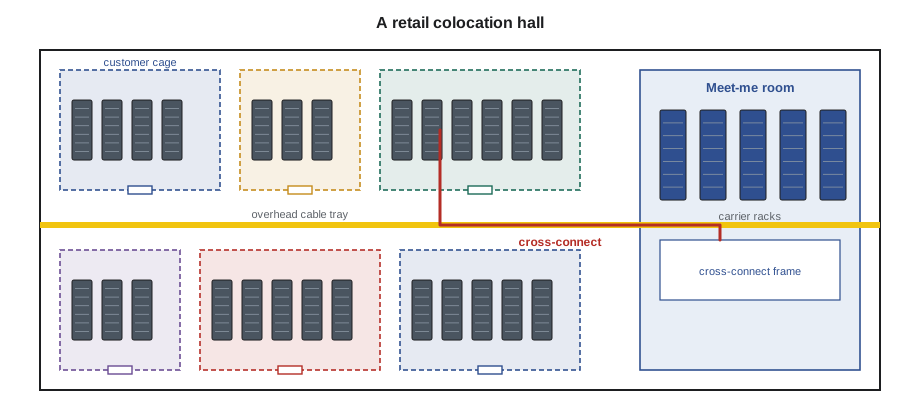
The second stop is a carrier hotel in an old downtown building near the financial district, a block of concrete floors where dozens of networks meet. Roz used to work here. Every floor is divided into cages and suites rented to different customers, and the meet-me rooms on two floors hold thousands of cross-connects between them. A colocation facility rents space, power, cooling and connectivity to many customers, who install their own equipment.
Colocation divides into two broad businesses:
- Retail colocation: customers rent individual cabinets, partial cabinets, cages or small suites, often with a few kilowatts to a few hundred kilowatts of power. The provider sells extra services: remote hands, cross-connects, shipping and receiving, and sometimes managed network or security services.
- Wholesale colocation: one customer rents a whole suite, hall or building, often with one megawatt or more, and usually runs its own equipment with its own staff. The provider runs the building systems.
In colocation the line between what the provider owns and what the customer owns is strict. The provider owns the building, the power and cooling plant, the cage walls, the overhead cable trays and the cross-connect cabling between customers. The customer owns everything inside its cabinets and cage. A technician may work on customer equipment only when the customer opens a ticket asking for it, describes exactly what to do and authorizes it. Lesson 11 explains how those requests work.
Interconnection is the heart of colocation. A cross-connect is a cable, usually fibre, that the provider installs from one customer's equipment to another's: from a bank's cage to a carrier's cage, for example, so that the bank can buy network service from that carrier. Large colocation sites house hundreds of carriers and cloud on-ramps, which is why companies want to be there. A technician in a busy colocation site may install and test dozens of cross-connects a week.
Hyperscale data centres
The third stop is only a drive-by: a hyperscale campus run by one of the large cloud companies, where visitors are not allowed past the gate. A hyperscale data centre is built and operated by a very large cloud or internet company for its own services, usually on a campus of several identical buildings, each with tens of megawatts of capacity. Hyperscalers design their own servers, racks, power systems and cooling, and they build the same design again and again. They automate much of their operations, run very large fleets of identical equipment and often treat individual servers as replaceable parts: when one fails, its work moves elsewhere and a technician swaps it later.
Technicians at hyperscale sites usually work for the operator or a contractor it hires. Their work is highly standardized: fixed procedures for replacing drives, memory, power supplies and whole servers, with tickets generated automatically by the monitoring software. The scale is large, a single technician may replace dozens of failed parts in a shift, and the rules about data security, such as how failed drives are tracked and destroyed, are strict.
Not every large campus is owned by the company that uses it. Many hyperscalers lease buildings from wholesale and build-to-suit providers like Stonebridge. Halls B and C at the campus are such a lease: the cloud provider's own staff run the IT equipment, and Stonebridge's critical facilities team runs the power and cooling.
Edge data centres
The fourth stop is the Saint-Hyacinthe edge site: a fenced pad behind a telecom company's central office with two prefabricated modules, a small generator and a fibre hut. Each module holds eight racks, a packaged cooling unit on its end wall and a small UPS. Nobody works there full time. Technicians drive out for scheduled maintenance and when an alarm needs a person on site.
An edge data centre is a small site placed close to the people or devices it serves, so that data does not have to travel far. Edge sites support mobile networks, content caching, factory and hospital systems, connected vehicles and AI services that need fast responses. They are often prefabricated modules, built in a factory and set on a pad, at cell towers, telecom offices, cable landing stations or industrial sites. Most are unstaffed and monitored remotely.
Edge work has its own challenges. The technician is often alone, may drive an hour to reach the site, has limited spare parts on hand and has no one to ask in person. Lone-worker check-ins, careful planning of parts and tools before each visit, and good remote monitoring matter more at the edge than in a staffed hall.
Cloud: someone else's data centre
People often contrast the cloud with data centres, but the cloud lives in data centres. When a company uses cloud services, it rents computing, storage or software from a provider that runs them in its own hyperscale campuses or in leased halls. The company never sees the hardware. For a technician, cloud matters because it changes who the customers are: many enterprises now run a mix of their own rooms, colocation cages and cloud services, and connect them with cross-connects and private links in colocation sites. These on-ramps, direct connections from a colocation cage to a cloud provider's network, are one of the busiest kinds of cross-connect.
| Enterprise | Retail colocation | Wholesale or build-to-suit | Hyperscale | Edge | |
|---|---|---|---|---|---|
| Who owns the building | The organization | The provider | The provider | The cloud company | The operator |
| Who owns the IT equipment | The organization | Many customers | One tenant | The cloud company | The operator or tenant |
| Typical size | A room to a building | Racks to suites | Megawatt halls | Campuses of tens of MW per building | A few racks |
| How work is requested | Internal requests | Customer tickets | Tenant tickets and contracts | Automated tickets | Remote alarms and schedules |
| Staff on site | Often IT staff | 24 hours a day | 24 hours a day | 24 hours a day | Usually none |
Telling them apart on the job
Many sites mix types. Stonebridge's campus has a retail colocation hall, a wholesale lease and a build-to-suit AI hall, plus an edge site. A carrier hotel is a colocation facility with an unusual concentration of networks. A university may run an enterprise data centre and rent colocation space for its backup systems. What matters to the technician on any given day is the answer to three questions:
- Who owns the equipment I am about to touch?
- Who has asked for the work, and do they have the authority to ask?
- What procedure and permission does this site require before I start?
Roz has Jamal write the three questions inside the cover of his notebook. In colocation, the answers decide whether a task is a routine job or a serious breach of a customer's trust.
# Sort the stops on Roz's tour by type, size and staffing
sites = [  # name, type, racks, kW per rack, staffed around the clock
    ("Hopital du Lac room", "enterprise", 20, 5, False),
    ("Downtown carrier hotel", "retail colocation", 3000, 6, True),
    ("Hyperscale campus", "hyperscale", 12000, 15, True),
    ("Saint-Hyacinthe edge", "edge", 16, 8, False),
    ("Stonebridge Hall D", "build-to-suit", 60, 132, True),
]
print(f"{'Site':26s} {'Type':18s} {'IT kW':>8s}  staffed")
for name, kind, racks, kw, staffed in sites:
    print(f"{name:26s} {kind:18s} {racks * kw:8,d}  {'yes' if staffed else 'no'}")
total = sum(r * k for _, _, r, k, _ in sites)
print(f"Combined IT load: {total / 1000:.1f} MW")Site Type IT kW staffed Hopital du Lac room enterprise 100 no Downtown carrier hotel retail colocation 18,000 yes Hyperscale campus hyperscale 180,000 yes Saint-Hyacinthe edge edge 128 no Stonebridge Hall D build-to-suit 7,920 yes Combined IT load: 206.1 MW
The table makes one point plainly: Hall D, with only 60 racks, has about the same IT load as the whole hospital room multiplied by eighty. Rack count no longer says much about the size of a site; power does. The industry describes data centres by their IT power in kilowatts or megawatts, not by their floor area.
Worked problem
Who may ask for the work?
A man calls the Hall A front desk and says he is from the Bayview Credit Union. One of the credit union's servers is unresponsive, and he asks for a technician to press its power button now. Jamal takes the call.
Show solution
- Ask for the ticket. Remote hands work in colocation is requested through the customer portal or by an authorized contact.
- Check the customer's authorized contact list. The caller's name is not on it.
- Explain politely that the site can act only on a request from an authorized contact, and offer to call the credit union's listed contact or wait for a ticket.
- The credit union's listed contact opens a ticket ten minutes later, naming the cabinet, the server and its label, and authorizing a power cycle. Jamal does the work under that ticket and records the time and result.
Answer: The rule protects the customer. Pressing the wrong button, or acting for someone who has no authority, could take down the credit union's service or help someone attack it.
Mixed estates and hybrid IT
Few large organizations use only one type of data centre. A typical bank keeps its core systems in its own enterprise data centre or in a private suite in a colocation building, keeps a second copy in another colocation site in a different city for disaster recovery, runs new applications in one or two public clouds and uses edge sites for its branch networks. The industry calls this hybrid IT. The links between the pieces run through colocation buildings, which is why carrier-rich sites stay in demand even as more computing moves to the cloud.
For a technician in a colocation site, hybrid IT means that a single customer may have equipment in several halls, cross-connects to several clouds and staff who rarely visit. Their tickets often refer to systems in other buildings, and their engineers may know their own network far better than the physical layout of the cage. Clear labels, accurate records and careful confirmation of every location are what make that work safely.
The type of site also shapes what a technician carries. In a hyperscale hall, the operator supplies the spare parts and tools, and procedures are identical from one building to the next. In retail colocation, customers ship their own parts and the technician follows each customer's instructions. At the edge, the technician brings everything needed for the visit and leaves nothing behind.
Common mistakes
MistakeTouching customer equipment without a ticket.
InsteadIn colocation, act only on a request from an authorized customer contact.
MistakeAssuming every site has the same rules.
InsteadEnterprise, colocation, hyperscale and edge sites each have their own procedures; learn the site you are in.
MistakeMeasuring a site's size by its floor area or rack count.
InsteadData centres are described by IT power in kilowatts or megawatts.
MistakeGoing to an edge site without planning parts and tools.
InsteadCheck the alarm, the parts list and the access arrangements before you drive out, and check in as a lone worker.
MistakeTreating the cloud as if it were not in a data centre.
InsteadCloud services run in data centres; on-ramps to them are a busy part of colocation.
Summary and key terms
- Enterprise data centres are owned and run by one organization for its own use.
- Colocation providers rent space, power, cooling and connectivity; retail serves many small customers and wholesale serves one tenant per hall or building.
- Hyperscale campuses are built and run by large cloud companies with standardized designs and automated tickets.
- Edge sites are small, close to users and usually unstaffed.
- Cross-connects and cloud on-ramps make colocation valuable.
- Before touching anything, know who owns it, who asked and what procedure applies.
- Enterprise data centre
- A data centre owned and run by one organization for its own use.
- Retail colocation
- Renting cabinets, cages or small suites to many customers.
- Cross-connect
- A cable installed by the provider between two customers or between a customer and a carrier.
- Meet-me room
- A room where carriers and customers interconnect.
- Carrier hotel
- A colocation building with an unusual concentration of networks.
- Cloud on-ramp
- A direct connection from a colocation site to a cloud provider network.
Practice problems
Work each problem on paper first, then reveal the answer to check.
Who owns the IT equipment in a retail colocation hall?
Show answer
The many customers who rent cabinets and cages.
What is a cross-connect?
Show answer
A provider-installed cable linking one customer to another or to a carrier.
Why are edge sites harder for technicians in some ways?
Show answer
They are usually unstaffed and remote, so the technician works alone with limited parts.
A hall has 60 racks at 132 kW each. What is its IT load?
Show answer
About 7.9 MW.
Lesson quiz · 5 questions
Score 60% or more to complete this lesson.
Create a free account to save your progress, take quizzes and earn a certificate.