
ARCH-231 · Lesson 8 of 12 · 21 min
Shells and vaults
Szymańska starts the eighth class with an egg. She asks Joon-ho to hold it end to end between his palms and squeeze as hard as he can. He strains; the egg survives. Then she hands him a second egg and asks him to press one point of it with a fingertip. It cracks almost at once. 'The shell of an egg is a fraction of a millimetre thick,' she says. 'Squeezed evenly over its curved surface, it is astonishingly strong. Pushed at a point, so that it has to bend, it is weak. That is the whole of shell design: give the structure a shape that lets it carry its loads by stretching and squeezing in its own surface, and never ask it to bend if you can help it.'
From arches to vaults and shells
An arch carries load in compression along a curved line. Extend an arch sideways and it becomes a barrel vault, a half-cylinder or segment of a cylinder spanning between two supporting walls. Rotate an arch about its vertical axis and it becomes a dome. Vaults and domes of stone and brick roofed the great buildings of the past, from the Pantheon in Rome, completed around 125 AD with a concrete dome 43 m across, to the Gothic cathedrals, whose ribbed vaults carried their thrusts out to flying buttresses. These masonry structures were thick and heavy, and they worked because their shapes kept the line of thrust within their thickness.
A shell is a thin curved surface that carries load by forces in its own plane. Modern concrete shells, developed from the 1920s onward, are often only 50 to 100 mm thick over spans of 20 to 60 m, thinner in proportion than an egg. They work because their curvature lets them resist loads by membrane action: compression and tension in two directions within the surface, and shear between them, without significant bending. A flat plate of the same thickness would sag and crack under its own weight; the curved shell barely notices it.
Curvature and the membrane state
The key to shells is curvature. A surface can be curved in one direction only, like a cylinder, or in two. If it curves the same way in both directions, like a dome or a bowl, it is synclastic, with positive Gaussian curvature. If it curves opposite ways, upward in one direction and downward in the other, like a saddle or a Pringle chip, it is anticlastic, with negative Gaussian curvature. Doubly curved surfaces are much stiffer than singly curved ones, because they cannot deform without stretching. A sheet of paper rolled into a cylinder is still easy to flatten; a ping-pong ball is not.
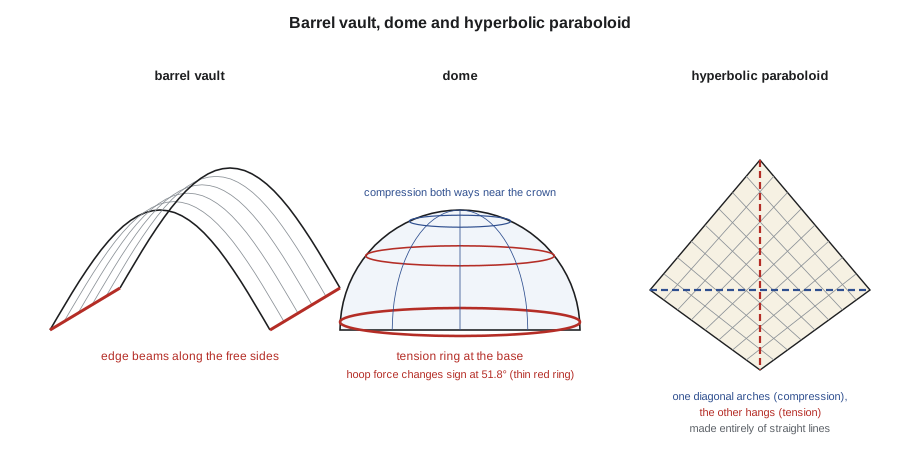
In the membrane state, a shell carries its load entirely through in-plane forces, called membrane forces, measured per unit length of the shell's edge. Bending appears only where the membrane state is disturbed: at the edges and supports, around openings, and under concentrated loads. Good shell design therefore pays most attention to the edges. A barrel vault needs stiff edge beams along its free sides, because the membrane forces of a cylinder cannot be satisfied at a free edge; a dome needs a ring at its base to collect its outward thrust; a saddle needs edge members to gather the shear that flows along its surface.
The dome
A spherical dome under its own weight has two sets of membrane forces. Along the meridians, the lines running from the crown down to the base, the force is always compression, and it grows toward the base. Around the hoops, the horizontal circles, the force is compression near the crown but changes to tension below a certain angle. The change happens at about 51.8 degrees from the crown, where the hoops change from being squeezed inward to being stretched outward. A hemispherical dome therefore has tension in its lower hoops, which is why masonry domes often cracked along their meridians near the base, and why many were bound with iron chains or ties.
In these expressions, w is the shell's weight per unit area of its surface, R the radius of the sphere and φ the angle from the crown; negative values are compression. The meridional force at the crown equals the hoop force there, wR/2 in compression. A dome cut off above 51.8 degrees, a shallow spherical cap, has compression in all its hoops, but its meridional forces arrive at the base at an angle and push outward. That outward thrust is collected by a tension ring around the base, which turns the thrust into a circumferential tension, like the hoops of a barrel.
# Membrane forces in a spherical dome under its own weight (kN, m)
import math
R, w = 30, 2.4                           # radius of the sphere and shell self-weight (kPa)
print("angle  meridional  hoop       (negative = compression, per unit length)")
for deg in range(0, 91, 15):
    p = math.radians(deg)
    N_phi = -w * R / (1 + math.cos(p))
    N_theta = w * R * (1 / (1 + math.cos(p)) - math.cos(p))
    print(f" {deg:3d}   {N_phi:8.1f}   {N_theta:8.1f}  kN/m")
# the hoop force changes sign where cos^2 + cos - 1 = 0
p0 = math.degrees(math.acos((math.sqrt(5) - 1) / 2))
print(f"Hoop force is zero at {p0:.1f} degrees from the crown")
for half in (51.8, 30):
    p = math.radians(half)
    N_phi = w * R / (1 + math.cos(p))
    r = R * math.sin(p)
    T = N_phi * math.cos(p) * r            # tension ring force: outward thrust times ring radius
    print(f"Dome cut at {half} degrees: base diameter {2 * r:.1f} m, rise {R * (1 - math.cos(p)):.1f} m, ring tension {T:.0f} kN")
t = 0.1
print(f"Compressive stress at the base of the {30}-degree dome, {t} m thick: {w * R / (1 + math.cos(math.radians(30))) / t / 1000:.2f} MPa")angle meridional hoop (negative = compression, per unit length) 0 -36.0 -36.0 kN/m 15 -36.6 -32.9 kN/m 30 -38.6 -23.8 kN/m 45 -42.2 -8.7 kN/m 60 -48.0 12.0 kN/m 75 -57.2 38.6 kN/m 90 -72.0 72.0 kN/m Hoop force is zero at 51.8 degrees from the crown Dome cut at 51.8 degrees: base diameter 47.2 m, rise 11.4 m, ring tension 649 kN Dome cut at 30 degrees: base diameter 30.0 m, rise 4.0 m, ring tension 501 kN Compressive stress at the base of the 30-degree dome, 0.1 m thick: 0.39 MPa
For a concrete dome on a sphere of radius 30 m, 100 mm thick, the forces are tiny compared with the strength of concrete: the compressive stress at the base of a shallow cap is about 0.4 MPa, less than a hundredth of what the concrete can carry. Strength is almost never the problem with shells. The problems are buckling, because a thin shell can snap through like a dented can if it is too flat or too thin; bending at the edges and around openings; and the forces at the base, where the ring must resist hundreds of kilonewtons of tension. The shallower the cap, the larger the thrust per unit length of the ring, though the ring itself is shorter.
Hyperbolic paraboloids and other forms
The hyperbolic paraboloid, or hypar, is the most remarkable of shell forms. It is a saddle-shaped surface with the property that it can be generated entirely by straight lines: take a square, raise two opposite corners and lower the other two, and join the edges with straight lines; the warped surface between them is a hypar. This made hypars easy to build in concrete, because their formwork could be made of straight boards, and the Spanish-Mexican architect and engineer Félix Candela built dozens of them in Mexico in the 1950s, many only about 40 mm thick. His restaurant at Los Manantiales in Xochimilco, completed in 1958, combines eight hypar segments into a flower-like roof.
Under a uniform load, a hypar carries the load by compression along the arching diagonal and tension along the hanging diagonal, which together produce a constant shear along the straight lines parallel to its edges. The edge members collect that shear and deliver it to the supports as large axial forces. Hypar roofs therefore always come with heavy edge beams and with supports at the low corners that must resist both vertical load and thrust.
Other shell forms have their own champions. The Swiss engineer Heinz Isler developed shells by hanging wet fabric, letting it freeze or harden, and inverting the shape, a method that finds funicular forms directly, as Gaudí's hanging models had done for arches. The Uruguayan engineer Eladio Dieste built thin vaults of reinforced brick, including the Church of Christ the Worker at Atlántida, completed in 1960, whose walls and roof undulate in Gaussian curves. Pier Luigi Nervi built ribbed concrete domes from precast elements, as in the Palazzetto dello Sport in Rome, completed in 1957. Eero Saarinen's Kresge Auditorium at MIT, completed in 1955, a dome cut into a triangle and resting on three points, is a cautionary example: its edges, which a sphere does not naturally want, needed stiffening and caused cracking and leaks.
Building shells today
Thin concrete shells became rare after the 1970s, mostly because their formwork was labour-intensive and labour became expensive, while flat roofs on steel trusses were cheap. But the materials and tools have changed. Computational form-finding, digital fabrication of formwork, reusable inflatable or fabric formwork and fibre-reinforced concretes have revived interest in shells, partly because they use so little material: a shell can roof a space with a fraction of the concrete, and therefore the carbon, of a beam and slab system. Gridshells, lattices of timber or steel bent into a doubly curved shape and braced, extend the idea to lighter materials, from Frei Otto's timber gridshell at Mannheim in 1975 to recent timber and steel-and-glass roofs over courtyards.
Vaults have also returned in an unexpected form. Thin-tile vaulting, the Catalan and Guastavino tradition of laying flat tiles in several layers with fast-setting mortar, built hundreds of vaults in American buildings from the 1880s to the 1940s, including the great ceilings of Grand Central Terminal's Oyster Bar and many public libraries and stations. Researchers and builders now use the same principles with compressed earth tiles and unreinforced stone to build very low-carbon floors and roofs, designed by graphic statics so that the line of thrust stays within the material.
Worked problem
Ingrid's rink as a barrel vault
For the rink at Kestrel Point, Ingrid sketches a variation on her arch scheme: a barrel vault of glulam ribs and plywood, 60 m wide, with a rise of 10 m, running the full 60 m length of the ice. What changes compared with separate arches?
Show solution
- A barrel vault is a set of arches joined side by side, so across the span it still thrusts outward, about 1,620 kN per 6 m of length as in Lesson 7.
- The ribs can be lighter, because the plywood skin joins them into a continuous surface that spreads concentrated loads and resists buckling.
- Along the free edges, where the vault meets the open sides, the membrane forces cannot be satisfied, so stiff edge beams are needed.
- The end openings, where skaters enter, cut the vault and need stiffening arches at the ends.
- Ties in the slab across the span still resist the thrust, at the rib spacing.
Answer: The vault behaves like joined arches across its span, with thrusts tied in the slab, plus edge beams and stiff end arches.
Exercise 8: shells
- Make a small shell by hanging a wet cloth from four points, letting it dry stiff with glue or plaster, and inverting it; load it with coins.
- Sketch a dome, a barrel vault and a hypar, and mark where each is in compression, where in tension and where it needs edge members.
- Calculate the hoop force at the base of a hemispherical dome and explain why masonry domes cracked there.
- Find a shell or vault building in your region and identify its form and thickness.
Self-check
- Can I explain why curvature makes a thin shell strong?
- Do I know why shell edges need special attention?
- Do I know where a dome's hoop forces change from compression to tension?
Common mistakes
MistakeDesigning a shell as if strength were the main issue.
InsteadCheck buckling, edges, openings and supports; stresses in the membrane are usually small.
MistakeCutting large openings in a shell without stiffening them.
InsteadOpenings disturb the membrane state; frame them with ribs or thickened edges.
MistakeChoosing a shape for appearance without checking it is funicular or doubly curved.
InsteadShapes that fight the flow of forces bend, crack and leak.
MistakeForgetting the ring or tie at the base of a dome or vault.
InsteadCollect the outward thrust with a tension ring or ties.
MistakeSupporting a shell on a few points without thinking about the edges.
InsteadPoint supports concentrate forces; design edge members to deliver them.
Summary and key terms
- A shell is a thin curved surface that carries load by in-plane membrane forces rather than bending.
- Double curvature, synclastic like a dome or anticlastic like a saddle, makes surfaces much stiffer than single curvature.
- A spherical dome has meridional compression everywhere and hoop compression near the crown, changing to hoop tension below about 51.8 degrees.
- Hypars carry load by compression and tension along their diagonals and need strong edge members; they can be built from straight lines.
- Shell design is about buckling, edges, openings and supports; computational and digital tools are reviving shells as low-material structures.
- Shell
- A thin curved surface that carries load mainly by in-plane forces.
- Membrane force
- An in-plane force per unit length in a shell.
- Synclastic
- Curved the same way in both directions, like a dome.
- Anticlastic
- Curved in opposite directions, like a saddle.
- Hyperbolic paraboloid
- A saddle-shaped surface that can be generated by straight lines.
- Tension ring
- A ring at the base of a dome that collects its outward thrust.
Practice problems
Work each problem on paper first, then reveal the answer to check.
At what angle from the crown does the hoop force in a spherical dome under self-weight change sign?
Show answer
About 51.8 degrees.
A dome has a radius of 20 m and weighs 2 kPa. What is the membrane force at its crown?
Show answer
wR/2 = 2 × 20 ÷ 2 = 20 kN/m compression.
Why could Candela build hypars with straight boards?
Show answer
A hyperbolic paraboloid can be generated entirely by straight lines.
Why do barrel vaults need edge beams?
Show answer
The membrane forces of a cylinder cannot be satisfied at a free edge, so a stiff beam must carry them.
Name one reason thin concrete shells became rare after the 1970s.
Show answer
Their formwork was labour-intensive and labour became expensive compared with flat roofs on steel.
Lesson quiz · 5 questions
Score 60% or more to complete this lesson.
Create a free account to save your progress, take quizzes and earn a certificate.