
AERO-410 · Lesson 9 of 12 · 25 min
Landing gear design
The landing gear is the only part of the aircraft designed mostly for the few minutes it spends on the ground. It must carry the aircraft's full weight while parked, absorb the energy of a hard landing, let the aircraft turn and brake, keep it from tipping over, keep the propellers and tail clear of the ground, and then fold away into a space that does not ruin the fuselage shape. On a northern commuter it must also survive thousands of landings on gravel, in ruts, slush and frozen ridges. This lesson places the Petrel's wheels, checks the geometry, sizes the tyres and the shock absorbers, and settles how the gear retracts.
Arrangement
Lesson 4 chose a retractable tricycle gear: a steerable nose gear under the cockpit and two main gears near the centre of gravity. On a high-wing aircraft the main gear cannot fold into the wing as it does on a low wing, because the wing is too high above the ground. The choices are to hang the gear from the engine nacelles on long legs, or to attach it to the fuselage and fold it into fairings, often called sponsons, on the fuselage sides. Nacelle gear gives a wide track but needs long, heavy legs and puts landing loads into the wing. Fuselage gear has short legs and keeps landing loads out of the wing, at the cost of a narrower track and the drag of the sponsons. The Petrel uses fuselage gear with twin wheels on each main leg, a common choice for high-wing freighters and commuters that operate from rough strips.
Placing the wheels
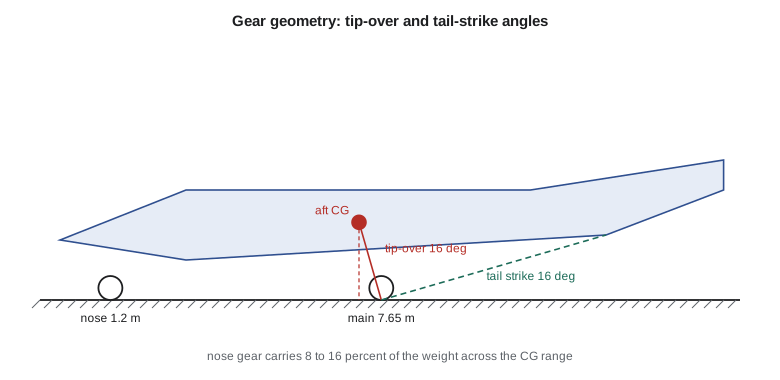
The main wheels must sit behind the aft-most centre of gravity, so that the aircraft does not sit back on its tail when loaded from the rear, and they must not sit so far behind it that the nose gear carries too much load and the elevator cannot lift the nose for rotation. Two rules of thumb set the range. The line from the aft CG to the main wheel contact point should make an angle of about 15 degrees or more with the vertical, the longitudinal tip-over angle; and the nose gear should carry about 8 to 15 percent of the weight across the CG range. Too little nose load gives poor steering, especially on slippery surfaces; too much makes rotation hard and loads the nose gear heavily.
# Petrel 19 tricycle landing gear: placement, tip-over, ground clearance, static loads and gravel tyre pressure.
import math
W = 8450 * 9.81
x_cg_fwd, x_cg_aft = 6.62, 7.12          # m from the nose (from the Lesson 10 envelope)
z_cg = 1.85                              # height of the CG above ground, gear compressed
x_nose, x_main = 1.2, 7.65                # nose and main wheel positions from the nose
track = 3.9
B = x_main - x_nose
for name, x in (("forward CG", x_cg_fwd), ("aft CG", x_cg_aft)):
    Mn = x_main - x                       # distance CG to main wheels
    nose_share = Mn / B
    print(f"{name}: nose gear carries {nose_share * 100:4.1f} percent of the weight ({nose_share * W / 1e3:.1f} kN)")
tip_long = math.degrees(math.atan((x_main - x_cg_aft) / z_cg))
print(f"longitudinal tip-over angle {tip_long:.1f} degrees (main wheels behind the aft CG; 15 degrees or more wanted)")
# lateral tip-over (overturn) angle
d = (x_cg_fwd - x_nose)
a = math.atan(track / 2 / B)
dist = d * math.sin(a)
overturn = math.degrees(math.atan(z_cg / dist))
print(f"lateral overturn angle {overturn:.1f} degrees (63 degrees or less wanted on land)")
# tail-strike: rotation angle allowed before the aft fuselage touches
tail_x, tail_z = 13.0, 1.55               # lowest point of the aft body and its height
strike = math.degrees(math.atan(tail_z / (tail_x - x_main)))
print(f"tail-strike angle {strike:.1f} degrees")
# tyres: main load per wheel with 4 main wheels (2 per side), dynamic factor 1.07
Pmain = W * (1 - (x_main - x_cg_fwd) / B) / 4 * 1.07
for p_kpa in (380, 520, 700):
    area = Pmain / (p_kpa * 1e3)
    print(f"main tyre at {p_kpa} kPa: contact area {area * 1e4:.0f} cm2 per wheel")
print(f"load per main wheel {Pmain / 1e3:.1f} kN")forward CG: nose gear carries 16.0 percent of the weight (13.2 kN) aft CG: nose gear carries 8.2 percent of the weight (6.8 kN) longitudinal tip-over angle 16.0 degrees (main wheels behind the aft CG; 15 degrees or more wanted) lateral overturn angle 49.7 degrees (63 degrees or less wanted on land) tail-strike angle 16.2 degrees main tyre at 380 kPa: contact area 490 cm2 per wheel main tyre at 520 kPa: contact area 358 cm2 per wheel main tyre at 700 kPa: contact area 266 cm2 per wheel load per main wheel 18.6 kN
The program places the nose wheel 1.2 m from the nose and the main wheels 7.65 m from the nose, using the CG limits of 6.62 m and 7.12 m that Lesson 10 will establish. The nose gear carries 16.0 percent of the weight at the forward limit and 8.2 percent at the aft limit. The forward value is a little above the usual range, which the team accepts: good nose-wheel steering on gravel and ice is worth more to the operators than slightly lighter rotation forces, and the elevator check in Lesson 7 shows that rotation is still possible at the forward limit. The tip-over angle is 16.0 degrees, just above the 15-degree guideline.
The lateral overturn angle checks that the aircraft will not roll over sideways in a fast turn on the ground or in a strong crosswind. It is the angle between the vertical and the line from the CG to the line joining the nose wheel and one main wheel, measured in the plane perpendicular to that line. A widely used guideline asks for no more than about 63 degrees on land. With a 3.9 m track the Petrel's angle is about 50 degrees, comfortably inside the guideline, so the fuselage-mounted gear's narrower track is not a problem.
The tail-strike angle is the pitch angle at which the lowest point of the aft fuselage touches the ground with the main gear compressed. It must exceed the angle needed for lift-off and the landing flare with some margin. With the upswept tail cone and the main wheels at 7.65 m, the Petrel can rotate about 16 degrees before the tail touches; the take-off rotation to the lift-off attitude needs about 10 to 12 degrees with take-off flaps, leaving a margin. A small tail bumper with a crushable insert protects the tail cone in case of a mishandled rotation.
Tyres and flotation
Tyre size depends on the load each wheel carries and on the surface. A hard runway can take high tyre pressures; gravel and soft surfaces cannot, because a small contact patch at high pressure digs ruts, throws stones and can sink. The contact area is roughly the wheel load divided by the inflation pressure. The program's dynamic main-wheel load, with the CG at the forward limit and a 7 percent allowance for braking and turning, is 18.6 kN per wheel on four main wheels.
At 700 kPa, a pressure typical of aircraft that operate only from paved runways, each main tyre would have a contact area of about 266 cm². At 520 kPa it rises to 358 cm², and at 380 kPa to 490 cm². Operators and authorities generally recommend low tyre pressures for unpaved strips, and the guidance for gravel operation of turboprops in the north typically points to pressures around or below the middle of this range. The Petrel uses larger low-pressure main tyres inflated to about 520 kPa for normal service, with a placarded lower pressure for soft strips in spring thaw. Larger tyres are heavier and need more stowage space, but they also cushion the airframe against the repeated small impacts of a rough surface, which matters for fatigue.
Twin wheels on each main leg help in three ways. They spread the load over two contact patches, they keep the aircraft safe if one tyre fails, and they give a smaller wheel diameter for the same load than a single wheel would, which eases stowage. The nose gear also has twin wheels, with a gravel deflector behind them, a shaped plate that throws stones down and sideways instead of up into the propellers and the fuselage underside.
Shock absorbers
The shock absorber must take the energy of the aircraft's vertical motion at touchdown without exceeding a set load factor on the airframe. Most transport gear uses an oleo-pneumatic strut, in which oil is forced through an orifice to absorb energy and compressed gas acts as the spring. Certification standards set a design descent velocity at touchdown, about 3 m/s for aircraft of this class, and the gear is designed so that the load factor stays at about 3 or less. The stroke needed follows from the energy balance:
Here \(V_s\) is the descent velocity, \(\eta\) the strut efficiency, about 0.8 for an oleo-pneumatic strut, \(N_{gear}\) the gear load factor, and \(\eta_t S_t\) the energy absorbed by the tyre's own deflection. For the Petrel this gives a stroke of about 0.17 m, and the design adds a margin to reach about 0.19 m. A rough-field aircraft is often given a longer stroke than the minimum, because repeated impacts on rough ground produce loads the certification case does not cover. The Petrel's main struts are designed with 0.25 m of stroke, which also lets them absorb the ridges and ruts of a gravel strip at taxi speeds.
Retraction and stowage
The retraction geometry is drawn early, because it decides how big the sponsons must be. The Petrel's main legs rotate backward and inward into the sponsons, with the wheels lying flat below the cabin floor beside the battery bay. Retracting backward has a safety benefit: if the gear fails to lock down and the actuator loses pressure, airflow helps swing it forward into the down position. The nose gear retracts forward into the nose under the cockpit floor for the same reason. Doors close over all the wheel wells in flight, and on gravel strips they also keep stones and slush out of the wells.
The gear actuators are electric on the Petrel, using the aircraft's high-voltage power network through a converter, because the aircraft has no engine-driven hydraulic pumps. A free-fall emergency extension, released by a mechanical cable from the cockpit, lets the gear fall and lock under its own weight and the airflow if the electric system fails. Marcus checks the stowed gear position against the CG: with the main wheels moving backward on retraction, the empty CG shifts aft by about 1 cm, too small to matter for balance.
Brakes, steering and ground handling
Carbon brakes are light but work poorly when cold; steel brakes are heavier but suit short cold sectors. The Petrel uses steel brakes with an anti-skid system, which is particularly useful on gravel and ice where friction varies from patch to patch. The nose wheel is steerable through about 60 degrees each side, enough for the aircraft to turn within the width of the small aprons at northern strips. Combined with the reverse thrust available from the electric motors, which can reverse propeller pitch quickly, the brakes and steering let the Petrel back out of a parking spot without a tug, a practical need at strips with no ground equipment.
Worked problem
Nose gear share
The nose wheel is at 1.2 m and the main wheels at 7.65 m from the nose. Find the nose gear share with the CG at 6.62 m.
Show solution
- Wheelbase \(B = 7.65 - 1.2 = 6.45\) m; CG to main wheels \(= 7.65 - 6.62 = 1.03\) m.
- Nose share \(= 1.03 / 6.45 = 0.160\).
Answer: About 16 percent of the weight.
Worked problem
Tyre contact area
A main wheel carries 18.6 kN at an inflation pressure of 520 kPa. Estimate the contact area.
Show solution
- \(A = F/p = 18\,600 / 520\,000 = 0.0358\) m².
- \(0.0358\) m² \(= 358\) cm².
Answer: About 360 cm².
Worked problem
Shock absorber stroke
With a descent velocity of 3.05 m/s, strut efficiency 0.8 and gear load factor 3, find the stroke ignoring the tyre.
Show solution
- \(S = 3.05^2 / (2 \times 9.81 \times 0.8 \times 3) = 9.30 / 47.1\).
- \(S = 0.198\) m.
Answer: About 0.20 m before the tyre's share is subtracted.
Common mistakes
MistakePlacing the main wheels at the aft CG.
InsteadPut them behind it with a tip-over angle of about 15 degrees or more.
MistakeUsing paved-runway tyre pressures on gravel.
InsteadLower pressures and larger tyres spread the load and reduce damage.
MistakeSizing the stroke to the certification minimum for a rough-field aircraft.
InsteadAdd stroke for repeated rough-surface impacts.
MistakeDrawing the retraction late.
InsteadStowage space sets the sponson size and fuselage drag.
Summary and key terms
- The Petrel's retractable tricycle gear has twin-wheel main legs on the fuselage that fold backward into sponsons and a twin-wheel nose gear with a gravel deflector.
- With the nose wheel at 1.2 m and the main wheels at 7.65 m, the nose gear carries 8 to 16 percent of the weight, the tip-over angle is 16 degrees, the overturn angle about 50 degrees and the tail-strike angle 16 degrees.
- Low-pressure tyres at about 520 kPa spread the load on gravel.
- Oleo-pneumatic struts with 0.25 m stroke absorb landings and rough-surface impacts.
- Tip-over angle
- The angle between the vertical and the line from the aft CG to the main wheel contact point.
- Overturn angle
- An angle that measures resistance to rolling over sideways on the ground.
- Sponson
- A fairing on the fuselage side into which the main gear retracts.
- Oleo-pneumatic strut
- A shock absorber using oil through an orifice for damping and gas as a spring.
- Flotation
- The ability of the gear to operate on soft or unpaved surfaces without sinking or rutting.
- Gravel deflector
- A plate behind the nose wheel that throws stones away from the propellers and fuselage.
Practice problems
Work each problem on paper first, then reveal the answer to check.
What share of the weight does the nose gear carry at the aft CG?
Show answer
About 8 percent.
What tip-over angle does the Petrel have?
Show answer
16 degrees.
Why are low tyre pressures used on gravel?
Show answer
A larger contact patch spreads the load and reduces rutting and stone throw.
What stroke do the main struts have?
Show answer
0.25 m.
Why does the main gear retract backward?
Show answer
Airflow helps it swing down and lock in a free-fall extension.
Why steel brakes rather than carbon?
Show answer
Carbon brakes work poorly when cold on short sectors.
Lesson quiz · 5 questions
Score 60% or more to complete this lesson.
Create a free account to save your progress, take quizzes and earn a certificate.