
AERO-410 · Lesson 12 of 12 · 26 min
Trade studies and design review
Eleven lessons have produced a design: the Petrel 19, a high-wing series-hybrid commuter of 8450 kg for the Kivalliq region of Nunavut, with a 19.2 m wing, two 3.0 m propellers, a 400 kg battery and a full-passenger range of about 557 km. Every step involved choices, and many were made with a preferred answer in mind. This final lesson steps back and asks two questions the programme must answer before spending serious money: is this concept better than the alternatives, and is the design mature enough to move into preliminary design? The first is answered with a trade study; the second with a design review.
What a trade study is for
A trade study compares alternatives against a set of criteria in an organised, recorded way. It does not make the decision by itself; people do. Its value is that it forces the team to say what matters, to show the evidence for each judgement, and to see how much the answer depends on the weights chosen. A good trade study also survives the departure of the people who did it: a reviewer five years later can see why the decision was made and what would have changed it.
The Petrel trade compares three concepts that the earlier lessons studied in enough depth to score: concept A, the baseline series hybrid with a 400 kg battery and 500 km design range; concept B, a conventional twin turboprop of the same size and cabin, using the same airframe with turboprop engines in place of the hybrid powertrain; and concept C, the hybrid with the 650 kg battery Dr. Nakamura first proposed, which fits under the certification mass limit only with a reduced range of 400 km. Other concepts, such as distributed propulsion and an all-electric design, were dropped earlier with reasons recorded in Lessons 1 and 4.
Choosing criteria and weights
The criteria come from the requirements of Lesson 1 and from the people who will buy, fly, certify and live near the aircraft. Sam, representing the operators, and representatives of the agencies behind territorial and federal funding for northern air service sit with the design team to agree the list: trip fuel and carbon dioxide; community noise; the margin below the maximum take-off mass limit, which measures room for growth; operating cost; certification risk; and suitability for gravel operations. Each criterion gets a weight, and the weights sum to one. Fuel gets the highest weight, 0.30, because fuel delivered to northern communities by sealift or air is costly and its emissions matter to the funders. Operating cost gets 0.20, mass margin and certification risk 0.15 each, and noise and gravel operations 0.10 each.
Each concept is scored from 1, poor, to 5, best, on each criterion. The scores must rest on evidence from the design work, not on enthusiasm. Concept B scores 5 on mass margin and certification risk, because a conventional turboprop is well understood and has the most mass to spare, but 2 on fuel and noise. Concept C scores 5 on fuel and noise, because its larger battery lets it climb and approach on electric power for longer, but 2 on margin, operating cost and certification risk, and 3 on gravel operations because its shorter range forces more fuel stops at small strips. Concept A sits between them.
| Criterion | Weight | A hybrid 400 kg | B turboprop | C hybrid 650 kg |
|---|---|---|---|---|
| Trip fuel and carbon dioxide | 0.30 | 4 | 2 | 5 |
| Community noise | 0.10 | 4 | 2 | 5 |
| Margin below maximum take-off mass | 0.15 | 3 | 5 | 2 |
| Operating cost | 0.20 | 3 | 3 | 2 |
| Certification risk | 0.15 | 2 | 5 | 2 |
| Gravel operations | 0.10 | 4 | 4 | 3 |
# Petrel 19 concept trade study: weighted scores and sensitivity to the criteria weights.
criteria = ["trip fuel and CO2", "community noise", "MTOW margin", "operating cost", "certification risk", "gravel operations"]
weights = [0.30, 0.10, 0.15, 0.20, 0.15, 0.10]   # customer weighting: northern fuel is costly to deliver
concepts = {  # scores 1 (poor) to 5 (best), from the design team's evidence in Lessons 1-11
    "A series hybrid, 400 kg battery (baseline)": [4, 4, 3, 3, 2, 4],
    "B conventional twin turboprop":             [2, 2, 5, 3, 5, 4],
    "C hybrid, 650 kg battery, 400 km range":    [5, 5, 2, 2, 2, 3],
}
def score(w):
    return {k: sum(a * b for a, b in zip(v, w)) for k, v in concepts.items()}
base = score(weights)
for k, v in sorted(base.items(), key=lambda kv: -kv[1]):
    print(f"{v:.2f}  {k}")
print("sensitivity: raise one weight by 0.10 and rescale the others")
for i, c in enumerate(criteria):
    new = weights[i] + 0.10
    w = [x * (1 - new) / (1 - weights[i]) for x in weights]; w[i] = new
    r = score(w); best = max(r, key=r.get)
    print(f"  {c:20s} -> leader {best.split(',')[0].split(' ')[0]} ({r[best]:.2f}); A {r[list(concepts)[0]]:.2f}")
# break-even fuel saving: how much cheaper fuel makes B win on cost alone
fuelA, fuelB = 389, 470          # kg per 220 km leg (B estimated from a conventional turboprop at the same size)
print(f"fuel per leg: A {fuelA} kg, B {fuelB} kg -> A saves {(1 - fuelA / fuelB) * 100:.0f} percent")3.35 A series hybrid, 400 kg battery (baseline) 3.30 B conventional twin turboprop 3.30 C hybrid, 650 kg battery, 400 km range sensitivity: raise one weight by 0.10 and rescale the others trip fuel and CO2 -> leader C (3.54); A 3.44 community noise -> leader C (3.49); A 3.42 MTOW margin -> leader B (3.50); A 3.31 operating cost -> leader A (3.31); A 3.31 certification risk -> leader B (3.50); A 3.19 gravel operations -> leader A (3.42); A 3.42 fuel per leg: A 389 kg, B 470 kg -> A saves 17 percent
Reading the result
Concept A leads with 3.35, ahead of B and C at 3.30 each. The program's sensitivity check is more informative than the totals. Raising the weight on fuel or on noise by 0.10 puts concept C ahead. Raising the weight on mass margin or on certification risk puts concept B ahead. Only when operating cost or gravel operations gets more weight does A stay ahead. In other words, the three concepts are close, and the winner depends on which risks the programme is most worried about.
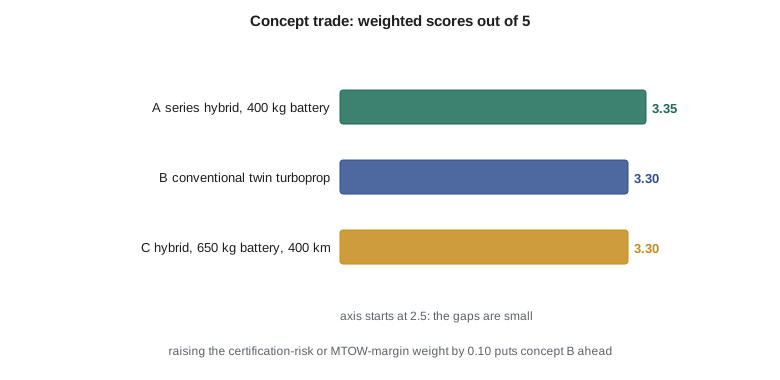
A narrow lead like this is common and is not a failure of the method. It tells the team that the decision cannot rest on the scores alone and that the main uncertainties must be reduced quickly. The figure's axis starts at 2.5 to make the small gaps visible; a chart drawn from zero would hide them, and Arjun notes on the chart that the axis does not start at zero so that no reader mistakes the size of the differences.
The team also checks the scores against the quantities behind them. Concept A's fuel advantage over B, 389 against 470 kg on the typical leg, a saving of 17 percent, is the single strongest piece of evidence for the hybrid. It depends on the turboshaft running near its best efficiency, the battery-assisted take-off and electric taxi, and the electrical chain efficiency of 0.89. If the chain efficiency were 0.85 instead, or the turboshaft's specific fuel consumption 5 percent worse than assumed, much of the saving would disappear, and concept B would lead. Those are the numbers the next phase must confirm first.
Other trade study tools
Weighted scoring is only one tool. Carpet plots show how a design's mass or cost changes across a grid of two design variables, for example wing loading and power loading, with the constraint lines overlaid, which lets a team see the optimum and how flat it is. Pugh matrices compare concepts against a baseline as better, same or worse on each criterion, useful early when scores cannot be justified. Multidisciplinary design optimization couples aerodynamics, structures, propulsion and cost models and searches for the best design automatically; it is powerful in preliminary design but needs models that are trustworthy across the range searched. The Petrel team uses a carpet plot to confirm that the chosen wing and power loadings sit near the minimum take-off mass within the constraints, and records the wider optimization for the next phase.
A trade study can also be run on a single parameter. The wing span, held to 19.2 m by the operators' hangars, is one such case. A span of 21 m, an aspect ratio of 12, would raise the cruise lift-to-drag ratio by about 4 percent and save fuel on every flight, at the cost of about 45 kg more wing and a hangar modification at each base. The study shows a payback within a few years at high utilization, and the team recommends that the operators be asked whether hangar changes are possible before the wing is frozen.
The design review
A design review is a formal meeting at which an independent panel examines whether the design meets its requirements, whether the analysis is sound and complete enough for the stage, and whether the risks are understood and managed. Most programmes hold a sequence of reviews at set points, with names such as conceptual design review, preliminary design review and critical design review, each requiring more detail and more evidence than the last. Passing a review is the gate to the next phase and its larger spending.
Dr. Nakamura chairs the Petrel's conceptual design review. The panel includes engineers from outside the project, a representative of the operators, a certification specialist who works with Transport Canada, and the company's Design Approval Representative. The design team presents the requirements, the sizing, the constraint diagram, the configuration, the component designs from Lessons 5 to 9, the mass and balance, the performance and cost, and the trade study. For each requirement, the team shows whether it is met, by how much and on what evidence. For each assumption, the team shows its source and how much the answer depends on it.
The panel's job is to find the weak points. Its questions this time include: how confident is the electrical chain efficiency; what happens to the CG if the battery is changed; has a feathered propeller been included in the engine-out drag; is the 20 percent drag allowance enough for a gravel kit and an upswept tail; will the 168 kg margin below the certification limit survive development; and what is the plan if the battery fails a propagation test. Each question becomes an action with an owner and a date.
The risk register and the decision
Alongside the review, the team keeps a risk register: a list of everything that could go wrong, each with its likelihood, its consequence, the actions to reduce it and an owner. The top risks for the Petrel are the mass margin, the battery's cold-weather life, the power electronics' reliability in a harsh climate, the certification basis for the hybrid powertrain, which the authorities are still developing for aircraft of this kind, and the electrical chain efficiency. The register shows which risks the trade study's narrow lead depends on.
The panel's decision is to proceed to preliminary design with concept A, with conditions. The programme must keep concept B alive as a fallback, at a low level of effort, until the battery propagation test, the powered wind tunnel test at the National Research Council and the generator efficiency test are complete. If any of these fails its target, the programme will reopen the trade. The airframe is designed so that the turboprop version can be built with minimal changes, using the same wing, fuselage, tail and gear with different nacelles, which keeps the fallback cheap. Kenji updates the programme plan, and Élise signs and seals the conceptual design report as the responsible professional engineer, making it the engineering basis for the next phase.
What the course has built
The Petrel story has followed the path every aircraft design takes: requirements from real missions, a first sizing loop and its hard truths, constraint analysis, layout, component design for the wing, fuselage, tail, propulsion and gear, mass and balance, performance and cost, and finally a recorded decision. Each step leaned on earlier courses: the aerodynamics of AERO-300 for the wing and tail, the structures of AERO-310 for the wing box and flutter, the stability and control of AERO-330 for the tail and roll, and the propulsion and performance courses for the powertrain and the mission. Real design is iterative, and the next phase will revisit every number here with better models and test data. What should remain is the method: make decisions explicit, keep the evidence, check the sensitivities, and know which assumptions the design depends on.
Worked problem
Weighted score
Find concept A's weighted score from the table.
Show solution
- \(0.30 \times 4 + 0.10 \times 4 + 0.15 \times 3 + 0.20 \times 3 + 0.15 \times 2 + 0.10 \times 4\).
- \(= 1.20 + 0.40 + 0.45 + 0.60 + 0.30 + 0.40 = 3.35\).
Answer: 3.35.
Worked problem
Rescaling weights
Raise the certification-risk weight from 0.15 to 0.25 and rescale the others. Find the new fuel weight.
Show solution
- The others must sum to \(1 - 0.25 = 0.75\) instead of 0.85; the scale factor is \(0.75/0.85 = 0.882\).
- Fuel weight \(= 0.30 \times 0.882 = 0.265\).
Answer: About 0.265.
Worked problem
Fuel saving
Concept A burns 389 kg and concept B 470 kg on the typical leg. Find the saving.
Show solution
- \(1 - 389/470 = 1 - 0.828\).
- \(= 0.172\).
Answer: About 17 percent.
Common mistakes
MistakeTreating the highest weighted score as the decision.
InsteadCheck sensitivity to the weights and the evidence behind the scores.
MistakeScoring concepts on enthusiasm.
InsteadEach score must rest on recorded design evidence.
MistakeDrawing a bar chart from a non-zero axis without saying so.
InsteadLabel the axis start so differences are not exaggerated.
MistakeDropping the runner-up after the review.
InsteadKeep a cheap fallback until the key risks are retired.
Summary and key terms
- A trade study compares concepts on agreed weighted criteria with recorded evidence.
- For the Petrel, concept A scores 3.35 against 3.30 for the conventional turboprop and the larger-battery hybrid, and a 0.10 change in a single weight can change the leader.
- The fuel saving of about 17 percent is the strongest evidence for the hybrid and depends on chain efficiency and turboshaft consumption.
- The conceptual design review approves concept A for preliminary design, with the turboprop kept as a fallback until the battery, wind tunnel and generator tests are complete.
- Trade study
- An organised comparison of alternatives against weighted criteria.
- Sensitivity analysis
- A check of how results change when inputs or weights change.
- Carpet plot
- A chart showing a result over a grid of two design variables.
- Pugh matrix
- A comparison of concepts against a baseline as better, same or worse.
- Design review
- A formal examination of a design by an independent panel at a programme gate.
- Risk register
- A list of risks with likelihood, consequence, actions and owners.
Practice problems
Work each problem on paper first, then reveal the answer to check.
What is concept A's weighted score?
Show answer
3.35.
Which weight changes put concept B ahead?
Show answer
Raising the mass margin or certification-risk weight.
What is the strongest evidence for the hybrid?
Show answer
A 17 percent fuel saving on the typical leg.
Who chairs the conceptual design review?
Show answer
Dr. Teresa Nakamura.
What did the review decide?
Show answer
Proceed with concept A, keeping concept B as a fallback.
What would reopen the trade?
Show answer
A failed battery propagation, wind tunnel or generator efficiency test.
Lesson quiz · 5 questions
Score 60% or more to complete this lesson.
Create a free account to save your progress, take quizzes and earn a certificate.