
AERO-410 · Lesson 2 of 12 · 26 min
Initial sizing and weight estimation
With the mission defined, the first number every designer wants is the take-off mass. Almost everything else scales with it: wing area, engine power, structure, cost. Yet the take-off mass depends on the empty mass, which depends on the size of the aircraft, which depends on the take-off mass. Initial sizing breaks this circle with a simple iteration that uses historical data for the empty mass and the mission analysis of Lesson 1 for the fuel. The result is not a final design but a first, defensible estimate that tells the team whether the requirements can be met at all.
Breaking the take-off mass into parts
Take-off mass \(W_0\) is the sum of crew, payload, fuel and empty mass. For a hybrid we add the battery as a separate fixed item, because its mass is chosen for its energy and power, not scaled with the airframe:
Dividing fuel and empty mass by \(W_0\) turns them into fractions, and the equation can be solved for take-off mass:
The fuel fraction comes from the mission, about 0.134 for 600 km. The empty-mass fraction comes from history: regressions of empty mass against take-off mass for aircraft of the same type. Raymer gives, for twin turboprops, an empty fraction of about \(0.96\, W_0^{-0.05}\) with \(W_0\) in pounds, which yields about 0.59 at 19,000 lb. Because the fraction falls slowly as take-off mass grows, larger aircraft are slightly more efficient structurally, and the equation must be iterated.
Historical regressions do not know about new technology. Two corrections are applied. A technology factor below 1 credits lighter materials: Marcus's structures group proposes composite wing skins and tail surfaces, worth about 5 percent on the empty mass, based on the materials work in AERO-360. A hybrid penalty adds the mass of systems a turboprop does not have, generators, motors, power electronics, high-voltage cables and thermal management, beyond the turboshafts themselves. Dr. Nakamura estimates this at about 4 percent of take-off mass with the large 650 kg battery and 3.5 percent with a smaller one.
The sizing loop
The loop is simple: guess a take-off mass, compute the empty fraction, compute a new take-off mass from the equation above, and repeat until the guess and the result agree. Each pass changes the answer less, and four to six passes usually converge to within half a kilogram. Crew is two pilots at 90 kg. Payload is 19 passengers at the company's planning value of 95 kg each, including carry-on and checked bags, or 1805 kg.
# Petrel 19 first weight estimate: iterate W0 = fixed masses / (1 - fuel fraction - empty fraction).
import math
LB = 2.20462
def fuel_fraction(R_km):          # same segment method as Lesson 1
    eta, k = 0.733, 0.30 / 3.6e6 * 9.81
    w = 0.992 * 0.996 * 0.986 * math.exp(-R_km * 1e3 * k / (eta * 11.5)) * 0.995 * 0.996
    w *= math.exp(-100e3 * k / (eta * 11.5)) * 0.99 * math.exp(-2700 * k * 77.8 / (eta * 14.0)) * 0.995
    return (1 - w) * 1.06
def empty_fraction(W0_kg, tech=1.0):
    W0_lb = W0_kg * LB
    return tech * 0.96 * W0_lb ** -0.05      # Raymer-type regression for twin turboprops (W0 in lb)
def size(payload, crew, battery, fuel_frac, hybrid_frac, tech=1.0, guess=8000.0):
    W0 = guess
    for i in range(50):
        we = empty_fraction(W0, tech) + hybrid_frac
        new = (payload + crew + battery) / (1 - fuel_frac - we)
        if abs(new - W0) < 0.5:
            return new, we, i + 1
        W0 = new
    return W0, we, 50
crew, payload = 2 * 90, 19 * 95
cap = 8618
cases = [("first pass: 600 km, 650 kg battery", payload, 650, fuel_fraction(600), 0.040, 1.00),
         ("composite wing and tail (tech 0.95)", payload, 650, fuel_fraction(600), 0.040, 0.95),
         ("plus battery cut to 400 kg", payload, 400, fuel_fraction(600), 0.035, 0.95),
         ("plus design range 500 km", payload, 400, fuel_fraction(500), 0.035, 0.95)]
print(f"fuel fraction 600 km {fuel_fraction(600):.4f}, 500 km {fuel_fraction(500):.4f}")
for name, pl, batt, ff, hf, tech in cases:
    W0, we, n = size(pl, crew, batt, ff, hf, tech)
    flag = "under cap" if W0 <= cap else f"over cap by {W0 - cap:.0f} kg"
print(f"{name:38s} W0 {W0:6.0f} kg empty fraction {we:.3f} ({n} iterations) {flag}")fuel fraction 600 km 0.1337, 500 km 0.1247 first pass: 600 km, 650 kg battery W0 10710 kg empty fraction 0.620 (6 iterations) over cap by 2092 kg composite wing and tail (tech 0.95) W0 9679 kg empty fraction 0.594 (5 iterations) over cap by 1061 kg plus battery cut to 400 kg W0 8696 kg empty fraction 0.592 (5 iterations) over cap by 78 kg plus design range 500 km W0 8443 kg empty fraction 0.593 (4 iterations) under cap
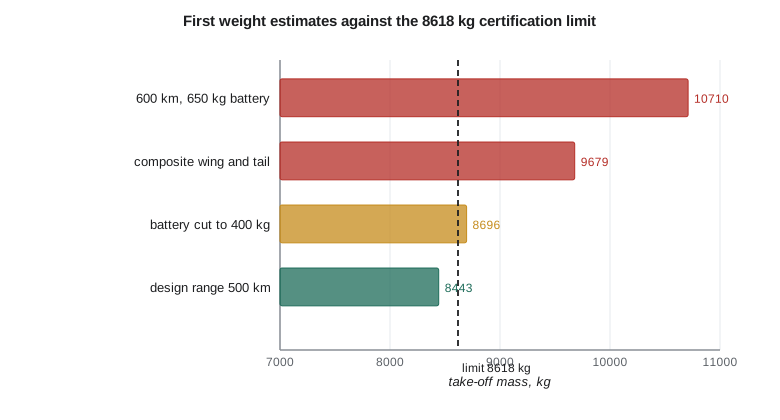
The first pass is sobering. With the 600 km range the operators first asked for and the 650 kg battery Dr. Nakamura first proposed, the loop converges at about 10,700 kg, more than 2000 kg over the limit of the certification category. An aircraft that heavy would have to be certified to transport-category standards, with much higher cost and longer schedules. Élise calls the result a gift: it is much cheaper to learn this on day five than in year three.
Each change is then tested in turn. The composite wing and tail bring the estimate to about 9680 kg, still over. Halving the battery's role, using it for taxi, take-off boost and a few minutes of climb with a generator failed instead of for long electric cruise, cuts the battery to 400 kg and the hybrid penalty to 3.5 percent, giving about 8700 kg, only 78 kg over. Finally, a route study shows that almost all the operators' flights are under 300 km and that a 500 km design range with reserves covers two typical legs without refuelling. With 500 km, the fuel fraction drops to about 0.125 and the loop closes at about 8443 kg, 175 kg under the limit.
The team adopts 8450 kg as the design take-off mass for the next steps. At that mass the program's numbers give an empty mass, including the hybrid systems, of about 5000 kg, a 400 kg battery, about 1050 kg of fuel, 180 kg of crew and 1805 kg of payload. The 168 kg margin to the certification limit is precious. History says empty mass grows during development, often by 5 to 10 percent, so Élise sets a mass target well below the limit and puts the remaining margin under her own control, to be released only for documented reasons.
Growth factors and sensitivities
The sizing equation explains why mass growth is so dangerous. If the empty mass grows by one kilogram, the take-off mass grows by more than one kilogram, because the larger aircraft needs more fuel, a larger wing, more power and more structure to carry the extra kilogram. The ratio is the growth factor:
For the Petrel the denominator is about \(1 - 0.125 - 0.594 = 0.281\), so the growth factor is about 3.6. Every kilogram added to the battery, the payload or a fixed system ultimately adds about 3.6 kg to take-off mass if range and performance are held. This is why the battery decision dominated the first pass, and why Marcus and Dr. Nakamura now track mass at the level of individual components.
Sensitivity studies vary one input at a time to see which assumptions matter most. Arjun's sweep shows that a 1 percent change in the empty fraction moves the take-off mass by about 300 kg, while a 1 percent change in powertrain efficiency moves it by about 40 kg. Uncertainty in the empty-mass regression therefore matters far more than small efficiency gains at this stage, and the team plans an early, more detailed weight estimate by components, which Lesson 10 develops.
Weight estimation methods through the design
Weight estimation becomes more detailed as the design matures. Conceptual design uses whole-aircraft fractions like the regression above. Preliminary design uses component or group weight equations that depend on wing area, span, thickness, load factor, fuselage size and so on; Raymer, Roskam and Torenbeek each give sets of such equations calibrated on many aircraft. Detailed design uses calculated masses from drawings and models, part by part, and finally the aircraft is weighed.
At every stage the estimate carries uncertainty. A weight engineer keeps a weight statement listing every group with its current estimate, its confidence and its maturity. Early estimates often include an allowance for growth, a few percent of empty mass held as a separate line until the design matures. Weighing the first aircraft is a moment of truth: any difference between the statement and the scales becomes the subject of urgent investigation.
Electric and hybrid sizing differences
Battery-electric and hybrid aircraft break some of the assumptions of classic sizing. A battery does not get lighter as it is used, so the aircraft lands at the same mass it would have if it had not used its battery energy; the Breguet equation for fuel does not apply to the battery part. Battery mass is set by the larger of an energy requirement, how many kilowatt-hours are needed, and a power requirement, how many kilowatts it must deliver, each divided by the pack's specific energy or specific power. For the Petrel, the 400 kg pack at about 200 Wh/kg stores about 80 kWh; Lesson 8 checks that this is enough for its jobs.
Batteries also degrade. Their usable capacity falls with cycles and age, and they deliver less in the cold, which matters for the Kivalliq region of Nunavut. The design must meet its requirements with an end-of-life battery at low temperature, not with a new one on a warm day, and the battery thermal management system must keep cells within their operating range on the ground in winter.
Checking the estimate against existing aircraft
A sizing result is only believable if it sits sensibly among aircraft that already fly. Arjun plots the Petrel's estimated empty mass against take-off mass on the same chart as the regression's source data, a scatter of twin turboprops from small commuters to regional types. The Petrel sits slightly above the line, as it should: its composite structure saves mass, but its hybrid systems, battery and extra cabling add more. A point far below the line would be a warning that the technology factors were too hopeful; a point far above it would suggest the hybrid system has not been designed tightly enough to compete.
The same check is made on individual fractions. The fuel fraction for the design mission is compared with the block fuel of conventional 19-seat turboprops on similar stage lengths; the payload fraction is compared with the same aircraft, and the useful load, payload plus fuel, is compared with the operators' current fleet. Sam brings the operators' actual load records to this meeting. They show that full passenger loads on the longest legs are rare and that freight usually fills the remaining capacity, which supports the decision to trade range for take-off mass rather than cut the cabin.
Mass definitions the team agrees on
Weight engineers use precise terms, and confusion between them causes real errors. Manufacturer's empty mass is the mass of the aircraft as built, with its structure, systems, engines and fixed equipment. Operating empty mass adds the items an operator carries on every flight: crew, unusable fuel and oil, galley items, manuals and emergency equipment. Zero-fuel mass adds the payload. Take-off mass adds the fuel used for the flight and the reserves. The maximum zero-fuel mass is a structural limit, because fuel in the wing relieves bending, so a wing carrying a full cabin but no fuel is in its worst bending case. For the Petrel the battery is counted in the operating empty mass, because it is always carried.
Élise insists on these definitions in every document from now on. The sizing program's empty mass is a manufacturer's empty mass with the hybrid systems included; the crew, the battery and operator items are added separately. When the Lesson 10 balance work begins, every item in the mass statement will be tagged with which of these totals it belongs to.
How much margin to hold
Aircraft almost always grow heavier during development. New requirements appear, parts turn out heavier than their estimates, and fixes for test findings add mass. Historical data for new aircraft programmes show empty mass rising by several percent between the first estimate and first flight. A design that starts exactly at its limit therefore has a problem waiting for it. The Petrel's 8450 kg sits only 168 kg below the certification limit, which is a thin margin for a new hybrid. Kenji's response is a mass management plan: each group owner gets a target mass, a review each month compares the current estimates with the targets, and any growth must be paid for by savings elsewhere or approved by the chief engineer. The fallback, written into the plan, is to accept a lower full-passenger range rather than exceed the limit.
Worked problem
One sizing pass
Fixed masses are 2385 kg (crew, payload and a 400 kg battery). With a fuel fraction of 0.125 and an empty fraction of 0.594, find take-off mass.
Show solution
- Denominator: \(1 - 0.125 - 0.594 = 0.281\).
- \(W_0 = 2385 / 0.281 = 8488\) kg.
Answer: About 8490 kg; further passes refine the empty fraction and settle near 8443 kg.
Worked problem
Growth factor
With the denominator 0.281, how much does take-off mass grow if a 30 kg cabin heater is added?
Show solution
- Growth factor \(1/0.281 = 3.56\).
- \(30 \times 3.56 = 107\) kg.
Answer: About 107 kg, more than half of the 168 kg margin.
Worked problem
Battery mass by energy
A hybrid needs 64 kWh of usable battery energy, and only 80 percent of the pack is usable. At 200 Wh/kg, what pack mass is needed?
Show solution
- Total energy \(64 / 0.8 = 80\) kWh.
- Mass \(80\,000 / 200 = 400\) kg.
Answer: 400 kg, the Petrel's chosen pack.
Common mistakes
MistakeTreating the first sizing result as final.
InsteadIt is a first estimate to test feasibility; refine it as the design matures.
MistakeApplying an empty-mass regression without technology corrections.
InsteadAdd factors for new materials and for systems the historical fleet did not have.
MistakeCounting a kilogram added to a system as just one kilogram.
InsteadThe growth factor multiplies it, about 3.6 times on the Petrel.
MistakeSizing the battery with new-cell, warm-day capacity.
InsteadDesign to end-of-life capacity at the coldest operating temperature.
Summary and key terms
- Initial sizing finds the take-off mass that closes the design mission, using fixed masses, a mission fuel fraction and a historical empty-mass fraction.
- Because the empty fraction depends on take-off mass, the equation is iterated.
- The Petrel's first pass at 600 km with a 650 kg battery was 2100 kg over the 8618 kg limit; composites, a smaller battery and a 500 km design range closed it at about 8443 kg.
- The growth factor of about 3.6 shows why mass control matters from the first day.
- Take-off mass
- The total mass at brake release, the sum of crew, payload, fuel, battery and empty mass.
- Empty-mass fraction
- Empty mass divided by take-off mass, estimated from historical regressions.
- Sizing loop
- The iteration that finds a take-off mass consistent with its own empty-mass fraction.
- Technology factor
- A multiplier on a historical estimate to credit new materials or methods.
- Growth factor
- The increase in take-off mass for each kilogram of fixed mass added.
- Weight statement
- A list of group or component masses with their current estimates.
Practice problems
Work each problem on paper first, then reveal the answer to check.
What take-off mass does the program find for the first pass?
Show answer
About 10,710 kg.
Which change brought the estimate under the limit?
Show answer
Reducing the design range from 600 to 500 km, after the composite and battery changes.
What design take-off mass does the team adopt?
Show answer
8450 kg.
What is the Petrel's growth factor?
Show answer
About 3.6.
Why is a battery a fixed mass in the sizing equation?
Show answer
Its mass is set by energy and power needs and does not burn off.
What does a technology factor of 0.95 represent here?
Show answer
About 5 percent less empty mass from composite wing and tail.
Lesson quiz · 5 questions
Score 60% or more to complete this lesson.
Create a free account to save your progress, take quizzes and earn a certificate.