
AERO-410 · Lesson 10 of 12 · 25 min
Weight and balance
An aircraft must be light enough to meet its mission and balanced so that its centre of gravity stays within limits for every way it can be loaded. Weight and balance work starts in conceptual design with a group weight statement and a first CG estimate, and it never stops: it continues through detailed design, the weighing of every aircraft built, and the load sheet a pilot or dispatcher completes before each flight. For the Petrel, balance is a particular challenge, because the hybrid adds heavy items, the battery and generators, whose positions are free choices, and because a long cabin and a rear cargo bay let the payload move the CG a long way.
The group weight statement
A group weight statement lists the aircraft's empty mass in standard groups: structure (wing, fuselage, tails, landing gear), propulsion, systems and furnishings. For each group the statement gives a mass and an arm, the distance of the group's CG from a reference datum, here the tip of the nose. Multiplying each mass by its arm gives a moment, and the CG of the whole is the total moment divided by the total mass:
Marcus's group assembles the Petrel's first statement from the group-weight methods mentioned in Lesson 2, checked against the sizing estimate. Each group has an owner who is responsible for its mass and arm, and each value carries a maturity tag, from early estimate to calculated from drawings to weighed. At this stage all are estimates.
| Group | Mass, kg | Arm from nose, m |
|---|---|---|
| Wing | 760 | 7.10 |
| Fuselage | 1050 | 7.60 |
| Horizontal tail | 120 | 14.90 |
| Vertical tail | 105 | 14.60 |
| Main landing gear | 300 | 7.65 |
| Nose landing gear | 75 | 1.20 |
| Motors, propellers and nacelles | 520 | 5.50 |
| Turboshaft generators | 560 | 6.10 |
| Power electronics and cables | 330 | 7.20 |
| Fuel system | 95 | 7.00 |
| Flight controls | 140 | 9.00 |
| Avionics and electrical | 260 | 2.40 |
| Hydraulics and de-icing | 160 | 6.80 |
| Furnishings and cabin systems | 360 | 8.10 |
| Operating items and fluids | 172 | 6.60 |
Expressing the CG as percent MAC
A CG position in metres from the nose means little on its own. What matters is where it sits relative to the wing, because that sets the stability and the tail loads. Designers express the CG as a percentage of the mean aerodynamic chord, measured from its leading edge. On the Petrel the leading edge of the mean aerodynamic chord sits 6.40 m from the nose and the chord is 2.01 m long, so a CG at 7.00 m is at \((7.00 - 6.40)/2.01 = 29.9\) percent MAC. For most conventional aircraft the CG range lies roughly between 10 and 40 percent MAC.
# Petrel 19 group weight statement and centre of gravity envelope.
mac, lemac = 2.01, 6.40                         # mean aerodynamic chord and its leading edge from the nose, m
pc = lambda x: (x - lemac) / mac * 100
def groups(gen_arm):  # (item, mass kg, arm m from nose)
    return [("wing", 760, 7.10), ("fuselage", 1050, 7.60), ("horizontal tail", 120, 14.90), ("vertical tail", 105, 14.60),
            ("main landing gear", 300, 7.65), ("nose landing gear", 75, 1.20), ("motors, props and nacelles", 520, 5.50),
            ("turboshaft generators", 560, gen_arm), ("power electronics and cables", 330, 7.20), ("fuel system", 95, 7.00),
            ("flight controls", 140, 9.00), ("avionics and electrical", 260, 2.40), ("hydraulics and de-icing", 160, 6.80),
            ("furnishings and cabin systems", 360, 8.10), ("operating items and fluids", 172, 6.60)]
def oew(gen_arm):
    g = groups(gen_arm); m = sum(x[1] for x in g); return m, sum(x[1] * x[2] for x in g)
for name, arm in (("generators in the aft fuselage", 9.60), ("generators in the wing nacelles", 6.10)):
    m, mom = oew(arm)
    print(f"{name:32s}: empty {m} kg, CG {mom / m:.2f} m = {pc(mom / m):5.1f} percent MAC")
m, mom = oew(6.10)
battery, crew = (400, 6.60), (180, 2.30)        # battery under the cabin floor ahead of the wing
seats = [4.40 + 0.76 * r for r in range(7)]       # row arms; 3 seats in rows 1-6, 1 seat in row 7
m0, M0 = m + battery[0] + crew[0], mom + battery[0] * battery[1] + crew[0] * crew[1]
print(f"plus crew and battery: {m0} kg, CG {pc(M0 / m0):.1f} percent MAC")
def load(order, mm=m0, MM=M0):
    pts = [pc(MM / mm)]
    for r in order:
        n = 1 if r == 6 else 3
        mm += 95 * n; MM += 95 * n * seats[r]; pts.append(pc(MM / mm))
    return mm, MM, pts
for name, order in (("front to back", list(range(7))), ("back to front", list(range(6, -1, -1)))):
    mm, MM, pts = load(order)
    print(f"passengers boarded {name}: CG between {min(pts):.1f} and {max(pts):.1f} percent MAC")
mm, MM, _ = load(range(7))
for fuel in (0, 1054):
    mt, Mt = mm + fuel, MM + fuel * 7.05
    print(f"full cabin, fuel {fuel:4d} kg: {mt} kg, CG {pc(Mt / mt):.1f} percent MAC")
lo, hi = 11.0, 36.0
print(f"limits {lo:.0f} and {hi:.0f} percent MAC = {lemac + lo / 100 * mac:.2f} and {lemac + hi / 100 * mac:.2f} m from the nose")
Vh, eta_t, at_a, deps, dfus = 0.90, 0.90, 0.72, 0.40, 0.10   # fuselage and nacelles move the neutral point forward
hn = 0.25 + Vh * eta_t * at_a * (1 - deps) - dfus
print(f"stick-fixed neutral point about {hn * 100:.0f} percent MAC; static margin at the aft limit {hn * 100 - hi:.0f} percent MAC")generators in the aft fuselage : empty 5007 kg, CG 7.47 m = 53.0 percent MAC generators in the wing nacelles : empty 5007 kg, CG 7.07 m = 33.6 percent MAC plus crew and battery: 5587 kg, CG 24.2 percent MAC passengers boarded front to back: CG between 12.8 and 24.2 percent MAC passengers boarded back to front: CG between 18.8 and 30.0 percent MAC full cabin, fuel 0 kg: 7392 kg, CG 18.8 percent MAC full cabin, fuel 1054 kg: 8446 kg, CG 20.5 percent MAC limits 11 and 36 percent MAC = 6.62 and 7.12 m from the nose stick-fixed neutral point about 50 percent MAC; static margin at the aft limit 14 percent MAC
Where to put the generators
The program's first result shows why the CG estimate must start early. In an early layout the two turboshaft generators sat in the aft fuselage, behind the cabin, where they were easy to reach and far from the passengers' windows. With that arrangement the empty CG lands at 53 percent MAC, far behind any workable aft limit and behind the neutral point. Moving the wing aft to follow the CG would lengthen the tail arm ahead and shorten it behind, needing a larger tail, and the loaded CG would still swing widely. Moving the generators into the wing nacelles, behind the motors, puts their 560 kg near the wing and brings the empty CG to 33.6 percent MAC. This is the decision recorded in Lesson 4 and the reason the nacelles are as large as they are.
Adding the crew in the cockpit and the 400 kg battery under the floor ahead of the wing brings the CG forward to 24.2 percent MAC at 5587 kg. That is the operating empty condition, with no passengers, freight or usable fuel, and it sits nicely in the middle of the range the team wants.
Loading cases and the loading loop
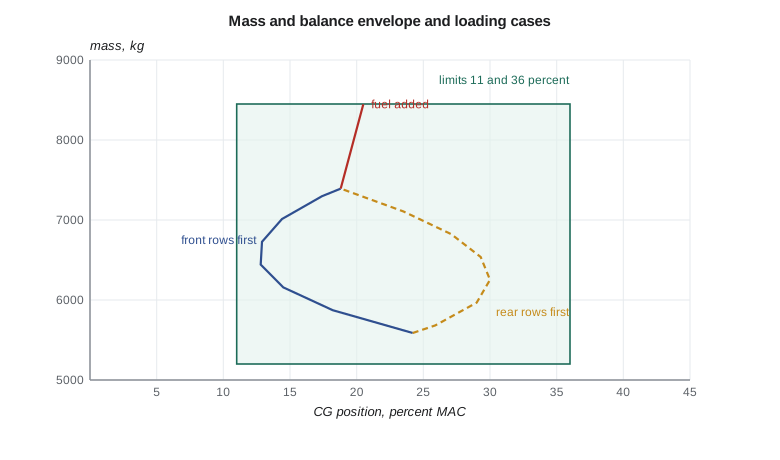
Passengers do not board all at once, and they do not sit where the designer would like. The standard check is to load passengers row by row from the front and from the back and plot the CG after each row. The resulting curves are often called a loading loop or, because of their shape, a potato plot. Each passenger is counted at the planning mass of 95 kg from Lesson 1, and the rows are 0.76 m apart starting 4.40 m from the nose.
Front-to-back boarding moves the CG forward first, because the front rows are ahead of the CG, to a minimum of 12.8 percent MAC; the later rows bring it back. Back-to-front boarding does the reverse, moving the CG aft to a maximum of 30.0 percent MAC before the front rows bring it forward again. Both curves end at the same point: 7392 kg with a full cabin at 18.8 percent MAC. Adding the 1054 kg of mission fuel, whose tanks sit at 7.05 m in the wing, moves the CG aft to 20.5 percent MAC at 8446 kg, just under the 8450 kg design mass.
Setting the limits
The CG limits must contain every loading case with some margin, and they must be achievable by the tail and the landing gear. The aft limit is set by stability: with the tail of Lesson 7, the stick-fixed neutral point sits at about 50 percent MAC, so an aft limit of 36 percent leaves a static margin of 14 percent of the chord. The forward limit is set by control: the elevator must be able to flare the aircraft and rotate it at take-off with the CG forward, flaps down and the aircraft in ground effect. The team sets the limits at 11 and 36 percent MAC, which are 6.62 m and 7.12 m from the nose, the values Lesson 9 used to place the wheels.
The range of 25 percent MAC is wider than the passenger loops need, between 12.8 and 30.0 percent. The extra room is for freight. The rear cargo bay sits far aft of the CG, about 11.5 m from the nose, and a few hundred kilograms there moves the CG aft by several percent MAC. The forward room protects against cases where passengers sit in the front rows with the rear bay empty and little fuel aboard. Each such case is listed in the loading manual with instructions, for example that freight above a certain mass in the rear bay requires passengers to fill the front rows first.
Fuel and battery in the balance
Fuel burn changes the CG during the flight, and the aircraft must be within limits at every point between take-off and landing. On the Petrel the fuel tanks sit close to the CG, at 7.05 m, so burning fuel moves the CG only by about 2 percent MAC across the mission. Large aircraft use tank sequencing or even transfer fuel to the tail to manage the CG in flight; the Petrel does not need this.
The battery does not burn off. Its mass stays at the same arm from engine start to shutdown, which simplifies the loading calculation but means its arm must be chosen carefully at design time. The team placed it ahead of the wing to balance the generators in the nacelles and the heavy rear cargo door. If a future battery of higher specific energy allows a lighter pack, the empty CG will move aft, and the loading manual or a small ballast item will need revision. Sam notes that operators dislike permanent ballast, because it is mass that earns nothing, and asks that any lighter battery be designed so its bay can move forward instead.
Weighing and control in service
Every aircraft built is weighed before delivery, usually on three load cells under the wheels or jacking points, and its empty mass and CG are recorded in its weight and balance report. Aircraft are reweighed periodically and after modifications, because repairs, paint, added equipment and accumulated dirt and moisture change the mass over the years. The operator uses the weighed values with the loading manual to complete a load sheet for each flight, showing the take-off mass and CG and confirming that both are within limits. For the Petrel the load sheet software will also include the battery's state of charge and temperature, tying the weight and balance check to the take-off power check from Lesson 8.
Worked problem
Empty CG
The 15 groups total 5007 kg with a moment of 35 400 kg m. Find the CG in metres and percent MAC (LEMAC 6.40 m, MAC 2.01 m).
Show solution
- \(x_{cg} = 35\,400/5007 = 7.07\) m.
- \((7.07 - 6.40)/2.01 = 0.333\), about 33 percent MAC.
Answer: About 7.07 m, or 33 to 34 percent MAC.
Worked problem
Freight in the rear bay
At 7392 kg the CG is at 18.8 percent MAC. Find the new CG after loading 300 kg of freight at 11.5 m.
Show solution
- Present CG \(= 6.40 + 0.188 \times 2.01 = 6.778\) m; moment \(= 7392 \times 6.778 = 50\,100\) kg m.
- New moment \(= 50\,100 + 300 \times 11.5 = 53\,550\) kg m; \(x = 53\,550/7692 = 6.962\) m, which is \((6.962 - 6.40)/2.01 = 28.0\) percent MAC.
Answer: About 28 percent MAC, still inside the 36 percent limit, though fuel must then be limited to keep within the maximum take-off mass.
Worked problem
Static margin
The neutral point is at 50 percent MAC and the aft limit at 36 percent. Find the static margin at the aft limit.
Show solution
- Static margin \(= h_n - h\).
- \(0.50 - 0.36 = 0.14\).
Answer: 14 percent MAC.
Common mistakes
MistakePlacing heavy items for convenience without checking balance.
InsteadRun the CG estimate from the first layout; aft generators gave 53 percent MAC.
MistakeChecking only the fully loaded case.
InsteadCheck loading loops and partial loads, with fuel added and burned.
MistakeSetting CG limits exactly at the loading extremes.
InsteadLeave room for freight cases and growth.
MistakeTreating the battery like fuel.
InsteadIts mass and arm stay fixed for the whole flight.
Summary and key terms
- The Petrel's group weight statement gives an empty mass of 5007 kg.
- Moving the generators from the aft fuselage to the wing nacelles brings the empty CG from 53 to 33.6 percent MAC.
- With crew and battery the operating empty CG is 24.2 percent MAC.
- Passenger loading loops span 12.8 to 30.0 percent MAC, and fuel moves the CG about 2 percent.
- The limits are 11 and 36 percent MAC, leaving a 14 percent static margin at the aft limit and room for freight in the rear bay.
- Group weight statement
- A list of empty-mass groups with their masses and arms.
- Arm
- The distance of an item's CG from the reference datum.
- Percent MAC
- A CG position measured from the leading edge of the mean aerodynamic chord as a percentage of its length.
- Loading loop
- A plot of CG against mass as passengers or cargo are added in a given order.
- Load sheet
- The record of mass and CG prepared for each flight.
- Ballast
- Mass added only to move the CG.
Practice problems
Work each problem on paper first, then reveal the answer to check.
What is the Petrel's empty mass?
Show answer
5007 kg.
Where would the empty CG be with the generators in the aft fuselage?
Show answer
About 53 percent MAC.
What is the operating empty CG?
Show answer
24.2 percent MAC at 5587 kg.
What range do the passenger loading loops span?
Show answer
12.8 to 30.0 percent MAC.
What are the CG limits in metres?
Show answer
6.62 m and 7.12 m from the nose.
Why does fuel burn move the CG only a little?
Show answer
The tanks are close to the CG.
Lesson quiz · 5 questions
Score 60% or more to complete this lesson.
Create a free account to save your progress, take quizzes and earn a certificate.