
ROOF-110 · Lesson 1 of 12 · 25 min
The roofing trade
▶ Video coming soon A video version of this lesson is on the way.
Every building has a roof, and sooner or later every roof needs a roofer. The roof takes the worst of the weather. On a clear summer afternoon a dark membrane can reach 160 to 175 °F, far hotter than the air. In winter the same roof carries snow, ice and wind, and it freezes and thaws over and over. Rain, hail, ultraviolet light and the building's own warm, moist air work on it all year. When a roof fails, water gets into insulation, ceilings, walls, wiring and stock, and a small leak can turn into a large repair bill. Roofers build, repair and replace the layers that keep all of that out. It is skilled, physical, outdoor work, and on most days it is done at height.
This course is the first roofing course in the Roofer program. It follows Rory Quintero, a first-year apprentice at Ridgecap Roofing in Columbus, Ohio, through his first season on the tools. Rory's foreperson is Dana Renaud, a journeyworker with 21 years in the trade who runs Ridgecap's Crew 2, the commercial low-slope crew. Dana has one rule she repeats until the apprentices can say it for her: "Plan the roof before you climb it." By the end of the course you will see why. Most of what goes wrong on a roof, from a fall to a fire to a soaked ceiling below, starts with something nobody planned.
Ridgecap is an invented company, but it is a typical one. It employs about 48 field workers in the busy season, split into six crews, plus seven people in the office. About 60 in every 100 dollars of its work comes from commercial and industrial low-slope roofs: strip plazas, warehouses, schools and apartment buildings. About 30 in 100 comes from houses with steep roofs, mostly asphalt shingles with some metal. The rest is sheet metal flashing, gutters and service calls. The owner, Glen Pelham, started as a roofer himself. Anjali Mukherjee, the safety and training coordinator, writes the fall protection plans, issues hot-work permits and keeps the training records. Rory's first week was mostly spent with her.
What roofers do
A roofer's job is to make a roof watertight and keep it that way. That covers several kinds of work:
- New construction: installing the complete roof system on a new building, from the vapor retarder and insulation to the membrane or shingles and the flashings.
- Re-roofing: removing an old roof (a tear-off) and installing a new one, often on an occupied building with people working or living underneath.
- Recovering: installing a new roof over an existing one where the building and the rules allow it, after checking that the old roof is dry and the structure can carry the extra weight.
- Repair and service: finding and fixing leaks, replacing damaged sections, resealing flashings and clearing drains.
- Inspection and maintenance: walking roofs on a schedule, reporting problems and doing small repairs before they grow.
- Sheet metal and flashing: forming and installing metal copings, counterflashings, drip edges, gutters, downspouts and, on some jobs, complete metal roofs.
On any given day a roofer may carry materials, run a kettle or a torch, cut and fit insulation boards, lay membrane, nail shingles, bend metal on a portable brake, seal penetrations around pipes and vents, clean up and load debris. Good roofers also read drawings and specifications, measure roofs, estimate materials and talk with building owners. Forepersons plan the work, set up the safety systems and make sure the roof is watertight before the crew leaves each night.
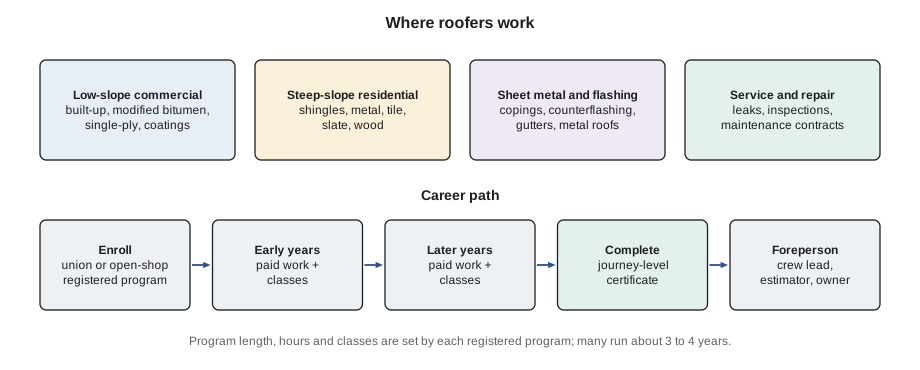
The sectors of the trade
Roofing splits into a few sectors. Most roofers spend most of their careers in one or two of them, although apprentices are expected to learn the basics of all.
Low-slope roofing covers roofs that look flat from the ground. They are never truly flat; they are built with a slight slope so water drains to roof drains, scuppers or gutters. Commercial, industrial and institutional buildings mostly have low-slope roofs. The main systems are built-up roofing (layers of felt and hot asphalt with a gravel or cap sheet surface), modified bitumen (factory-made sheets of asphalt modified with rubber or plastic, applied with a torch, hot asphalt, cold adhesive or self-adhesive backing), single-ply membranes (sheets of thermoplastic or rubber, such as TPO, PVC and EPDM, welded with hot air or glued at the seams), spray polyurethane foam, and liquid-applied coatings. Low-slope crews are often larger and work with heavier equipment: kettles, torches, hot-air welders, power cutters for tear-off and hoists or cranes for loading.
Steep-slope roofing covers roofs where you can see the roof surface from the street. Houses are the classic example, but churches, small commercial buildings and some condominium projects also have steep roofs. The coverings are shed-type materials that overlap like fish scales so water runs off them: asphalt shingles, metal panels and shingles, clay and concrete tile, slate and wood shakes and shingles. Steep-slope crews tend to be smaller and move between more jobs. The hazards are different too. On a steep roof the surface itself tries to throw you off, so fall protection is needed almost everywhere on the roof, not just near the edges.
Sheet metal work is part of almost every roof. Metal flashings close the joints where a roof meets a wall, a chimney, a skylight, a curb or the edge of the building. Metal copings cap parapet walls. Gutters and downspouts carry water away. Some roofing companies have their own sheet metal shop and mechanics; others buy flashings from a sheet metal contractor. Either way, roofers install a lot of metal and need to understand how it sheds water and how it moves with temperature.
Service and repair is a sector of its own. A good service roofer is part detective: water can travel a long way inside a roof before it shows up on a ceiling, so finding a leak means understanding how the roof was built. Service work also brings roofers onto roofs they did not build, often in bad weather, sometimes alone. That makes planning and fall protection even more important.
| Sector | Typical buildings | Typical materials | Key hazards |
|---|---|---|---|
| Low-slope commercial | plazas, warehouses, schools, apartments | built-up, modified bitumen, TPO, PVC, EPDM, coatings | unprotected edges, skylights, hot asphalt, torches, heavy loads |
| Steep-slope residential | houses, churches, small commercial | asphalt shingles, metal, tile, slate, wood | slope itself, ladders, nail guns, heat, power lines |
| Sheet metal and flashing | all roofs | galvanized steel, aluminum, copper, prefinished steel | sharp edges, edge work, hand cuts, wind on panels |
| Service and repair | any building | whatever is on the roof | unfamiliar roofs, bad weather, working alone |
A day on Crew 2
Rory's first full week was on a tear-off at a small office building. The crew met at the Ridgecap yard at 6:30 in the morning. Marco Lindell, the kettle operator and lead hand, loaded the trailer while Dana went over the day with the crew. The plan covered how much roof would be torn off, how the debris would come down, where the guardrails and barrier lines were, who was on the torch, where the extinguishers would be and what the forecast said about wind and rain. Rory noticed that nobody touched a tool until that talk was done.
On site, the first hour went to setting up. The hoist went up at the back of the building with guardrails on both sides of the landing. The crew set a barrier line back from the open edges and clamped guardrail posts to the low parapet at the front. The disposal bin was placed under the chute, with barricades around it. Only then did the tear-off begin. By early afternoon the torn-off section was covered with new base sheet and the crew was torching the cap sheet. At 2:30 the torch went out for the day. For the next two hours Marco walked every seam and flashing as fire watch while the others cleaned up. At the end of the day the roof was watertight, the debris was gone and the edges were still protected.
"Most of roofing is not the roofing," Dana told him on the drive back. "It's the setup, the loading, the weather, the cleanup and keeping everyone in one piece. If you get those right, the roofing part is the easy part."
Apprenticeship and certification
In the United States, roofing apprenticeship is organized in two main ways. In union shops, apprentices enter a registered program run jointly by the employers and the local of the United Union of Roofers, Waterproofers and Allied Workers. In open-shop (non-union) companies, apprentices may join a registered apprenticeship sponsored by the employer, an employer association or a training center. In Ohio, registered programs are approved and overseen through ApprenticeOhio, the state apprenticeship agency, and many programs combine on-the-job hours with classroom hours each year for about three to four years. Completing a registered apprenticeship earns a nationally recognized completion certificate and journey-level status. There is no single national roofing license; licensing is handled by states and cities, as described below. Many roofers also earn voluntary credentials, such as OSHA 10-hour or 30-hour construction outreach cards and manufacturer certifications.
Rory enrolled in Ridgecap's registered program in his first month. Ridgecap logs his hours by task: tear-off, low-slope installation, steep-slope installation, flashing, safety systems and so on. Dana signs off on skills as he shows them, and he attends classes in the winter, when roofing slows down. Keisha Grant, a second-year apprentice on the steep-slope crew, has already finished her first year of classes and warned him that they include math, drawings and building science as well as safety.
Licensing and the rules that govern roofing work
Roofing work in Ohio is governed by several layers of rules. The federal Occupational Safety and Health Act applies to private employers, and Ohio has no state plan for private-sector workers, so federal OSHA enforces the rules. The construction standards in 29 CFR Part 1926 include Subpart M (fall protection), Subpart X (ladders) and many others that apply to roofing. Ohio does not issue a state license to roofing contractors; the Ohio Construction Industry Licensing Board covers trades such as electrical, plumbing and HVAC, but not roofing. Cities and counties may require registration or licensing. In Columbus, contractors doing roofing on one- to three-family homes need a Home Improvement Limited Contractor license from the city, and building permits are required for some roofing work. Fire codes adopted by the state and city cover kettles, propane and hot work.
Rules change. Regulations are amended, new training requirements come into force and codes are updated on a cycle. A good roofer does not try to memorize every rule; instead, they know where the rules live, they check the current version and they ask their supervisor or safety coordinator when something is unclear. In this course you will see section numbers and dates so you can look up the rules yourself. Always check that you are reading the current version.
| Who | Main duties on a roofing job |
|---|---|
| Employer | provide training, equipment and safe systems of work; write and enforce procedures; keep records |
| Supervisor or foreperson | plan the work, set up protection, make sure workers follow the rules, tell workers about hazards |
| Worker or apprentice | work safely, use the protection provided, report hazards and injuries, refuse unsafe work |
| OSHA compliance officer | inspect sites, investigate incidents, issue orders or citations |
| Building owner | tell the contractor about known hazards (for example asbestos or weak decks), give access, coordinate occupants |
Your rights and duties as a new worker
As a worker in the United States you have rights under the Occupational Safety and Health Act: the right to a workplace free of recognized serious hazards, the right to training in a language you understand, the right to see records of injuries and hazards, the right to report an injury or file a complaint with OSHA, and protection from retaliation for using those rights. You are expected to follow your employer's safety rules, use the protective equipment provided and report hazards. If you face an imminent danger and there is no time to fix it through normal channels, you may refuse to do the dangerous task after asking your employer to correct the hazard.
New workers are injured far more often than experienced ones, and roofing is one of the construction trades with the highest rate of serious and fatal falls. That is not because new workers are careless. It is because they do not yet know what they do not know. Anjali gave Rory a short list on his first day:
- Ask before you climb. If you do not know how you will be protected on a roof, you are not ready to go up.
- Speak up. If something looks wrong, tell Dana or the lead hand right away.
- Report every injury, including small cuts and burns, the same day.
- Never remove or bypass a guardrail, barrier line or cover without permission and a plan to protect the opening.
- Never work on a roof alone without a check-in plan.
Rory wrote the list in the notebook he keeps in his chest pocket. Dana checks it every Friday.
Skills and habits of a good roofer
Roofing rewards people who are fit, careful and good with their hands, but those are not the only skills. The roofers Rory admires most share a few habits. They read the weather every morning and keep watching it all day. They measure twice and cut once, because wasted membrane and metal cost money. They keep a clean roof, since loose materials and debris are trip hazards and can blow off the roof. They understand how water moves, so they lap materials the right way and never leave a joint that faces uphill. They respect hot work. And they look after their crew.
Math matters too. Roofers work out roof areas and slopes, count bundles and rolls, measure flashing lengths and calculate setbacks for barrier lines. The worked example below shows the kind of planning that apprentices start with: how long the apprenticeship itself takes.
Worked problem
Planning an apprenticeship
Rory's registered program requires about 6,000 hours of on-the-job training over the program and about 144 hours of classes each year. Ridgecap works 40-hour weeks for about 34 weeks of the year, with classes in the winter. Roughly how many seasons will it take Rory to log the on-the-job hours?
Show solution
- Work hours per season: 40 × 34 = 1,360 hours.
- Seasons needed: 6,000 ÷ 1,360 ≈ 4.4 seasons.
- Classes are taken each winter alongside the program.
Answer: About four and a half seasons. Some programs count overtime and winter work, which can shorten it; the program hours used here are an example, so check the actual program standard.
Safety culture on a roofing crew
Roofing has hazards that are easy to see, such as edges, ladders, kettles and torches, and hazards that are easy to miss, such as heat, sun, dust and the slow damage to backs, shoulders and knees from years of lifting and kneeling. A good safety culture deals with both. On Crew 2 that culture shows up in small ways: the daily toolbox talk, the fact that Dana walks the roof before the crew goes up, the habit of calling out "hot" when someone carries a mop of asphalt, and the expectation that anyone can stop the work if something looks wrong.
Safety also depends on the hierarchy of controls, which you met in TRD-101. The most effective controls remove or reduce the hazard itself: a guardrail that stops anyone reaching the edge, a self-adhered membrane that needs no torch near a wood curb, a crane that lifts a pallet instead of a worker carrying bundles up a ladder. Next come procedures and training, such as hot-work permits and lift plans. Personal protective equipment, such as harnesses, gloves and safety glasses, is the last line of defense. You will see this order of thinking in every lesson of this course.
Dana explained it to Rory with an example from his first week. "We could have put everyone in harnesses on that office roof. Instead we used the barrier line and the guardrail at the hoist, so nobody needed to tie off for most of the day. Harnesses are good, but a harness only works after you've already fallen. The guardrail means you never fall."
Common mistakes
MistakeThinking roofing is only about the roofing materials.
InsteadMost of the work, and most of the risk, is in setup, loading, weather, hot work and cleanup. Plan those as carefully as the roof itself.
MistakeAssuming that because Ohio has no state roofing license, training does not matter.
InsteadFederal OSHA rules apply on every job, city licenses may apply, and a registered apprenticeship proves skill to employers and customers.
MistakeStaying quiet about a hazard because you are new.
InsteadNew workers are expected to ask and to report hazards. Supervisors would rather answer a question than file an injury report.
MistakeRelying on a harness as the first choice.
InsteadUse the hierarchy of controls: guardrails and other measures that keep people away from the edge come before personal fall protection.
Summary and key terms
- Roofers build, replace, repair and maintain the layers that keep weather out of buildings, including the metal flashings.
- The trade divides into low-slope commercial, steep-slope residential, sheet metal and flashing, and service and repair.
- In the US, roofers train through union or open-shop registered apprenticeships; Ohio has no state roofing license, but Columbus licenses residential roofing contractors.
- Federal OSHA's 29 CFR 1926 standards govern construction safety in Ohio, including Subpart M for fall protection and Subpart X for ladders.
- Workers have the right to know, to participate and to refuse or report unsafe work, and the duty to follow the rules and report hazards.
- A strong safety culture uses the hierarchy of controls and plans every job before anyone climbs.
- Low-slope roof
- A roof with a gentle slope that looks flat, covered by a continuous membrane; most commercial roofs are low-slope.
- Steep-slope roof
- A roof steep enough to shed water with overlapping materials such as shingles, metal, tile or slate.
- Tear-off
- Removing an existing roof covering down to the deck or to a sound layer before re-roofing.
- Flashing
- A piece of membrane or metal that seals a joint where the roof meets a wall, edge, curb or penetration.
- Registered apprenticeship
- A formal training agreement combining paid work hours with classroom training, recorded with the government apprenticeship authority.
- Toolbox talk
- A short safety meeting held at the start of a shift or task.
Practice problems
Work each problem on paper first, then reveal the answer to check.
Name the four main sectors of the roofing trade.
Show answer
Low-slope commercial, steep-slope residential, sheet metal and flashing, and service and repair.
What is the difference between re-roofing and recovering?
Show answer
Re-roofing removes the old roof first; recovering installs a new roof over the old one where allowed.
Which OSHA subpart covers fall protection in construction?
Show answer
Subpart M of 29 CFR Part 1926.
Does Ohio issue a state roofing contractor license?
Show answer
No. The state licensing board does not cover roofers, but cities such as Columbus may license roofing contractors.
Name two ways to become an apprentice roofer in the US.
Show answer
Through a union joint apprenticeship program, or through an open-shop registered apprenticeship sponsored by an employer or association.
Lesson quiz · 5 questions
Score 60% or more to complete this lesson.
Create a free account to save your progress, take quizzes and earn a certificate.