
ROOF-110 · Lesson 5 of 12 · 20 min
Personal protective equipment
▶ Video coming soon A video version of this lesson is on the way.
On Rory's first morning, Anjali laid a pile of gear on the table in the Ridgecap office: a hard hat with a chin strap, safety glasses with clear and tinted lenses, earplugs and earmuffs, two kinds of gloves, a high-visibility vest, a full-body harness, knee pads and a tube of sunscreen. Rory had brought his own boots. Anjali checked them, found the right marking on the label and nodded. "Everything on this table is the last line of defense," she said. "We try to fix hazards before they reach you. But on a roof, there are always some left over, and this is what stands between them and you."
Personal protective equipment (PPE) is gear worn by the worker to reduce exposure to a hazard. In the hierarchy of controls it comes last, after eliminating hazards, substituting safer methods or materials, engineering controls such as guardrails and ventilation, and administrative controls such as procedures and training. PPE is last not because it is unimportant, but because it depends on being chosen correctly, fitted properly, worn every time and kept in good condition. If any of those fail, the protection fails. This lesson covers the PPE roofers use every day except fall protection equipment, which has its own lessons.
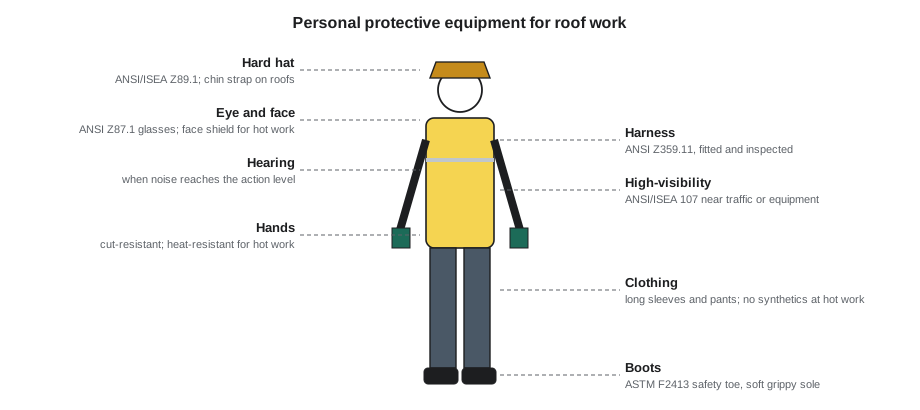
Who provides PPE and who wears it
Under OSHA's construction standards (29 CFR 1926 Subpart E and the general PPE rules), employers must provide the PPE workers need and pay for most of it. There are a few exceptions, such as ordinary safety-toe boots that workers may wear off the job, which employers are not required to pay for. Employers must assess the hazards, choose suitable PPE, make sure it fits and is maintained, and train workers in when and how to use it. Workers must wear the PPE that the job requires.
At Ridgecap, the rule is simple. PPE is worn by everyone in the work area, including the owner and visitors, and anyone who sees someone without it says so. Dana once sent a building manager back to his car for a hard hat before he could walk the roof with her.
Head protection
A hard hat protects against falling objects and bumps. OSHA requires head protection where there is a danger of head injury from impact, falling or flying objects, or electrical shock and burns, and hard hats must meet ANSI/ISEA Z89.1. Type I hats protect mainly against blows to the top of the head; Type II hats also protect against blows to the front, back and sides, and many contractors now require them. The class (such as Class E) shows the voltage protection the shell gives.
Roofers need two extra features. First, a chin strap: on a roof, a hat that blows or falls off when you bend over is useless, and it can strike someone below. Second, sun protection: a brim and a neck flap or shade cut down sun exposure on hot days. Never drill holes in a hard hat, paint it or put stickers over cracks. Replace the suspension and the shell according to the manufacturer's schedule, and replace any hat that has taken a hard blow, even if it looks fine. Sunlight breaks down the plastic over time, so a hard hat that has spent years on a truck dashboard is not the hat it used to be.
Eye and face protection
Safety glasses protect against flying particles from cutting, nailing, grinding and tear-off, and against splashes of sealants, primers and adhesives. OSHA requires eye and face protection that meets ANSI/ISEA Z87.1 where these hazards exist. Roofers often choose tinted lenses with ultraviolet protection for bright days, especially on white single-ply roofs that reflect sunlight. For hot asphalt work, kettle loading and grinding, a face shield is worn over safety glasses; a face shield alone is not eye protection. Goggles are used where dust or splashes come from many directions.
Nail guns are a special eye hazard. A nail that ricochets off a hard knot or a metal flashing can travel at high speed. Everyone near a nail gun, not only the operator, wears safety glasses.
Hearing protection
Roof cutters, tear-off machines, grinders, saws, compressors and nail guns are loud. The louder the noise and the longer you are exposed, the greater the damage to your hearing. Noise is measured in decibels on the A-weighted scale (dBA), which matches how the ear responds. The scale is logarithmic, so a small increase in decibels is a large increase in sound energy.
OSHA's construction noise standard (29 CFR 1926.52) sets a permissible exposure of 90 dBA averaged over an 8-hour day, with a 5 dB exchange rate: for every 5 dB increase, the allowed time is cut in half. So 95 dBA is allowed for 4 hours, 100 dBA for 2 hours and so on. When noise exceeds the limits, employers must use feasible engineering or administrative controls, and if those are not enough, provide hearing protection (29 CFR 1926.101). NIOSH recommends a stricter limit of 85 dBA with a 3 dB exchange rate, and many contractors follow it.
Worked problem
Working out allowed time at a noise level
Theo runs a roof cutter that measures 97 dBA at his ear. Under OSHA's construction limit of 90 dBA for 8 hours with a 5 dB exchange rate, how long can he be exposed without hearing protection? How long under the NIOSH recommendation of 85 dBA with a 3 dB exchange rate?
Show solution
- OSHA: difference 97 − 90 = 7 dB; halvings 7 ÷ 5 = 1.4.
- OSHA allowed time: 8 ÷ 2^1.4 ≈ 8 ÷ 2.64 ≈ 3.0 hours.
- NIOSH: difference 97 − 85 = 12 dB; halvings 12 ÷ 3 = 4.
- NIOSH allowed time: 8 ÷ 2⁴ = 0.5 hours.
Answer: About 3 hours under OSHA, but only 30 minutes under the NIOSH recommendation. Theo wears hearing protection whenever the cutter runs, and the crew stays back from it when they can.
Earplugs only work if they are inserted properly. Foam plugs are rolled into a thin cylinder, inserted deep into the ear canal while pulling the ear up and back, and held while they expand. Earmuffs must seal around the ear; safety glasses arms and long hair break the seal and reduce protection. On a roof you also need to hear warnings, so choose protection that brings the noise down enough without cutting you off completely, and agree on hand signals with the crew.
Hand protection
Roofers' hands meet sharp metal, knives, hot asphalt, solvents, adhesives, rough materials and cold. No one glove does everything, so Ridgecap stocks several kinds:
| Task | Glove type | Why |
|---|---|---|
| Handling sheet metal and flashing | cut-resistant (rated for cut level) | cut edges are razor sharp |
| Utility knife work | cut-resistant, close fitting | protects the free hand while keeping grip |
| Kettle and hot asphalt work | heat-resistant leather with gauntlet cuffs | protects from splashes and hot surfaces |
| Primers, adhesives and solvents | chemical-resistant (nitrile or as the safety data sheet says) | many solvents pass through cloth and thin latex |
| General tear-off and carrying | heavy work gloves with good grip | abrasion, splinters, nails |
| Cold-weather work | insulated work gloves | cold hands lose grip and feeling |
Check the safety data sheet (SDS) for any primer, adhesive or solvent before using it; section 8 lists the PPE needed, including the glove material. Replace gloves that are worn through, soaked or contaminated, and never wear loose gloves near rotating tools such as drills, where they can be caught.
Foot protection
OSHA requires protective footwear where there is a danger of foot injuries from falling or rolling objects or objects piercing the sole. Safety footwear should meet ASTM F2413, which covers toe impact and compression and, where marked, puncture resistance. Roofers also need a sole that grips on the roof surface. Many roofers prefer softer rubber soles that grip membranes and shingles and do not damage them; deep, stiff lugs can pick up gravel and slip on smooth surfaces. Keep pant legs outside boots during hot work so hot asphalt cannot run inside.
Boots wear out. When the tread is worn smooth, the sole is cracked or the toe cap is exposed, replace them. Slips on roofs often start with worn soles.
Respiratory protection
Roofers may need respirators when exposed to dust from tear-off or cutting, silica dust from cutting tile, masonry or concrete, asbestos from old materials, solvent vapors from adhesives and primers in poorly ventilated areas, and spray foam chemicals. The type of respirator depends on the hazard and the level of exposure: a filtering facepiece or a half-face elastomeric respirator with P100 filters for dust, cartridges for organic vapors, and supplied-air or powered air-purifying respirators for higher exposures and spray foam.
A respirator only protects if it fits. Tight-fitting respirators must be fit-tested for the individual worker, and the wearer must be clean-shaven where the face seal sits. When respirators are required, OSHA requires a written respiratory protection program (29 CFR 1910.134, applied to construction by 29 CFR 1926.103) that covers medical evaluation, selection, fit testing, training, use, cleaning and storage. The SDS for each product and the hazard assessment for the job decide which respirator is needed. A dust mask that is not NIOSH-approved as a respirator does not protect against silica or asbestos.
High-visibility clothing and work clothes
High-visibility clothing makes workers easier to see. Workers exposed to traffic in highway and street work zones must wear high-visibility garments meeting ANSI/ISEA 107, as required by the federal traffic control standard, and most contractors require high-visibility vests or shirts for anyone working near vehicles, equipment, hoists and cranes, including ground crews loading roofs and working around the disposal bin. On a hot roof, a light, breathable high-visibility shirt is more comfortable than a vest over a T-shirt.
Work clothes are protection too. Long sleeves and long pants protect against sun, sharp edges and hot asphalt. For hot work, choose cotton, wool or flame-resistant fabrics, because many synthetic fabrics melt onto the skin when they catch fire. Loose clothing and drawstrings can catch on tools, ladders and hoists. In winter, dress in layers that can be removed as you warm up, and keep a dry change of clothes on the truck.
Knee pads are standard roofing PPE. Roofers spend hours kneeling, and the long-term damage to knees is one of the trade's most common health problems. Choose pads that stay in place and do not mark the roof surface.
Sun protection
Roofers are among the most sun-exposed workers in construction. Ultraviolet (UV) radiation causes sunburn, eye damage and skin cancer, and roofing surfaces reflect UV back up at you. White and light-colored membranes can reflect most of the sunlight that hits them. Sun protection is part of PPE:
- Wear long sleeves and pants made of tightly woven or UV-rated fabric.
- Use a hard hat brim and neck flap or a sun shade attachment.
- Wear UV-protective safety glasses.
- Apply a broad-spectrum sunscreen of SPF 30 or higher to exposed skin before work and reapply it every two hours or more often when sweating.
- Use shade at breaks and plan heavy work for the early morning when possible.
Check your skin regularly and see a doctor about any mole or spot that changes in size, shape or color. Skin cancers found early are usually curable.
Inspecting, maintaining and storing PPE
PPE should be checked before every use. A quick daily check at Ridgecap covers: hard hat shell and suspension for cracks or brittleness, chin strap; safety glasses for scratches and cracks; earplugs clean and earmuffs sealing; gloves intact; boots with good tread and no exposed toe caps; respirator valves, straps and filters; and high-visibility clothing clean and bright. Damaged items are replaced, not repaired with tape. PPE is stored out of direct sun and away from solvents, which weaken plastics and webbing.
Common mistakes
MistakeWearing a hard hat without a chin strap on a roof.
InsteadUse a chin strap so the hat stays on when you bend or the wind gusts.
MistakeUsing a face shield as eye protection.
InsteadWear safety glasses under a face shield; the shield protects the face, the glasses protect the eyes.
MistakeWearing a synthetic shirt during torching.
InsteadChoose cotton, wool or flame-resistant fabric for hot work, because synthetics melt onto skin.
MistakeTrusting a nuisance dust mask for silica or asbestos.
InsteadUse a properly selected, fit-tested respirator under a respiratory protection program.
MistakeSkipping sunscreen on cloudy days.
InsteadUV passes through clouds and reflects off roofs; protect skin every day.
Summary and key terms
- PPE is the last line of defense and works only if chosen, fitted, worn and maintained correctly.
- OSHA requires head protection (ANSI/ISEA Z89.1), eye protection (ANSI/ISEA Z87.1) and foot protection (ASTM F2413) where hazards exist.
- OSHA's construction noise limit is 90 dBA for 8 hours with a 5 dB exchange rate; NIOSH recommends 85 dBA with 3 dB.
- Choose gloves for the task: cut-resistant, heat-resistant, chemical-resistant or insulated.
- Respirators must be selected for the hazard, fit-tested and used under a written program.
- Sun protection, high-visibility clothing, proper work clothes and knee pads are part of roofing PPE.
- PPE
- Personal protective equipment, worn by a worker to reduce exposure to a hazard.
- dBA
- Decibels on the A-weighted scale, the unit used to measure workplace noise.
- Exchange rate
- The number of decibels by which noise can rise for the allowed exposure time to be cut in half.
- Fit test
- A test that checks whether a tight-fitting respirator seals properly on a particular worker's face.
- Safety data sheet (SDS)
- A document from the supplier giving a product's hazards and the precautions and PPE needed.
- Type 2 hard hat
- A hard hat designed to protect against blows to the top, front, back and sides of the head.
Practice problems
Work each problem on paper first, then reveal the answer to check.
What standard should safety-toe boots meet?
Show answer
ASTM F2413.
Noise measures 95 dBA. How long is the allowed exposure under OSHA's construction limit?
Show answer
95 − 90 = 5 dB, 1 halving: 8 ÷ 2 = 4 hours.
Which section of an SDS lists the PPE for a product?
Show answer
Section 8 (exposure controls and personal protection).
Why should pant legs be worn outside boots during hot work?
Show answer
So hot asphalt cannot run into the boot.
How often should sunscreen be reapplied?
Show answer
Every two hours, or more often when sweating.
Lesson quiz · 5 questions
Score 60% or more to complete this lesson.
Create a free account to save your progress, take quizzes and earn a certificate.