
ROOF-110 · Lesson 4 of 12 · 21 min
Kettles, torches and hot work
▶ Video coming soon A video version of this lesson is on the way.
Marco Lindell has run kettles for Ridgecap for 17 years. On Rory's first built-up roofing job, Marco let him stand beside the kettle for a full morning without touching anything. "Watch first," he said. "This thing holds a tank full of liquid that's hotter than a pizza oven and will stick to your skin. It can catch fire. The propane next to it can catch fire. And the roof up there is full of things that burn. So for today, you watch."
Hot work in roofing means any work with open flame, heat or sparks: heating asphalt in kettles, torching modified bitumen, welding single-ply seams with hot air, using heat guns, and cutting or grinding metal. It is one of the leading causes of roofing fires and serious burns. Many of the worst fires on roofing jobs did not start where the torch was pointed; they started minutes or hours later, inside a wall, under a flashing or in insulation the flame reached through a gap. This lesson covers how kettles and torches work, how to set them up and use them, and how hot work permits and fire watches keep a small flame from becoming a building fire.
Hot asphalt and the kettle
Built-up roofing and some modified bitumen systems use hot asphalt as the adhesive and waterproofing layer between plies. Roofing asphalt arrives as solid blocks in cartons or as bulk hot asphalt in a tanker. On the job it is melted in a kettle, a wheeled tank heated by propane burners, and pumped or carried to the roof. Roofing asphalt is graded by how soft or hard it is at roof temperatures, and the manufacturer prints key temperatures on the carton or data sheet:
- The equiviscous temperature (EVT): the temperature range at which the asphalt has the right thickness for mopping or for mechanical spreaders. Asphalt applied too cool will not bond; too hot, it can thin out and lose its properties.
- The maximum heating temperature: the hottest the asphalt may be heated in the kettle. Overheating breaks the asphalt down, produces heavy fumes and brings it closer to its flash point.
- The flash point: the lowest temperature at which vapors above the asphalt can ignite from a flame or spark. The maximum heating temperature sits safely below it.
A kettle has a thermometer or temperature controller, and the kettle operator keeps the asphalt within the range on the carton. Never guess the temperature, never heat past the maximum and never leave a kettle unattended while the burners are lit.
Worked problem
Checking a kettle temperature
The carton of asphalt on the Ashgrove Plaza job lists an EVT range of 420 to 465 °F, a maximum heating temperature of 500 °F and a flash point of 550 °F. Marco's kettle thermometer reads 520 °F. What should he do, and how far below the flash point is the maximum heating temperature?
Show solution
- Compare the reading with the maximum: 520 °F is 20 °F above 500 °F.
- The asphalt is overheated, so Marco turns the burners down or off and keeps the lid closed.
- Margin between maximum and flash point: 550 − 500 = 50 °F.
- He lets the asphalt cool into the EVT range before applying it, checking the thermometer often.
Answer: Turn the heat down at once and let the asphalt cool into its EVT range. The maximum heating temperature is 50 °F below the flash point, and the kettle had already used up 20 °F of that margin.
Setting up the kettle
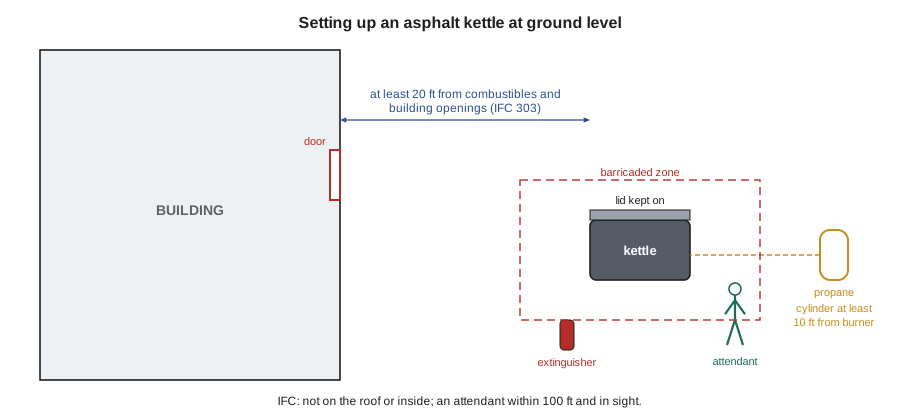
Kettle placement is controlled by the fire code. Ohio and Columbus adopt fire codes based on the International Fire Code (IFC), whose section 303 covers asphalt kettles. In summary, the IFC keeps kettles off roofs and out of buildings, requires them to be at least 20 feet from combustible materials, combustible construction and building openings, requires an attendant within 100 feet of an operating kettle with the kettle in sight, requires a portable fire extinguisher close to the kettle (with a minimum rating) and another on the roof where asphalt is being applied, keeps fuel cylinders at least 10 feet from the burner, and requires kettles to have tight-fitting lids. Check the edition adopted locally and any permit conditions from the fire department, because local amendments and insurers can add requirements.
On the Ashgrove Plaza job, the kettle sits in the rear laneway, inside a barricade of fencing and cones, upwind of the rooftop air intakes. Before lighting it, Marco walks a quick check:
- Kettle on level, firm ground, wheels chocked, away from doors, windows, intakes and anything that burns.
- Lid working and closed; thermometer or controller working; no water in the kettle (water in hot asphalt boils explosively and throws hot asphalt out).
- Propane cylinder upright, secured from falling, at the required distance from the burner, with valve, regulator and hose in good condition.
- Hose connections leak-tested with soapy water, never with a flame.
- Fire extinguisher in place, charged and within reach; lid shut-off and burner shut-off locations known to the crew.
- Barricade up, signs posted, and the attendant assigned for as long as the burners are lit.
Loading the kettle is the moment with the most splashing. Asphalt blocks are lowered in, not dropped, with the lid raised only as far as needed. Marco wears a face shield over his safety glasses, heat-resistant gloves with cuffs, long sleeves and boots with pant legs worn outside them, so hot asphalt cannot run into the boot.
Moving hot asphalt to the roof
Hot asphalt reaches the roof by pumping it through a pipe to the roof, by lifting it in buckets or luggers on a hoist, or, on larger jobs, from a tanker. Secure the pipe so it cannot move or whip, and protect workers at the discharge point from the roof edge with the fall protection described in lesson 6. Lift buckets no more than about three-quarters full and carry them with lids or in luggers designed for the purpose. Call out "hot" when moving hot material, and never carry hot asphalt up a ladder.
On the roof, hot asphalt is spread with mops or mechanical spreaders, and plies are rolled into it. Keep mops and buckets out of walkways, set buckets on a level surface where they cannot tip, and keep hot asphalt off skin at all costs.
Burns from hot materials
Hot asphalt causes deep burns because it sticks to the skin and keeps releasing heat. First aid for a hot asphalt burn is different from first aid for many other burns, and every roofer should know it:
- Cool the asphalt and the skin under it right away with clean, cool running water for at least 20 minutes, or use cool wet compresses if running water is not available.
- Do not try to peel off asphalt that has stuck to the skin. It will tear the skin away with it.
- Do not use ice, solvents, gasoline or kerosene to remove asphalt.
- Remove rings, watches and loose clothing near the burn if they come off easily, before swelling starts.
- Get medical help for anything larger than a small spot, any burn on the face, eyes, hands, feet, joints or groin, and any burn that goes deeper than the outer skin.
Medical staff use special ointments to dissolve asphalt off burns. Crew 2 carries a burn kit and a jug of clean water near the kettle and on the roof whenever hot asphalt is in use.
Asphalt fumes
Heating asphalt releases fumes. Short-term exposure can irritate the eyes, nose and throat and cause headaches and nausea; long-term heavy exposure is linked to more serious health effects. Controls include keeping the asphalt within its temperature range (overheating greatly increases fumes), keeping the kettle lid closed, using kettles with fume-reducing features where available, setting the kettle up downwind of workers and building air intakes, and working upwind of mops and spreaders where possible. Fumes can enter buildings through air intakes and open windows, so the owner is asked to shut off or cover intakes near the work, as you will see in lesson 11.
Torch-applied roofing
Torch-applied modified bitumen sheets have a layer of asphalt on the underside that the roofer melts with a propane torch as the roll is unrolled, bonding the sheet to the surface below and to the sheet beside it at the laps. Torching is fast and produces a strong, watertight roof, but it is the most fire-prone common roofing method. The flame from a roofing torch is very hot and can reach well beyond where the roofer is looking. It can find its way through gaps in decks, around curbs, under metal flashings and into walls and parapets, where wood, insulation, dust and debris can smolder unnoticed and burst into flame long after the crew has gone home.
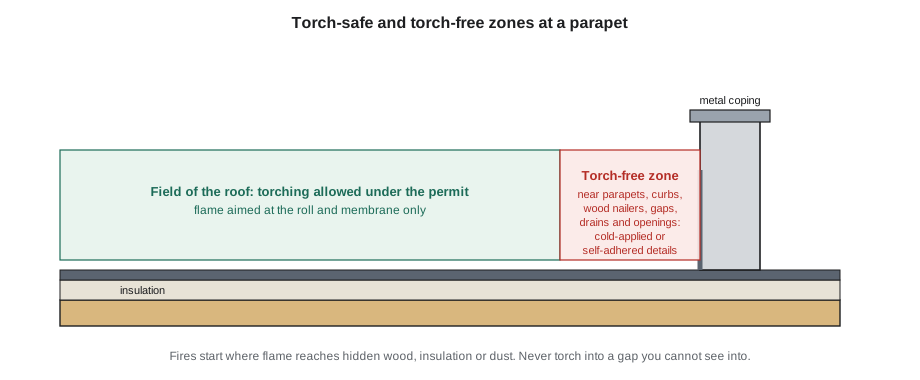
For that reason, torch work is planned and controlled. Many insurers and owners require torch applicators to hold a recognized torch-safety certification, such as the National Roofing Contractors Association's CERTA (Certified Roofing Torch Applicator) program, and the hot-work permit system described below applies. The key rules, which Ridgecap follows on every torch job, are:
- Never torch directly onto combustible materials such as wood nailers, wood decks, insulation or paper-faced boards. Use a base layer or protection board that is suitable for torching, or switch to a non-flame method.
- Never torch into gaps, holes, voids or seams you cannot see into, including around curbs, drains, pipes and at walls.
- Use self-adhered, cold-applied or hand-sealed methods at flashings, curbs, parapets and other details where combustibles may be hidden. This torch-free approach near details is called a torch-safe or torch-free zone.
- Keep the flame moving and pointed at the roll and the membrane surface, never at walls, flashings or building openings.
- Set the torch down only on a stand designed for it, with the flame pointed up or away from anything that burns, and shut it off at the cylinder when not in use.
- Keep a charged extinguisher within reach of every torch operator.
- Stop torching well before the end of the shift so a full fire watch can be completed before the crew leaves.
Propane cylinders on the roof are kept to the number needed for the work, secured upright, away from roof edges and openings, and shut off when not in use. Hoses are checked for cracks and burns at the start of each day and kept clear of the flame. If a hose leaks or a fitting frosts badly, the cylinder is shut off at the valve before anything else is touched.
Hot-work permits and fire watch
A hot-work permit is a written authorization, usually issued daily, that confirms the hot work has been planned and the precautions are in place before the first flame is lit. On Ridgecap jobs, Anjali's permit form is completed by the foreperson and, where the building owner has its own system, countersigned by the owner's representative. A typical permit records:
- Where the hot work will be done and by whom, and the date and hours the permit is valid.
- A check that combustibles have been removed or protected and that openings, gaps and drains near the work have been covered or sealed.
- The fire extinguishers and other fire protection in place, and the location of the nearest alarm and phone.
- Who will act as fire watch, and for how long after the hot work ends.
- A final sign-off after the fire watch, confirming no smoldering or heat remains.
A fire watch is a trained person whose only job is to watch for fire during hot work and for a set time afterward, with an extinguisher in hand. NFPA 241, the fire safety standard for construction, alteration and demolition operations, requires a fire watch after torch-applied roofing, and its 2022 edition sets that watch at a minimum of two hours after torching ends. Insurers and owners may require more. Lesson 10 looks at fire watch, extinguishers and fire emergencies in detail.
Hot-air welders and heat guns
Single-ply membranes such as TPO and PVC are welded with hot-air welders, either hand-held or automatic machines that run along the seam. Their air can be hundreds of degrees, hot enough to ignite paper, wood and dust and to cause serious burns. Treat them as hot work: keep them away from combustibles, set them down on their stands, unplug them when not in use and include them in the hot-work permit. Overheated PVC can produce irritating fumes, so follow the manufacturer's temperature settings.
Common mistakes
MistakeHeating asphalt as hot as possible so it spreads easily.
InsteadKeep asphalt within its EVT range and never above the maximum heating temperature on the carton.
MistakeLeak-testing a propane hose with a lighter.
InsteadUse soapy water on connections and watch for bubbles.
MistakePeeling hot asphalt off a burn.
InsteadCool it with clean, cool running water for at least 20 minutes and leave the asphalt for medical staff to remove.
MistakeTorching up to a wood curb or into the gap at a parapet.
InsteadUse torch-free methods at details where combustibles may be hidden.
MistakeTorching until the end of the shift.
InsteadStop torching early enough for the full fire watch before the crew leaves.
Summary and key terms
- Hot work includes kettles, torches, hot-air welders, heat guns and cutting or grinding metal.
- Keep asphalt in its EVT range and below the maximum heating temperature, which sits below the flash point.
- IFC section 303 keeps kettles off roofs and out of buildings, at least 20 feet from combustibles and openings, attended and with extinguishers.
- Cool hot asphalt burns with cool running water for at least 20 minutes and never peel off the asphalt.
- Torch only on suitable surfaces, never into gaps, and use torch-free methods at details.
- Hot-work permits and fire watches, two hours after torching under NFPA 241 (2022), catch fires before they spread.
- Equiviscous temperature (EVT)
- The temperature range at which roofing asphalt has the right viscosity for application.
- Flash point
- The lowest temperature at which vapors above a liquid can ignite from a flame or spark.
- Kettle
- A wheeled, propane-heated tank used to melt roofing asphalt.
- Hot-work permit
- A written authorization confirming that precautions are in place before hot work begins.
- Fire watch
- A trained person who watches for fire during and after hot work, with an extinguisher ready.
- Torch-free zone
- An area near details and combustibles where torching is not done and non-flame methods are used instead.
Practice problems
Work each problem on paper first, then reveal the answer to check.
Why must there be no water in a kettle?
Show answer
Water in hot asphalt boils explosively and throws hot asphalt out of the kettle.
What three temperatures does an asphalt carton usually give?
Show answer
The EVT range, the maximum heating temperature and the flash point.
How long should a hot asphalt burn be cooled?
Show answer
With cool running water for at least 20 minutes.
Name two places where torching should not be done.
Show answer
Into gaps or voids, and at wood nailers, curbs, parapets, drains or other details where combustibles may be hidden.
What minimum fire watch after torch-applied roofing does NFPA 241 (2022) set?
Show answer
Two hours after torching ends.
Lesson quiz · 5 questions
Score 60% or more to complete this lesson.
Create a free account to save your progress, take quizzes and earn a certificate.