
ROOF-110 · Lesson 9 of 12 · 24 min
Weather, heat and cold stress
▶ Video coming soon A video version of this lesson is on the way.
Roofers work in the weather, not just under it. On a July afternoon at Ashgrove Plaza the air temperature was 90 °F, the humidity was high and there was no shade anywhere on the roof. The new black cap sheet was too hot to touch, the kettle was running in the laneway and the torch crew was working beside open flame. By two o'clock, Rory had drunk three bottles of water and felt fine. Then he stood up from a seam, saw gray spots and had to sit down again. Dana saw it, sent him into the shade of the hoist tower with a cold drink and a wet towel, and stayed with him until he felt better. "That's the warning," she said. "Next step is the one we don't let anybody reach."
Weather affects almost every decision on a roofing job: whether work can start, which materials can be installed, how much can be torn off, how workers are protected and when work must stop. This lesson covers the main weather hazards: heat, sun, cold, wind, rain, ice and lightning. It also covers how roofers plan for them.
Why roofers are at high risk from heat
Heat stress happens when the body cannot get rid of heat as fast as it gains it. The body gains heat from hot air, from the sun and from hot surfaces, and it makes its own heat through physical work. It loses heat mainly by sweating, and sweat only cools the body when it evaporates. In humid air, sweat evaporates slowly, so the body struggles to cool itself even when the air temperature is not extreme.
Roofers get heat from every direction. The sun beats down and reflects back up from the roof. Dark roof surfaces get far hotter than the air, and hot asphalt, torches and kettles add radiant heat. The work is heavy, the PPE adds layers, and there is rarely shade. Not surprisingly, roofing is one of the trades with the highest rates of heat illness, and heat-related deaths in construction happen most often to workers in their first few days on the job, before their bodies have adjusted.
Heat illnesses
| Condition | Signs | What to do |
|---|---|---|
| Heat rash | red, itchy bumps where sweat collects | keep skin cool and dry, loose clothing, rest in shade |
| Heat cramps | painful muscle cramps in legs, arms or stomach during or after work | rest in shade, drink water and an electrolyte drink, stretch gently |
| Heat exhaustion | heavy sweating, weakness, dizziness, headache, nausea, pale clammy skin, fast pulse | stop work, move to shade or air conditioning, loosen clothing, cool with water and fans, sip fluids; get medical help if no improvement within about an hour or if symptoms get worse |
| Heat stroke | confusion, slurred speech, strange behavior, collapse, seizures; skin may be hot and dry or still sweating; very high body temperature | medical emergency: call emergency services, cool the worker immediately and aggressively (soak with cold water, ice packs to neck, armpits and groin, fan), stay with them |
Heat stroke kills. The body's cooling system fails and the core temperature climbs until the brain and organs are damaged. Anyone who becomes confused or acts strangely in the heat should be treated as having heat stroke until proven otherwise. Do not give fluids to someone who is confused or unconscious, and do not leave them alone. Getting the body temperature down fast is what saves lives, so start cooling before the ambulance arrives.
Some things make heat illness more likely: being new to the work or back from time off, being unfit, being overweight, having had a heat illness before, some medications, alcohol the night before, illness with fever or diarrhea, and heavy or dark clothing. Tell your foreperson if any of these apply to you.
Measuring heat
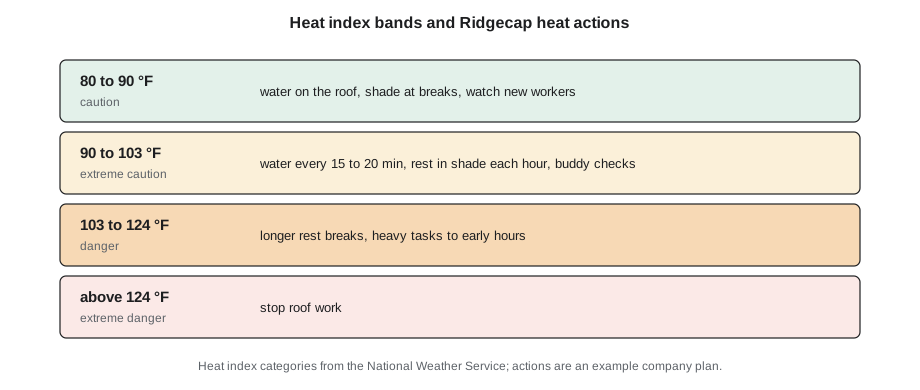
Air temperature alone does not tell the whole story, because humidity, sun and wind all change how hot it feels and how well the body can cool itself. The National Weather Service (NWS) reports the heat index, which combines temperature and relative humidity into an apparent temperature in the shade. The NWS groups heat index values into caution (80 to 90 °F), extreme caution (90 to 103 °F), danger (103 to 124 °F) and extreme danger (above 124 °F). Direct sun can add up to about 15 °F to the heat index, which matters on an unshaded roof. Occupational hygienists also use the wet bulb globe temperature (WBGT), which accounts for radiant heat from the sun and hot surfaces and is the basis of the NIOSH recommended heat exposure limits.
The rules on heat
There is no federal OSHA standard specific to heat as of late 2026. OSHA published a proposed rule on heat injury and illness prevention in August 2024, with requirements triggered at a heat index of 80 °F and extra measures at 90 °F, but the rule had not been finalized, and the agency has signaled further proposals. Meanwhile, OSHA enforces heat hazards under the General Duty Clause of the OSH Act, which requires employers to protect workers from recognized serious hazards, and it runs a National Emphasis Program on heat that directs inspections in high-heat industries, including construction, on days when the heat index is high. Ohio has no state heat standard. NIOSH's criteria document recommends heat illness prevention programs with water, rest, shade, acclimatization, training and medical monitoring.
Whatever the rules say, the practical controls are the same everywhere. Ridgecap's heat plan, which Anjali reviews every spring, sets actions for each heat band, shown in the figure above. The key parts are:
- Water: cool drinking water on the roof, not just in the truck, and the expectation that everyone drinks about one cup every 15 to 20 minutes, even when not thirsty. Electrolyte drinks are added when sweating heavily for several hours.
- Rest: scheduled breaks in shade or air conditioning, longer and more frequent as the heat rises.
- Shade: pop-up canopies or shade structures on the roof where possible, and in the shade of the truck or building at ground level.
- Acclimatization: new and returning workers build up exposure gradually over the first week or two.
- Work scheduling: heavy work and hot work early in the day; on the hottest days, starting at dawn and stopping by early afternoon.
- Buddy system: workers watch each other for signs of heat illness, and anyone can call a break.
- Training: everyone learns the signs of heat illness and what to do, and the emergency plan includes heat stroke.
Acclimatization
The body adapts to heat over about one to two weeks of working in it: it starts sweating sooner and more, loses less salt in sweat and keeps the heart rate lower. Without that adaptation, a new worker doing the same job as an experienced one on the same day can be at far greater risk. NIOSH recommends that new workers start with no more than about 20 in 100 of a full day's heat exposure on the first day and increase by no more than about 20 in 100 each day. Workers who already have experience should build back up over a few days after a week or more away. Ridgecap starts new crew members on lighter tasks and shorter heat exposure for their first week, and it treats the first hot days of each spring as a reason to slow everyone down.
Worked problem
Making a heat decision
At 1:00 pm on the Ashgrove Plaza job, the temperature is 92 °F and the relative humidity is 50 percent. The heat index works out to about 99 °F in the shade. Rory is in his first week of hot weather work. What do the heat index category and Ridgecap's plan call for, and how does full sun change it?
Show solution
- Find the category: 99 °F falls in the extreme caution band, 90 to 103 °F.
- Full sun can add up to about 15 °F: 99 + 15 = 114 °F, which would be in the danger band.
- The crew is on an unshaded roof, so Dana plans for the danger band.
- Ridgecap action: longer rest breaks in shade, buddy checks, and heavy tasks and torching moved to the early hours.
- Rory is not yet acclimatized, so he moves to lighter work and takes extra breaks.
Answer: Treat it as a danger day on an unshaded roof: lighter duties for Rory, longer shaded breaks, buddy checks and torching moved to the early morning.
Calculating the humidex or heat index by hand is complicated. In practice, roofers read the value from a weather service, an app or a heat stress meter on site. What matters is knowing which band you are in and what your company's plan says to do.
Worked problem
Planning drinking water
Dana wants each of the 8 workers on the roof to have about 8 ounces of water every 15 minutes for a 9-hour hot day. How much water should the crew have on site?
Show solution
- Per worker per hour: 4 × 8 oz = 32 oz (1 quart).
- Per worker per day: 1 quart × 9 = 9 quarts.
- Crew of 8: 8 × 9 = 72 quarts, or 18 gallons.
Answer: About 18 gallons, kept cool on the roof and refilled during the day. Drinking more than about 48 ounces an hour for long periods is not recommended, so the plan pairs water with electrolytes and food.
Cold stress
Roofing does not stop in winter. Leaks still need fixing, new buildings still need to be closed in, and some commercial work continues through the cold months. Cold brings its own hazards. Hypothermia happens when the body loses heat faster than it can make it; early signs are shivering, numb hands and clumsiness, and later signs are confusion, slurred speech, drowsiness and the shivering stopping. Frostbite is the freezing of skin and the tissue under it, most often on fingers, toes, ears, nose and cheeks; the skin goes white or grayish and numb. Wind makes cold far more dangerous because it strips heat away from the body; weather services report wind chill to show the combined effect.
Controls for cold work include dressing in layers with a wicking base layer, an insulating middle layer and a wind-resistant outer layer; keeping spare dry gloves and socks; covering the head and ears under the hard hat with a liner; taking warm-up breaks in a heated space; drinking warm, non-alcoholic fluids; and working in pairs so someone notices the early signs. Hands that are numb cannot grip ladders, tools or materials safely, so a warm-up break is a safety measure, not a luxury.
Cold also changes the roof itself. Frost, ice and snow make every surface slippery, and ice can hide under snow. Roofs must be cleared of snow and ice before work starts, and steep roofs are not worked when frost or ice is present. Many roofing materials have minimum installation temperatures: adhesives may not cure, self-adhered membranes may not stick, and shingles become brittle and crack. Propane cylinders lose pressure in cold weather, which tempts people to warm them with a torch. Never do that; use only methods the cylinder and torch makers approve. Daylight is short, so plan the day so that the roof is closed in and the crew is down before dark, or provide proper lighting.
Wind
Wind is one of the most underrated roofing hazards. A sheet of plywood, a piece of insulation board, a length of metal flashing or a roll of membrane caught by a gust can knock a worker off balance or off the roof, and loose materials can be blown off the roof onto people, cars and neighboring property. Wind also lifts partially installed roofing, which is why every roof must be secured at the end of each day.
There is no single wind speed at which all roofing must stop. Manufacturers set limits for some products and installation methods, and fall protection and hoisting equipment have their own limits. Ridgecap's plan sets its own rules: stop handling large sheets, panels and insulation boards when gusts reach a set speed, stop all crane lifts at the crane's limit, and stop torching when wind makes the flame hard to control or blows it toward combustibles. The foreperson checks the forecast at the start of the day and watches conditions all day. Materials on the roof are weighted or tied down, and partly used rolls and boards are secured at every break.
Rain, ice and lightning
Wet roofs are slippery, and wet materials cannot be installed: water trapped in a roof assembly causes blisters, rot, mold and loss of insulating value. When rain is forecast, the crew tears off only what it can make watertight before the rain arrives. A temporary cut-off or night seal is installed at the edge of each day's work so water cannot run under the new roof. If a sudden storm arrives, the first job is to make the open areas watertight and the second is to get everyone off the roof safely.
Lightning is a serious threat to anyone on a roof, the highest point around. When you hear thunder, you are close enough to be struck. The National Weather Service's rule is: when thunder roars, go indoors. Everyone gets off the roof and away from ladders, hoists, metal and kettles, and waits at least 30 minutes after the last thunder before returning.
Planning for weather
Weather planning starts the day before and continues all day. At Ridgecap, the foreperson checks the forecast each evening and morning for temperature, humidex or heat index, wind and gusts, precipitation and thunderstorms. The toolbox talk covers the day's weather plan: how much can be opened up, when heat breaks will happen, wind limits for the day's tasks and what happens if a storm arrives. Through the day, someone on the crew is assigned to watch the sky and the radar. At the end of the day, the roof is secured: open areas sealed, materials weighted or removed, debris cleaned up and everything that could blow away tied down.
Common mistakes
MistakeWaiting until you are thirsty to drink.
InsteadDrink about a cup of water every 15 to 20 minutes in the heat, thirsty or not.
MistakePutting a new worker on full heavy tasks on the first hot day.
InsteadBuild heat exposure up gradually over the first week or two.
MistakeTreating a confused worker as simply tired.
InsteadConfusion in the heat is a sign of heat stroke: call emergency services and cool the worker immediately.
MistakeWarming a propane cylinder with a torch on a cold morning.
InsteadNever heat cylinders with a flame; use approved methods only.
MistakeStaying on the roof to finish a seam when thunder is heard.
InsteadWhen thunder roars, go indoors and wait 30 minutes after the last thunder.
Summary and key terms
- Roofers gain heat from sun, hot surfaces, hot work and heavy labor, and humidity slows cooling.
- Heat illness ranges from rash and cramps to exhaustion and heat stroke, which is a medical emergency needing immediate cooling.
- The heat index combines temperature and humidity; OSHA's heat rule is still proposed, so it enforces heat under the General Duty Clause and a National Emphasis Program.
- Water, rest, shade, acclimatization, early scheduling, buddy checks and training prevent heat illness.
- Cold, wind, rain, ice and lightning each need planning; secure the roof at the end of every day.
- When thunder roars, go indoors, and wait 30 minutes after the last thunder.
- Heat stress
- The total heat load on the body from the environment, work and clothing.
- Heat stroke
- A life-threatening failure of the body's cooling system, with confusion and very high body temperature.
- Acclimatization
- The body's gradual adaptation to working in heat over one to two weeks.
- Humidex
- A Canadian index combining temperature and humidity to describe how hot it feels.
- Heat index
- A US index combining temperature and humidity to describe how hot it feels in the shade.
- Wind chill
- The combined cooling effect of cold air and wind on exposed skin.
Practice problems
Work each problem on paper first, then reveal the answer to check.
What heat index range does the NWS call extreme caution?
Show answer
90 to 103 °F.
What is the first aid priority for heat stroke?
Show answer
Call emergency services and cool the worker immediately and aggressively.
How much water should workers drink in the heat?
Show answer
About one cup (8 ounces) every 15 to 20 minutes.
How much can direct sun add to the heat index?
Show answer
Up to about 15 °F.
How long should the crew wait after the last thunder before going back on the roof?
Show answer
At least 30 minutes.
Lesson quiz · 5 questions
Score 60% or more to complete this lesson.
Create a free account to save your progress, take quizzes and earn a certificate.