
ROOF-110 · Lesson 7 of 12 · 21 min
Fall protection on steep-slope roofs
▶ Video coming soon A video version of this lesson is on the way.
Rory spent his fifth week with the steep-slope crew on Linden Street, re-roofing a row of 1920s houses with 8 in 12 gable roofs. On the first morning Keisha handed him a harness and watched him put it on. She made him do it three times. The first time the chest strap sat on his stomach. The second time the leg straps were loose enough to slide a fist under. The third time she pulled on the back D-ring, checked the straps and nodded. "On a roof this steep," she said, "the roof is trying to put you on the ground all day. The harness and the anchor are what say no."
On a low-slope roof, the danger is mostly at the edges and openings. On a steep roof, you can lose your footing anywhere, slide down the slope and go over the eave in a second or two. Wet shingles, frost, morning dew, loose granules, sawdust, plastic wrappers and even shade lines where the surface is cooler and damper can turn a good footing into a slide. That is why steep-slope roofers need fall protection for almost all of their work, and why personal fall arrest systems are a daily tool.
The rules for steep roofs
OSHA's rule for steep roofs is 29 CFR 1926.501(b)(11): each employee on a steep roof (a slope greater than 4 in 12) with unprotected sides and edges 6 feet or more above lower levels must be protected by guardrail systems with toeboards, safety net systems or personal fall arrest systems. For residential construction, 1926.501(b)(13) applies the same 6-foot trigger and requires those conventional systems; an employer may use a written alternative fall protection plan only if it can show that conventional systems are infeasible or create a greater hazard, and such plans must be site-specific and prepared by a qualified person. Neither warning lines nor safety monitors are options on steep roofs, and slide guards (roof brackets with boards) alone do not meet the rule. Workers must be trained in fall hazards and the systems used, and employers must plan for prompt rescue.
Roof brackets with planks, often called slide guards or toe boards, are still essential on steep roofs. They give workers a level place to stand and stop tools, bundles and debris from sliding off. But they are not, on their own, fall protection: a worker who stumbles can go over the plank or bounce past it. They are used together with a personal fall arrest system.
The ABCs of personal fall arrest
A personal fall arrest system (PFAS) has three main parts, often remembered as the ABCs: an anchor, body support and a connector. A fourth part, descent and rescue, is the plan for what happens after the fall is stopped.
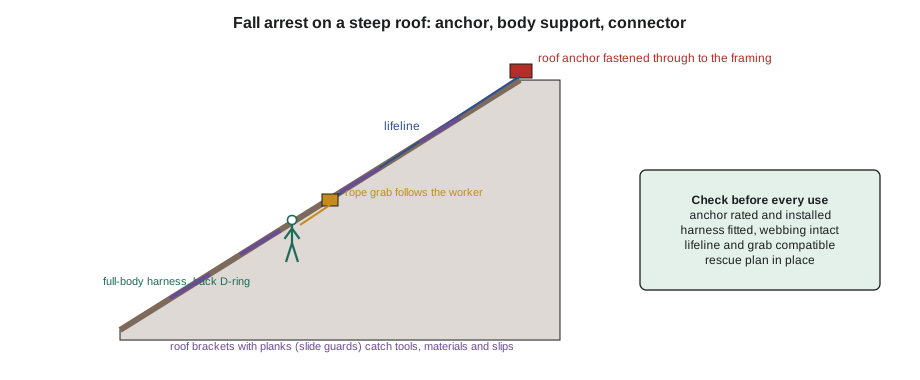
Anchors on steep roofs are usually roof anchors that bolt or screw through the sheathing into the rafters or trusses at the ridge, following the manufacturer's instructions for the type of framing and fasteners. OSHA requires anchorages for personal fall arrest to be capable of supporting at least 5,000 pounds per employee attached, or to be designed, installed and used as part of a complete system that maintains a safety factor of at least two under the supervision of a qualified person (29 CFR 1926.502(d)(15)). Permanent roof anchors on commercial buildings should be inspected regularly; temporary anchors installed for a re-roof are installed by trained workers using the exact fasteners and number of fasteners the manufacturer specifies. A plumbing vent, chimney, satellite dish bracket or gutter is never an anchor.
Body support means a full-body harness. Harnesses should meet the ANSI/ASSP Z359.11 standard. Body belts are not acceptable for fall arrest, because they concentrate the force on the abdomen and can cause serious internal injuries or allow the worker to slip out.
Connectors join the harness to the anchor. On steep roofs, the most common setup is a vertical lifeline (a rope running from the ridge anchor down the slope) with a rope grab that slides up and down the line and locks if the worker falls, connected to the harness by a short lanyard with an energy absorber. Self-retracting lifelines (SRLs), which work like a seat belt reel, are also widely used. All the parts must be compatible: the rope grab must be designed for that diameter and type of rope, the snap hooks and carabiners must be self-locking and the right size for the D-ring and anchor, and the energy absorber must be suited to the worker's weight and the clearance available.
| Component | What to check before use |
|---|---|
| Anchor | correct type for the roof; installed into framing with the specified fasteners; no cracks, bends or loose fasteners |
| Harness | webbing not cut, frayed, burned or stiff with asphalt; stitching intact; buckles and D-rings undamaged; labels readable |
| Lifeline | no cuts, abrasion, melted spots or chemical damage; correct diameter for the rope grab; end knot or stop in place |
| Rope grab | locks when pulled sharply downward; installed in the right direction (arrow pointing up toward the anchor) |
| Lanyard and energy absorber | cover intact; absorber not deployed; snap hooks self-closing and self-locking |
| SRL | line retracts smoothly and locks when jerked; housing undamaged; within the inspection date |
Any part that has stopped a fall is removed from service immediately and either destroyed or sent to the manufacturer, even if it looks fine. Equipment is also inspected periodically by a competent person, at least as often as the manufacturer and the regulations require, and the results recorded.
Fitting a harness
A harness only works if it fits. Keisha's method, which matches most manufacturers' instructions, goes like this:
- Hold the harness by the back D-ring and shake it so the straps fall into place.
- Slip the shoulder straps on like a jacket, with the D-ring between the shoulder blades.
- Connect the leg straps and tighten them so you can fit only a flat hand between the strap and your leg.
- Connect the chest strap and position it at mid-chest, across the breastbone, not at the throat or the stomach.
- Tighten the shoulder straps so the back D-ring sits between the shoulder blades, and tuck away loose strap ends.
- Have a partner check the back and the D-ring position.
Loose leg straps are the most common fitting mistake. In a fall, a loose harness lets the body drop further and can cause serious injury to the groin or let the worker slip partly out. A chest strap that is too high can choke; one that is too low lets the worker tip backward out of the harness.
Fall clearance
A fall arrest system does not stop a fall instantly. The worker falls until the lanyard or line goes tight, then the energy absorber stretches or the SRL brakes while the body slows down, the harness stretches and shifts, and the body hangs below the D-ring. All of that takes vertical distance. If the ground, a lower roof or a deck is closer than that distance, the worker hits it before the fall is stopped. Calculating the clearance is part of choosing the system.
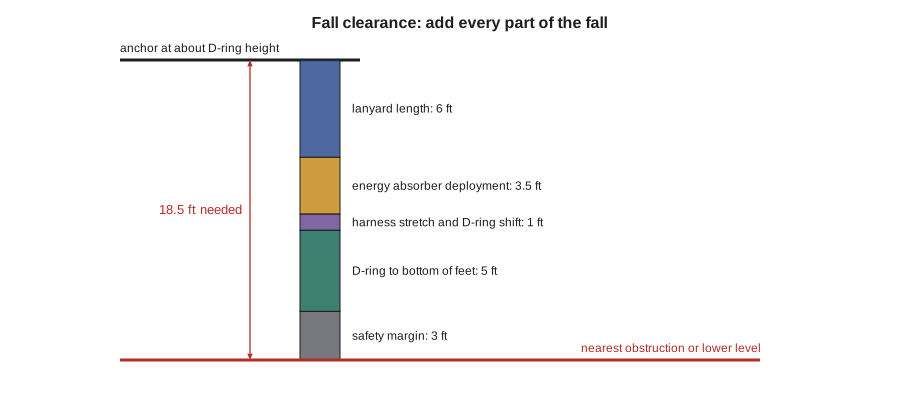
The numbers used in the worked example below are typical values for a 6-foot energy-absorbing lanyard anchored at about the height of the back D-ring, so the free fall is no more than the lanyard length. OSHA limits free fall to 6 feet and deceleration distance to 3.5 feet, and requires that the worker not contact any lower level (29 CFR 1926.502(d)(16)). Always use the values from the manufacturer's instructions for the actual equipment.
Worked problem
Calculating fall clearance
Rory is flashing a dormer on a Linden Street house. His lanyard is 6 ft long with an energy absorber that can deploy up to 3.5 ft, and it is attached to an anchor at about the height of his back D-ring. Allow 1 ft for harness stretch and D-ring shift, 5 ft from the D-ring to the soles of his feet, and a 3 ft safety margin. The porch roof below the dormer is 16 ft below the anchor. Is the clearance enough?
Show solution
- Add the parts: 6 + 3.5 + 1 + 5 + 3.
- Lanyard and absorber: 6 + 3.5 = 9.5 ft.
- Plus harness and body: 9.5 + 1 + 5 = 15.5 ft.
- Plus safety margin: 15.5 + 3 = 18.5 ft.
- Available: 16 ft, which is less than 18.5 ft.
Answer: No. He needs 18.5 ft and has only 16 ft, so he would hit the porch roof. Dana moves the anchor higher on the main roof, above his work, and switches him to a self-retracting lifeline, which limits free fall and arrests the fall in a much shorter distance.
Two ways to reduce the clearance needed are to keep the anchor above the worker (which reduces free fall) and to use shorter connectors or SRLs. On steep roofs, the anchor at the ridge is usually above the worker, and the rope grab follows the worker up and down the lifeline, so the free fall is short. The rope grab should be kept above the worker's D-ring as much as possible; letting it slide down below the worker adds free fall.
Swing falls
If the anchor is not directly above or upslope of the worker, a fall becomes a pendulum. The worker swings sideways and can hit a dormer, a chimney, a wall or the ground. The line can also drag across the roof edge or eave and be cut. To limit swing falls, keep your work within a narrow band directly downslope of the anchor (most manufacturers give a maximum angle), move the anchor or add more anchors as the work moves across the roof, and use horizontal lifelines along the ridge on long roofs so that the attachment point travels with the worker.
Working on a steep roof day to day
Fall arrest is the backup. The first line of defense on a steep roof is good footing and a good workplace. Steep-slope crews at Ridgecap follow these habits:
- Install the anchor from a protected position, such as a ladder at the gable or from the ridge reached with temporary protection, so the first person on the roof is never unprotected.
- Install roof brackets and planks as you work up the roof, and on steeper roofs install them at every few courses.
- Keep the roof clean: sweep granules and debris, bag wrappers, and do not leave tools on the slope.
- Do not work on wet, frosty or icy roofs; wait for them to dry and remove snow and ice before starting.
- Keep the lifeline from crossing sharp edges and away from the cutting path of saws and knives.
- Stay connected at all times when on the roof, including when moving from one area to another; use two lanyards or a second line where needed to stay tied off while switching anchors.
- Watch the weather: wind gusts on a steep roof can knock a worker off balance, especially while carrying a bundle or a sheet.
Keisha told Rory that the most dangerous time on a steep roof is the start of the day, when the anchors are not in yet, and the end of the day, when people are tired and start cutting corners. Ridgecap installs anchors first and removes them last.
Rescue after a fall
A worker caught by a fall arrest system is not safe yet. Hanging in a harness can quickly become a medical emergency. The leg straps press on the veins in the legs, blood pools in the legs, and the worker can lose consciousness and suffer serious harm within minutes. This is called suspension intolerance or suspension trauma. That is why every fall arrest system needs a rescue plan before work begins.
- Plan the rescue for each roof: how a fallen worker will be reached, by ladder, by an aerial lift, from a window or with a rescue kit, and who will do it.
- Keep rescue equipment on site and make sure the crew knows how to use it.
- Call emergency services right away if a worker falls, and give the address and access details.
- While waiting, encourage a conscious worker to use relief straps (foot loops on many harnesses) or to push against anything solid with the legs to keep blood moving.
- After rescue, get the worker medical attention even if they seem fine.
OSHA requires the employer to provide for prompt rescue of employees after a fall or to make sure they can rescue themselves (29 CFR 1926.502(d)(20)). Dana's crew practices a ladder rescue from the eave every spring.
Common mistakes
MistakeTreating roof brackets and planks as fall protection by themselves.
InsteadBrackets and planks give footing and stop materials; use them with a personal fall arrest system.
MistakeWearing harness leg straps loose for comfort.
InsteadTighten leg straps so only a flat hand fits underneath.
MistakeLetting the rope grab slide down below your D-ring.
InsteadKeep the rope grab above the D-ring to keep free fall short.
MistakeWorking far to the side of the anchor.
InsteadStay within the manufacturer's angle below the anchor or move the anchor to prevent swing falls.
MistakeAssuming clearance is fine because the roof looks high.
InsteadAdd up every part of the fall and compare it with the actual distance to the next level below.
Summary and key terms
- On steep roofs (over 4 in 12), OSHA requires guardrails with toeboards, safety nets or personal fall arrest systems at 6 feet.
- Roof brackets and planks give footing but are not fall protection alone.
- A PFAS has an anchor, body support (full-body harness) and a connector, plus a rescue plan.
- Anchors must support 5,000 pounds per worker or be designed with a safety factor of two by a qualified person.
- Fall clearance adds connector length, deployment, harness stretch, body length and a safety margin.
- Suspension in a harness is dangerous within minutes, so rescue must be planned before work begins.
- Personal fall arrest system
- An anchor, connector and full-body harness that stop a fall after it begins.
- Rope grab
- A device that slides on a vertical lifeline and locks on it if the worker falls.
- Self-retracting lifeline (SRL)
- A reel-type connector that keeps the line taut and locks quickly in a fall.
- Energy absorber
- A device in a lanyard that tears or stretches to reduce the force on the body during an arrest.
- Swing fall
- A pendulum fall that happens when the anchor is not above the worker.
- Suspension intolerance
- A dangerous condition caused by hanging motionless in a harness after a fall.
Practice problems
Work each problem on paper first, then reveal the answer to check.
What are the ABCs of fall arrest?
Show answer
Anchor, body support and connector (plus descent and rescue).
What is the maximum free fall OSHA allows for a PFAS?
Show answer
6 feet.
Add up the clearance for: lanyard 6 ft, absorber 3.5 ft, stretch 1 ft, body 5 ft, margin 3 ft.
Show answer
18.5 ft.
What anchorage strength does OSHA require per attached worker?
Show answer
5,000 pounds, or a design with a safety factor of two under a qualified person.
Are slide guards alone acceptable fall protection on a steep roof?
Show answer
No. Use guardrails with toeboards, nets or PFAS.
Lesson quiz · 5 questions
Score 60% or more to complete this lesson.
Create a free account to save your progress, take quizzes and earn a certificate.