
ROOF-110 · Lesson 10 of 12 · 25 min
Fire safety on roofing jobs
▶ Video coming soon A video version of this lesson is on the way.
Anjali keeps a photo on the wall of the Ridgecap office. It shows a church in another city, its roof gone and its walls blackened, the morning after a roofing fire. The crew working on it had torched a flashing at the base of a wooden bell tower in the afternoon, cleaned up and gone home. Some time that evening, heat that had traveled into the tower's framing through a gap behind the flashing set the wood smoldering. By the time anyone saw smoke, the fire was in the roof space. Nobody was hurt, but the building was lost. Anjali shows the photo to every new hire, and Rory looked at it for a long time. "Every one of those people knew how to use a torch," she said. "What they didn't do was watch long enough."
Roofing work brings fire risks to buildings that may have stood for decades without a fire. Torches, kettles, hot-air welders, grinders, propane, solvents and adhesives all add fuel or heat, and roofs hide combustible materials in places nobody can see: wood blocking, old wood decks, insulation, paper facers, dust and debris in cavities. Lesson 4 covered how to use kettles and torches and how hot-work permits work. This lesson looks at fire itself: how fires start on roofing jobs, how to prevent them, how to fight a small fire safely and how to respond when a fire is too big to fight.
How fires start
A fire needs three things: fuel, heat and oxygen. This is the fire triangle. Take away any one of them and the fire goes out; keep any one of them apart from the others and the fire never starts. On a roofing job, each side of the triangle is easy to find:
- Fuel: wood nailers and decks, insulation, cover boards with paper facers, old roofing, asphalt, membranes, solvents, adhesives, primers, propane, gasoline, rags soaked in solvent, cardboard and plastic wrappers, leaves and debris in gutters and at walls.
- Heat: torch flames, kettles and hot asphalt, hot-air welders, heat guns, grinder sparks, hot exhaust from engines, damaged batteries, electrical faults and cigarettes.
- Oxygen: always present in air, and air moving through gaps and cavities in walls and roofs can feed a hidden fire.
Most roofing fires start in one of a few ways. A torch flame reaches combustible material hidden behind or under a flashing, curb, parapet or deck gap, and it smolders. A kettle overheats or boils over, or its burner ignites spilled asphalt. A propane hose or fitting leaks and the gas finds a flame. Grinder sparks land in debris or insulation. Rags soaked in solvents or adhesives heat up on their own in a pile and ignite. Or a cigarette is dropped into debris. The most dangerous fires are the hidden ones, because they can burn for hours before anyone sees smoke.
| Source | How it causes fires | Main prevention |
|---|---|---|
| Torch | flame reaches hidden combustibles at details or through deck gaps | torch-free zones at details, never torch into gaps, fire watch |
| Kettle | overheating, boil-over, burner igniting spills | temperature control, lid, attendant, set up away from building |
| Propane | leaks at hoses and fittings meet a flame | leak tests with soapy water, inspected hoses, valves shut when idle |
| Hot-air welder and heat gun | hot air ignites paper, wood or dust | stands, keep away from combustibles, unplug when idle |
| Grinder and saw sparks | sparks land in debris or insulation | treat as hot work, shield sparks, clear debris, fire watch |
| Solvent and adhesive rags | self-heating in piles, vapors ignited by flame | store rags in closed metal containers, keep away from flame |
| Smoking | cigarettes in debris or near propane and solvents | no smoking on roofs or near materials |
| Batteries and electrical | damaged batteries or cords overheat | inspect, charge on the ground away from combustibles |
Preventing fires on the roof
Fire prevention starts in planning. Before hot work begins on any job, Ridgecap's foreperson walks the roof with the hot-work permit in hand and looks for combustibles, gaps and details. The checks include:
- Identify combustible decks, nailers, blocking, insulation and wall materials, and choose non-flame methods where torching would be risky.
- Seal or cover gaps, holes, drains and openings near torch work, and protect walls and curbs with non-combustible material where torching is planned nearby.
- Clear debris, leaves and packaging from the work area, and keep wrappers bagged and off the roof.
- Store propane cylinders upright, secured and away from edges, openings and heat; bring onto the roof only the cylinders needed for the day.
- Store solvents and adhesives in closed, labeled containers in a shaded spot away from torches and kettles.
- Put solvent-soaked rags in a closed metal container and remove them from the site daily.
- Keep fire extinguishers charged, inspected and at hand.
- Confirm how to call for help, the site address and the location of the nearest fire alarm, and that fire department access is not blocked.
Housekeeping matters as much as any of these. A roof covered in wrappers, scrap and cardboard is a roof full of fuel. Crew 2 bags debris as it works and lowers it down the chute through the day.
Propane safety
Propane is stored in cylinders as a liquid under pressure. When released, it turns into a gas that is heavier than air, so a leak flows downhill and pools in low spots: in drains, on lower roofs, in stairwells and in basements, where it can find an ignition source. Propane has an odorant added to it that smells like rotten eggs or cabbage, but do not rely on smell alone; cold, wind and some people's sense of smell can make it hard to detect.
- Keep cylinders upright and secured, with the valve on top, so liquid cannot reach the regulator and hose.
- Inspect hoses, regulators and fittings daily, and replace cracked, burned or stiff hoses.
- Leak-test every connection with soapy water after connecting a cylinder.
- Close the cylinder valve when the torch is not in use, at breaks and at the end of the day.
- Never store cylinders inside a building or a closed vehicle, and never leave them in direct sun longer than necessary.
- Never heat a cylinder with a torch or any flame, and never roll or drop cylinders.
If a cylinder or hose leaks and catches fire at the valve, the safest action, if you can reach the valve without being in the flame, is often to shut off the valve, which removes the fuel. If you cannot reach it safely, get everyone away, call emergency services and keep others back. A cylinder exposed to fire for a long time can fail violently.
Fire extinguishers
Fires are grouped into classes by what is burning, and extinguishers are labeled for the classes they can fight:
| Class | What is burning | Roofing example |
|---|---|---|
| A | ordinary combustibles: wood, paper, cloth, many plastics | wood nailers, insulation facers, cardboard |
| B | flammable liquids and gases | asphalt, solvents, adhesives, gasoline, propane |
| C | energized electrical equipment | extension cords, tools, a rooftop unit's wiring |
| D | combustible metals | rare on roofing jobs |
| K | cooking oils and fats | restaurant kitchens below a roof, not roofing materials |
Multipurpose extinguishers marked A, B and C are the standard on roofing jobs. They are listed by UL and labeled with a rating such as 4-A:80-B:C, where the numbers show the relative size of fire each class can handle. The International Fire Code sets minimum extinguisher ratings for asphalt kettles and for roofs where asphalt is applied, and the hot-work permit, the fire department or the owner's insurer may require more. Ridgecap puts a 10-pound multipurpose extinguisher with every torch operator, one at the kettle and at least one more on the roof where hot asphalt or torching is under way.
Using an extinguisher is a skill, and the time to learn it is in training, not during a fire. Most people remember the steps as PASS:
- Pull the pin, breaking the tamper seal.
- Aim the nozzle at the base of the fire, not at the flames.
- Squeeze the handle to discharge the agent.
- Sweep the nozzle from side to side across the base of the fire until it is out.
Before fighting any fire, make sure it is small and contained, that you have a clear way out behind you, that someone has called emergency services or raised the alarm, and that you have the right extinguisher. Stand upwind, a few feet back, and move closer as the fire shrinks. Watch the area afterwards, because fires can rekindle. If the fire is spreading, is inside a wall or roof space, or the extinguisher does not knock it down quickly, get out and leave it to the fire department. A portable extinguisher runs out in a matter of seconds.
Check extinguishers when you pick them up each day: the pressure gauge needle in the green, the pin and seal in place, the hose undamaged and the inspection tag current. An extinguisher that has been used, even briefly, must be recharged before it is relied on again.
Kettle and hot asphalt fires
A fire in an asphalt kettle is a flammable liquid fire. Never throw water on it: water sinks below the hot asphalt, flashes to steam and throws burning asphalt in every direction. The response is to smother the fire and remove the fuel:
- Close the kettle lid to cut off oxygen; most kettle fires go out when the lid is closed.
- Shut off the burners and close the propane cylinder valve if it can be reached safely.
- Use a multipurpose or B:C extinguisher on any burning spills around the kettle, aiming at the base of the flames.
- Keep people back, call emergency services if the fire is not out at once, and do not move the kettle while it is burning.
The kettle attendant is trained in this response before ever lighting a kettle. Marco runs a practice drill with each new kettle helper in the spring, with the burners off.
The fire watch
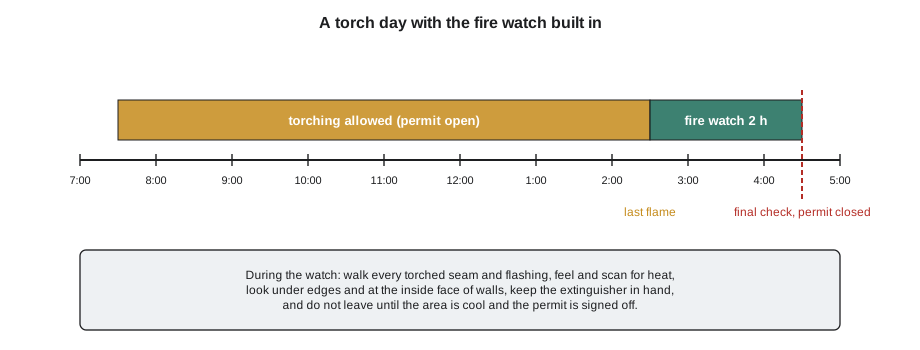
Because torch fires often start out of sight and develop slowly, the fire watch after torching is the most important fire control on a roofing job. NFPA 241, the fire safety standard for construction, alteration and demolition, requires a fire watch after torch-applied roofing, and its 2022 edition sets the minimum at two hours after the torching ends. Insurers, owners and permits may require longer, and some require periodic checks after the watch ends.
A fire watch is not someone who happens to be around. The fire watch at Ridgecap:
- Is trained in fire watch duties and in using the extinguisher, and has no other duties during the watch.
- Has a charged extinguisher in hand and a way to call for help at once.
- Walks every area where torching happened, especially flashings, curbs, walls, parapets, penetrations and roof edges.
- Feels for heat with the back of a hand near (not on) surfaces, and uses an infrared thermometer to scan details and wall faces.
- Looks and smells for smoke, including from below the roof deck, inside walls and at the inside face of parapets, and checks inside the building where access allows.
- Stays until the end of the watch, then does a final check and signs off the hot-work permit.
If the fire watch sees smoke or finds heat that keeps rising, they raise the alarm and call emergency services immediately. They do not wait to see whether it grows, and they do not open up a wall or flashing to look for the fire, because air rushing in can make a smoldering fire flare up.
Worked problem
Scheduling the last torch of the day
The Ashgrove Plaza crew must be off site by 5:00 pm. The hot-work permit requires a two-hour fire watch after the last flame, followed by a 30-minute final check and sign-off. What is the latest time torching can stop? If the crew wants to torch one more strip that takes 40 minutes, what is the latest time it can start?
Show solution
- Work back from 5:00 pm: subtract the 30-minute final check, giving 4:30 pm.
- Subtract the two-hour fire watch: 4:30 pm − 2 h = 2:30 pm.
- The last flame must be out by 2:30 pm.
- The last strip takes 40 minutes: 2:30 pm − 40 min = 1:50 pm.
Answer: Torching must stop by 2:30 pm, so the last 40-minute strip must start by 1:50 pm. If it is not started by then, it waits for the next morning.
Dana's rule is stricter than the arithmetic: no new torch work starts after 1:30 pm on any Ridgecap job, which leaves a margin for delays. "The watch is the part of the job that saves the building," she said. "You don't squeeze it."
Fire emergencies
Every job has an emergency plan, and part of it covers fire. Before work starts, the crew knows:
- The site address, the nearest cross street and the best access point for fire trucks, so the 911 call is quick and clear.
- Where the building's fire alarm pull stations are and how to tell the occupants to leave.
- How to get everyone off the roof quickly, by more than one route if possible.
- Where to meet on the ground so that the foreperson can count heads.
- Who will meet the fire department to tell them where the fire is, what is burning and where the propane cylinders are.
If a fire cannot be put out immediately with an extinguisher, call emergency services, pull the fire alarm, get everyone off the roof, shut off propane only if it can be done safely and move to the meeting point. Report the fire to the foreperson and safety coordinator, and do not go back onto the roof until the fire department says it is safe. Every fire, even a small one that was put out quickly, is reported and investigated so the cause can be fixed.
Worked problem
Planning extinguishers for a torch day
Ashgrove Plaza has three torch operators, one kettle and one hot-air welder in use on the same day. Ridgecap's rule is one extinguisher with each torch operator, one at the kettle, one with the hot-air welder and one spare at the hoist landing on the roof. The fire watch carries one of the torch extinguishers after torching ends. How many charged extinguishers must be on site?
Show solution
- Torch operators: 3 extinguishers.
- Kettle: 1 extinguisher.
- Hot-air welder: 1 extinguisher.
- Spare at the hoist landing: 1 extinguisher.
- Total: 3 + 1 + 1 + 1 = 6.
Answer: Six charged extinguishers. Each is checked at the start of the day, and any that is used is replaced before work continues.
Common mistakes
MistakeThrowing water on a kettle fire.
InsteadClose the lid, shut off the burner and fuel, and use a B:C or multipurpose extinguisher on spills.
MistakeEnding the fire watch early because nothing has happened.
InsteadHidden fires can take hours to show; complete the full watch and the final check.
MistakeLeaving solvent-soaked rags in a pile.
InsteadStore them in a closed metal container and remove them daily.
MistakeFighting a fire with no way out behind you.
InsteadKeep an escape route, call for help first and leave if the fire is not knocked down quickly.
MistakeOpening up a flashing to look for a suspected hidden fire.
InsteadRaise the alarm and call emergency services; air can make a smoldering fire flare.
Summary and key terms
- A fire needs fuel, heat and oxygen; roofs hide fuel in places nobody can see.
- Torches, kettles, propane, welders, grinders, rags, smoking and batteries are the main ignition sources.
- Prevention means planning hot work, protecting details, housekeeping and safe storage of propane and solvents.
- Multipurpose ABC extinguishers are used with PASS: pull, aim at the base, squeeze, sweep.
- Never use water on an asphalt fire; close the lid and cut off the fuel.
- NFPA 241 (2022) requires a fire watch of at least two hours after torching; schedule the last flame so the watch is never cut short.
- Fire triangle
- The three things a fire needs: fuel, heat and oxygen.
- Class B fire
- A fire involving flammable liquids or gases, such as asphalt, solvents or propane.
- Multipurpose extinguisher
- An extinguisher rated for class A, B and C fires.
- PASS
- The steps for using an extinguisher: pull, aim, squeeze, sweep.
- Smoldering
- Burning slowly without flame, often hidden inside materials.
- Infrared thermometer
- A hand-held device that measures surface temperature from a distance.
Practice problems
Work each problem on paper first, then reveal the answer to check.
What are the three sides of the fire triangle?
Show answer
Fuel, heat and oxygen.
Why does propane collect in low places?
Show answer
Its gas is heavier than air.
What do the letters PASS stand for?
Show answer
Pull, aim, squeeze, sweep.
What is the first step for a fire inside a kettle?
Show answer
Close the lid.
Torching stops at 1:45 pm and a two-hour watch is required. When does the watch end?
Show answer
At 3:45 pm, followed by the final check and sign-off.
Lesson quiz · 5 questions
Score 60% or more to complete this lesson.
Create a free account to save your progress, take quizzes and earn a certificate.