
PWR-510 · Lesson 1 of 12 · 21 min
The chief engineer's responsibilities
▶ Video coming soon A video version of this lesson is on the way.
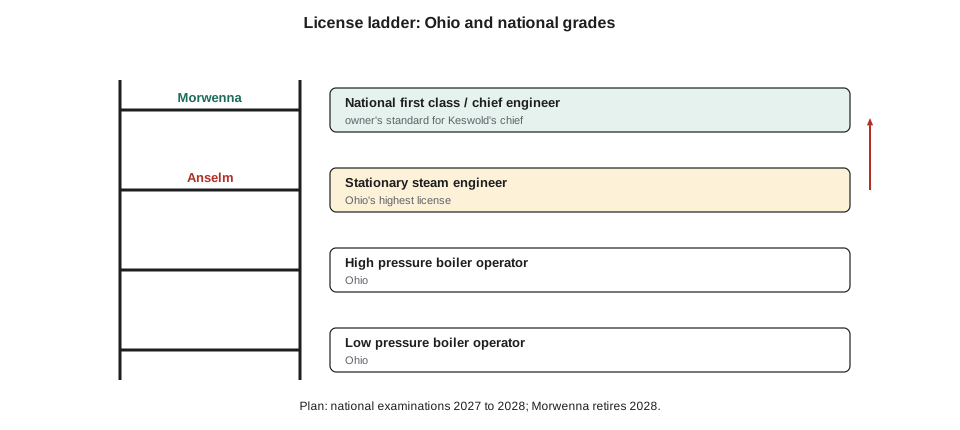
Anselm Rasmusen had been a shift supervisor at Keswold Energy Center since the plant was commissioned in 2020. Before that he had spent years at the paper mill where he and Grazyna Wolanski had worked side by side. He held Ohio's stationary steam engineer license, the highest operating license the state issues. In the fall of 2026 Morwenna Faulds, Keswold's chief engineer, told him she planned to retire in 2028 and that the owner wanted him to succeed her. Ohio law would not require anything more of him, but the owner's own standard asks its chief engineers to hold a national chief engineer license, as Morwenna does. Anselm enrolled in a part-time course built around the national first class and chief engineer standards, and Morwenna offered to meet him one evening a week in the training room.
"The certificate on the wall is the small part," Morwenna said at their first session. "The big part is that everything in this plant that can hurt someone, break, leak, cost money or break the law ends up on your desk. You don't do all of it yourself. You make sure it gets done, by the right people, and you can show that it was." She began with a blank sheet of paper and asked Anselm to list everything the chief engineer is answerable for. It took him most of an hour.
This lesson sets out the legal and practical responsibilities of a chief engineer: the duties the law places on the chief and on the owner, the difference between being responsible and doing the work, the chief's role in operations, maintenance, engineering, safety, the environment, people and money, and how the chief manages all of that through systems, delegation and records. It closes with the path to the highest certificate or license and what the examinations at that level expect.
A legal position, not only a job title
Ohio, like many states, licenses operators but does not define a chief engineer in its boiler rules. The state's stationary steam engineer license is the top of its ladder, and the chief engineer is a position the owner creates and fills. In states and cities with graded engineer laws, such as Massachusetts, the law ties the class of license to the size of the plant and names the engineer in charge. Where the law is silent, the owner's insurance carrier, its corporate standards and its contracts usually fill the gap, and Keswold's owner, like many operators of large plants, sets out the chief engineer's authority and duties in a written appointment.
Elsewhere, some cities license high pressure boiler operating engineers, and states with graded engineer licenses set the class of license by plant size and type, with a chief or first class engineer license at the top. National programs such as NIULPE's six grades, from fifth class to chief engineer, give an engineer a portable credential that employers and insurers recognize even where the law asks for less. The details differ, but the idea is common: the size and hazard of a plant decide what the person in charge should know, and that person carries a duty that cannot be handed back to the owner.
The owner's duties remain. The owner must register equipment, keep it in a safe condition, pay for inspections and repairs, provide competent staff and the resources they need, and not direct anyone to operate unsafely. A chief engineer who is refused the resources to operate safely has a duty to say so in writing and, if necessary, to the regulator. Morwenna put it bluntly: "The owner can overrule my budget. The owner cannot overrule my judgment about whether a boiler is safe to run."
Responsible is not the same as doing
A chief engineer at a plant the size of Keswold cannot personally watch every shift, inspect every vessel or approve every work order. The job is to build and run the systems that make those things happen and to check that they work. That is the difference between accountability, which stays with the chief, and delegation, which hands the work and the authority for it to someone else. Delegation without a clear scope, the competence to do the work and a way of checking it is not delegation; it is abdication.
Morwenna showed Anselm Keswold's delegation of authority table. It lists, for each type of decision, who may make it and who must be told. Shift supervisors may take equipment out of service, approve lockouts and permits, and call in contractors for urgent work within a spending limit. The maintenance planner schedules the backlog. The reliability engineer, Ingeborg Haverlund, sets inspection plans and condition monitoring intervals. Some decisions stay with the chief: returning a pressure vessel to service after a repair, approving a change to a safety instrumented function, accepting a deviation from a code or a jurisdictional requirement, and signing anything that goes to a regulator.
- Written authority says what each role may decide, approve and spend.
- Competence is checked before authority is given, through qualification records, not assumed from seniority.
- Reporting brings back what was decided, so that the chief can see patterns and step in when something drifts.
- Audit samples the work, as Pilar's permit audit did at Cantwell (PWR-420), to confirm that the system works as written.
The chief engineer's areas of responsibility
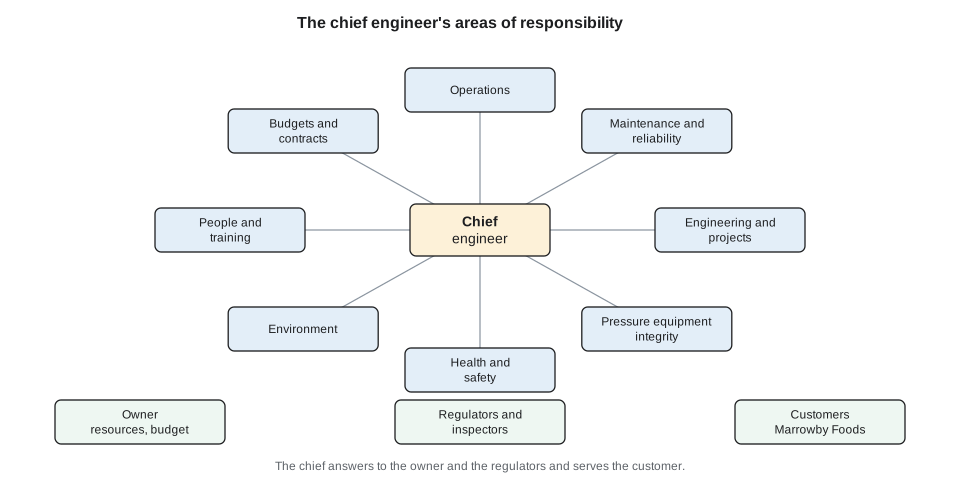
Anselm's hour-long list, tidied up, fell into eight areas. Each is the subject of later lessons in this course or earlier courses in the program, and each needs a system, an owner and a record.
- Operations. Safe, reliable and efficient operation within the plant's limits: procedures, shift staffing, handover, logs, alarms, operating envelopes and the conduct of operations (PWR-420).
- Maintenance and reliability. A maintenance strategy based on failure modes and consequences, planned work, condition monitoring, spares, backlog and the decisions about repair, replacement and life extension (PWR-420, lessons 7 and 8 of this course).
- Engineering and projects. Design reviews, modifications, management of change, capital projects and outages, and the economic case for each (lessons 2 to 6).
- Pressure equipment integrity. Registration, inspection, repairs and alterations by qualified organizations, relief device servicing and records, increasingly managed through risk-based inspection (PWR-340, lesson 7).
- Health and safety. The employer's duties under occupational health and safety law, process safety management where it applies, permits, lockout, contractor safety and incident investigation (PWR-340, PWR-420).
- Environment. Air approvals or permits, water and wastewater, spills, emissions reporting and greenhouse gas programs (PWR-420, lesson 10).
- People and training. Staffing, recruitment, qualification, succession, discipline and the culture of the plant (lesson 11).
- Budgets and contracts. The operating and capital budgets, service contracts, long-term agreements and the plant's commercial obligations to customers such as Marrowby Foods (lesson 11, PWR-420).
Running through all eight is the chief's relationship with the owner, the regulators, the insurer and the customers. Lesson 9 deals with regulators and audits. The steam contract with Marrowby Foods is a reminder that a cogeneration plant's chief has a customer across the road whose production depends on the plant's reliability, and whose own auditors check Keswold as a supplier (PWR-340).
The chief engineer's working rhythm
Morwenna's week has a pattern that has hardly changed in twenty years. Each morning she reads the shift logs and the overnight alarm summary, walks part of the plant, and holds a fifteen-minute meeting with the day shift supervisor, the maintenance planner and Ingeborg. Each week she reviews the backlog, the permits issued, open management of change items and the week's operating data against its targets. Each month she reports to the owner on safety, reliability, efficiency, emissions, costs and the status of projects, and she meets Marrowby's plant engineer to review steam supply. Each year she prepares the budget and capital plan, reviews every major procedure, chairs the management review of the safety and environmental programs, and plans the outage.
| Interval | Typical chief engineer activities |
|---|---|
| Daily | Read logs and alarm summary, walk part of the plant, short coordination meeting |
| Weekly | Backlog and permits review, open MOCs, operating data against targets |
| Monthly | Owner report, customer meeting, KPI review, safety committee follow-up |
| Quarterly | Contract reviews, emergency plan contacts check, training progress |
| Annually | Budget and capital plan, procedure review, management review, outage plan |
The rhythm matters because problems rarely announce themselves. The boiler 3 pitting at Cantwell came from a routine test that quietly dropped off a task list months earlier (PWR-340). A chief who looks at the same indicators at the same intervals notices when a line on a report stops moving, a backlog grows, or the same alarm appears on every night shift.
Records that prove the work was done
A plant is judged by its records as much as by its equipment. Regulators, insurers, auditors and lawyers ask to see the operating log, the inspection and repair records, relief valve servicing records, permits and lockout records, training and qualification records, management of change files, incident reports and environmental data. Many of these have legal retention periods, and all of them are evidence of whether the plant's systems work. Morwenna's rule is that a record should be made at the time, by the person who did the work, in a form someone else can understand in ten years.
Ohio's boiler rules require certificates of operation, inspection reports and repair records, and insurers and the state's inspectors read the plant's logs and maintenance records during their visits. Repairs and alterations to boilers and pressure vessels must follow the National Board Inspection Code and be documented by the certificate holder who made them (PWR-340).
When the chief must say no
Most of a chief engineer's decisions are about how to do things. A few are about whether to do them at all: whether to return a boiler to service with an unresolved defect, whether to run a turbine with a vibration trend that is rising, whether to accept a contractor's crew whose permits are poorly filled in, whether to defer an inspection to suit production. In each case the chief has to weigh the commercial pressure against the risk and make a decision that can be defended later. Morwenna's advice was to write the reasons down before making the decision, not after.
The Keswold bearing 3 vibration trend from November 13 is a live example (PWR-320). The 1X amplitude rose from 38 to 52 micrometers, well below the alarm of 100, and the plan is a trim balance at the next short shutdown. Anselm asked when Morwenna would stop the unit instead. "If the trend steepens, if the phase moves, if the bearing metal temperature changes, or if anything at all happens that the trim balance theory does not explain," she said. "Marrowby would rather lose steam for a day than lose it for a month."
The path to the highest certificate or license
In the United States there is no single path to the top. Where a state or city issues graded licenses, its own rules set the experience, examinations and plant size for each grade. National programs such as NIULPE set standards for each grade from fifth class to chief engineer and proctor their examinations on paper or online, and employers and insurers use them as evidence of competence. Each examining body sets its own experience rules, formats and references, so a candidate's first task is to obtain the current requirements in writing. Anselm's six years as a stationary steam engineer at Keswold, and his years at the paper mill before that, gave him far more operating experience than the course would ask for; the question was how to document it.
Worked problem
Checking the experience
Anselm is preparing the experience record for his application. His log extract for the last 30 months shows 5,460 hours as shift supervisor at Keswold, of which 2,350 hours were spent with the heat recovery steam generator or the auxiliary boiler under his direct charge and 1,010 hours on maintenance of regulated equipment. Suppose the examining body uses the same proportions as some Canadian jurisdictions: a minimum of a third in boiler operation and a maximum of a third in maintenance, out of 4,800 hours. Does the extract meet them?
Show solution
- \[\frac{2{,}350}{5{,}460} = 0.43 \ge 0.33 \qquad \frac{1{,}010}{5{,}460} = 0.18 \le 0.33\]
- \[5{,}460 \text{ h} \ge 4{,}800 \text{ h}\]
Answer: Yes. The total exceeds 4,800 hours, the boiler operation share is 0.43, above a third, and the maintenance share is 0.18, below a third. Whatever proportions the examining body actually uses, the record should break the hours down this way, with dates, plant equipment and a signed confirmation from the chief engineer, because that is what an assessor will look for.
Examinations at the first class and chief engineer level test the same subjects as the second class standard at greater depth and with a management emphasis: applied mechanics and thermodynamics, materials, codes and design calculations, boilers and their auxiliaries, prime movers and electrical machines, instrumentation and control, plant management, environment and law. Morwenna's advice was the same as Grazyna's had been for Pilar: plan the examinations like a project, write practice answers in full, and have someone mark them (PWR-420).
"You'll find that the First Class material is mostly about decisions," Morwenna said, "and the engineering is there so you can make them on evidence. Every lesson from here on, ask yourself who decides, on what information, and what record is left behind."
Common mistakes
MistakeThinking the chief engineer's duties transfer to the owner when the owner sets the budget.
InsteadThe owner sets resources; the chief's duty for safe operation stays with the chief and must be raised in writing if resources are inadequate.
MistakeDelegating work without written authority, checked competence and reporting.
InsteadDelegate with a written scope, qualified people and a way to check the work.
MistakeTreating records as paperwork to be done after the job.
InsteadMake records at the time, by the person who did the work, in a form others can understand later.
MistakeAssuming seniority proves competence.
InsteadCheck qualification records before giving authority.
MistakeDeciding first and writing the reasons later.
InsteadWrite down the reasons before a difficult decision, so the decision can be defended.
MistakeCounting total hours without checking how they divide between operation and maintenance.
InsteadBreak experience down the way the examining body asks, with dates and a signed confirmation.
Summary and key terms
- The chief engineer holds a defined legal position in many jurisdictions and an owner-defined one elsewhere; the class required follows the size and hazard of the plant.
- The owner provides registration, resources and competent staff; the chief is accountable for safe operation and must say so in writing when resources are inadequate.
- Accountability stays with the chief; work is delegated through written authority, checked competence, reporting and audit.
- The chief's responsibilities cover operations, maintenance and reliability, engineering and projects, pressure equipment integrity, health and safety, environment, people and budgets.
- A regular working rhythm and good records let the chief see when systems drift.
- The path to the highest certificate or license depends on documented experience and examinations at a management level.
- Chief operating engineer
- The person appointed by the owner to be responsible for the operation of a registered plant.
- Accountability
- Responsibility for an outcome that stays with a person even when the work is delegated.
- Delegation of authority
- A written statement of which roles may make which decisions, approvals and commitments.
- Shift engineer
- The qualified engineer in charge of the plant on a shift.
- Log book
- The plant's continuous record of operation, kept by the engineers on duty.
- Owner
- The person or organization that owns the plant and carries the duties of registration, maintenance and resourcing.
- Management review
- A periodic review by senior management of whether a management system is working and what must change.
Practice problems
Work each problem on paper first, then reveal the answer to check.
A candidate has 4,950 hours, 1,500 of them boiler operation and 1,700 maintenance. Would a one-third rule for each be met?
Show answer
No: boiler operation is 0.30, below a third, and maintenance is 0.34, above a third.
Does Ohio define a chief engineer in its boiler rules?
Show answer
No; it licenses operators, and the chief engineer is a position the owner defines.
What is the highest operating license Ohio issues?
Show answer
Stationary steam engineer.
What should an experience record include for an assessor?
Show answer
Hours by type of work, dates, the plant and equipment, and a signed confirmation from the chief engineer.
Lesson quiz · 5 questions
Score 60% or more to complete this lesson.
Create a free account to save your progress, take quizzes and earn a certificate.