
PWR-510 · Lesson 11 of 12 · 22 min
Managing people, contractors and budgets
▶ Video coming soon A video version of this lesson is on the way.
Keswold employs 25 people. Morwenna knew each of them, their families' names, their strengths and the shifts they disliked, and she said that was the part of the job she would miss most and the part Anselm should worry about most. "You've run a shift for six years," she told him. "Running a plant means you're responsible for people you don't see every day, contractors you didn't hire, and a budget somebody else will judge you on. The engineering is the easy part."
This lesson covers the organization and staffing of a plant, recruiting, developing and keeping good people, succession, performance and discipline, working with unions and collective agreements, managing contractors from selection to evaluation, and preparing and controlling the operating and capital budgets. It builds on the crew leadership and training lessons of PWR-420.
Organizing the plant
Keswold's organization is typical of an independent cogeneration plant of its size. The chief engineer reports to the owner's director of operations and is responsible for everything on the site. Five shift crews of three, each with a shift supervisor, a board operator and a field operator, cover the plant around the clock on a rotation of twelve-hour shifts. A maintenance supervisor leads four technicians, mechanical, instrument and electrical, on days. The reliability engineer, Ingeborg, and an environmental and chemistry lead report to the chief, as do a maintenance planner and an administrator. Contractors and the gas turbine manufacturer's field engineers under the long-term service agreement add to the team for major work (PWR-420).
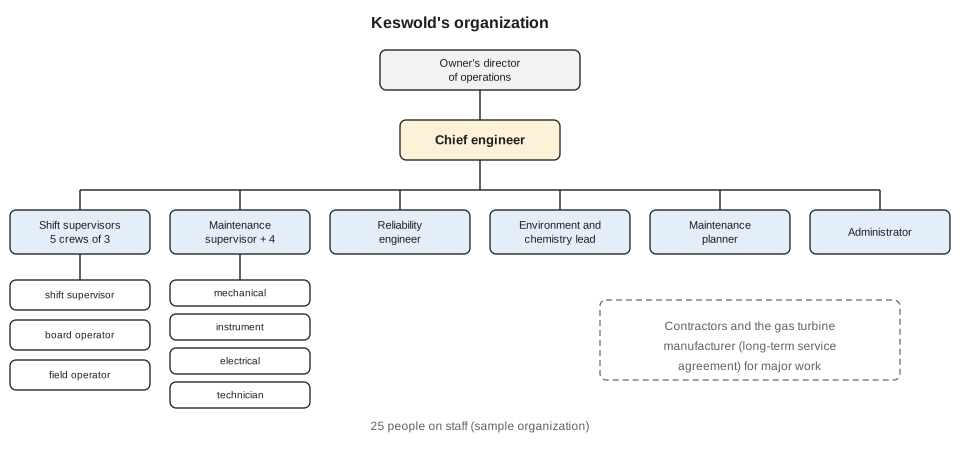
The structure follows a few principles: one person in charge of the plant at all times, a clear line from each person to the chief, a span of control small enough for each supervisor to know the work, and technical specialists close to the chief so that their advice is heard. The shift supervisor holds the authority on shift, as the regulations require, and the day staff support the shifts rather than direct them.
How many people does a shift position need?
A position that must be filled around the clock needs far more than one person. Each person works a limited number of hours a year, after vacation, statutory holidays, training, sickness and other absences, and the rotation must still cover every hour.
Worked problem
Staffing a round-the-clock position
A position must be filled for all 8,760 hours of the year. Each operator works about 1,800 hours a year after vacation, holidays, training and typical absences (a sample figure; the rotation schedules about 2,184 hours). How many people does one position need, and how many for Keswold's three shift positions?
Show solution
- \[\frac{8{,}760}{1{,}800} = 4.87 \text{ people per position} \qquad 3 \times 4.87 = 14.6\]
Answer: Almost five people per position, or about fifteen for the three shift positions, which is why Keswold has five crews of three. With exactly fifteen, any long-term absence, a vacancy or a training program has to be covered by overtime. Many plants add one or two relief operators who are qualified on several positions, which is cheaper than chronic overtime and safer, because overtime brings fatigue (PWR-420).
Overtime is easy to approve and hard to control. Keswold paid about 1,200 hours of overtime in 2025, mostly to cover a vacancy and two long-term absences, and at a sample base rate of 52 dollars an hour paid at time and a half, those hours cost about 93,600 dollars, close to the cost of a relief operator. Morwenna had used that comparison to win approval for a relief position in the 2027 budget.
Recruiting and developing people
Recruiting skilled operators and technicians has become harder as experienced staff retire. Keswold recruits from college power engineering programs, from other plants and from the trades, and its strongest source has been its own trainees. A good recruitment process defines the job and its certificate or license requirements, tests for the skills that matter, such as reasoning about systems, attention to procedure and teamwork, checks references, and gives candidates a realistic preview of shift work.
Development turns a new hire into a qualified operator and a good operator into a future supervisor. It uses the qualification program (PWR-420), coaching by experienced staff, rotation through different positions, support for certificate or license study, as Morwenna was giving Anselm and Grazyna was giving Pilar and Okonkwo, and small leadership responsibilities that grow over time. Development is also the best tool for keeping people: staff who see a future at the plant are less likely to leave for another.
Succession
A succession plan identifies, for each critical role, who could fill it if the holder left, what they would need to be ready, and when. At Keswold, the critical roles are the chief engineer, the shift supervisors, the reliability engineer and the instrument technician, whose knowledge of the control system is hard to replace. Morwenna's own succession was the most visible part of the plan: Anselm would be ready by 2028, with his certificate or license, a year of acting as chief during her vacations, and responsibility for the expansion project. His own position would go to Liesl Brannagan, whose six years at the board and steady handling of the turbine restart had shown she was ready to supervise (PWR-320).
Succession planning also covers knowledge. Experienced staff carry knowledge that is not written down: why a procedure has an odd step, which valve sticks, which alarm means trouble. Keswold captures it in procedure notes, in recorded walk-downs, and by pairing retiring staff with their successors for months before they leave.
Performance, feedback and discipline
Most people want to do good work and need to know how they are doing. Regular, specific feedback, both recognition and correction, is a supervisor's most powerful tool (PWR-420). A yearly performance review should hold no surprises; it summarizes conversations that have happened all year and sets goals for development.
When performance or conduct falls short, the response should be fair, consistent and documented. Most problems are resolved by a conversation that makes the expectation clear and offers support. Persistent problems move to progressive discipline: a documented verbal warning, a written warning, suspension, and finally dismissal, with each step explained and an opportunity to improve. Serious misconduct, such as deliberately defeating a safety system, working impaired or falsifying records, can justify skipping steps. The just culture principle (PWR-420) applies: honest errors are treated as system problems, at-risk shortcuts are coached, and reckless or deliberate violations are disciplined.
Employment law sets the limits. Federal and state law set minimum wage and overtime rules, protect workers who raise safety concerns from retaliation, and require accommodation of disability under the Americans with Disabilities Act, along with other protections against discrimination. Where a union represents the workers, the collective bargaining agreement adds its own rules.
Working with a union
Keswold's operators and technicians are represented by a union, as are those at many power plants. The collective agreement sets wages, hours, shift rotations, overtime distribution, seniority rules, job postings, discipline procedures and grievance and arbitration. A chief engineer must know the agreement well, apply it consistently, and work with the union's stewards on the many issues where both sides want the same thing, especially safety and training. Disputes that cannot be resolved go through the grievance procedure, which is designed to settle them without disrupting the plant.
Morwenna's practice was to talk with the stewards before announcing any change that affected the crews, such as a new rotation or a new procedure, and to involve operators in writing procedures and in the expansion project's model reviews. "The agreement is the floor, not the ceiling," she said. "The plant runs on trust, and trust is built in the hundreds of small decisions where you do what you said."
Selecting and managing contractors
Contractors do much of a plant's specialized and peak work, and the plant remains responsible for their safety on its site. Managing them well starts before they arrive.
- Prequalification: safety performance, programs and training; technical competence and certifications, such as a repair organization's registration or certificate (PWR-340); insurance; and references.
- Selection: by best value, not lowest price, using the contracting approaches of PWR-420.
- Orientation: every contractor worker learns the site's hazards, rules, emergency procedures and permit system before starting work.
- Control of work: permits, isolations and supervision apply to contractors as to staff; the plant assigns a coordinator for each contract.
- Monitoring: field observations, audits of permits and safe work practices, and stopping unsafe work.
- Evaluation: after each job, a short evaluation of safety, quality, schedule and cost, kept for the next selection.
Worked problem
Comparing contractors' safety records
Two mechanical contractors bid for the expansion's installation work. Contractor A reported 3 recordable injuries in 410,000 hours worked over the last three years; Contractor B reported 2 in 150,000 hours. Compare their total recordable incident rates, which normalize injuries to 200,000 hours, about 100 full-time workers for a year.
Show solution
- \[TRIR_A = \frac{3 \times 200{,}000}{410{,}000} = 1.46 \qquad TRIR_B = \frac{2 \times 200{,}000}{150{,}000} = 2.67\]
Answer: Contractor A's rate is about half of B's. Rates based on few incidents are noisy, so the prequalification also looks at leading indicators, such as near-miss reporting, safety training, supervisor-to-worker ratios and how the contractor investigates incidents, and at its record on similar work. A contractor with a low rate and no near-miss reports may simply not be reporting.
Under OSHA's multi-employer worksite policy, more than one employer can be cited for a hazard: the one that created it, the one whose workers were exposed, the one responsible for correcting it, and the one controlling the site. The plant, as the controlling employer, keeps duties for the safety of its workplace even when contractors do the work.
The operating budget
The operating budget covers the cost of running and maintaining the plant for a year. At Keswold, fuel is by far the largest cost, but it is managed with the owner's commercial team and passed through the steam and power contracts, so the chief engineer's controllable budget is the rest.
| Item | 2027 budget, million dollars (sample) |
|---|---|
| Staff (wages, benefits, overtime) | 3.10 |
| Contract services (excluding the long-term service agreement) | 1.45 |
| Parts and materials | 0.95 |
| Chemicals and consumables | 0.32 |
| Training and certification | 0.08 |
| Other (insurance share, fees, IT, travel) | 0.40 |
| Total controllable operating budget | 6.30 |
A budget is built from the plant's plans, not from last year's number plus inflation: the staffing plan, the maintenance plan and its contract work, the outage plan, the training plan and known changes such as the relief operator position. Each line has an owner. During the year, actual costs are compared with the budget each month, and variances are explained: a variance is acceptable when it has a reason and a plan, and worrying when nobody can explain it. A forecast of the year's final cost is updated each quarter so that the owner is never surprised.
Some costs are lumpy. Major inspections and overhauls happen every few years, and long-term service agreements often charge by fired hours or starts, building up a liability that is paid at the next major inspection. Keswold keeps a major maintenance reserve for these, so that the year of a major outage does not look like a disaster and the years between do not look artificially cheap.
The capital budget
The capital budget funds projects that create or extend assets: replacements, improvements, compliance projects and expansions. Each year Keswold submits a five-year capital plan to the owner, with each project described, justified by its economics, risk reduction or compliance need (lesson 6), and classified by the maturity of its estimate (lesson 5). The owner approves projects at gates, releasing money for each phase. The expansion project for Marrowby would enter the plan as a feasibility study in 2027.
Morwenna's advice on capital requests was to be disciplined about the reasons. "Must do" projects are those required by law, by the insurer or by a safety risk that cannot be accepted. "Should do" projects have a positive NPV or reduce a significant reliability risk. "Nice to do" projects are everything else. A plan that puts every project in the first category loses credibility quickly.
The chief engineer's balance
People, contractors and money pull in different directions: the budget wants fewer people and cheaper contractors, safety wants more training and better contractors, reliability wants more spares and more maintenance. The chief engineer's job is to find the balance, explain it to the owner in terms the owner understands, and hold the line on safety when the pressure comes. Morwenna ended the session with the advice she had received from her own predecessor. "Spend the owner's money as if it were yours, look after the crews as if they were family, and never let either of them talk you into something you'd have to explain to a coroner."
Common mistakes
MistakeStaffing a round-the-clock position with four people.
InsteadCalculate the hours each person actually works; about five are needed per position.
MistakeCovering vacancies with chronic overtime.
InsteadCompare the cost and fatigue of overtime with a relief position.
MistakeLeaving succession to chance.
InsteadName successors for critical roles, develop them and capture undocumented knowledge.
MistakeSelecting contractors by lowest price alone.
InsteadPrequalify on safety and competence, select on best value and evaluate after each job.
MistakeBuilding next year's budget as this year's plus inflation.
InsteadBuild it from the staffing, maintenance, outage and training plans, with an owner for each line.
MistakeCalling every capital project a must-do.
InsteadClassify projects honestly as must, should or nice to do.
Summary and key terms
- A plant organization has one person in charge at all times, clear reporting lines, manageable spans of control and specialists close to the chief.
- A round-the-clock position needs about five people; relief positions are often cheaper and safer than chronic overtime.
- Recruitment, development and succession planning keep a plant staffed with qualified people and preserve knowledge.
- Feedback, fair progressive discipline, just culture, employment law and the collective agreement govern how performance is managed.
- Contractors are prequalified, selected on value, oriented, controlled, monitored and evaluated; the plant keeps duties for their safety.
- Operating and capital budgets are built from plans, tracked monthly with explained variances, smoothed with reserves for lumpy costs, and justified honestly.
- Span of control
- The number of people a supervisor directly manages.
- Relief operator
- An operator qualified on several positions who covers absences.
- Succession plan
- A plan naming and preparing successors for critical roles.
- Progressive discipline
- A sequence of increasingly serious responses to repeated performance or conduct problems.
- Collective agreement
- A contract between an employer and a union setting terms of employment.
- Prequalification
- Checking a contractor's safety, competence and insurance before inviting a bid.
- Total recordable incident rate
- Recordable injuries per 200,000 hours worked.
- Variance
- The difference between actual and budgeted cost.
- Major maintenance reserve
- Money set aside each year for periodic major inspections and overhauls.
Practice problems
Work each problem on paper first, then reveal the answer to check.
People needed for two round-the-clock positions if each works 1,750 hours a year?
Show answer
About 10.0.
TRIR for 4 recordables in 320,000 hours?
Show answer
2.5.
Cost of 900 overtime hours at 50 dollars an hour at time and a half?
Show answer
67,500 dollars.
Which category does a project required by the insurer fall in?
Show answer
Must do.
Lesson quiz · 5 questions
Score 60% or more to complete this lesson.
Create a free account to save your progress, take quizzes and earn a certificate.