
PWR-510 · Lesson 9 of 12 · 20 min
Regulatory relationships and audits
▶ Video coming soon A video version of this lesson is on the way.
Grazyna came to the ninth session at Morwenna's invitation. Between them they had nearly fifty years of dealing with inspectors, auditors and regulators, and Morwenna wanted Anselm to hear the stories that never appear in a textbook. "The regulator is not your enemy and not your friend," Grazyna said. "The regulator is the public's representative in your plant. Treat them that way and most of the relationship takes care of itself."
This lesson describes the regulators and other bodies that oversee a power plant, how a chief engineer keeps track of the plant's obligations, how to prepare for and manage inspections and audits, how to respond to findings and orders, and how to build a relationship of trust that survives a bad day. It builds on the audit methods of PWR-420.
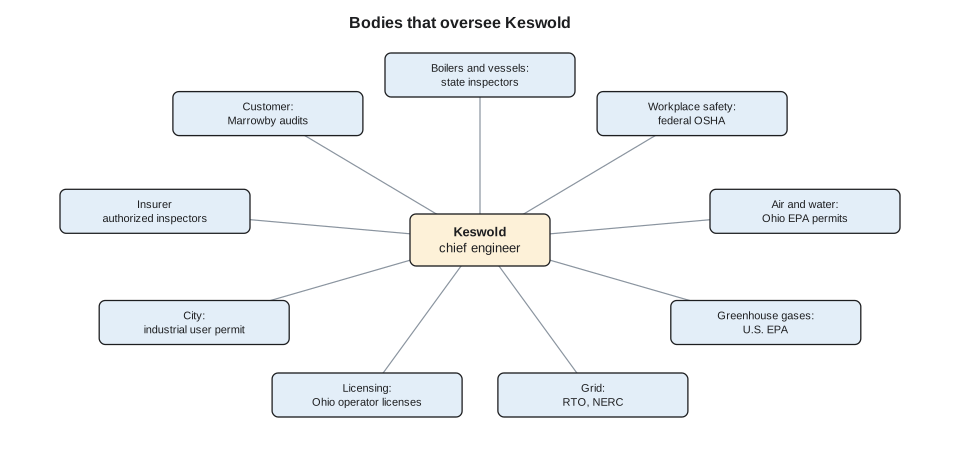
Who oversees a power plant
A plant like Keswold answers to many bodies, each with its own legislation, inspectors and reporting requirements.
| Area | Main bodies (Ohio and federal) |
|---|---|
| Boilers and pressure vessels | Ohio Department of Commerce boiler section; insurer's authorized inspectors |
| Operator licensing | Ohio's boiler operator and stationary steam engineer licensing |
| Worker health and safety | Federal OSHA (Ohio has no state plan for private employers) |
| Air permits | Ohio EPA (permit to install and operate; Title V operating permit for major sources) |
| Water discharges | Ohio EPA under NPDES; the city under its industrial user permit |
| Greenhouse gases and federal air rules | U.S. EPA (greenhouse gas reporting, new source performance standards) |
| Hazardous chemicals and planning | EPA and the local emergency planning committee (EPCRA, RMP where it applies) |
| Grid connection and reliability | The regional transmission organization, NERC and its regional entity for registered generators |
| Electrical and building codes | State and local building departments |
| Utility regulation | Public Utilities Commission of Ohio where its rules apply |
Beyond the regulators are the insurer, whose inspectors examine boilers and pressure vessels and whose loss control engineers audit the plant's risk; the customer, Marrowby Foods, whose supplier audits look at Keswold's reliability, food safety requirements for boiler chemicals and environmental performance (PWR-330, PWR-340); the owner's corporate audit group; and certification bodies for any management system standards the plant has adopted, such as ISO 14001 or ISO 45001.
Knowing the obligations
A chief engineer cannot comply with obligations nobody has written down. Keswold keeps a compliance register: every legal and contractual requirement that applies to the plant, the document it comes from, what must be done, how often, by whom, and where the record is kept. The register includes the conditions of each approval or permit, registration and inspection requirements, operator certification, reports and their due dates, notification requirements for incidents and changes, and obligations in the steam contract and the grid connection agreement.
| Obligation | Source | Frequency | Owner | Record |
|---|---|---|---|---|
| HRSG annual inspection | Ohio boiler rules | Annual | Chief engineer | Inspection certificate and report |
| Relief valve servicing | Insurer and NBIC | Per schedule | Reliability engineer | Service records |
| Stack test for NOx and CO | Air permit | As specified | Environmental lead | Test report |
| Greenhouse gas report | EPA greenhouse gas reporting | Annual | Environmental lead | Submitted report |
| Operator certificates current | Ohio licensing rules | Continuous | Chief engineer | Certificate register |
| Steam quality and supply report | Marrowby steam contract | Monthly | Chief engineer | Monthly report |
The register is reviewed whenever a law, approval, permit or contract changes, and at least once a year. Keeping up with changes is part of the job: the code adoption documents change, federal and provincial or state rules change, and the plant must know about each one in time to act. Morwenna subscribes to the regulators' bulletins, belongs to two industry associations that track changes, and keeps a line in each monthly report for "regulatory changes coming".
Worked problem
How many pressure equipment inspections a year?
Keswold's register lists, among its pressure equipment inspections: the HRSG, inspected annually; the insurer's annual operating inspection of the plant; six pressure vessels on two-year intervals; and eight on three-year intervals (sample intervals for teaching). On average, how many inspections must be planned and hosted each year?
Show solution
- \[1 + 1 + \frac{6}{2} + \frac{8}{3} = 1 + 1 + 3 + 2.67 = 7.67 \text{ per year}\]
Answer: About eight a year, before counting environmental tests, electrical inspections, insurer loss control visits, customer audits and the owner's own audits. Spread across the year, with vessel inspections grouped into outages where possible, they become a manageable calendar. Missed, they become findings. A calendar of due dates, reviewed monthly, is the simplest and most important compliance tool a chief engineer has.
Preparing for an inspection or audit
Most inspections are scheduled, and preparation makes them shorter and less stressful for everyone. Before the visit, the chief engineer or a delegate confirms the scope and who will attend, gathers the records the inspector is likely to ask for, walks the area to be inspected, makes sure the equipment is prepared if it is to be opened, and briefs the people who will be involved.
- Prepare equipment safely: isolated, locked out, drained, ventilated and tested before an internal inspection, with entry permits ready.
- Have the records ready: previous reports, repairs since the last visit, relief valve records, operating logs and any open findings with their status.
- Assign an escort who knows the area and can answer questions or find the person who can.
- Tell the shift what is happening and when.
Unannounced visits happen too, especially after an incident or a complaint. The plant's procedure should say who receives the inspector, who is called, and how the visit is supported. Morwenna's instruction to every shift supervisor is the same: be courteous, check identification, call her or her delegate, and help the inspector do the job safely.
During the visit
Grazyna's advice came from experience. Answer the question asked, accurately and completely, and do not speculate. If you do not know, say so and find out. Do not hide anything, and do not volunteer opinions about things outside your knowledge. Take notes of what is inspected, what is asked and what is said. If samples are taken, take duplicates for the plant. If the inspector points out a problem, acknowledge it, ask questions to understand it, and say what will be done; do not argue on the spot about whether it is a violation, which can be discussed later with the facts.
Accompany the inspector everywhere for safety, and make sure the inspector follows the plant's safety rules, as anyone else would. Inspectors expect this. At the end, ask for a closing meeting to go over what was found, so there are no surprises in the written report.
Responding to findings and orders
Findings range from observations to written citations and orders. The state's boiler inspectors may refuse a certificate of operation or order equipment out of service until defects are corrected. OSHA may issue citations with penalties, which must be posted and can be contested within a set period. Ohio EPA may issue notices of violation and orders. Each has an appeal or contest route. The chief engineer's response should be prompt, specific and documented: what was found, what has been done or will be done, by when, by whom, and how the plant will prevent it from happening again.
Findings go into the plant's corrective action system (PWR-420), with an owner and a due date, and are closed only when the action is complete and verified. If a deadline cannot be met, the regulator is told before it passes, with the reason and a new date. A plant that misses a deadline without explanation loses trust that took years to build.
When the plant disagrees with a finding, it says so through the proper route, with facts and engineering evidence, and continues to comply while the disagreement is resolved, unless a stay is granted. Grazyna remembered a dispute over a relief valve capacity calculation that took three months to settle. "We were right in the end," she said, "but we ran with a second valve fitted the whole time, because the inspector's concern was reasonable until we proved otherwise."
Reporting and self-disclosure
Many events must be reported: certain boiler and pressure vessel accidents and defects to the state (PWR-330), fatalities and serious injuries to OSHA within short deadlines, spills and releases to the National Response Center and Ohio EPA, and permit deviations as the permit requires. The rules on what, when and how are in the compliance register, and the shift supervisors know the immediate notifications by heart.
Beyond the legal minimum, a plant that finds a problem itself and reports it promptly usually fares better than one whose problem is found by someone else. Many regulators recognize voluntary disclosure and prompt correction in their enforcement decisions. More important, self-disclosure builds the kind of trust that lets an inspector accept a plant's word on a bad day.
Audits as a management tool
Audits are not only something done to a plant; they are something a good plant does to itself. An audit program plans internal audits of each management system element on a cycle, using auditors independent of the work, objective evidence and representative samples (PWR-420). External audits, by the owner, the insurer, the customer or a certification body, add a fresh pair of eyes. Every audit's findings go into the same corrective action system, and the management review looks at all of them together each year to see what they say about the plant's systems.
Morwenna's view was that a plant should know its own weaknesses better than any auditor. "If an auditor finds something we didn't already know about, that's a finding about our own audit program." At Keswold, the internal audit schedule covers permits, lockout, management of change, training records, pressure equipment records, environmental reporting and the compliance register itself, each at least every three years, and more often where earlier audits found problems.
Building the relationship
Over a career, a chief engineer will deal with many inspectors. The relationship is professional and depends on consistency: being prepared, being honest, keeping commitments and telling the regulator early about problems and changes. It does not depend on friendliness, and it must never involve favors. A regulator who trusts a plant's information may accept a reasonable proposal, such as an inspection plan built on RBI (lesson 7), a temporary operating restriction instead of a shutdown, or a schedule for a complex correction. A regulator who has been misled once will check everything forever.
Grazyna's last story was about the November 2026 tube leak at Cantwell (PWR-220). Desmond found the leak at night by water balance and the boiler came off line. Grazyna called the insurer's inspector, Ottoline Brackwater, that morning to tell her what had happened, and as soon as the leak was located the next day she sent the facts, the photos and a proposed repair plan. Ottoline agreed the plan the same day, witnessed the hydrostatic test two days later and accepted the repair. "It went smoothly because she knew we'd call her the moment something happened," Grazyna said. "That's twelve years of phone calls."
Management of change and the regulator
Some changes need the regulator's involvement before they are made. In Ohio, a new boiler or pressure vessel needs a code stamp, National Board registration, an installation inspection and a certificate of operation; repairs and alterations must be made by a certificate holder under the National Board Inspection Code (PWR-340); and new air or water sources, or changes to existing ones, generally need a permit to install and operate or a permit revision before construction. The plant's management of change procedure should ask, for every change, whether any regulator must be told or must approve it, and the compliance register lists the triggers.
Early conversations help. Before Keswold applies for any approval or permit for the expansion, Morwenna plans to meet the regulators informally to describe the project, ask what they will need, and learn about any concerns. Regulators generally prefer to be consulted early rather than presented with a finished design, and a pre-application meeting often saves months. The same applies to the insurer, whose engineers may have requirements for the new boilers' controls and fire protection.
Records that stand up
Every inspection, finding, response and closure leaves a record, and those records are the plant's evidence if anything is questioned later. Keswold files each inspection report with the plant's response and the evidence of closure, keeps correspondence with regulators in one place, and records phone calls with the date, the person and what was agreed. Grazyna's advice was to confirm in writing anything important that was agreed by phone, the same day. "Memories differ," she said. "Emails don't."
Common mistakes
MistakeRelying on memory for the plant's legal and contractual obligations.
InsteadKeep a compliance register with sources, frequencies, owners and records, and review it when requirements change.
MistakeSpeculating or arguing during an inspection.
InsteadAnswer accurately, say when you don't know, take notes and discuss disagreements later with facts.
MistakeLetting a corrective action deadline pass without telling the regulator.
InsteadInform the regulator before the deadline with the reason and a new date.
MistakeStopping compliance while disputing a finding.
InsteadContinue to comply, or obtain a stay, while the disagreement is resolved through the proper route.
MistakeTreating audits only as something done to the plant.
InsteadRun an internal audit program and use all audit findings in the management review.
MistakeReporting only what must be reported.
InsteadDisclose problems promptly; trust built this way pays off when it is needed.
Summary and key terms
- A cogeneration plant answers to pressure equipment, operator, workplace, environmental, greenhouse gas, grid and municipal regulators, plus insurers, customers, owners and certification bodies.
- A compliance register lists every obligation with its source, frequency, owner and record, and is reviewed when requirements change.
- Inspections are prepared for with safe equipment, ready records, an escort and a briefed shift; unannounced visits follow a procedure.
- During visits, answer accurately, do not speculate, take notes and duplicates, and hold a closing meeting.
- Findings and orders get prompt, specific, documented responses through the corrective action system; disagreements go through proper routes while compliance continues.
- Reporting, self-disclosure, an internal audit program and consistent honesty build the trust that matters on a bad day.
- Compliance register
- A list of all legal and contractual obligations with their sources, frequencies, owners and records.
- Order
- A written direction from a regulator requiring action by a date.
- Self-disclosure
- Reporting a problem to the regulator promptly after the plant finds it.
- Audit program
- A planned cycle of audits covering each element of a management system.
- Closing meeting
- A meeting at the end of an inspection or audit to review findings.
- Stay
- A suspension of an order while an appeal is decided.
- Insurer inspector
- An inspector employed by an insurance company who examines insured pressure equipment.
Practice problems
Work each problem on paper first, then reveal the answer to check.
Inspections per year for 2 annual items, 9 on two-year and 6 on three-year intervals?
Show answer
2 + 4.5 + 2 = 8.5.
What should be done if a corrective action deadline cannot be met?
Show answer
Tell the regulator before it passes, with the reason and a new date.
Who must be called first when an inspector arrives unannounced at Keswold?
Show answer
The chief engineer or her delegate.
Why take duplicate samples?
Show answer
So the plant has its own evidence of what was sampled.
Lesson quiz · 5 questions
Score 60% or more to complete this lesson.
Create a free account to save your progress, take quizzes and earn a certificate.