
PWR-510 · Lesson 7 of 12 · 22 min
Risk-based inspection
▶ Video coming soon A video version of this lesson is on the way.
Ingeborg had spent the last two years building a risk-based inspection program for Keswold's heat recovery steam generator and piping, and she led the session on it. Grazyna came over from Cantwell for the evening, because she was thinking about the same approach for her own plant and had brought her deaerator's thickness records. "Time-based inspection treats every vessel as if it were equally likely to fail and equally bad if it did," Ingeborg began. "They aren't. Risk-based inspection spends the inspection budget where it buys the most safety."
This lesson explains risk as a combination of probability and consequence, the main steps of a risk-based inspection (RBI) program, how damage mechanisms are identified, how remaining life and inspection intervals are set from measured damage rates, how risk is ranked and used to plan inspections, and how an RBI program fits with the jurisdiction's inspection requirements.
Risk, probability and consequence
Risk is the combination of how likely an event is and how bad it would be. For pressure equipment, the event is a loss of containment, a leak or rupture, and risk is often expressed as the probability of failure (PoF) per year times the consequence of failure (CoF). The consequence can be measured in harm to people, damage to the environment, or cost, including repairs, lost production and penalties, and a program may rank each type separately.
Traditional inspection sets intervals by type of equipment and by the jurisdiction's maximum intervals, and inspects each item the same way each time. That is simple and has served well, but it can inspect low-risk items too often and miss the specific mechanisms that threaten high-risk ones. RBI keeps the inspector's judgment and the jurisdiction's requirements at its core, and adds a structured way of asking, for each item, how it could fail, how likely that is now, what would happen if it did, and what inspection would reduce the risk most.
The standards
In the oil, gas and petrochemical industries, and increasingly in power plants, RBI follows the American Petroleum Institute's documents. API RP 580, whose fourth edition was published in 2023, sets out the principles and minimum elements of an RBI program without prescribing a method. API RP 581, whose fourth edition was published in 2025, provides a detailed quantitative methodology, with damage factors for each mechanism and consequence models. API RP 571 describes the damage mechanisms that affect fixed equipment, and API RP 584 covers integrity operating windows. Power plants also draw on guidance from their insurers, the National Board Inspection Code and industry research organizations for boiler-specific mechanisms. None of these documents is reproduced here; they are the references a program is built on.
The steps of an RBI program
- Define the scope: the equipment and piping included, the plant's operating conditions, the team and the risk criteria the owner will accept.
- Gather data: design and construction records, materials, operating conditions and their history, water chemistry, inspection history, repairs and failures.
- Group into corrosion loops or circuits: parts of the system that share materials and conditions and therefore the same damage mechanisms.
- Identify damage mechanisms for each loop, with their expected rate and where they would appear.
- Estimate the probability of failure, from the damage rate, the remaining wall, the time since the last inspection and how effective that inspection was at finding the mechanism.
- Estimate the consequence of failure, from the fluid, its pressure and temperature, the inventory that would be released, nearby people and equipment, and the cost of the outage.
- Rank the risk and compare it with the owner's criteria.
- Plan inspections that target each mechanism with the right method, coverage and interval, and other actions such as monitoring, operating limits or replacement.
- Reassess after each inspection, after any change in operation or chemistry, and at a set interval.
Damage mechanisms in a heat recovery steam generator
Ingeborg's damage mechanism review for Keswold's HRSG listed the mechanisms that matter in combined cycle plants, many of which became widely known only when plants built for base load began to cycle.
- Flow-accelerated corrosion (FAC) thins carbon steel in low pressure evaporators, economizers, feedwater and drain lines where water or wet steam flows fast at about 250 to 430 °F, especially where the water chemistry is reducing and very low in oxygen (lesson 8, PWR-330).
- Thermal fatigue cracks attemperator liners and downstream piping where cold spray water hits hot pipe, superheater and reheater headers that cycle, and drum nozzles during fast starts.
- Creep slowly deforms and ruptures superheater tubes and headers that run hot, especially where flow is poor or temperatures overshoot during starts.
- Under-deposit corrosion and hydrogen damage attack evaporator tubes where deposits concentrate boiler water chemicals.
- Dew point corrosion attacks the cold end of the economizer and stack when flue gas cools below its acid dew point.
- Corrosion under insulation attacks the outside of piping and vessels where insulation gets wet.
- Pitting during layup, as Cantwell's boiler 3 showed, when wet layup chemistry is not maintained (PWR-340).
For each mechanism the review notes the locations where it is most likely, the inspection methods that can find it, such as ultrasonic thickness scanning for FAC, phased array or time-of-flight diffraction ultrasonics for fatigue cracks at nozzles, replication and hardness for creep, and internal visual and tube samples for under-deposit corrosion, and the operating conditions that drive it. Those conditions become integrity operating windows: limits on parameters such as feedwater oxygen and pH, attemperator spray rates, ramp rates and drum level, with alarms and responses when they are exceeded.
Remaining life and inspection interval
For thinning mechanisms the most useful calculation is simple. The corrosion rate is the loss of wall between two measurements divided by the time between them. The remaining life is the remaining wall above the minimum required thickness divided by the corrosion rate. A common rule, used in API inspection codes, sets the next inspection at no more than half the remaining life, subject to any maximum interval the jurisdiction imposes.
Worked problem
Grazyna's deaerator
Cantwell's deaerator storage tank has a minimum required thickness of 0.236 in. A general shell condition monitoring location measured 0.378 in in 2016 and 0.358 in in 2026. The location near the condensate return inlet measured 0.358 in in 2022 and 0.331 in in 2026 (PWR-340). Find each location's corrosion rate, remaining life and maximum interval by the half-life rule.
Show solution
- \[\text{Shell: } r = \frac{0.378 - 0.358}{10} = 0.0020 \text{ in/yr} \quad RL = \frac{0.358 - 0.236}{0.0020} = 61 \text{ yr} \quad \text{interval} \le 30 \text{ yr}\]
- \[\text{Inlet: } r = \frac{0.358 - 0.331}{4} = 0.0068 \text{ in/yr} \quad RL = \frac{0.331 - 0.236}{0.0068} = 14.1 \text{ yr} \quad \text{interval} \le 7.0 \text{ yr}\]
Answer: The shell is in no danger, and its interval is set by the jurisdiction's inspection rules, not by corrosion. The inlet is thinning three or four times faster, probably by impingement or flow-accelerated corrosion, and its remaining life of about 14 years is short enough to need attention: more measurement points around the inlet at the next inspection, a check of the condensate pH with Keziah, and perhaps an impingement plate. A single high reading can also be a measurement error, which is why the rate is confirmed before decisions are made on it.
The calculation depends on the measurements being taken at the same points, with the same method, and corrected for temperature where needed. That is why condition monitoring locations are marked on the equipment and on drawings, and why a program records every reading rather than only the lowest.
Ranking and planning by risk
Once each item has an estimated probability and consequence, the items can be placed on a risk matrix, usually five categories of probability by five of consequence, with zones that the owner has decided are acceptable, need action within a set time, or are unacceptable. Quantitative programs calculate risk as an expected annual cost or harm; semi-quantitative and qualitative programs use the categories directly. Either way, the matrix shows at a glance where attention is needed and whether an inspection or other action moves an item to a lower-risk zone.
Worked problem
Ranking four HRSG items
Ingeborg's first pass at four Keswold items gave these estimates (sample values for teaching): the economizer inlet header, probability of failure 1 × 10⁻³ per year, consequence 4.0 million dollars; the low pressure drum, 2 × 10⁻⁴ per year, 2.5 million; the continuous blowdown line, 5 × 10⁻³ per year, 0.15 million; and the pipe downstream of the high pressure attemperator, 4 × 10⁻³ per year, 1.8 million. Rank them by risk as expected annual cost.
Show solution
- \[\text{Attemperator pipe: } 4 \times 10^{-3} \times 1.8 \times 10^6 = 7{,}200 \text{ dollars/yr}\]
- \[\text{Economizer header: } 1 \times 10^{-3} \times 4.0 \times 10^6 = 4{,}000 \text{ dollars/yr}\]
- \[\text{Blowdown line: } 5 \times 10^{-3} \times 0.15 \times 10^6 = 750 \qquad \text{LP drum: } 2 \times 10^{-4} \times 2.5 \times 10^6 = 500\]
Answer: The attemperator pipe and the economizer header carry most of the risk, for different reasons: the attemperator pipe because thermal fatigue from spray water is a known mechanism in cycling plants, the economizer header because a rupture would be expensive. The blowdown line fails more often but costs little; the drum is unlikely to fail. The inspection plan therefore puts phased array ultrasonics on the attemperator pipe welds and a review of spray valve leakage and control at the next outage, and FAC thickness scanning on the economizer header and its tubes, while the blowdown line gets a simpler routine check. Safety consequences are ranked separately, and any item whose failure could injure someone is reviewed on that basis whatever its cost.
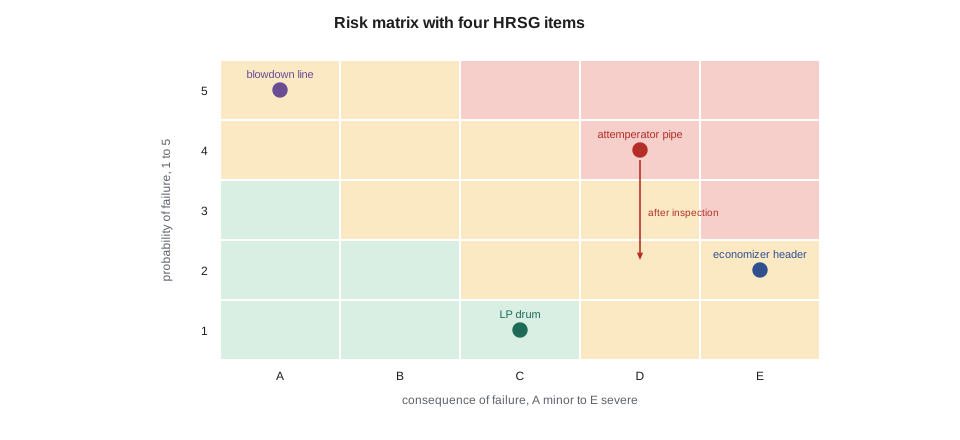
Inspection reduces risk mainly by reducing uncertainty. An effective inspection that confirms the wall is thick or that no cracks are present lowers the estimated probability of failure until the next assessment; it does not change the consequence. Other actions, such as tighter operating limits, chemistry changes, replacement with better materials or reducing the inventory that could be released, change the probability or the consequence directly.
Inspection effectiveness
Not all inspections are equal. API RP 581 grades inspection effectiveness from highly effective to ineffective for each damage mechanism, according to the method, the coverage and the access. A visual inspection of an evaporator's outside says nothing about FAC inside its tubes; a few spot thickness readings may miss localized thinning that a scanning method would find. An RBI program records not only that an item was inspected but how well, and a less effective inspection earns less credit in the probability estimate.
RBI and the jurisdiction
RBI does not replace the law. Ohio's boiler rules set inspection frequencies for power boilers, process boilers and pressure vessels, with longer intervals available on application where conditions are met (PWR-340), and the National Board Inspection Code includes guidance on risk-based inspection that jurisdictions and owner-user inspection organizations can use. An owner that wants to use RBI to extend intervals must have the jurisdiction's agreement and an inspection organization that accepts the program. Within the required inspections, RBI is freely used to decide what to inspect, where, and how.
Grazyna took two ideas back to Cantwell: a damage mechanism review for each of her registered items, and a register of condition monitoring locations with every reading, not only the minimum. "I don't need a software package," she said. "I need to know what's attacking each vessel and whether my inspections can see it."
People and data
An RBI program is only as good as its people and its data. API RP 580 expects a multidisciplinary team, typically an inspector, a materials or corrosion specialist, a process or operations person who knows how the plant is really run, and someone who can judge consequences, led by a person trained in the method. At Keswold that team was Ingeborg, the insurer's inspector, a corrosion specialist from the water treatment supplier, and one of the shift supervisors, who often knew more about what the equipment actually saw than any drawing did.
The data often turns out to be the hardest part. Design data reports, material certificates and inspection records may be incomplete, and the operating history that drives damage, such as how often the attemperator sprays heavily or how fast the unit is started, has to be dug out of the historian. Where data are missing, the program assumes conservatively and plans an inspection to fill the gap. Each assessment also records its date, its assumptions and who approved it, so that the next reassessment can see what changed.
Common mistakes
MistakeTreating every vessel as equally likely to fail and equally serious.
InsteadRank items by probability and consequence and inspect where risk is highest.
MistakeInspecting without knowing what damage mechanism to look for.
InsteadIdentify mechanisms first and choose methods that can find them.
MistakeCalculating a corrosion rate from inconsistent measurement points.
InsteadMeasure at marked condition monitoring locations with the same method each time.
MistakeGiving full credit for a quick visual inspection.
InsteadGrade inspection effectiveness for each mechanism.
MistakeUsing RBI to exceed jurisdictional intervals without acceptance.
InsteadObtain the regulator's acceptance for any change to required intervals.
MistakeLeaving an RBI assessment unchanged after a change in operation.
InsteadReassess after inspections, operating or chemistry changes and at set intervals.
Summary and key terms
- Risk combines probability and consequence of failure; RBI directs inspection effort to the items where it reduces risk most.
- API RP 580 (2023) sets the principles, API RP 581 (2025) a quantitative method, API RP 571 the damage mechanisms and API RP 584 integrity operating windows.
- An RBI program defines scope, gathers data, groups loops, identifies mechanisms, estimates probability and consequence, ranks risk, plans inspections and reassesses.
- HRSG mechanisms include FAC, thermal fatigue, creep, under-deposit corrosion, dew point corrosion, corrosion under insulation and layup pitting.
- Corrosion rate, remaining life and the half-life rule set inspection intervals for thinning, within jurisdictional maximums.
- Inspection reduces risk by reducing uncertainty; its effectiveness must be graded; RBI works within the jurisdiction's requirements.
- Risk-based inspection
- An approach that plans inspection by the probability and consequence of failure of each item.
- Probability of failure
- The likelihood that an item loses containment in a given period.
- Consequence of failure
- The harm, environmental damage or cost that would follow a loss of containment.
- Damage mechanism
- A physical or chemical process that degrades equipment.
- Corrosion loop
- A group of equipment and piping with similar materials and conditions and the same damage mechanisms.
- Remaining life
- The time until the wall reaches its minimum required thickness at the current corrosion rate.
- Integrity operating window
- A limit on an operating parameter that protects equipment from damage.
- Inspection effectiveness
- How well an inspection method and its coverage can find a given mechanism.
Practice problems
Work each problem on paper first, then reveal the answer to check.
Wall 0.472 in in 2018 and 0.440 in in 2026, minimum 0.315 in. Rate and remaining life?
Show answer
0.004 in/yr; about 31 years.
Maximum interval for that item by the half-life rule?
Show answer
About 15 years, subject to the jurisdiction's rules.
Risk of an item with PoF 2 × 10⁻³ per year and CoF 3.0 million dollars?
Show answer
6,000 dollars a year.
Which mechanism is targeted by FAC thickness scanning?
Show answer
Flow-accelerated corrosion.
Lesson quiz · 5 questions
Score 60% or more to complete this lesson.
Create a free account to save your progress, take quizzes and earn a certificate.