
PWR-510 · Lesson 5 of 12 · 22 min
Major projects and turnarounds
▶ Video coming soon A video version of this lesson is on the way.
Keswold's fall outage had ended five weeks before Anselm's session on projects, and the debrief notes were still on Morwenna's desk. The outage ran from Monday, September 21 to Wednesday, October 21, 2026, with the steam turbine rotor out for inspection, the condenser cleaned and eddy current tested, the lube oil system flushed, the gas turbine borescoped and washed, and a long list of smaller jobs (PWR-320). It finished on schedule, and over budget. "An outage is a project with a fixed end date and a customer waiting across the road," Morwenna said. "Most of what goes wrong was decided months before the first bolt came out."
This lesson covers how a chief engineer leads major projects and turnarounds: the phases and decision gates of a capital project, estimates and their accuracy, contracting strategies, schedules and the critical path, cost control with earned value, risk and change management, commissioning and handover, and the particular discipline of planning and running a turnaround.
The life of a capital project
Capital projects pass through a series of phases, each ending in a decision gate where the owner decides whether to continue, change direction or stop. The names vary between companies, but the pattern is common:
- Identify: a need or opportunity is recognized, such as Marrowby's growth, an aging component or a new regulation, and a first idea of scope and value is written down.
- Select (feasibility): alternatives are developed and compared on cost, risk, schedule and value, and one is chosen. This is where Anselm's study for the expansion sits.
- Define (front-end engineering design): the chosen option is engineered enough to fix its scope, produce a reliable estimate and schedule, identify permits and long-lead items, and prepare the contracts.
- Execute: detailed design, procurement, construction, commissioning and handover.
- Operate and close out: performance tests, final documentation, lessons learned and a review of whether the project delivered its expected value.
Most of a project's value is decided in the early phases, when changes are cheap, and most of its money is spent in execution, when changes are expensive. The chief engineer's influence is greatest early, by insisting that the scope reflects how the plant will really be operated and maintained, and that operators and maintainers are involved in reviews (lesson 4).
Estimates and their accuracy
Every phase produces a cost estimate, and its accuracy improves as the design matures. The AACE International classification, widely used in the industry, describes five classes from Class 5, based on little more than the idea and a capacity factor, to Class 1, based on complete design. Typical expected accuracy ranges, which AACE gives as broad bands that depend on the project's complexity, are shown below.
| Class | Typical stage | Typical accuracy range |
|---|---|---|
| Class 5 | Identify (concept screening) | −20 to −50 / +30 to +100 in 100 |
| Class 4 | Select (feasibility) | −15 to −30 / +20 to +50 in 100 |
| Class 3 | Define (budget authorization) | −10 to −20 / +10 to +30 in 100 |
| Class 2 | Execute (control estimate) | −5 to −15 / +5 to +20 in 100 |
| Class 1 | Execute (check estimate or bid) | −3 to −10 / +3 to +15 in 100 |
Two lessons follow from the table. First, an early estimate should be presented as a range, not a single number, and the owner should know which class it is. Second, a contingency is added to an estimate to cover the cost of things that are expected to happen but cannot yet be identified individually, and it is sized from the estimate's class and a review of the project's risks. Contingency is not a reserve for changes in scope, which need their own approval.
Contracting strategies
How the work is contracted shapes who carries the risk (PWR-420). In an engineer-procure-construct (EPC) lump sum contract, one contractor designs, buys and builds for a fixed price, carrying most of the cost risk but charging for it, and the owner's influence over the design is limited once the contract is signed. In an engineer-procure-construction management (EPCM) arrangement, an engineering firm designs and manages on the owner's behalf while the owner holds the construction contracts and carries the cost risk. Design-bid-build separates the designer and the builder, giving the owner control at the cost of time and of disputes about the design. Small projects in operating plants are often done with the plant's own engineers and a few trusted contractors under unit-price or time-and-materials contracts.
For a pair of package boilers at Keswold, Morwenna expected a split: the boilers bought from a vendor under a supply contract with guarantees (lesson 3), and the installation, piping, electrical and controls done by a contractor working to Keswold's own design under a lump sum or unit-price contract. Long-lead items such as the boilers themselves, the burners and switchgear might be ordered before the installation contract is let, to save months.
Scheduling and the critical path
A project schedule starts with a work breakdown structure, a hierarchy of deliverables broken into packages small enough to estimate, assign and track. Each activity is given a duration and its logical links to other activities: which must finish before another can start. The critical path method calculates the earliest start and finish of each activity, the earliest finish of the project, and the latest each activity can start without delaying it. The difference is the activity's float. Activities with zero float form the critical path; a day lost on any of them is a day lost on the project.
Worked problem
The outage critical path
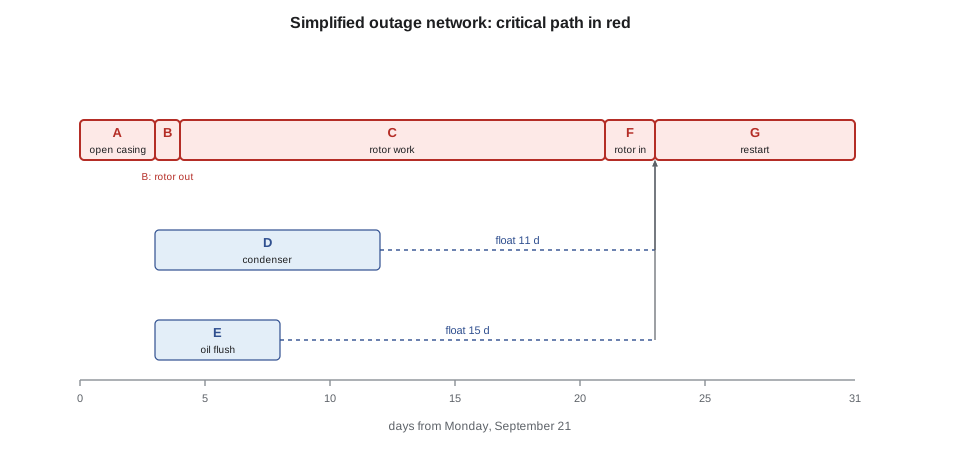
A simplified network for Keswold's fall outage, counting days from Monday, September 21: A, cool down and open the turbine casing, 3 days; B, remove the rotor, 1 day after A; C, rotor and blade inspection and repairs, 17 days after B; D, condenser cleaning and eddy current testing, 9 days after A; E, lube oil flush, 5 days after A; F, reinstall the rotor and close the casing, 2 days after C; G, turning gear, final checks and restart, 8 days after F, D and E. Find the project duration and the float of each activity.
Show solution
- \[\text{A: } 0 \to 3 \quad \text{B: } 3 \to 4 \quad \text{C: } 4 \to 21 \quad \text{F: } 21 \to 23 \quad \text{G: } 23 \to 31\]
- \[\text{D: } 3 \to 12,\ \text{float} = 23 - 12 = 11 \text{ days} \qquad \text{E: } 3 \to 8,\ \text{float} = 23 - 8 = 15 \text{ days}\]
Answer: The project takes 31 days, finishing at the end of Wednesday, October 21, and the critical path is A, B, C, F, G: the turbine work. Condenser cleaning has 11 days of float and the oil flush has 15, which is why the real oil flush could wait until October 5 to 9, when the crews were free. The real schedule had hundreds of activities, but the same logic held: anything that delayed the rotor delayed the whole outage, and the outage manager watched the rotor work every day.
Cost control with earned value
A budget and a list of costs spent to date do not show whether a project is on track, because they do not say how much work the money bought. Earned value management compares three numbers at a point in time: the planned value, the budgeted cost of the work scheduled to be done by then; the earned value, the budgeted cost of the work actually done; and the actual cost of that work. From them come two indices. The cost performance index is earned value over actual cost; below one means the work is costing more than budgeted. The schedule performance index is earned value over planned value; below one means less work has been done than planned.
Worked problem
Halfway through the outage
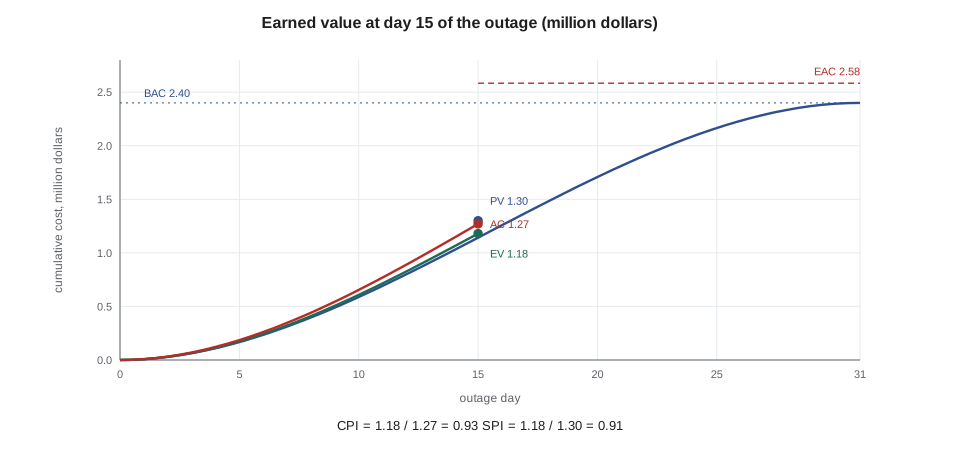
The outage's budget at completion was 2.40 million dollars. At the end of day 15, the planned value was 1.30 million, the earned value was 1.18 million, and the actual cost was 1.27 million. Calculate CPI, SPI and a simple estimate at completion.
Show solution
- \[CPI = \frac{1.18}{1.27} = 0.929 \qquad SPI = \frac{1.18}{1.30} = 0.908\]
- \[EAC = \frac{2.40}{0.929} = 2.58 \text{ million}\]
Answer: Each dollar was buying about 93 cents of planned work, and about 91 in 100 of the planned work had been done. If the trend continued, the outage would cost about 2.58 million, about 180,000 dollars over budget. The schedule index was a warning too, but the critical path was on time: the work behind schedule had float. The causes, found in the daily reviews, were emergent repairs to the stop valve strainer and stage 9 packing (PWR-320), and a scaffolding contractor's crew that arrived smaller than ordered. The final cost came in close to this estimate.
Risk and change
A risk register lists what could go wrong or right, how likely it is, what it would cost or delay, who owns it and what is being done about it. On an outage, the biggest risks are usually discovery risks: what will be found when the equipment is opened. Keswold's register for the turbine included blade damage found at inspection, a rotor that needed to go to the shop, and a late return of the stop valve from repair, each with a response planned in advance, such as a spare blade set on order and a reserved shop slot.
Change control applies to the project itself as well as to the plant. A change in scope, a new requirement from the regulator or the customer, or a design change found during construction is written up, estimated for cost and schedule, reviewed and approved before it is done. Changes that affect the plant's design or operation also go through the plant's management of change process (PWR-340), so that procedures, drawings, training and the safety case are updated before the change is put into service.
Commissioning and handover
A project is not finished when construction is complete; it is finished when the plant has accepted a system that works, with the documents, spares and training to run it. Commissioning proceeds in stages: mechanical completion and inspection, pre-commissioning (flushing, cleaning, testing instruments and electrical systems), cold commissioning, hot commissioning and the performance test. A pre-startup safety review (PWR-340) confirms that the system was built as designed, that hazards have been addressed and that procedures and training are in place before hazardous materials or energy are introduced. Systems are handed over to operations one at a time, each with its own punch list of incomplete items classified by whether they must be finished before startup.
Handover documents include the as-built drawings, the manufacturers' data reports and registration documents, operating and maintenance manuals, test records, spare parts lists and the training records of the operators. Morwenna's rule was that no new system goes into operation until the shift supervisors have signed that they are ready to run it.
Planning and running a turnaround
A turnaround or major outage is a special kind of project: short, intense, with a fixed end date, hundreds of contractor workers and a great deal of discovered work. Good turnarounds are planned a year or more in advance.
- Scope development begins with the inspection plan, the reliability engineer's recommendations, the maintenance backlog that needs the unit offline, and projects with tie-ins.
- Scope freeze, often several months before the outage, closes the list; later additions need a strong case and the chief's approval.
- Detailed planning breaks every job into steps with crafts, hours, materials, permits, isolations and scaffolding, and long-lead materials are ordered early.
- Scheduling builds the integrated schedule and resource plan, identifies the critical path and plans around peaks in manpower and crane use.
- Safety planning covers contractor orientation, permits and isolations for hundreds of jobs, confined spaces, lifting plans and the risk of a crowded site.
- Execution runs on a daily cycle of shift handovers, a progress meeting, updates to the schedule and a fast process for emergent work.
- Startup follows a written plan with hold points, as Keswold's did (PWR-320), and the outage ends only when the plant is back on stable load.
- The critique after the outage captures what went well and badly, while memories are fresh, and feeds the plan for the next one.
Keswold's debrief listed ten lessons for next time. The three Morwenna considered most important were: walk down every scaffolding request before ordering it, so the contractor can plan the crew; order the parts for likely discoveries before the outage, as was done for the stop valve strainer screen; and confirm the rented package boiler's changeover plan with Marrowby the day before startup, which had become a line in the startup procedure (PWR-320).
Common mistakes
MistakePresenting an early estimate as a single, precise number.
InsteadPresent it as a range and state its class.
MistakeUsing contingency to pay for scope changes.
InsteadContingency covers expected unknowns; scope changes need their own approval.
MistakeTracking only money spent against the budget.
InsteadUse earned value to see how much work the money bought and whether the schedule is on track.
MistakeWatching every activity equally.
InsteadFocus on the critical path and on activities whose float is running out.
MistakeAdding jobs to an outage after scope freeze without review.
InsteadRequire a strong case and approval for late additions.
MistakeHanding over a system without documents, training or a signed acceptance by operations.
InsteadHand over system by system, with punch lists, documents and operator sign-off.
Summary and key terms
- Capital projects pass through identify, select, define, execute and close-out phases, with decision gates; early phases decide most of the value.
- Estimate accuracy improves with design maturity; estimates are ranges with a contingency for expected unknowns.
- Contracting strategy decides who carries the risk: EPC lump sum, EPCM, design-bid-build or plant-managed contracts.
- The critical path method identifies the activities with zero float that control the end date.
- Earned value compares planned value, earned value and actual cost to measure cost and schedule performance and forecast the final cost.
- Risk registers, change control, staged commissioning and disciplined turnaround planning and critiques keep projects and outages under control.
- Decision gate
- A point between project phases at which the owner decides whether to continue.
- Contingency
- An amount added to an estimate for expected but unidentified costs.
- Work breakdown structure
- A hierarchy of project deliverables broken into manageable work packages.
- Critical path
- The sequence of activities with zero float that sets the project duration.
- Float
- The time an activity can be delayed without delaying the project.
- Earned value
- The budgeted cost of the work actually done.
- Cost performance index
- Earned value divided by actual cost.
- Scope freeze
- The date after which the work list for an outage is closed except by approval.
- Punch list
- A list of incomplete or deficient items at handover.
Practice problems
Work each problem on paper first, then reveal the answer to check.
EV 0.80 million, AC 0.95 million, PV 0.90 million. CPI and SPI?
Show answer
CPI 0.84, SPI 0.89.
Budget at completion 3.0 million with CPI 0.90. Estimate at completion?
Show answer
About 3.33 million.
An activity can start on day 5 at the earliest and day 12 at the latest. Float?
Show answer
7 days.
Which estimate class is typical at budget authorization?
Show answer
Class 3.
Lesson quiz · 5 questions
Score 60% or more to complete this lesson.
Create a free account to save your progress, take quizzes and earn a certificate.