
PWR-330 · Lesson 8 of 12 · 23 min
Steam purity and turbine deposits
▶ Video coming soon A video version of this lesson is on the way.
The deposit on Keswold's turbine had been thin enough to leave alone. Ingeborg's inspection notes from the outage, which she let Okonkwo read, described it as a tan film on the Curtis wheel's nozzles and blades and the first few impulse stages, mostly silica with some iron oxide by the laboratory's analysis, with no measurable effect on the turbine's performance. Her recommendation was a single line: review the HRSG's steam purity with the water treatment supplier.
"A turbine is a very good collector," she said. "Every kilogram of steam that goes through it leaves a little of whatever it was carrying, and it does that eight thousand hours a year. A few micrograms per kilogram is nothing in a sample bottle. It is a lot on a blade."
This lesson explains how impurities get into steam, the two kinds of carryover and how drum internals limit them, why silica becomes volatile at high pressure, what steam purity limits turbines need, where in a turbine the different deposits form and what damage they do, and how steam purity is measured and protected. It also covers the purity of steam that goes to customers, as Cantwell's does.
What steam carries
Steam leaving a boiler drum is never perfectly pure. It can carry:
- Dissolved solids: sodium salts such as sodium chloride, sodium sulfate, sodium hydroxide and sodium phosphate, carried in droplets of boiler water or, at high pressure, dissolved in the steam itself.
- Silica, which becomes volatile in steam at high pressure.
- Corrosion products, mainly iron oxides and, in systems with copper alloys, copper oxides, carried as particles or dissolved.
- Gases: carbon dioxide, ammonia and other volatile treatment chemicals, and oxygen.
- Organic compounds from the make-up water or from breakdown of treatment chemicals, which decompose to organic acids that raise cation conductivity.
Carryover is the general name for impurities leaving the drum with the steam. It happens in two quite different ways, and the cure for each is different.
Mechanical carryover
Mechanical carryover is boiler water carried out of the drum as droplets or foam. Each droplet carries dissolved solids at the boiler water's concentration, so the steam's solids content is the boiler water concentration multiplied by the fraction of moisture carried over:
where w is the mass of water carried over per unit mass of steam. Its main causes are:
- Priming: a slug of water thrown into the steam outlet, from a high drum level, a sudden load increase that swells the level, or a pressure drop that makes the water flash. Opening a steam valve too quickly on a boiler at low pressure is a classic cause.
- Foaming: a stable froth on the water surface, caused by high dissolved solids, high alkalinity, suspended solids, oil or organic contamination. Foam fills the steam space and passes the separators.
- Damaged or poorly fitted drum internals, or a drum operated above its design steaming rate.
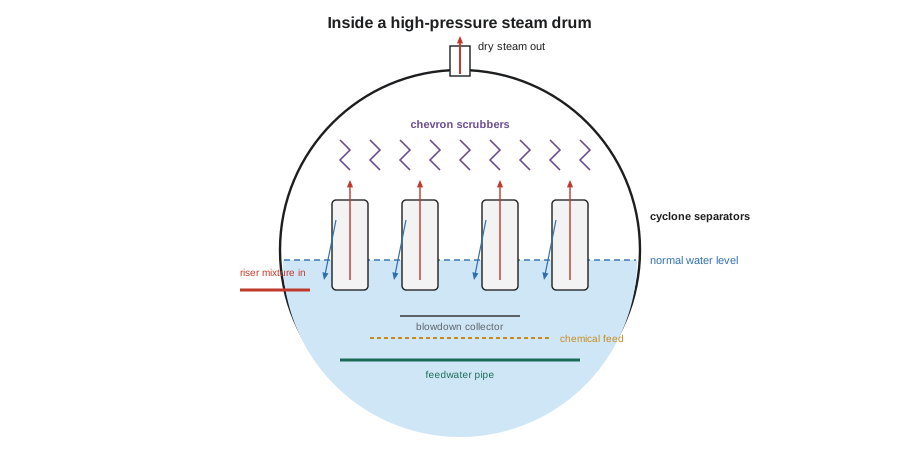
Drum internals separate water from steam in two stages. Primary separators, usually banks of cyclone separators, take the steam-water mixture from the risers and spin it, throwing the water outward and down while the steam rises from the center. Secondary separators, scrubbers made of corrugated plates (chevrons) or wire mesh, catch the fine droplets that remain before the steam leaves through the drum's dry pipe or outlet nozzles. Good internals in a high-pressure drum limit moisture carryover to a few hundredths of a percent, a carryover fraction of about 0.0001 to 0.0005 (typical); poor or damaged internals can pass ten times that.
Worked problem
Mechanical carryover at two pressures
Cantwell's boiler water is held at about 3,000 µS/cm, about 1,950 mg/L of dissolved solids. Its packaged drum's simple baffles pass about 0.1 in 100 moisture (w = 0.001). Keswold's drum holds about 1.5 ppm of sodium from its phosphate treatment and its cyclones and scrubbers pass about w = 0.0002. Find the solids in Cantwell's steam and the sodium in Keswold's.
Show solution
- Cantwell:
- \[C = 0.001 \times 1{,}950 = 1.95 \text{ ppm} = 1{,}950 \text{ ppb}\]
- Keswold:
- \[C_{Na} = 0.0002 \times 1{,}500 = 0.3 \text{ ppb}\]
Answer: Cantwell's steam carries about two parts per million of solids, which is of no consequence to heating coils and pressure reducing valves, but would ruin a turbine within months. Keswold's sodium is well inside the typical turbine limit of about 2 ppb, provided the drum level stays normal and the internals are intact. A drum level excursion that floods the separators could multiply it a hundredfold in seconds.
Vaporous carryover and silica
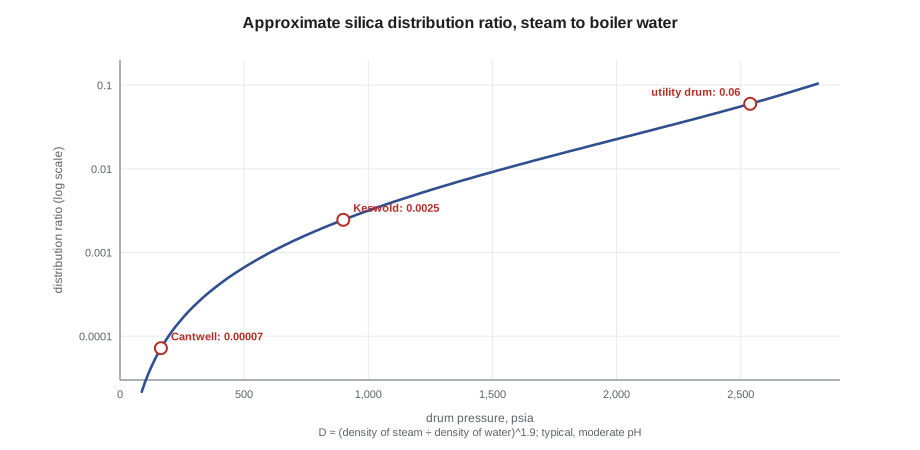
Vaporous carryover is impurity dissolved in the steam itself, not in droplets. No separator can remove it. At low pressure it is negligible, but as pressure rises, steam becomes denser and more like water, and it dissolves more of some substances. Silica is the most important: at high pressure it passes from the boiler water into the steam in a proportion that depends mainly on pressure. The distribution ratio is the ratio of silica concentration in the steam to that in the boiler water. A widely used approximate correlation relates it to the ratio of the densities of saturated steam and water:
for boiler water of moderate pH; higher pH lowers the ratio somewhat, because some of the silica is then held as non-volatile silicate.
Worked problem
Silica in Keswold's steam
At Keswold's drum pressure of 900 psia, IAPWS-IF97 gives saturated water and steam densities of 47.09 and 1.994 lb/ft³. Estimate the silica distribution ratio, the steam silica with the drum at its 2.0 ppm limit, and the highest drum silica that would keep the steam within a typical limit of 10 ppb.
Show solution
- Distribution ratio:
- \[D \approx \left(\frac{1.994}{47.09}\right)^{1.9} = (0.0423)^{1.9} = 0.0025\]
- Steam silica at the drum limit:
- \[0.0025 \times 2{,}000 \text{ ppb} = 4.9 \text{ ppb}\]
- Highest drum silica for 10 ppb in the steam:
- \[\frac{10}{0.0025} = 4{,}100 \text{ ppb} \approx 4 \text{ ppm}\]
Answer: The program's 2.0 ppm limit keeps the steam at about half the typical turbine limit. The same correlation gives a ratio of only 0.00007 at Cantwell's pressure, where silica stays in the water, and about 0.06 at 2,540 psia, where a twentieth of the drum's silica goes with the steam and boiler water silica must be held to a fraction of a ppm. That steep rise is why silica limits for boiler water fall so sharply with pressure, as PWR-220 lesson 7 noted.
Sodium salts and sodium hydroxide also become volatile at higher pressures, though less so than silica below about 2,200 psi (typical). Above the critical pressure, in once-through boilers, every impurity in the feedwater goes with the steam, which is why those units need the purest water of all.
Other routes into the steam
Two more sources are easy to overlook. Attemperator spray water, injected into the steam between superheater stages to control its temperature, goes straight into the steam with all its impurities. It must be of steam purity quality, usually feedwater taken from the economizer inlet or the feed pump discharge. A spray flow of 5 in 100 of the steam flow, carrying feedwater at 10 ppb of silica, adds about 0.5 ppb to the steam: small when the feedwater is right, but a direct path for contamination if a polisher or condenser problem fouls the feedwater. And contaminated feedwater from a condenser tube leak or a returned process condensate carries salts and organics straight into the drum, where some pass to the steam before the blowdown and chemistry can respond.
Ingeborg's review would look at all of these: the drum's sodium and silica, the steam's, the spray water's, the polisher's breakthroughs and the drum level history. A silica deposit on the first stages, she pointed out, did not by itself say which route had carried it, and the trend data would matter more than any single sample.
Steam purity limits
Turbine makers, the International Association for the Properties of Water and Steam (IAPWS) in its technical guidance documents, and the Electric Power Research Institute publish steam purity guidance. Typical continuous targets for steam to a modern turbine are (typical; the turbine maker's limits apply):
| Parameter | Typical target in steam |
|---|---|
| Cation conductivity | below about 0.2 µS/cm |
| Sodium | below about 2 ppb |
| Silica | below about 10 ppb |
| Chloride and sulfate, each | below about 2 ppb |
| Iron | below about 5 ppb |
Older industrial guidance, written for lower-pressure boilers and smaller turbines, often allowed silica of up to about 20 ppb and total dissolved solids in steam well above these. The guidance also sets action levels: increasingly urgent steps, from investigating, to correcting within a set time, to shutting down, as the readings rise above normal. A plant's chemistry manual turns these into its own limits, alarms and responses.
Where deposits form in a turbine
As steam expands through a turbine, its pressure and temperature fall, and the solubility of each impurity falls with them. Each deposits where the steam can no longer hold it:
- Copper oxides and some sodium compounds deposit mainly in the high-pressure stages, where they can reduce output significantly on units with copper in the feedwater system.
- Silica stays dissolved through the high-pressure section as long as the steam is superheated and dense, and deposits mostly in the intermediate and low-pressure stages, as a hard, glassy layer that does not dissolve in water. Droplets from mechanical carryover, which flash to dryness on hitting the first nozzles, can leave silica and salts at the inlet stages instead.
- Sodium salts and acids collect in the phase transition zone of the low-pressure turbine, where the expanding steam first begins to condense. The first droplets of condensate there are highly concentrated solutions of chloride, sulfate and sodium hydroxide, which cause pitting, stress corrosion cracking and corrosion fatigue of the low-pressure blades and discs. Many of the most serious turbine failures have started in this zone.
- Iron oxide particles erode nozzles and blades, especially in the first stages, as solid particle erosion, worst during start-ups when oxide exfoliated from superheater and reheater tubes is blown through.
Deposits cause loss of output and efficiency, because they roughen the blades and narrow the nozzle passages; they increase thrust on the rotor, because they change the pressure drop across the stages; and they can make stop valve and control valve stems stick, a danger because a valve that cannot close cannot protect the turbine from overspeed. Turbine makers specify regular stroking tests of the valves partly for this reason.
Detecting deposits and contamination
Steam purity is measured continuously by sampling saturated steam at the drum outlet and superheated steam at the main steam line. Steam samples must be taken with a properly designed sampling nozzle, often isokinetic, drawing the sample at the same velocity as the steam in the pipe, so that droplets and particles are represented fairly; a poor nozzle can give readings that are wrong by a large factor. The sample is condensed, cooled and analyzed for cation conductivity, sodium and silica. Saturated steam samples show mechanical carryover directly, by comparison with the drum water's sodium.
Deposits in the turbine itself show in its performance. The first-stage pressure, or the pressure after the control stage, rises at a given steam flow as deposits narrow the downstream nozzles; plotting it against flow over months shows deposits building up. Stage pressures, efficiency tests and output at a given throttle condition confirm it. Water-soluble deposits, such as sodium salts, can sometimes be removed by steam washing, running the turbine on wet, saturated steam at reduced load under the maker's procedure; silica and oxides must be removed mechanically during an outage, usually by abrasive blasting.
Keswold's outage report recorded the first-stage pressure trend over the previous two years as flat, which matched the inspection's finding that the deposit had not yet affected performance. That trend, Ingeborg said, would now be checked every month.
Steam for customers and processes
District steam and process steam have their own purity concerns. Cantwell's customers use steam in heating coils, heat exchangers, domestic hot water heaters and, in a few buildings, humidifiers. Steam that goes into the air of a building or into contact with food or medical products must not carry harmful chemicals. Cantwell's neutralizing amine, which travels with the steam to protect the condensate lines, is fed at a controlled rate and is approved for its use; buildings that need chemical-free steam for humidification or sterilizing use clean steam generators, small exchangers that make steam from purified water using district steam as the heat source.
At Keswold, the steam extracted for Marrowby Foods is used in the food plant's processes. Under the US Food and Drug Administration's rule for boiler water additives, 21 CFR 173.310, only listed chemicals may be used in steam that contacts food, within set limits, and the water treatment supplier provides the documentation that Marrowby's auditors examine.
Okonkwo left with a copy of Ingeborg's three-line trend and a note to himself for the examination: priming and foaming carry boiler water; silica distils; sprays bypass the drum; salts concentrate where steam first condenses.
Common mistakes
MistakeExpecting separators to remove silica from high-pressure steam.
InsteadSilica at high pressure is dissolved in the steam itself; only lower drum silica reduces it.
MistakeRaising drum level for safety during a load increase.
InsteadHigh level and swell cause priming; keep the level at its normal band and change load at a controlled rate.
MistakeUsing any available water for attemperator spray.
InsteadSpray water goes straight into the steam; it must be of steam purity quality.
MistakeTaking a steam sample through any convenient tap.
InsteadSteam samples need a proper sampling nozzle; otherwise droplets and particles are misrepresented.
MistakeIgnoring a slowly rising first-stage pressure at constant flow.
InsteadIt indicates deposits narrowing the turbine's nozzles; trend it and investigate the steam purity.
Summary and key terms
- Steam can carry dissolved solids, silica, corrosion products, gases and organics; carryover is mechanical or vaporous.
- Mechanical carryover is boiler water in droplets, from priming or foaming; cyclone separators and scrubbers limit it.
- Silica's distribution ratio rises steeply with pressure, roughly as (ρg ÷ ρf)^1.9; only low drum silica prevents it.
- Attemperator spray and contaminated feedwater carry impurities directly into the steam.
- Typical turbine targets: cation conductivity below 0.2 µS/cm, sodium below about 2, silica below about 10 parts per billion.
- Silica deposits in IP and LP stages, salts concentrate in the phase transition zone, and oxides erode the first stages; first-stage pressure trends reveal deposits.
- Carryover
- Impurities leaving the boiler drum with the steam.
- Mechanical carryover
- Boiler water carried into the steam as droplets or foam.
- Vaporous carryover
- Impurities dissolved in the steam itself, mainly silica at high pressure.
- Priming
- A sudden discharge of water slugs with the steam, from high level, swell or rapid pressure drop.
- Foaming
- Stable froth on the boiler water surface that passes with the steam.
- Distribution ratio
- The ratio of an impurity's concentration in steam to its concentration in boiler water.
- Phase transition zone
- The region of a low-pressure turbine where expanding steam first begins to condense.
- Isokinetic sampling
- Drawing a sample at the same velocity as the flow, so that droplets and particles are represented fairly.
Practice problems
Work each problem on paper first, then reveal the answer to check.
Boiler water contains 1,200 ppm of dissolved solids and carryover is 0.05 in 100 moisture. What are the solids in the steam?
Show answer
0.0005 × 1,200 = 0.60 ppm.
At a drum pressure where the silica distribution ratio is 0.005, the steam limit is 10 ppb. What is the highest drum silica?
Show answer
10 ÷ 0.005 = 2,000 ppb, or 2 ppm.
Spray water at 4 in 100 of steam flow contains 25 ppb of sodium. How much sodium does it add to the steam?
Show answer
0.04 × 25 = 1.0 ppb.
Why are silica deposits removed by blasting rather than washing?
Show answer
Silica deposits are hard and do not dissolve in water.
Lesson quiz · 5 questions
Score 60% or more to complete this lesson.
Create a free account to save your progress, take quizzes and earn a certificate.