
PWR-330 · Lesson 6 of 12 · 27 min
Boiler efficiency calculations
▶ Video coming soon A video version of this lesson is on the way.
PWR-210 had calculated boiler 1's efficiency from Pilar's combustion test day by the simplest route: steam out, gas in, divide. It came to 0.812. Okonkwo's course asked for the same boiler's efficiency by a second route, adding up the heat lost in the flue gas, the water vapor, the radiation from the casing and the rest, and subtracting from one. He worked it through on a Sunday afternoon, from the same test data, and got 0.828. The gap bothered him until Grazyna asked him which of the two numbers he believed, and why.
"Both methods are honest," she said. "But they have different errors. One divides two big numbers that are each measured to a percent or two. The other adds up small numbers, each measured roughly but none of them very big. Know where the uncertainty is, and you will know which one to trust for what."
This lesson covers the two standard methods of finding boiler efficiency, the direct or input-output method and the indirect or heat-loss method, the individual losses and how each is calculated, the difference between efficiencies on the higher and lower heating values, the difference between combustion and boiler efficiency, and how the results are used to find and value improvements. The methods follow the principles of ASME PTC 4, the performance test code for fired steam generators, last issued in 2013 and reaffirmed in 2023, which is widely used in Canada and the United States for acceptance and performance tests.
Two definitions of efficiency
Boiler efficiency, sometimes called fuel-to-steam efficiency, is the heat absorbed by the water and steam divided by the heat supplied in the fuel:
This is the direct or input-output method. It needs the steam flow, the steam and feedwater enthalpies, the fuel flow and the fuel's heating value. Heat taken out in the blowdown is either counted as output or treated as a loss, and the choice must be stated.
The indirect or heat-loss method, also called the energy balance method, measures what does not reach the steam:
where each loss is expressed as a fraction of the heat input. Credits are heat added by sources other than the fuel, such as heat in combustion air that enters warmer than the reference temperature or the power of a fan heating the air; in simple calculations they are often ignored or folded into the reference temperature.
The direct method
Worked problem
Boiler 1 by input-output
On the day of Pilar's test, boiler 1 made 24,950 lb/h of saturated steam at 150 psig from feedwater at 221 °F, with 1,006 Btu/lb added to each pound, burning 30,000 ft³/h of natural gas with a higher heating value of 1,030 Btu/ft³. Find the efficiency, ignoring blowdown.
Show solution
- \[\text{output} = 24{,}950 \times 1{,}006 = 25.10 \times 10^6 \text{ Btu/h}\]
- \[\text{input} = 30{,}000 \times 1{,}030 = 30.90 \times 10^6 \text{ Btu/h}\]
- \[\eta = \frac{25.10}{30.90} = 0.812\]
Answer: 0.812, the figure PWR-210 found.
The direct method is simple and needs no knowledge of the fuel's composition, but its accuracy is limited by the accuracy of the flow meters. A steam flow meter on an orifice or vortex shedder may be good to about 1 to 2 in 100 of reading, and a gas meter, corrected for pressure and temperature, to about 1 in 100 (typical). An error of 2 in 100 in steam flow alone moves the efficiency by about 1.6 points. The heating value also matters: it varies with the gas composition and should come from the gas utility's or a laboratory's analysis for the test period, not from a textbook. The method is good for tracking a boiler's efficiency from day to day, where the same meters are used each time, and less good for finding exactly where heat is being lost.
The heat-loss method
The heat-loss method calculates each loss from the fuel analysis, the flue gas analysis and temperatures. It is usually more accurate, because the losses add to less than a fifth of the input, so a 5 in 100 error in the losses changes the efficiency by less than one point. It also shows where the heat goes, which the direct method cannot. The main losses for a gas-fired boiler are:
- Dry flue gas loss: the sensible heat carried out by the dry products of combustion and the excess air, from the reference (ambient air) temperature to the stack temperature. It depends on the mass of dry gas per unit of fuel, which rises with excess air, and on the stack temperature.
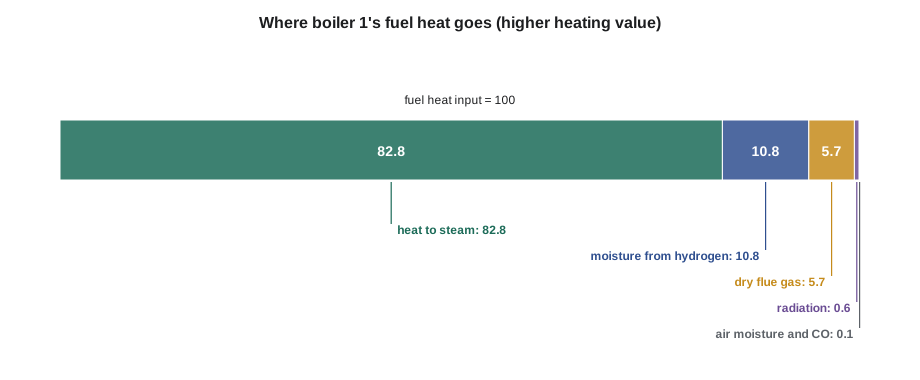
- Loss due to moisture from hydrogen in the fuel: the hydrogen burns to water, which leaves the stack as vapor. On the higher heating value basis, this loss includes the latent heat of that vapor, and for natural gas it is the largest single loss, about 11 points.
- Loss due to moisture in the fuel (negligible for gas, large for wet bark or coal) and moisture in the combustion air (small).
- Loss due to unburned combustibles: CO in the flue gas, and on solid fuels, unburned carbon in the ash.
- Radiation and convection loss: heat lost from the boiler's casing, drums and pipes to the boiler room. It is usually taken from the boiler maker's data or the standard curves for the boiler's size and load. For a well-insulated packaged boiler at full load it is typically about 0.5 to 1 point, rising as a fraction of input at low load because the casing loses about the same heat whatever the firing rate.
- Unaccounted or manufacturer's margin losses, a small allowance in guarantee calculations.
The dry gas and moisture losses are calculated from the masses of each product per unit of fuel, found from the combustion equations of PWR-310 lesson 10 and the measured oxygen:
where m_dg and m_w are the masses of dry gas and of water formed per ft³ of fuel, c_p is about 0.246 Btu/lb·°F for the dry gas, and temperatures are in °F. The moisture term is the enthalpy of low-pressure water vapor at the stack temperature less that of liquid water at the reference temperature.
Worked problem
Boiler 1 by heat loss
From Pilar's test: oxygen 3.0 in 100 dry (15.0 in 100 excess air), CO 20 ppm, stack 370 °F, combustion air 68 °F. For Cantwell's gas at that excess air, each ft³ of gas produces 0.790 lb of dry flue gas and 0.0947 lb of water. Take the radiation loss as 0.6 points from the maker's curve, and the moisture in the air as 0.010 lb per lb of dry air. Find the efficiency.
Show solution
- Dry flue gas:
- \[L_{dg} = \frac{0.790 \times 0.246 \times (370 - 68)}{1{,}030} = 0.0569\]
- Moisture from hydrogen:
- \[L_{H_2O} = \frac{0.0947 \times [(1{,}061 + 0.45 \times 338) - 36]}{1{,}030} = 0.1082\]
- Moisture in air (0.845 lb of air per ft³ of gas), CO and radiation:
- \[L_{air} = 0.0011, \quad L_{CO} = 0.0001, \quad L_{rad} = 0.0060\]
- Total and efficiency:
- \[\sum L = 0.1724, \qquad \eta = 1 - 0.1724 = 0.828\]
Answer: 0.828 by heat loss against 0.812 by input-output. The difference of 1.6 points is about what a steam meter reading 2 in 100 low would cause, so it is within the uncertainty of the direct method, but only just.
| Loss | Boiler 1, points in 100 | What raises it |
|---|---|---|
| Dry flue gas | 5.7 | Higher excess air, higher stack temperature |
| Moisture from hydrogen in fuel | 10.8 | Fuel hydrogen content; slightly, stack temperature |
| Moisture in air | 0.1 | Humid air, stack temperature |
| Unburned CO | 0.01 | Poor combustion |
| Radiation and convection | 0.6 | Low load, poor insulation |
| Total | 17.2 | |
| Efficiency (HHV) | 82.8 |
Higher and lower heating value
The moisture loss is so large for natural gas because the efficiency is stated on the higher heating value (HHV), which includes the latent heat of the water formed in combustion. North American boiler practice, and ASME PTC 4, use the HHV. European practice, and most gas turbine and engine ratings, use the lower heating value (LHV), which excludes that latent heat. The same boiler has a much higher efficiency on the LHV basis:
Worked problem
Boiler 1 on the lower heating value
Cantwell's gas has an HHV of 1,030 Btu/ft³ and, after subtracting the latent heat of the 0.0947 lb of water each ft³ forms, an LHV of about 931 Btu/ft³. Express boiler 1's input-output efficiency of 0.812 on the LHV basis.
Show solution
- \[\eta_{LHV} = 0.812 \times \frac{1{,}030}{931} = 0.898\]
Answer: About 0.90 on the LHV basis. Neither number is wrong, but an engineer comparing boilers or quoting efficiencies must always say which basis is used. A condensing boiler advertised at over 1.0 efficiency is using the LHV.
Condensing boilers recover part of that latent heat by cooling the flue gas below its dew point, about 133 °F for natural gas at 15 in 100 excess air, which needs return water colder than that. They are common in hot water heating but not in steam plants, where the feedwater is hot. Cantwell's hot water boilers are not condensing either, because the district loop returns at about 122 °F or warmer, at the edge of the range where condensing begins.
Combustion efficiency
Portable combustion analyzers display a combustion efficiency, calculated from the stack temperature, oxygen and fuel type. It accounts only for the stack losses, dry gas and moisture, and ignores radiation, blowdown and any heat lost elsewhere. For boiler 1 on the test day, the stack losses alone come to about 16.6 points, so the combustion efficiency is a little higher than the boiler efficiency calculated above. It is useful for tuning, because it responds directly to changes in excess air and stack temperature, but it is not the boiler's efficiency and should not be reported as such.
Stack temperature and fouling
The stack temperature is the most sensitive indicator of a boiler's heat transfer condition. For a gas-fired boiler at about 3 in 100 oxygen, each 40 °F rise in stack temperature costs about one point of efficiency. A rise at the same load and excess air means the surfaces are fouling: soot or deposits on the fire side, scale on the water side. On a water tube boiler, a sudden rise can also mean a baffle has failed and gas is bypassing part of the tube bank.
Worked problem
Boiler 2's stack temperature
Boiler 2's stack temperature rose from about 374 °F to 417 °F over a week in November with its oxygen steady at 3.4 in 100. Estimate the change in efficiency by the heat-loss method, and the extra fuel needed to make the same steam.
Show solution
- Repeating the heat-loss calculation at 3.4 in 100 oxygen (17.4 in 100 excess air) with 25 ppm CO and 68 °F air gives:
- \[\eta_{374} = 0.825, \qquad \eta_{417} = 0.815\]
- The fuel for the same output rises in the inverse ratio:
- \[\frac{0.825}{0.815} - 1 = 0.013\]
Answer: About 1.1 points of efficiency, or 1.3 parts in 100 more gas for the same steam. That is not yet costly, but a rise that fast means something has changed inside the boiler, and finding out what is worth more than the gas. The fire-side inspection booked for later in November was the right response.
Blowdown and other losses
Continuous blowdown removes water at saturation temperature, and the heat in it is lost unless it is recovered. If the input-output method counts only the steam as output, blowdown appears as a loss. Its size is the blowdown mass times the enthalpy difference between the blowdown and the feedwater. At Cantwell's pressure and its usual 20 cycles, blowdown of 5 in 100 of the feedwater carries away about 0.8 of 100 of the boiler's output; the flash tank and the make-up heat exchanger described in PWR-220 recover most of it.
On solid-fuel boilers, other losses become important: unburned carbon in the bottom ash and fly ash, which can be several points on a poorly run stoker; moisture in the fuel, which on wet bark can be the largest loss of all, because every kilogram of water in the fuel must be evaporated and carried up the stack; and sensible heat in the ash. These are why bark boilers run at efficiencies of 0.65 to 0.75 on the HHV (typical) while gas-fired boilers reach 0.80 to 0.85.
Using efficiency results
Efficiency figures are used to set targets, find problems and justify improvements. A plant keeps a record of each boiler's efficiency at standard loads, from regular tests or from the distributed control system's continuous calculation, and investigates a fall. Improvements are valued by the fuel they save:
Common improvements for gas-fired boilers include: lowering excess air with oxygen trim (lesson 3), worth about 0.3 points for each point of oxygen at Cantwell's stack temperatures; an economizer, which on boiler 2 would recover about 484,000 Btu/h, as PWR-220 estimated, or about 1.6 points; cleaning fouled surfaces; combustion air preheat from boiler room air at the ceiling; insulating bare piping and valves; and reducing the number of boilers kept hot on standby, whose radiation losses continue while they make little steam.
Okonkwo answered Grazyna's question at their next session. He trusted the heat-loss result for understanding where the heat went, because each loss was measured directly and none was large; he trusted the input-output trend for seeing a change from week to week, because the same meters gave the same errors each time. He had also looked up the steam flow transmitter's calibration record. It was due, and he wrote a work request.
Common mistakes
MistakeReporting combustion efficiency from a portable analyzer as boiler efficiency.
InsteadCombustion efficiency counts only stack losses; boiler efficiency also includes radiation, blowdown and other losses.
MistakeMixing HHV and LHV efficiencies when comparing boilers.
InsteadState the basis; North American boiler practice uses the higher heating value.
MistakeBelieving the direct method is exact because it is simple.
InsteadIt divides two meter readings, each with an uncertainty of one or two in 100.
MistakeIgnoring the moisture loss because the stack looks clear.
InsteadFor natural gas the moisture from hydrogen, including its latent heat, is the largest loss.
MistakeTreating a rising stack temperature as a mere efficiency issue.
InsteadAt steady load and excess air it means fouling or bypassing inside the boiler; investigate the cause.
Summary and key terms
- The direct method divides heat output by heat input; it depends on accurate flow meters and heating values.
- The heat-loss method subtracts the sum of measured losses from one; it is usually more accurate and shows where heat goes.
- For gas-fired boilers the main losses are moisture from hydrogen (about 11 points on HHV), dry flue gas (about 6) and radiation (under 1).
- Efficiency on the LHV is higher than on the HHV by the ratio HHV ÷ LHV; always state the basis.
- Combustion efficiency counts stack losses only; each 40 °F of stack temperature costs about a point.
- Fuel saved by an improvement is fuel₁ × (1 − η₁ ÷ η₂).
- Input-output method
- Finding boiler efficiency directly as heat output divided by fuel heat input.
- Heat-loss method
- Finding boiler efficiency as one minus the sum of the losses, each as a fraction of heat input.
- Dry flue gas loss
- Sensible heat carried up the stack by the dry products of combustion and excess air.
- Moisture loss
- Heat carried away as water vapor formed from hydrogen in the fuel, or present in the fuel and air.
- Radiation and convection loss
- Heat lost from the boiler casing and its surfaces to the surroundings.
- Higher heating value
- Heat released by combustion with the water formed condensed to liquid.
- Lower heating value
- Heat released by combustion with the water formed remaining as vapor.
- Combustion efficiency
- One minus the stack losses, as calculated by a combustion analyzer.
Practice problems
Work each problem on paper first, then reveal the answer to check.
A boiler makes 11,000 lb/h of steam absorbing 1,010 Btu/lb and burns 14,000 ft³/h of gas at 1,030 Btu/ft³. Find its efficiency.
Show answer
Output 11.11 MMBtu/h; input 14.42 MMBtu/h; η = 0.770.
A boiler's losses are 6.5, 11.0, 0.1 and 1.0 points. Find its efficiency.
Show answer
1 − 0.186 = 0.814.
A boiler is 0.80 efficient on HHV with HHV ÷ LHV = 1.11. What is its LHV efficiency?
Show answer
0.80 × 1.11 = 0.888.
Efficiency rises from 0.80 to 0.82 on a boiler using 75,000 MMBtu of gas a year. How much gas is saved?
Show answer
75,000 × (1 − 0.80 ÷ 0.82) = 1,830 MMBtu.
Lesson quiz · 5 questions
Score 60% or more to complete this lesson.
Create a free account to save your progress, take quizzes and earn a certificate.