
PWR-330 · Lesson 4 of 12 · 28 min
Flue gas analysis
▶ Video coming soon A video version of this lesson is on the way.
Okonkwo had watched Pilar Quenneville's combustion test on boiler 1 the day it was done, from the far side of the control room glass, and had seen it only as numbers on her portable analyzer's screen: 3.0 oxygen, 20 ppm CO, 370 °F at the stack. Now he had the analyzer itself on the table in the instrument shop, borrowed for an evening with Lorne Fitzwilliam's permission, along with its manual, its calibration certificate and a bottle of calibration gas.
"The number on the screen is the end of a long chain," Lorne said. "A probe in the right place, a sample that hasn't leaked or condensed on the way, a sensor that's been checked against a known gas, and a person who knows whether the reading is wet or dry. Break any link and the number is still there, looking just as sure of itself."
This lesson covers flue gas analysis as a Third Class engineer must understand it: what is measured and why, the difference between wet and dry measurement, the main types of analyzer, sampling and calibration, and how to read flue gas results to find excess air, correct emissions to a reference oxygen, detect air in-leakage and diagnose combustion problems. Lesson 5 uses the same measurements for emissions compliance.
What is measured, and why
Flue gas analysis serves three purposes: to set and check combustion, to calculate efficiency, and to measure emissions. The usual measurements are:
- Oxygen (O₂), the main measure of excess air, and the input to oxygen trim.
- Carbon dioxide (CO₂), the main product of combustion, which rises to a maximum at zero excess air and falls as air is added.
- Carbon monoxide (CO), the sign of incomplete combustion, reported in parts per million (ppm).
- Nitrogen oxides (NO and NO₂, together NOx) and sulfur dioxide (SO₂), the main regulated gaseous pollutants.
- Combustibles, the total of unburned gases such as CO, hydrogen and hydrocarbons, on large boilers.
- Stack temperature, measured with the gas sample, needed for the efficiency calculation in lesson 6, and opacity, the darkening of light by particles, on solid and liquid fuels.
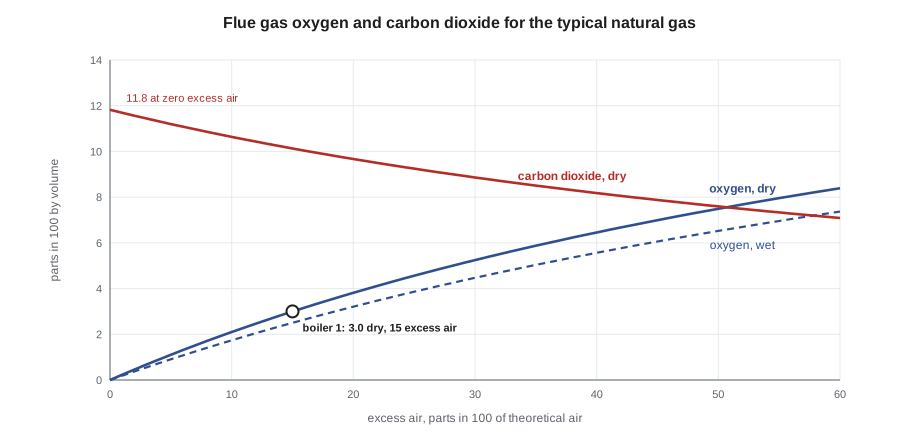
Oxygen is preferred to carbon dioxide for control because the relationship between oxygen and excess air hardly depends on the fuel, while the CO₂ at a given excess air does. For Cantwell's natural gas, the dry flue gas contains about 11.8 in 100 CO₂ at zero excess air; for light oil the maximum is about 15.5 and for bituminous coal about 18.5 (typical). An oxygen reading of 3.0 means much the same excess air for all three fuels.
Wet and dry
Flue gas from natural gas is about a sixth water vapor by volume. Whether a reading is on a wet basis, with the water vapor included, or a dry basis, with it removed, changes the numbers noticeably, and mixing the two is one of the commonest errors in combustion work.
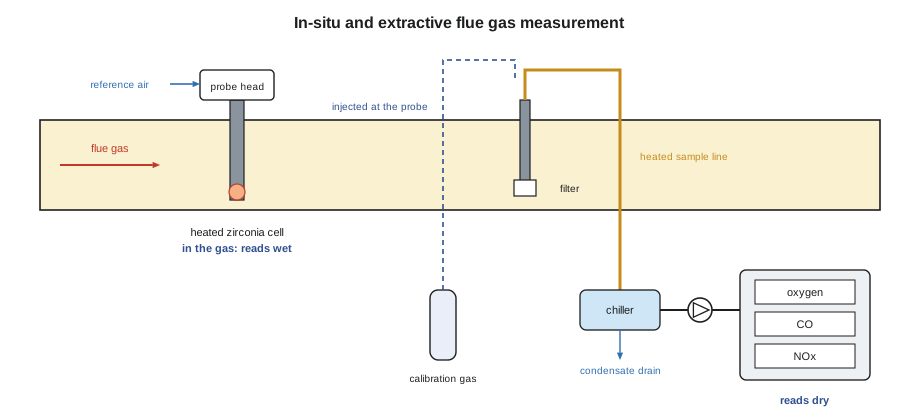
- Extractive analyzers draw a sample out of the duct, cool it to condense the water and analyze it dry. Portable combustion analyzers, laboratory instruments and most continuous emission monitoring systems report on a dry basis.
- In-situ analyzers measure the gas where it is, hot and wet. The zirconium oxide probes used for oxygen trim, like the one on boiler 1, report on a wet basis.
Because the dry gas is the wet gas with the water removed, each component's dry fraction is its wet fraction divided by the dry share of the total:
Worked problem
A trim probe and a portable analyzer
Boiler 1's zirconia trim probe reads 2.2 in 100 oxygen at high fire. The flue gas from Cantwell's natural gas at that excess air contains about 0.168 water vapor by volume. What should Pilar's portable analyzer, which measures dry, read at the same moment?
Show solution
- \[x_{dry} = \frac{2.2}{1 - 0.168} = 2.6 \text{ in 100}\]
Answer: About 2.6 in 100 dry. The two instruments are both right; they are measuring different things. The trim set points on boiler 1 are entered in the trim probe's wet values, and the burner test sheet records dry values, so the commissioning report lists both. An engineer who compared the two numbers without converting would think one instrument was faulty.
Analyzers
Each gas is measured by a property that distinguishes it from the others:
- Zirconium oxide (zirconia) cells measure oxygen. A ceramic of zirconium oxide heated to about 1,300 °F conducts oxygen ions, and when it has different oxygen concentrations on its two sides, with reference air on one side and flue gas on the other, it produces a voltage that depends on the logarithm of the ratio. The cell is robust and fast, and it can be mounted directly in the duct. At its operating temperature it burns any combustibles in the sample with some of the oxygen, so in a fuel-rich gas it reads low: it measures net oxygen, not free oxygen.
- Paramagnetic analyzers measure oxygen by its attraction to a magnetic field, which is unusually strong among common gases. They are used in extractive systems and laboratories.
- Electrochemical cells measure oxygen, CO, NO, NO₂ and SO₂ in portable analyzers. Each cell's chemical reaction produces a current proportional to the gas concentration. They are small and inexpensive, but they drift, age and can be poisoned or saturated by high concentrations, and they need regular checking against calibration gas.
- Non-dispersive infrared (NDIR) analyzers measure CO, CO₂ and some other gases by the infrared wavelengths each absorbs.
- Chemiluminescence analyzers measure NOx by the light given off when NO reacts with ozone, the usual method in continuous emission monitoring. Ultraviolet analyzers measure SO₂. Tunable diode laser analyzers send a laser across the duct and measure the average concentration along its path.
The Orsat apparatus, which the older textbooks still describe, measured CO₂, O₂ and CO by absorbing them one after another in chemical solutions from a measured volume of gas and noting the shrinkage. Because the sample was cooled and measured over water, its results were on a dry basis. Orsats are now historical, but the idea that a dry analysis sums the CO₂, O₂, CO and nitrogen to 100 is still the basis of flue gas calculations.
Sampling
An analyzer can only measure what reaches it. The gas in a large duct is rarely uniform: it is stratified by burners that run differently, by air in-leakage along one wall, by bends that push the gas to one side. A single probe may read a value quite different from the average, so test points are chosen with care, and large ducts are traversed or sampled through a grid of probes for tests. Continuous probes are placed where tests have shown the gas to be representative.
In an extractive system, the sample passes through a filter in the probe, along a sample line, through a chiller or dryer that removes the water, and into the analyzers. Each step can spoil the reading. A leak in the sample line or a cracked probe draws in room air, which raises the oxygen and dilutes everything else; a leak check, by plugging the probe tip and watching the flow fall to zero, catches it. Condensation in a cold sample line dissolves NO₂ and SO₂, so that they read low; sample lines for those gases are heated. A blocked filter slows the response.
Portable analyzers have the same chain in miniature: a probe pushed into the test port, a hose, a water trap, a filter and a pump. The probe tip should be in the middle of the gas stream, the test port sealed around it, and the reading allowed to settle before it is recorded. The water trap must be emptied and the filter changed, and the analyzer should be started and zeroed in fresh air, not in a boiler room full of exhaust.
Calibration
Analyzers are checked against calibration gases of known composition, supplied with a certificate of their concentration. A zero check uses a gas with none of the component, such as nitrogen for oxygen, or clean air for CO; a span check uses a gas near the top of the measuring range. If the analyzer reads outside its tolerance, it is adjusted, and the size of the adjustment is recorded, because a large drift means the readings since the last check are in doubt.
Continuous emission monitoring systems, discussed in lesson 5, are checked daily by injecting calibration gas at the probe, so that the whole sample system is tested, not only the analyzer, and are audited regularly against a reference method. Portable analyzers are calibrated by the supplier or a service shop on a schedule, typically once or twice a year, and bump tested by the user before important tests: a quick exposure to calibration gas to confirm that each sensor responds.
Lorne had Okonkwo run the portable analyzer on the calibration bottle. The oxygen cell read correctly; the CO cell read 92 ppm on a gas certified at 100. "Inside its tolerance," Lorne said, checking the manual, "but note it. If it's 85 next month, it goes back to the shop."
From oxygen to excess air
PWR-310 lesson 10 related dry flue gas oxygen to excess air for Cantwell's natural gas. The quick approximation, accurate enough for checking a burner on rounds, is:
A full calculation, which follows the combustion equations for the actual fuel, gives a slightly lower excess air for natural gas, because the approximation ignores the water vapor that was removed from the dry gas. For Cantwell's gas, 3.0 in 100 oxygen dry corresponds to 15.0 in 100 excess air by the full calculation and 16.8 by the approximation; 2.0 corresponds to 9.5 and 10.6. The examinations accept either, provided the method is stated, and the full calculation is used for efficiency work.
Carbon dioxide gives excess air too, approximately, from the maximum CO₂ for the fuel:
Worked problem
Excess air from carbon dioxide
A dry analysis of boiler 1's flue gas shows 10.1 in 100 CO₂ and 3.0 in 100 O₂. The maximum CO₂ for the fuel is 11.8. Estimate the excess air from the CO₂, and compare it with the value from oxygen.
Show solution
- \[EA \approx \frac{11.8}{10.1} - 1 = 0.17\]
Answer: About 17 in 100 from CO₂, against 15 in 100 from oxygen by the full calculation. The CO₂ method depends on knowing the maximum CO₂ for the fuel exactly, and on the gas analysis being accurate at the high end of the CO₂ range, where small errors in CO₂ change the result considerably. That is why oxygen is the preferred measurement.
Correcting to a reference oxygen
Emission concentrations depend on how much the flue gas has been diluted by excess air. A boiler running with 6 in 100 oxygen shows a lower CO or NOx concentration than the same boiler at 3 in 100 making exactly the same mass of pollutant, simply because there is more air in the gas. Regulations and permits therefore state concentrations corrected to a reference oxygen, commonly 3 in 100 dry for gas-fired and oil-fired boilers and 6 in 100 for solid fuels (typical; the permit sets the reference):
Worked problem
CO corrected to 3 in 100 oxygen
A portable analyzer on a boiler reads 45 ppm CO and 5.0 in 100 oxygen, both dry. What is the CO concentration corrected to 3 in 100 oxygen?
Show solution
- \[C_{3} = 45 \times \frac{20.9 - 3.0}{20.9 - 5.0} = 45 \times \frac{17.9}{15.9} = 50.7 \text{ ppm}\]
Answer: About 51 ppm at 3 in 100 oxygen. Correction always raises a reading taken at higher oxygen than the reference, and lowers one taken at lower oxygen. It is never applied to an oxygen reading itself, and it must be applied to dry concentrations with a dry oxygen reading.
Air in-leakage and air heater leakage
Oxygen that rises between two points in the gas path, with no burner in between, means air is leaking in. On large balanced-draft boilers, where the gas path is under suction, leakage through casing seams, expansion joints and access doors is normal in small amounts and can be serious in large ones, and the biggest single source is often the rotary regenerative air heater, whose rotating seals let some high-pressure air pass into the low-pressure gas side. Air heater leakage is estimated from the oxygen before and after the air heater. A simple approximation for the leakage as a fraction of the gas entering is:
Worked problem
Air heater leakage
On a utility boiler, the flue gas oxygen is 3.0 in 100 at the air heater inlet and 4.2 in 100 at its outlet, both dry. Estimate the air heater leakage.
Show solution
- \[\text{leakage} \approx \frac{4.2 - 3.0}{20.9 - 4.2} = \frac{1.2}{16.7} = 0.072\]
Answer: About 7 parts of leakage air for every 100 parts of gas entering the air heater (ASME's performance test method includes a further correction factor for the ratio of molecular weights, which gives a slightly lower figure). The leaking air does not help combustion and loads the ID fans; it also cools the gas leaving the air heater, which makes the exit gas temperature look better than it is. Efficiency calculations use the gas temperature corrected for leakage.
Reading the results
With oxygen and CO measured together, most combustion problems can be recognized from the pattern:
| Oxygen | CO | Likely meaning |
|---|---|---|
| Normal | Low | Normal combustion |
| Low | High | Burner short of air: air reduced too far, hot weather, fouled fan or damper slipped |
| High | High | Poor mixing: damaged burner parts, wrong air distribution, a burner out of adjustment, or oxygen read downstream of air in-leakage |
| High | Low | Too much excess air, cold weather, or air in-leakage between burner and probe |
| Rising slowly at steady load | Low | Developing air in-leakage or drift of the positioning curve |
| Normal | Rising slowly | Burner deterioration, dirty fuel nozzles, a fouling flame scanner sight tube changing the flame |
Stack temperature completes the picture. A rising stack temperature at the same load and oxygen means the heat transfer surfaces are fouling, on the fire side with soot or on the water side with scale, or that gas is bypassing a surface through a failed baffle. Boiler 2's stack temperature, which PWR-120 recorded climbing from 385 to 417 °F over a week in November with its oxygen unchanged, is the reason its fire-side inspection was booked.
Okonkwo's evening ended with a test on boiler 2, with Lorne watching. He ran the analyzer through its warm-up in the control room, carried it to the boiler, sealed the probe in the test port with the rubber cone and waited for the readings to settle: 3.3 oxygen dry, 22 ppm CO, stack 415 °F. He converted the CO to 3 in 100 oxygen and calculated the excess air both ways in the log, and wrote the stack temperature in red beside the previous week's.
Common mistakes
MistakeComparing a zirconia probe reading with a portable analyzer reading directly.
InsteadThe in-situ probe reads wet and the portable reads dry; convert before comparing.
MistakeIgnoring a leak in the sample line.
InsteadRoom air drawn into the sample raises oxygen and dilutes CO and NOx; leak-check the sample system.
MistakeApplying the oxygen correction with a wet oxygen reading.
InsteadCorrect dry concentrations using dry oxygen, and never correct the oxygen reading itself.
MistakeUsing carbon dioxide to find excess air without knowing the fuel.
InsteadThe maximum CO₂ depends on the fuel; oxygen gives excess air almost independently of fuel.
MistakeTrusting a zirconia probe in fuel-rich gas.
InsteadThe hot cell burns combustibles with the oxygen and reads low; watch CO as well.
Summary and key terms
- Flue gas analysis measures O₂, CO₂, CO, NOx, SO₂, combustibles and stack temperature, for combustion control, efficiency and emissions.
- In-situ analyzers read wet; extractive and portable analyzers read dry; divide a wet reading by one minus the water fraction to get dry.
- Zirconia, paramagnetic, electrochemical, NDIR, chemiluminescence, ultraviolet and laser analyzers each measure by a distinguishing property.
- Representative sampling, leak-free and condensation-free sample systems, and zero and span checks with certified gases make the numbers trustworthy.
- Excess air comes from O₂ (preferred) or CO₂; emissions are corrected to a reference oxygen by (20.9 − O₂ref) ÷ (20.9 − O₂meas).
- Rising oxygen along the gas path means in-leakage; the oxygen and CO pattern, with stack temperature, diagnoses most combustion problems.
- Dry basis
- A gas analysis with the water vapor removed from the sample.
- Wet basis
- A gas analysis that includes the water vapor present in the gas.
- In-situ analyzer
- An analyzer that measures the gas in the duct without drawing a sample out.
- Zirconia cell
- A heated zirconium oxide cell that produces a voltage depending on the oxygen concentration difference across it.
- Calibration gas
- A gas of certified composition used to check and adjust an analyzer.
- Reference oxygen
- The oxygen concentration to which emission concentrations are corrected for comparison with limits.
- Stratification
- Uneven composition or temperature across a duct.
- Air heater leakage
- Combustion air passing across the seals of an air heater into the flue gas.
Practice problems
Work each problem on paper first, then reveal the answer to check.
A zirconia probe reads 3.0 in 100 oxygen wet in gas with 0.17 water vapor. What is the dry oxygen?
Show answer
3.0 ÷ 0.83 = 3.6 in 100.
Estimate the excess air for 4.0 in 100 dry oxygen using the approximation.
Show answer
4.0 ÷ 16.9 = 0.24, or 24 in 100.
A boiler shows 80 ppm NOx at 6.0 in 100 oxygen dry. Correct it to 3 in 100.
Show answer
80 × 17.9 ÷ 14.9 = 96 ppm.
Oxygen is 2.5 at an air heater inlet and 3.6 at its outlet. Estimate the leakage.
Show answer
1.1 ÷ 17.3 = 0.064, about 6 parts per 100 of gas.
Lesson quiz · 5 questions
Score 60% or more to complete this lesson.
Create a free account to save your progress, take quizzes and earn a certificate.