
PWR-330 · Lesson 5 of 12 · 25 min
Emissions and their control
▶ Video coming soon A video version of this lesson is on the way.
PWR-240 had taught Okonkwo how Cantwell stays within the law on air: its Ohio EPA permit-to-install and operate, the fuel records required by the federal New Source Performance Standards, and good burner tuning. His stationary engineer course went further, to the plants where emissions control is a set of large machines in its own right: selective catalytic reduction reactors, flue gas desulfurization towers, electrostatic precipitators and baghouses, with continuous emission monitors reporting every hour to the regulator.
"At Cantwell, emissions control is mostly done by the burner," Grazyna said. "At a coal plant, the burner is the first of five or six things between the fuel and the sky, and each one has to be run like a piece of plant, with its own alarms, its own chemistry and its own failure modes. The engineer who thinks of them as somebody else's equipment is the one who has an exceedance at three in the morning."
This lesson explains how the main air pollutants from boilers form, the methods used to control each of them, how emissions are measured and calculated, and the main regulations that apply to large boilers in the United States. The figures for Cantwell are worked through for comparison.
The pollutants
Combustion of fossil and biomass fuels produces several pollutants that are regulated:
- Nitrogen oxides (NOx), mainly nitric oxide (NO) with some nitrogen dioxide (NO₂). NOx contributes to smog, fine particles and acid deposition, and NO₂ is itself a respiratory irritant.
- Sulfur dioxide (SO₂), from sulfur in the fuel, with a little sulfur trioxide (SO₃). SO₂ causes acid deposition and fine particles; SO₃ forms sulfuric acid mist and raises the acid dew point of the flue gas (PWR-310 lesson 10).
- Particulate matter, fly ash and unburned carbon from solid fuels and heavy oil, regulated as total particulate and as the fine fractions PM₁₀ and PM₂.₅, which penetrate deep into the lungs.
- Carbon monoxide and volatile organic compounds, products of incomplete combustion.
- Hazardous air pollutants: mercury, metals, acid gases such as hydrogen chloride, and organic compounds such as dioxins, mainly from coal, oil, waste and biomass.
- Greenhouse gases, mainly carbon dioxide, with small amounts of methane and nitrous oxide.
Natural gas contains essentially no sulfur or ash, so a gas-fired boiler like Cantwell's emits mainly NOx, a little CO and carbon dioxide. When Cantwell burns fuel oil during a gas curtailment, its emissions change: some SO₂ from the oil's sulfur, a little particulate, and more NOx, which is one reason oil firing is limited by its approval.
How NOx forms
NOx is formed in flames in three ways:
- Thermal NOx: at high flame temperatures, the nitrogen and oxygen of the combustion air combine. The rate rises very steeply with temperature, roughly doubling for every few tens of degrees above about 2,700 °F (typical), and increases with oxygen availability and residence time at high temperature. In gas flames, thermal NOx is most of the NOx.
- Fuel NOx: nitrogen bound in the fuel itself, as in coal and heavy oil, is released and partly oxidized. It depends less on temperature and more on how much oxygen is available where the fuel nitrogen is released. In coal flames, fuel NOx is most of the NOx.
- Prompt NOx: a small amount formed quickly in the fuel-rich front of a hydrocarbon flame.
The control methods follow from these mechanisms: lower the peak flame temperature, limit the oxygen where nitrogen is being released, shorten the time at high temperature, or remove the NOx from the flue gas after it is formed.
Reducing NOx in the flame
Combustion modifications are the first and cheapest line of defense:
- Low-NOx burners stage the air or the fuel. In an air-staged burner, the fuel first meets only part of its air in a fuel-rich zone, where fuel nitrogen is released with little oxygen to oxidize it, and the rest of the air joins further out, where the flame is cooler. Fuel-staged burners divide the gas instead. Modern ultra-low-NOx gas burners reach about 9 to 30 ppm at 3 in 100 oxygen (typical), compared with 80 to 120 ppm for an older conventional burner.
- Flue gas recirculation (FGR) returns cooled flue gas to the burner air. The inert gas lowers the peak flame temperature and the oxygen concentration, cutting thermal NOx sharply on gas and light oil. It adds fan power and slightly raises the gas flow through the boiler.
- Overfire air (OFA) on large boilers diverts part of the combustion air to ports above the burners, so that the burner zone runs substoichiometric and combustion is completed higher in the furnace.
- Low excess air: less oxygen in the flame means less NOx, which is one more reason for tight combustion control, within the limit set by CO.
- Water or steam injection and lean premixed combustion, used mostly in gas turbines, where dry low-NOx combustors premix fuel and air very lean to keep flame temperatures low.
Each of these trades something. Staged and lean flames are longer and less stable, closer to the CO knee and more sensitive to tuning. A boiler retrofitted with low-NOx burners may lose some steam capacity, run with more CO, or need more excess air at low fire. NOx and CO pull in opposite directions, and the burner technician's tuning finds the point where both are within limits.
Removing NOx from the flue gas
Where combustion modifications are not enough, NOx is chemically reduced back to nitrogen in the flue gas by ammonia or urea:
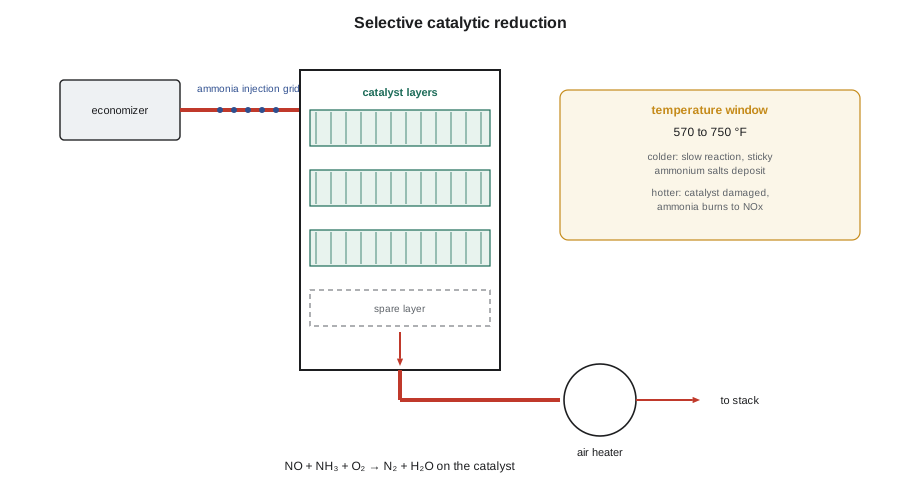
- Selective catalytic reduction (SCR) injects ammonia into the flue gas upstream of a catalyst, usually honeycomb or plate elements of titanium dioxide with vanadium or tungsten oxides. On the catalyst, ammonia reacts with NO and oxygen to form nitrogen and water. SCR removes about 80 to 95 in 100 of the NOx (typical) and works only within a temperature window, about 570 to 750 °F for conventional catalysts (typical), so on a boiler it is placed between the economizer and the air heater; on a HRSG it sits in the tube banks where the gas is at the right temperature.
- Selective non-catalytic reduction (SNCR) injects urea or ammonia into the furnace where the gas is hotter, about 1,600 to 2,000 °F (typical), and the reaction runs without a catalyst. It is cheaper but removes less, typically 30 to 60 in 100.
Both methods leave some unreacted ammonia in the flue gas, called ammonia slip, which is limited by permit, typically to a few ppm. Slip rises as the catalyst ages, as the ammonia distribution becomes uneven, or if too much ammonia is injected. Slip can combine with SO₃ to form ammonium bisulfate, a sticky deposit that fouls air heaters, which is why SCR operation and air heater cleaning are closely linked on coal and oil units. Ammonia itself is a hazardous chemical, whether stored as anhydrous liquid under pressure or as an aqueous solution, and many plants use urea, converted to ammonia on site, to avoid storing it.
Worked problem
Ammonia for an SCR
A utility boiler's flue gas flow is 55,000 lbmol/h. Its NOx, nearly all NO, is 180 ppm at the SCR inlet and must be reduced to 18 ppm. The reaction uses one mole of ammonia per mole of NO. Ignoring slip, how much ammonia is used per hour, and what is the removal efficiency?
Show solution
- NO removed:
- \[55{,}000 \times (180 - 18) \times 10^{-6} = 8.91 \text{ lbmol/h}\]
- Ammonia, at 17.03 lb/lbmol:
- \[8.91 \times 17.03 = 152 \text{ lb/h}\]
- Removal efficiency:
- \[\frac{180 - 18}{180} = 0.90\]
Answer: About 152 lb/h of ammonia, or about 1.8 tons a day, for 90 in 100 removal. In practice the ammonia flow is controlled from the measured NOx at the inlet and outlet, slightly above the stoichiometric ratio, and the operators watch the slip.
Sulfur dioxide
SO₂ depends on the fuel's sulfur content and almost nothing else: nearly all the sulfur burned leaves as SO₂. It is controlled by burning low-sulfur fuel or by removing it from the flue gas in flue gas desulfurization (FGD):
- Wet scrubbers spray a slurry of limestone or lime through the gas in an absorber tower. The SO₂ reacts to form calcium sulfite, which is oxidized to gypsum, often sold for wallboard. Removal of 95 in 100 or more is common. The cooled, saturated gas leaves through a lined wet stack.
- Dry and semi-dry scrubbers spray lime slurry into the gas so that the water evaporates and the product is collected as a dry powder in a downstream baghouse; dry sorbent injection blows powdered sorbent such as sodium bicarbonate or hydrated lime into the duct.
- Fluidized bed boilers capture sulfur in the bed with limestone, as lesson 1 described.
SO₃, although a small fraction of the sulfur, matters out of proportion to its quantity: it raises the acid dew point, condenses as sulfuric acid on cold surfaces at the back of the boiler, and forms a visible plume. Air heaters and economizers on sulfur-bearing fuels are designed to keep metal temperatures above the acid dew point, as PWR-310 described.
Particulate
Fly ash from coal, biomass and heavy oil is collected before the stack by:
- Electrostatic precipitators (ESPs), which charge the particles with high-voltage discharge electrodes and collect them on grounded plates, from which they are knocked off by rappers into hoppers. ESPs collect over 99 in 100 by mass (typical), but their performance depends on the electrical resistivity of the ash, which depends on the fuel and the gas temperature.
- Fabric filters, or baghouses, which pass the gas through hundreds or thousands of fabric bags and clean them periodically by pulses of compressed air or reverse gas flow. They collect very fine particles well and are less sensitive to the fuel. Bags must be protected from temperatures above their rating and from acid condensation below the dew point, and a burst bag shows at once as a rise in opacity.
- Mechanical collectors, or multicyclones, which spin the gas so that the larger particles are thrown out; they are used before ESPs or baghouses on biomass boilers, partly to catch burning embers that could damage the bags.
Hoppers under ESPs and baghouses must be emptied regularly. Ash left to accumulate can reach the electrodes or bags, cause fires with unburned carbon, or pack so hard it cannot be removed. Hopper level alarms and heaters are part of the operator's rounds.
Measuring emissions
Emissions are measured by stack testing, in which a specialist contractor samples the gas by the regulator's reference methods over a set series of runs, or continuously by a continuous emission monitoring system (CEMS). Large units are required to have CEMS for NOx, SO₂ and the diluent oxygen or CO₂, with a flow monitor and an opacity or particulate monitor where required. The CEMS is checked by daily calibration with certified gases injected at the probe, and audited by comparison with reference method testing at set intervals.
In the United States, CEMS for utility units are governed by 40 CFR Part 75, used for the federal emissions trading programs, and for other sources by the performance specifications of 40 CFR Part 60.
To compare emissions with a limit stated per unit of heat input, a concentration is converted with an F-factor, the volume of flue gas produced per unit of fuel heat at zero excess air. For natural gas, the US EPA's dry F-factor is 8,710 dry standard cubic feet per million Btu of higher heating value . The emission rate is:
where C is the concentration as a mass per unit volume of dry gas and O₂ is the dry oxygen measured with it. For NOx expressed as NO₂, one ppm by volume at the EPA's standard conditions is 1.194 × 10⁻⁷ lb per standard cubic foot.
Worked problem
NOx per unit of heat input
A gas-fired boiler's NOx is 30 ppm at 3.0 in 100 oxygen, dry. Find its NOx emission rate in lb/MMBtu.
Show solution
- \[E = 30 \times 1.194 \times 10^{-7} \times 8{,}710 \times \frac{20.9}{17.9} = 0.0364 \text{ lb/MMBtu}\]
Answer: About 0.036 lb/MMBtu. A rule of thumb that follows from this: for natural gas, 1 ppm of NOx at 3 in 100 oxygen is about 0.0012 lb/MMBtu. Many permits for new gas-fired boilers set limits in that range or lower.
The regulations for large boilers
Federal and state rules work together in the United States. New Source Performance Standards in 40 CFR Part 60 set limits for new and modified boilers: Subpart Da for utility units, Db for industrial units above 100 million Btu/h heat input and Dc for those between 10 and 100 million Btu/h. The Boiler MACT, 40 CFR Part 63 Subpart DDDDD, sets hazardous air pollutant standards for boilers at major sources of hazardous air pollutants, with numerical limits for solid and liquid fuel units and work practice standards, chiefly periodic tune-ups, for gas-fired units; the area source rule, Subpart JJJJJJ, exempts gas-fired boilers, as PWR-240 explained. Utility units have their own mercury and air toxics standards, and the large ones trade NOx and SO₂ allowances under federal programs. The Greenhouse Gas Reporting Program requires facilities emitting 25,000 metric tons CO₂e or more a year to report; in September 2025 EPA proposed to end reporting for most source categories, and as of mid-2026 that proposal had not been finalized, so the current status should be checked.
These regulations change often, and a plant's own permit or approval is what binds it. An engineer at a large plant keeps the current permit conditions, monitoring requirements and reporting deadlines at hand, and treats a monitor outage or an exceedance as an event to be recorded and reported, not something to be explained away later.
Carbon dioxide
Carbon dioxide cannot be scrubbed out of a boiler's flue gas economically at small scale, so it is controlled by burning less fuel, or fuel with less carbon per unit of energy. Natural gas emits about 117 lb of CO₂ per million Btu; coal emits roughly 1.7 to 1.8 times as much per unit of heat (typical). Every gain in boiler efficiency is a reduction in CO₂, which is why the efficiency calculations of lesson 6 now appear in environmental reports. Large-scale carbon capture by amine scrubbing of flue gas has been built at a few power plants, including SaskPower's Boundary Dam unit 3 in Saskatchewan, at great cost and with a large energy penalty.
At Cantwell, the roughly 360,000 MMBtu of gas burned in 2025 corresponds to about 19,100 metric tons of CO₂, as PWR-240 calculated, below the 25,000-ton federal reporting threshold.
The operator's part
Whatever the equipment, emissions compliance depends on operation as much as design. Burners must be kept in tune, because a burner that drifts lean makes more NOx and one that drifts rich makes CO. SCR ammonia flow, catalyst pressure drop and slip are watched like any other plant parameter. Scrubber pH and slurry density, precipitator voltages and currents, baghouse pressure drop and opacity are logged on rounds. Start-ups and shutdowns, when controls are not yet effective, are planned and recorded, because many permits treat them separately. Monitor calibrations are checked every day, and a failed calibration is reported and corrected the same day.
Grazyna showed Okonkwo the mill's old monthly environmental report, with its precipitator power, opacity hours and SO₂ averages. "The plants with good records are not the ones with the best equipment," she said. "They are the ones where the operators read the emissions screen with the same attention as the drum level."
Common mistakes
MistakeThinking NOx comes only from nitrogen in the fuel.
InsteadGas flames make mostly thermal NOx from the air's own nitrogen; fuel NOx dominates on coal and heavy oil.
MistakeLowering NOx by any means without watching CO.
InsteadStaged, lean and low-excess-air flames move toward the CO knee; tune for both limits together.
MistakeRunning an SCR outside its temperature window.
InsteadBelow the window the reaction slows and ammonia salts deposit; above it the catalyst is damaged and ammonia oxidizes.
MistakeTreating ammonia slip as harmless.
InsteadSlip is regulated, wastes reagent and forms ammonium bisulfate that fouls air heaters.
MistakeAssuming a regulation applies because a boiler is large.
InsteadMany rules apply by industry, fuel, size and date of construction; the plant's permit or approval sets what binds it.
Summary and key terms
- Boilers emit NOx, SO₂, particulate, CO and VOC, hazardous air pollutants and greenhouse gases; gas-fired boilers emit mainly NOx, CO and CO₂.
- Thermal NOx rises steeply with flame temperature; fuel NOx comes from nitrogen in coal and oil; prompt NOx is small.
- Low-NOx burners, FGR, overfire air and low excess air reduce NOx in the flame; SCR and SNCR reduce it with ammonia or urea afterwards.
- SO₂ is controlled by low-sulfur fuel or scrubbing; particulate by ESPs, baghouses and mechanical collectors.
- Emission rates per unit of heat come from concentration, the F-factor and oxygen; CEMS are calibrated daily and audited.
- NSPS Subparts Da, Db and Dc, the Boiler MACT and utility programs apply by size, fuel and source type.
- Thermal NOx
- Nitrogen oxides formed from the nitrogen and oxygen of the combustion air at high flame temperatures.
- Fuel NOx
- Nitrogen oxides formed from nitrogen bound in the fuel.
- Flue gas recirculation
- Returning cooled flue gas to the combustion air to lower flame temperature and NOx.
- Selective catalytic reduction
- Reduction of NOx to nitrogen by ammonia on a catalyst in a set temperature window.
- Ammonia slip
- Unreacted ammonia leaving an SCR or SNCR system in the flue gas.
- Flue gas desulfurization
- Removal of sulfur dioxide from flue gas, usually by reaction with limestone or lime.
- Electrostatic precipitator
- A particulate collector that charges particles and collects them on grounded plates.
- F-factor
- The volume of flue gas produced per unit of fuel heat at zero excess air, used to convert concentrations to emission rates.
Practice problems
Work each problem on paper first, then reveal the answer to check.
A gas boiler's NOx is 45 ppm at 3 in 100 oxygen. Estimate its emission rate in lb/MMBtu using the rule of thumb.
Show answer
45 × 0.0012 = 0.055 lb/MMBtu.
An SCR reduces NOx from 150 ppm to 12 ppm. What is its removal efficiency?
Show answer
(150 − 12) ÷ 150 = 0.92.
Flue gas of 22,000 lbmol/h contains 100 ppm NO, all to be removed. How much ammonia is needed?
Show answer
22,000 × 100 × 10⁻⁶ × 17.03 = 37 lb/h.
A boiler burns 75,000 MMBtu of natural gas a year. Estimate its CO₂ emissions.
Show answer
75,000 × 117 = 8.8 × 10⁶ lb, about 4,000 metric tons.
Lesson quiz · 5 questions
Score 60% or more to complete this lesson.
Create a free account to save your progress, take quizzes and earn a certificate.