
PWR-330 · Lesson 3 of 12 · 28 min
Combustion control and excess air
▶ Video coming soon A video version of this lesson is on the way.
When Halvard Rosemund commissioned the oxygen trim on boiler 1 in October, Okonkwo had been on nights and missed it. He read the commissioning report instead, and one table in it held his attention: the oxygen at each firing rate before and after the trim was tuned, with the carbon monoxide beside it. At high fire the oxygen had come down from 3.0 to about 2.0 in 100, with CO still below 30 ppm. At low fire it had stayed at 3.5. He asked Grazyna why the burner needed more air at low fire, when it was burning less fuel.
"Because at low fire the air and gas mix worse," she said. "Lower velocities, less turbulence, a flame that is easier to quench. Excess air is the price of making sure every molecule of fuel finds oxygen. The art of combustion control is paying that price, and not a cent more, at every load, in every weather, while the steam demand is moving."
This lesson develops the combustion control introduced in PWR-220 lesson 6 to the Third Class level: the firing rate demand and how it is shared between boilers, positioning and fully metered control, the cross-limiting that keeps a boiler on the safe side of its air-fuel ratio during load changes, the choice of excess air and the reasons it varies with load and fuel, the effect of air temperature, oxygen and carbon monoxide trim, and furnace pressure control on balanced-draft boilers.
From steam demand to firing rate
A boiler's combustion controls exist to make steam at the rate the plant uses it. In a plant with several boilers on a common header, the plant master controller measures header steam pressure and produces a firing rate demand: if pressure falls, the steam is being used faster than it is made, and the demand rises. Each boiler's boiler master receives that demand, adjusted by a bias set by the operator, so that boilers can be loaded unequally. A boiler can be put on base load at a fixed demand while others swing to follow the load, or a boiler can be taken out of automatic altogether.
Large plants often add a feedforward from steam flow: a rise in steam flow raises the firing demand at once, before pressure has had time to fall, and the pressure controller only trims. On a utility unit the demand comes from the turbine and the grid instead, through a unit load demand, and the boiler and turbine controls are coordinated so that the boiler's slow response and the turbine's fast one work together.
At Cantwell, the header pressure controller in the distributed control system sends one demand to the three steam boilers' masters. In the winter, two boilers usually carry the load with the third on standby or at low fire; in the summer, one boiler is enough, and the others are on layup or under inspection. The shift engineer decides which boiler swings and sets the biases, and the plant's procedures require that the boiler with the newest burner tuning swings, because it holds its air-fuel ratio best through rapid changes.
Positioning control
In positioning control, the firing rate demand drives the fuel valve and the air damper to positions set by a fixed relationship, with no measurement of either flow. The oldest systems use a jackshaft, a single rotating shaft with linkages and cams to the fuel valve and air damper, so that one actuator moves both. Modern parallel positioning systems, like Cantwell's, drive the fuel valve and air damper with separate servo motors, each following a characterized curve of position against firing rate, programmed point by point at commissioning, with the oxygen and CO measured at each point.
Positioning control is simple, fast and inexpensive, and on a well-maintained single-burner boiler it works well. Its weakness is that it controls positions, not flows. Anything that changes the flow through a given position changes the air-fuel ratio: a change in gas supply pressure or temperature, a change in combustion air temperature or barometric pressure, a dirty fan or a worn linkage. The burner technician sets enough excess air to cover these changes, and the oxygen trim, where fitted, corrects the rest.
Fully metered control and cross-limiting
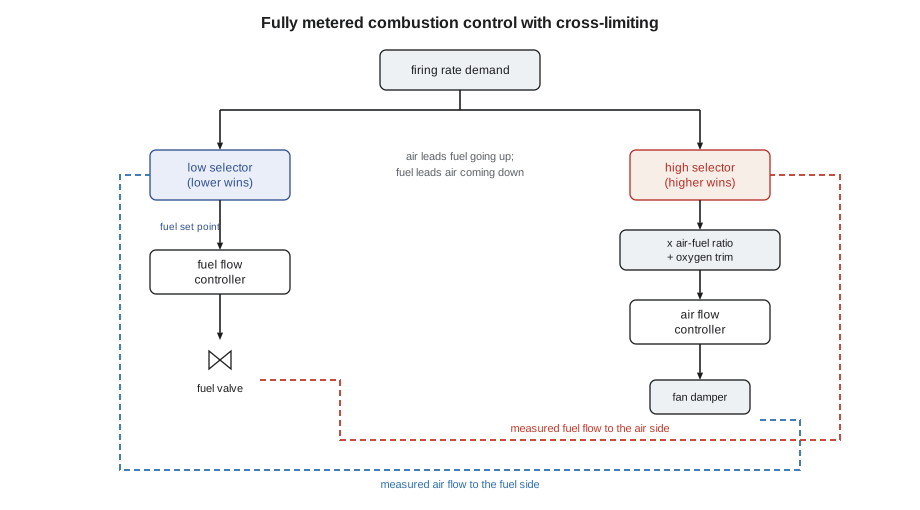
In fully metered control, the fuel flow and the air flow are both measured, and each has its own control loop. The firing rate demand becomes a fuel flow set point and an air flow set point, and the ratio between them is held by measurement, whatever the fan or gas supply is doing. Fully metered control is used on larger boilers, multiple-burner boilers and boilers that fire more than one fuel.
Its essential feature is cross-limiting, also called lead-lag control. On a load increase, air must rise before fuel; on a load decrease, fuel must fall before air. In either case the boiler passes through the change with extra air rather than too little. The logic is built from two selectors:
- The fuel set point is the *lower* of the firing rate demand and the air actually flowing (converted to the fuel it can burn). Fuel cannot rise ahead of the measured air.
- The air set point is the *higher* of the firing rate demand and the fuel actually flowing (converted to the air it needs). Air cannot fall below what the measured fuel requires.
Worked problem
Cross-limiting through a load change
On a boiler with fully metered control, firing rate demand, fuel flow and air flow are all scaled from 0 to 100 so that equal numbers mean the correct air-fuel ratio. The boiler is steady at 60. The demand steps to 80. At the first instant, the air has risen to 64 and the fuel is still at 60. What are the fuel and air set points? Later, steady at 80, the demand falls suddenly to 50; at the first instant fuel has fallen to 70 and air is still at 80. What are the set points then?
Show solution
- Load increase, first instant:
- \[\text{fuel SP} = \min(80, 64) = 64, \qquad \text{air SP} = \max(80, 60) = 80\]
- Fuel is held to what the measured air can burn and follows the air up. Load decrease, first instant:
- \[\text{fuel SP} = \min(50, 80) = 50, \qquad \text{air SP} = \max(50, 70) = 70\]
Answer: On the increase, the air leads and the fuel is limited to 64 until the air rises further; on the decrease, the fuel falls straight to 50 while the air is held at 70, the air the remaining fuel still needs, until the fuel has fallen. In both directions the boiler is never short of air. Without cross-limiting, a fast fuel valve and a slow fan would send the boiler briefly fuel-rich on every load increase, making CO and soot and, in the worst case, a furnace full of unburned fuel.
Cross-limiting has a cost: the boiler responds to load increases only as fast as its air can rise. Some systems allow a small cross-limit tolerance, so that fuel may run slightly ahead of air for a faster response while staying above the minimum safe ratio.
How much excess air
Excess air is air supplied beyond the theoretical, or stoichiometric, air the fuel needs for complete combustion. PWR-310 lesson 10 calculated the theoretical air for Cantwell's natural gas, about 9.6 ft³ of air per ft³ of gas, and related excess air to flue gas oxygen. Some excess is always needed, because mixing is never perfect. Too little gives carbon monoxide, unburned hydrocarbons and soot, and wastes fuel; too much carries extra air through the boiler, heats it and sends it up the stack, which wastes fuel too.
The best setting is just above the point at which CO starts to rise, the CO knee. As air is reduced from a generous setting, the dry flue gas loss falls steadily while the CO stays low; then, at some oxygen level, CO begins to rise steeply. The ideal operating point is a little above that knee, with enough margin to cover the changes the controls cannot correct.
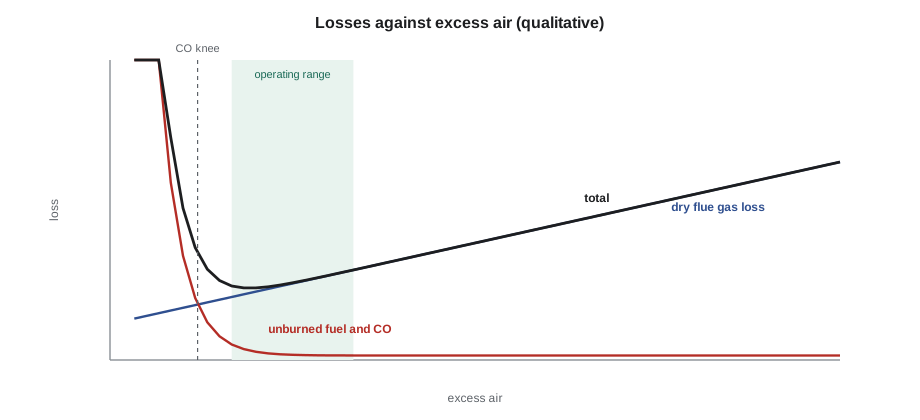
Typical flue gas oxygen targets at high fire are about 2 to 3 in 100 for natural gas, 3 to 4 for light oil, and 3.5 to 5 for pulverized coal and other solid fuels, with more on stokers burning wet bark (typical; the burner and boiler maker set the actual values). The excess air needed rises at low fire, because the burner's velocities and turbulence fall, so oxygen set points are characterized against firing rate, high at low fire and lower at high fire, as boiler 1's set points are.
Worked problem
Air for a Cantwell boiler at full fire
A Cantwell steam boiler burns about 32,600 ft³/h of natural gas at full fire. The theoretical air is 9.61 ft³ per ft³ of gas. Find the combustion air required at 15 in 100 excess air (about 3.0 in 100 oxygen) and at 9.5 in 100 excess air (about 2.0 in 100 oxygen).
Show solution
- \[V_{air} = 32{,}600 \times 9.61 \times 1.15 = 360{,}300 \text{ ft}^3\text{/h} = 6{,}000 \text{ cfm}\]
- \[V_{air} = 32{,}600 \times 9.61 \times 1.095 = 343{,}000 \text{ ft}^3\text{/h} = 5{,}720 \text{ cfm}\]
Answer: Lowering the oxygen from 3.0 to 2.0 cuts the air, and therefore the flue gas leaving the stack, by about 5 in 100. Lesson 6 calculates what that is worth: about 0.3 of a percentage point of efficiency at boiler 1's stack temperature. The fan also uses a little less power.
Excess air in the flue gas is not all combustion air that passed through the burner. Air in-leakage, through casing leaks, observation ports, sootblower openings or a leaking air heater, raises the measured oxygen without helping combustion. On a balanced-draft boiler, an oxygen probe at the economizer outlet can read high from leakage while the burners themselves are short of air, which is why large boilers measure oxygen close to the furnace exit and watch CO as well.
Air density and the weather
A fan moves a roughly fixed *volume* of air at a given damper position and speed, but combustion needs a *mass* of oxygen. The mass of air in a given volume varies inversely with its absolute temperature, and directly with barometric pressure. A positioning system tuned on a mild day therefore supplies more oxygen than intended on a cold day and less on a hot one.
Worked problem
A burner tuned in spring
A positioning burner drawing outdoor air was tuned at 59 °F to 15 in 100 excess air. Ignoring trim, estimate the excess air and dry flue gas oxygen if the air is at −4 °F, and if it is at 86 °F.
Show solution
- The mass of air at the same volume scales with absolute temperature. At −4 °F:
- \[\frac{518.67}{455.67} = 1.138, \qquad 1.15 \times 1.138 = 1.309\]
- That is 31 in 100 excess air, and the flue gas oxygen rises to about 5.4 in 100. At 86 °F:
- \[\frac{518.67}{545.67} = 0.951, \qquad 1.15 \times 0.951 = 1.093\]
- That is about 9 in 100 excess air, with oxygen about 2.0 in 100.
Answer: The cold day wastes fuel, with twice the excess air the burner needs. The hot day is the dangerous one: a burner tuned at only 2.0 in 100 oxygen in spring could be driven into CO on a hot afternoon. This is one reason burner technicians check combustion in both summer and winter, and one of the strongest arguments for oxygen trim. Cantwell's boilers draw their air from the boiler room, which stays warmer and steadier than the outdoors, so the swing there is much smaller.
Changes in the fuel matter in the same way. Natural gas composition varies slightly from day to day, and its supply temperature and pressure at the meter affect how much fuel passes a given valve position. Fully metered systems that correct their flow measurements for temperature and pressure hold the ratio through these changes; positioning systems rely on margin and trim.
Oxygen and CO trim
Oxygen trim, as PWR-220 described, measures flue gas oxygen continuously, usually with a zirconium oxide probe, and adjusts the air, or sometimes the fuel, by a small amount to hold a set point that is characterized against firing rate. On a positioning system, the trim moves the air damper or the fan speed a few degrees either side of its curve; on a fully metered system, it adjusts the air-fuel ratio multiplier. The trim's authority is deliberately limited, so that a failed analyzer cannot drive the burner far from its safe curve, and on an analyzer fault the trim freezes or returns to zero.
CO trim uses a carbon monoxide measurement, often an infrared analyzer across the stack, to find the CO knee continuously: it reduces air slowly until CO begins to rise, then backs off. It can run closer to the optimum than oxygen trim, because the knee moves with burner condition and fuel and CO trim follows it. Many systems combine the two, with oxygen trim providing the base and CO acting as a limit. Large coal-fired units also measure combustibles, the total of unburned gases, and loss on ignition, the unburned carbon in fly ash.
An operator should watch the trim output, not only the oxygen reading. If the trim is sitting at the edge of its band, the burner's base curve no longer fits, and the trim is hiding a problem the burner technician needs to fix: a fouled fan, a slipped linkage or a changed gas supply.
Furnace pressure control
On a balanced-draft boiler, the forced draft fans supply the air that the combustion controls call for, and the induced draft fans are controlled to hold furnace pressure at its slightly negative set point. A feedforward from the FD fan demand moves the ID fans with the FD fans, so that the furnace pressure controller only trims. Furnace pressure is measured with several transmitters, and the median or a two-out-of-three vote is used for control and trips.
Two hazards limit this control. A furnace explosion produces a sudden positive pressure. A furnace implosion is the opposite: after a master fuel trip, the collapse of the flame lowers the gas temperature and volume suddenly, and if the ID fans keep pulling, the furnace pressure can fall far enough to buckle the walls inward. Large boilers therefore apply implosion protection: the ID fans' demand is cut back by a set amount on a trip, and their maximum capability is limited in the design. Cantwell's forced draft boilers do not face this hazard in the same way, because they have no ID fans.
Multiple fuels and multiple burners
Boilers that fire more than one fuel need combustion controls that know which fuel is in service. Each fuel has its own theoretical air per unit of heat, its own required excess air and its own curves, and a change of fuel is made gradually, often with both fuels firing together through the change. Cantwell's boilers can fire light fuel oil from the backup tank when the gas supply is curtailed, and each burner's controls hold a separate set of oil curves, tested at the annual burner service.
On multiple-burner boilers, air must be distributed evenly among burners, and the windbox-to-furnace differential pressure is controlled or monitored so that each burner gets its share. Burners taken out of service have their air registers closed to a cooling position. Overfire air, introduced above the burners, lets the burners run with less than their full air to reduce NOx, with the remainder of the air completing combustion higher in the furnace (lesson 5). Each of these changes the way excess air is measured and controlled, but the principle is the same: enough air everywhere, and not much more.
Okonkwo made himself a one-page summary for the course: the cross-limiting logic in two lines, the oxygen ranges by fuel, and the hot-day example underlined. At the bottom, in Grazyna's handwriting after she had read it, was one more line: "Every one of these settings is a margin against something. Know what each margin is for before you take it away."
Common mistakes
MistakeLetting fuel lead air on a load increase.
InsteadCross-limiting makes air lead fuel going up and fuel lead air coming down, so the boiler never runs short of air.
MistakeSetting excess air for the minimum loss with no margin.
InsteadRun just above the CO knee with a margin for changes in air temperature, fuel and burner condition.
MistakeExpecting the same oxygen at low fire as at high fire.
InsteadMixing is poorer at low fire, so oxygen set points are characterized higher at low firing rates.
MistakeAssuming a positioning burner holds its air-fuel ratio in all weather.
InsteadHot air is less dense; a burner tuned lean in cool weather can go fuel-rich on a hot day without trim.
MistakeTrusting flue gas oxygen as a measure of burner air on a leaking boiler.
InsteadAir in-leakage raises measured oxygen downstream of the burners; watch CO and measure close to the furnace exit.
Summary and key terms
- A plant master turns header pressure into a firing rate demand, shared among boilers by biases, with steam flow feedforward on larger plants.
- Positioning control sets fuel and air positions from curves; fully metered control measures and controls both flows.
- Cross-limiting uses a low selector on fuel and a high selector on air so that air leads on load increases and lags on decreases.
- Excess air is set just above the CO knee, characterized higher at low fire, with typical oxygen of 2 to 3 for gas and more for oil and solid fuels.
- Air density varies with temperature and pressure; oxygen and CO trim correct the drift that positioning cannot.
- Balanced-draft boilers control furnace pressure with the ID fans and protect against implosion after a trip.
- Firing rate demand
- The signal from the plant or boiler master that sets how hard a boiler is to fire.
- Parallel positioning
- Combustion control in which separate actuators position the fuel valve and air damper along programmed curves.
- Fully metered control
- Combustion control in which fuel flow and air flow are measured and controlled in ratio.
- Cross-limiting
- Selector logic that makes air lead fuel on load increases and fuel lead air on decreases.
- CO knee
- The excess air level below which carbon monoxide rises steeply.
- Oxygen trim
- Continuous correction of the air-fuel ratio from a flue gas oxygen measurement.
- Air in-leakage
- Air entering the boiler setting or flue gas path other than through the burners.
- Furnace implosion
- Inward collapse of a furnace caused by excessive negative pressure, usually after a fuel trip.
Practice problems
Work each problem on paper first, then reveal the answer to check.
A burner fires 21,000 ft³/h of gas with theoretical air of 9.61 ft³/ft³. How much air is needed at 20 in 100 excess air?
Show answer
21,000 × 9.61 × 1.20 = 242,000 ft³/h.
With fully metered control, the demand is 70, air is 55 and fuel is 50. What is the fuel set point?
Show answer
The lower of 70 and 55: 55.
In the same situation, what is the air set point?
Show answer
The higher of 70 and 50: 70.
A burner tuned at 68 °F runs on air at 14 °F. By what factor does the air mass at the same fan volume rise?
Show answer
527.67 ÷ 473.67 = 1.114, about 11 in 100 more.
Lesson quiz · 5 questions
Score 60% or more to complete this lesson.
Create a free account to save your progress, take quizzes and earn a certificate.