
PWR-330 · Lesson 2 of 12 · 29 min
Burner management systems
▶ Video coming soon A video version of this lesson is on the way.
Boiler 1's lockout on the night of October 20 had been a small event: a cracked flame scanner lens, a safe shutdown, a purge, a new lens and a relight. Okonkwo had read Desmond Kirwan's log entry for it more than once, because it was a model of what a burner management system is for. The burner had been firing normally; the scanner signal had dropped; within seconds the safety shutoff valves had closed, the fan had run a post-purge, and the boiler had waited, cold and safe, for a person to find out why.
"Every furnace explosion I have read about has the same two ingredients," Grazyna said, when they came to burner management in his course notes. "Fuel that did not burn when it should have, and something that lit it later. The burner management system exists to make sure those two never meet. It does not care about efficiency or steam pressure. It only cares about that."
This lesson describes burner management systems on single-burner and multiple-burner boilers: the codes that govern them, the start-up sequence, flame supervision, the fuel safety shutoff valves and valve proving, the master fuel trip, and the design and testing of the logic itself. PWR-120 lesson 6 introduced flame safeguards on packaged boilers; this lesson takes them to the scale and detail the Third Class examinations expect.
What a burner management system does
A burner management system (BMS) is the set of controls, interlocks and devices that ensure fuel is admitted to a furnace only when it is safe to do so, and is shut off at once when it is not. On a packaged boiler it is a flame safeguard control in a box on the burner front; on a utility boiler it is a dedicated safety controller, often redundant, with hundreds of inputs. Its functions are the same:
- Prevent unsafe light-off: check the permissives, purge the furnace, and supervise ignition.
- Supervise the flame whenever fuel is flowing, and shut off fuel if the flame is lost.
- Trip the fuel on any condition that makes continued firing unsafe, through a master fuel trip (MFT).
- Manage shutdown safely, including the post-purge.
A BMS is kept separate from the combustion control system, which modulates fuel and air to meet load (lesson 3). The combustion controls may be complex and adjustable; the BMS should be simple, fixed and difficult to alter. Many codes require them to be in separate controllers, so that a fault or a careless change in the combustion controls cannot defeat a safety function. The combustion controls can ask for fuel; only the BMS can open the safety shutoff valves.
The codes
In the United States, burner management is governed mainly by two documents. ASME CSD-1, *Controls and Safety Devices for Automatically Fired Boilers*, covers boilers with fuel inputs up to 12,500,000 Btu/h. Above that, NFPA 85, the *Boiler and Combustion Systems Hazards Code*, applies: it has chapters for single-burner boilers, multiple-burner boilers, pulverized fuel systems, fluidized bed boilers and heat recovery steam generators. NFPA revises the code on a regular cycle, and the edition that applies is the one adopted by the state or required by the insurer. Ohio's boiler rules adopt CSD-1, and insurers commonly require NFPA 85 for boilers above its threshold. Cantwell's steam boilers, at about 33,600,000 Btu/h input each, are above the CSD-1 limit, and their burner management systems were built to NFPA 85.
These codes do not tell an operator how to run a boiler. They set what the safety system must do: how long and how hard the purge must be, how quickly the flame must be proved, which conditions must trip the fuel, and how the system must be tested. The details are written into the BMS logic by the burner maker and verified at commissioning, and the operators' job is to keep them intact.
Permissives and purge
Before a start, the BMS checks its permissives: the conditions that must be true before the sequence can begin. Typical permissives are: all fuel safety shutoff valves proved closed; no flame detected (a scanner that sees a flame before ignition is faulty, or there is fire in the furnace); drum level normal; fans running; furnace pressure normal; fuel pressure within limits; combustion air dampers and fuel control valves in their purge or light-off positions; and the MFT reset.
The pre-purge then sweeps the furnace and gas passes with air, to remove any fuel that may have leaked in or remained from a previous attempt. For single-burner boilers the purge must provide a set number of volume changes of the furnace and boiler gas passes, at least four in typical practice. For multiple-burner boilers, NFPA 85 requires a purge at an airflow of at least a quarter of full-load mass airflow, for at least five minutes, and for at least five volume changes, whichever is longer. During the purge the airflow must be proved by measurement, not assumed from a damper position, and if the airflow falls out of range the purge timer resets and starts again.
Worked problem
Purge time for a large boiler
A gas-fired multiple-burner boiler has a furnace and gas pass volume of 159,000 ft³, and a full-load airflow of 590,000 cfm. Purging at a quarter of full-load airflow, how long must the purge last?
Show solution
- Purge airflow:
- \[0.25 \times 590{,}000 = 147{,}500 \text{ cfm}\]
- Time for five volume changes:
- \[t = \frac{5 \times 159{,}000}{147{,}500} = 5.4 \text{ min}\]
Answer: About 5.4 minutes, because five volume changes take longer than the five-minute minimum. The boiler maker would set the timer with a margin above it. For comparison, PWR-120 lesson 6 found that boiler 2 at Cantwell, with about 1,480 ft³ of furnace and gas passes and 6,300 cfm of purge air, needs under a minute for four volume changes; its 90-second purge gives about 6.4.
Light-off and the trial for ignition
After the purge, the dampers and fuel control valve move to their light-off positions, a low firing rate and a matching airflow, proved by position switches. Lighting a burner at low fire limits the amount of fuel that can collect if ignition fails, and limits the pressure rise if a small accumulation does ignite late.
The igniter is lit first and proved by its own flame detector, then the main fuel valves open for the main flame trial for ignition. If the main flame is not proved within the trial time, typically about 10 seconds for gas and somewhat longer for heavy oil (typical; the code and the burner maker set the actual time), the BMS closes the fuel valves. A failed trial on a single-burner boiler leads to a lockout, and a new purge before any further attempt.
Why the trial is short becomes clear from the arithmetic of unburned gas.
Worked problem
How fast an explosive mixture forms
A Cantwell boiler burns about 32,600 ft³/h of natural gas at full fire. Its furnace and gas passes hold about 1,480 ft³. If gas flowed for 10 seconds at full fire without lighting, what would its average concentration be? Compare it with 3 seconds at a light-off rate of a quarter of full fire. Natural gas is flammable in air between about 5 and 15 parts in 100 by volume.
Show solution
- Ten seconds at full fire:
- \[V = 32{,}600 \times \frac{10}{3{,}600} = 91 \text{ ft}^3, \qquad \frac{91}{1{,}480} = 0.061\]
- Three seconds at light-off rate:
- \[V = 0.25 \times 32{,}600 \times \frac{3}{3{,}600} = 6.8 \text{ ft}^3, \qquad \frac{6.8}{1{,}480} = 0.005\]
Answer: Ten seconds of unlit gas at full fire would fill the whole furnace with a mixture of about 6 parts in 100, inside the flammable range: enough to wreck the boiler if it found an ignition source. At a quarter of full fire for 3 seconds the average is well below the lower limit, although near the burner the mixture would still be locally flammable. That is why burners light at low fire, why the trial is short, and why a failed trial is followed by a purge, never by an immediate retry.
On multiple-burner boilers, igniters are classified by how much energy they provide relative to the main burner and whether they may remain in service. NFPA 85 defines three classes. A Class 1 igniter is large enough, commonly about a tenth or more of the main burner's input, to ignite the main fuel under any firing condition and may stay in service to support the main flame. A Class 2 igniter is smaller and can only light the main burner under prescribed light-off conditions. A Class 3 igniter is smaller still, is used only to light the burner, and is shut off at the end of the trial. The burners must be lit in a set order, and on most large boilers the first burner may only be lit with a minimum airflow established and the other burners following within prescribed limits.
Flame supervision
Once a flame is proved, the BMS watches it for as long as fuel flows. PWR-120 described the detectors: flame rods for gas pilots, ultraviolet scanners, and infrared scanners, with self-checking scanners on any burner that runs continuously. The flame failure response time, from loss of flame to closure of the fuel valves, is limited to a few seconds, commonly 4 seconds or less for the scanner and relay together (typical).
Multiple-burner boilers add the problem of flame discrimination. A scanner aimed at one burner can also see the flames of its neighbors and the glow of the furnace, so that it might report a flame at its own burner after that burner has gone out. Scanners are therefore aimed along the burner's own axis at the root of its flame, where the flicker frequency and intensity are characteristic, and are set up with all other burners firing and their own burner off, to prove that they read no flame. On pulverized coal and multiple-burner gas boilers, losing the flame at one burner shuts off that burner, while losing the flame across a whole elevation, or across the furnace, trips the boiler.
A scanner's signal strength is worth logging on rounds. A slowly falling signal warns of a dirty lens, a failing cooling air supply or a flame that has changed shape. Boiler 1's cracked lens had probably been weakening the signal for days before the trip, and after it Lorne added the scanner signal to the night log sheet for all three boilers.
Fuel trains and valve proving
Gas is admitted to the burner through a fuel train of manual and automatic valves and switches. In order of flow, a typical gas train has a manual shutoff valve, a strainer, a pressure regulator, a low gas pressure switch, two safety shutoff valves in series, a high gas pressure switch, and the fuel control valve that modulates the firing rate. Between the two safety shutoff valves, larger trains have an automatic vent valve to atmosphere that opens when the safety valves close: the double block and bleed arrangement. If the upstream valve leaks, the gas escapes through the vent to a safe outdoor location rather than past the downstream valve into the furnace. Each safety shutoff valve carries a proof of closure switch that tells the BMS the valve is fully shut, and that switch is one of the light-off permissives.
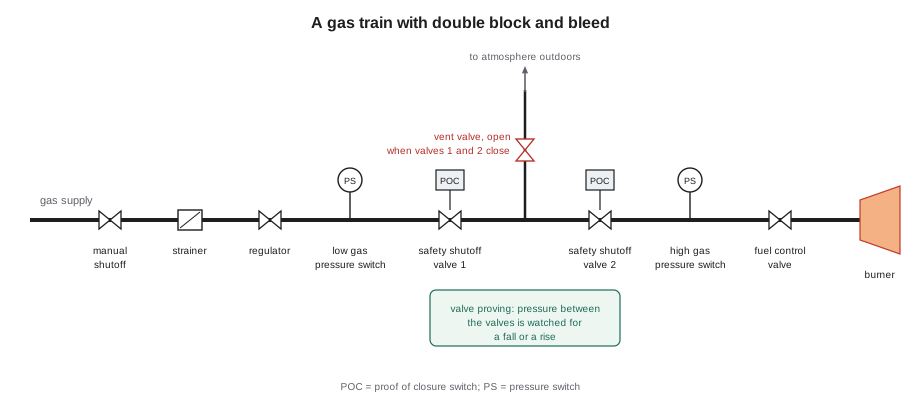
Valve proving systems test the safety shutoff valves for leakage automatically, before each start or after each shutdown. In a common method, the system closes both valves and the vent, pressurizes the space between the valves by briefly opening the upstream valve, and watches the pressure: if it falls, the downstream valve or the vent is leaking; then it vents the space and watches for a rise, which would mean the upstream valve is leaking. A leak beyond the set limit locks the burner out.
Worked problem
A valve proving test
The space between the safety shutoff valves on a gas train has a volume of 0.42 ft³. During a proving test, the pressure in it falls by 0.44 psi in 30 seconds. Estimate the leakage rate, as gas at atmospheric pressure.
Show solution
- The gas lost, as a volume at atmospheric pressure, is the space volume times the pressure drop divided by atmospheric pressure:
- \[V_{leak} = 0.42 \times \frac{0.44}{14.7} = 0.0126 \text{ ft}^3 \text{ in 30 s}\]
- Per hour:
- \[0.0126 \times 120 = 1.5 \text{ ft}^3\text{/h}\]
Answer: About 1.5 ft³/h. Whether that passes depends on the limit set for the valve size by the valve proving system's maker and the code; for a valve that should be bubble-tight it is a clear sign of wear, and the burner should not be returned to service until the valve is repaired.
Oil trains have the same principle with different devices: safety shutoff valves, oil pressure and temperature interlocks, an atomizing medium interlock that proves steam or air is available at the right differential before oil is admitted, and a scavenging sequence that blows the oil out of the burner gun with steam or air after the burner shuts down, so that oil cannot drip into a hot furnace.
The master fuel trip
A master fuel trip shuts off all fuel to the furnace at once, including the igniters, by de-energizing every safety shutoff valve. Typical MFT causes on a large boiler are:
- Loss of all flame, or flame loss across a set number of burners.
- Low drum water level, measured by independent transmitters, or loss of feedwater flow on a once-through unit.
- Loss of all forced draft fans or all induced draft fans, or loss of combustion airflow below the minimum.
- High or low furnace pressure, protecting against explosion and against implosion, the collapse of the furnace inward when the ID fans pull too hard after a trip.
- Fuel pressure outside its limits, or loss of atomizing medium for oil.
- High steam pressure, high superheater outlet temperature or loss of reheat steam flow, where the design requires them.
- Loss of the BMS's own power, or a fault in its logic solver.
- The manual trip push-button, hardwired so that it works even if the logic solver does not.
After an MFT, the fans continue to run where possible, and the furnace is post-purged before any restart, so that any fuel left in the furnace is swept out with the fire out. On a balanced-draft boiler, the fans are held near their positions at the moment of the trip for a short time, rather than run to full air, to avoid a sudden pressure transient. The BMS records the first-out cause, the first trip condition to occur, because one failure often causes several others within a second, and the first one is the one to investigate.
Building and testing the logic
Modern BMS logic runs in a safety-rated programmable controller, often with redundant processors and inputs, designed so that its own failures are detected and lead to a safe state. The safety functions are usually de-energize to trip: the safety shutoff valves are held open by energized solenoids, and any loss of power, broken wire or failed output closes them. Large industrial plants analyze their safety instrumented functions under IEC 61511, published in North America as ANSI/ISA 61511, assigning each a required safety integrity level and testing it at intervals that support that level.
The logic is fixed at commissioning and protected by passwords, keys and management of change. Bypasses, temporary overrides of an interlock for testing or maintenance, are the most dangerous tool in a burner management system, because a bypass that is forgotten disables a safety function silently. Good practice keeps bypasses few, displays them prominently, logs them, limits them in time, and requires the shift supervisor's authorization in writing.
Interlocks and trips must be tested to be trusted. Plants keep a trip test schedule: low water cutoffs and drum level trips blown down and proved, flame scanners checked by blocking them, pressure switches checked against a calibrated source, safety shutoff valves stroked and their proof of closure switches verified, the manual trip push-button pressed. Insurers and inspectors ask to see the records. At Cantwell, the low water cutoffs are tested on the frequency the boilers' manuals and the jurisdiction require, and the full BMS functional test is part of the annual inspection.
The operator and the BMS
Most of an operator's contact with the BMS comes at lockouts, and the discipline PWR-120 taught still holds: read and record the first-out alarm, find and fix the cause, complete the purge, and allow only the number of reset attempts the plant's procedure permits, usually no more than one or two before the shift engineer or chief must be involved. An operator never jumpers a limit, never shortens a purge, never holds a flame relay in by hand, and never relights a hot furnace from a lingering flame.
Grazyna told Okonkwo about a night at the mill when the bark boiler's gas support burner kept tripping on flame failure at low load, and a young operator suggested bypassing the scanner "just until the bark catches." The shift supervisor refused, kept the burner off, and ran the boiler on bark alone at reduced load until the instrument shop arrived in the morning. The scanner's cooling air line had been crushed and its lens was coated in tar. "The trip was doing its job," she said. "It just could not tell us why."
Common mistakes
MistakeTreating the burner management system as part of the combustion controls.
InsteadThe BMS is a separate safety system; combustion controls modulate firing, but only the BMS opens the safety shutoff valves.
MistakeAssuming the purge has been done because the timer has run.
InsteadThe purge must be at proven airflow; if the airflow falls out of range during the purge, the timer resets.
MistakeRetrying ignition straight after a failed trial.
InsteadEach failed trial may leave fuel in the furnace; purge before any new attempt, within the plant's limit on resets.
MistakeThinking a scanner that sees flame from neighboring burners is giving a useful signal.
InsteadOn multiple-burner boilers each scanner must discriminate its own burner's flame, or it may hold fuel open on a dead burner.
MistakeLeaving a bypass in place after a test.
InsteadBypasses must be authorized, displayed, logged and removed; a forgotten bypass silently disables a trip.
Summary and key terms
- A BMS prevents unsafe light-off, supervises the flame, trips fuel on unsafe conditions and manages shutdown; it is kept separate from combustion control.
- ASME CSD-1 covers boilers up to 12,500,000 Btu/h input; NFPA 85 covers larger boilers, multiple-burner units and HRSGs.
- Light-off follows permissives and a purge at proven airflow; multiple-burner purges are at least five minutes and five volume changes at a quarter of full airflow.
- Burners light at low fire with short trials for ignition, because unburned gas reaches the flammable range in seconds.
- Gas trains use two safety shutoff valves with a vent between them, proof of closure switches and valve proving.
- A master fuel trip closes all fuel valves on unsafe conditions, records the first-out cause and is followed by a post-purge.
- Burner management system
- The safety system that controls the admission of fuel to a furnace and shuts it off when conditions are unsafe.
- Permissive
- A condition that must be satisfied before a step in the start-up sequence can proceed.
- Purge
- Sweeping the furnace and gas passes with a proven airflow to remove combustible gases before light-off or after shutdown.
- Trial for ignition
- The limited time allowed for a flame to be proved after fuel is admitted.
- Flame discrimination
- The ability of a flame scanner to detect its own burner's flame and not those of neighboring burners.
- Double block and bleed
- Two safety shutoff valves in series with a vent valve between them that opens when they close.
- Valve proving
- An automatic test of the safety shutoff valves for leakage by watching the pressure between them.
- Master fuel trip
- The action that shuts off all fuel to a furnace at once.
- First-out
- The first trip condition recorded when several occur together.
Practice problems
Work each problem on paper first, then reveal the answer to check.
A single-burner boiler's furnace and gas passes hold 2,100 ft³ and the purge fan moves 8,500 cfm. How long is a purge of four volume changes?
Show answer
4 × 2,100 ÷ 8,500 = 0.99 min, about 60 s.
A multiple-burner boiler has 99,000 ft³ of furnace and passes and a full-load airflow of 318,000 cfm. How long must it purge at a quarter of full airflow?
Show answer
Five changes take 5 × 99,000 ÷ 79,500 = 6.2 min, longer than five minutes.
A burner fires 17,600 ft³/h of gas. How much gas enters the furnace in a 10-second trial?
Show answer
17,600 × 10 ÷ 3,600 = 49 ft³.
Why is there a vent valve between the two safety shutoff valves?
Show answer
If the upstream valve leaks, the gas escapes to atmosphere instead of reaching the furnace past the downstream valve.
Lesson quiz · 5 questions
Score 60% or more to complete this lesson.
Create a free account to save your progress, take quizzes and earn a certificate.