
PWR-330 · Lesson 1 of 12 · 27 min
Large industrial and utility boilers
▶ Video coming soon A video version of this lesson is on the way.
Okonkwo Demarest had spent four years around Cantwell's three packaged D-type boilers, and he knew them well: the steam drum and the mud drum, the furnace wall tubes, the single burner in the front wall, the forced draft fan, the stack. His Third Class course assumed he knew them. Its boiler module opened with a different scale of equipment altogether: field-erected boilers several stories high that make more steam in an hour than Cantwell makes in a week, fired by pulverized coal, bark, black liquor or natural gas, with reheaters, air heaters, sootblowers and induced draft fans that Cantwell does not have.
"You will be examined on boilers you may never stand beside," Grazyna Wolanski told him at the first of their study sessions on the module. Before Cantwell she had spent eleven years at a paper mill with a bark-and-gas power boiler and a chemical recovery boiler, and she still kept a binder of its drawings. "The examiners want to know that you understand why a big boiler is built the way it is, and what can go wrong with it. Most of it is the same physics as boiler 1, pushed much harder."
This lesson surveys large boilers: how they are classified, how water circulates in them at high pressure and why circulation becomes difficult as pressure rises, the arrangement of their furnaces and heat transfer surfaces, the main firing methods, and the special cases of supercritical once-through units and chemical recovery boilers. Later lessons build on it: burner management in lesson 2, combustion control in lesson 3 and heat recovery boilers in lesson 11.
From packaged to field-erected
Cantwell's boilers are packaged units: built complete in a factory, shipped on a truck or rail car, set on a foundation and connected. Packaged watertube boilers reach up to roughly 220,000 lb/h of steam (typical), limited mostly by what can be moved on a road. Beyond that, boilers are field-erected: the drums, headers, tube panels and steel are shipped in pieces and assembled on site over months or years.
Large boilers are commonly grouped by duty:
- Industrial boilers supply process steam, and often power through a turbine, to mills, refineries, chemical plants and food processors. Typical sizes run from 45,000 to 1,100,000 lb/h at pressures of 600 to 1,800 psi (typical), and many burn a by-product fuel: bark, wood waste, refinery gas or black liquor.
- Utility boilers supply steam to large condensing turbines that generate electricity for the grid. A single unit may serve a 500 MW to 1,000 MW turbine generator, with steam flows over 3,300,000 lb/h at 2,400 to 3,600 psi and 1,000 to 1,110 °F (typical), almost always with a reheater.
- Heat recovery steam generators and waste heat boilers have no furnace of their own and take their heat from a gas turbine exhaust or a process. They are the subject of lesson 11.
Many coal-fired utility boilers in the United States have retired or been converted to natural gas, and gas turbines with heat recovery steam generators now supply much of the country's fossil-fueled generation. Large boilers remain at mills, refineries and biomass plants, at gas-fired and oil-fired units, and at the remaining coal plants, and the stationary engineer examinations still cover their design and operation, including coal firing.
Circulation at high pressure
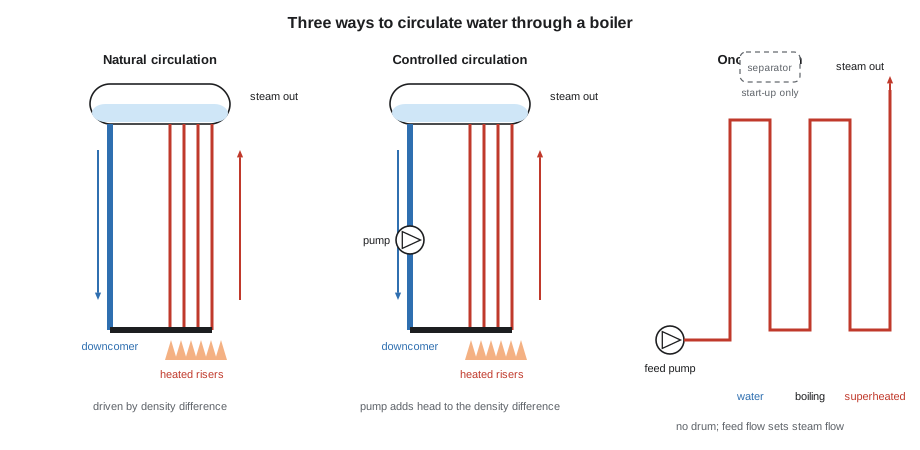
In a drum boiler, the water in the downcomers is unheated and dense; the mixture of water and steam in the heated risers, the furnace wall tubes, is light. The difference in density between the two columns drives natural circulation: water flows down the downcomers, up the risers, and back into the drum, where the steam separates and leaves. PWR-220 explained this for Cantwell's boilers.
The driving force depends on the difference between the density of water and the density of the steam and water mixture. At low pressure the difference is enormous, because steam is far lighter than water. As pressure rises, saturated water expands and saturated steam compresses, and the two densities approach each other until, at the critical point of 3,200 psia and 705 °F, they are equal and there is no longer any distinction between liquid and vapor.
Worked problem
The density ratio at two pressures
Using IAPWS-IF97 properties, compare the ratio of saturated vapor to saturated liquid specific volume at Cantwell's drum pressure of 164.7 psia and at a utility drum pressure of 2,538 psia.
Show solution
- At 164.7 psia (365.9 °F):
- \[\frac{v_g}{v_f} = \frac{2.756}{0.01818} = 152\]
- At 2,538 psia (670.4 °F):
- \[\frac{v_g}{v_f} = \frac{0.1270}{0.02887} = 4.4\]
Answer: At Cantwell's pressure, a pound of steam occupies 152 times the volume of a pound of water, and a small fraction of steam in a riser makes it far lighter than the downcomer. At 2,538 psia the ratio is only 4.4, so the same steam fraction produces a much smaller density difference and much weaker circulation. Utility drum boilers make up for it with tall furnaces, large downcomers and carefully sized risers, or with pumps.
The circulation ratio is the mass of water circulated through the risers divided by the mass of steam generated. A ratio of 4 means each kilogram of water passes round the circuit four times, on average, before it leaves as steam, and the mixture leaving the risers is about 0.25 steam by mass. Low-pressure industrial boilers run circulation ratios of 10 to 30 or more; large high-pressure drum boilers run about 3 to 8 (typical). The ratio matters because a riser must always carry enough water to keep its wall wetted. If the steam fraction rises too far, the water film on the tube wall breaks down, the tube is blanketed in steam, heat transfer collapses and the metal overheats: a departure from nucleate boiling, which PWR-220 lesson 12 met as one cause of overheating failures.
Three circulation systems are used:
- Natural circulation, driven by density difference alone, used in most drum boilers up to about 2,800 psi drum pressure (typical).
- Controlled or assisted circulation, in which large boiler circulating pumps in the downcomers add head to the natural driving force. The tubes can be smaller and arranged more freely, and circulation is positive from the first moment of firing, which helps start-up. The pumps are a point of failure: on loss of circulating pumps the boiler must be tripped or run back to a safe load.
- Once-through circulation, with no drum and no recirculation: the feed pump pushes water into the tubes, where it is heated, evaporated and superheated in a single pass. Once-through boilers can operate at any pressure, and they are the only kind that can operate above the critical pressure.
Supercritical once-through boilers
Above 3,200 psia, water heated at constant pressure changes smoothly from a dense liquid-like fluid to a light gas-like one, with no boiling, no bubbles and no fixed boiling temperature. A supercritical boiler takes advantage of this: it heats feedwater at about 3,500 to 3,900 psi to 1,050 to 1,110 °F, and ultra-supercritical units go higher still (typical). Higher pressure and temperature raise the Rankine cycle efficiency, as PWR-310 lesson 5 showed, and modern supercritical coal units reach net efficiencies of about 0.42 to 0.45 on the higher heating value, against about 0.35 to 0.38 for older subcritical units (typical).
Without a drum, a once-through boiler has no reservoir of water and no fixed point where evaporation ends. Its control is different: the feedwater flow sets the steam flow, and the firing rate sets the steam temperature, with the two held in a fixed ratio by the controls. Spray attemperation trims the final temperature. Because the tubes must never be starved of flow, a minimum flow, often about a quarter to a third of full-load flow (typical), is maintained through the furnace walls from the moment of firing. During start-up and at low load, when the fluid leaving the furnace walls is still a mixture of water and steam, a start-up separator and drain system separate the water and return it, so that the boiler runs much like a drum boiler until load rises.
Water chemistry in a once-through boiler is unforgiving. With no drum, there is no blowdown: every impurity that enters with the feedwater either deposits in the tubes or goes with the steam to the turbine. Once-through units therefore run with condensate polishers and very pure feedwater, as lesson 7 describes.
Worked problem
Heat duty of a supercritical unit
A supercritical boiler delivers 3,570,000 lb/h of steam at 3,625 psia and 1,112 °F from feedwater at 554 °F and 4,060 psia. Using IAPWS-IF97 enthalpies of 1,502.0 Btu/lb for the steam and 549.9 Btu/lb for the feedwater, find the heat absorbed, and the fuel input if the boiler efficiency is 0.90. Ignore the reheater.
Show solution
- Heat absorbed per pound:
- \[h_1 - h_{fw} = 1{,}502.0 - 549.9 = 952.1 \text{ Btu/lb}\]
- Heat absorbed:
- \[Q = 3{,}570{,}000 \times 952.1 = 3{,}399 \times 10^6 \text{ Btu/h}\]
- Fuel input:
- \[\frac{3{,}399}{0.90} = 3{,}777 \times 10^6 \text{ Btu/h}\]
Answer: About 3,777 MMBtu/h of fuel, before the reheater's duty is added. The steam flow is some 130 times Cantwell's boiler 1 at full load. Note how little heat each pound absorbs compared with Cantwell, where feedwater at 221 °F becomes saturated steam: the feedwater here has already been heated to 554 °F by the turbine's extraction heaters.
The furnace and the gas path
A large boiler's furnace is a tall box whose walls are made of membrane water walls: tubes joined by welded steel bars into gas-tight panels, so that the whole furnace enclosure is cooled by boiling water. The furnace is where most of the heat is transferred, by radiation from the flame, and it must be large enough to burn the fuel completely and to cool the gas before it reaches the closely spaced tubes of the convection pass. A furnace too small for its fuel produces slagging, molten ash freezing on the walls, and high gas temperatures at the furnace exit that overheat the superheater.
After the furnace, the hot gas passes through a series of heat exchangers, each placed where the gas temperature suits it. In a typical utility drum boiler, in the direction of gas flow:
- Platen superheaters, wide flat panels hanging in the upper furnace, absorbing radiant heat.
- The finishing superheater and reheater, in the hottest part of the convection pass. The reheater reheats steam that has expanded through the high-pressure turbine, before it returns to the intermediate-pressure turbine.
- The primary superheater, in cooler gas, taking saturated steam from the drum.
- The economizer, heating feedwater before it enters the drum, often to within a few tens of degrees of saturation.
- The air heater, using the last of the gas heat to warm the combustion air. Large units use a regenerative rotary air heater, a slowly turning wheel of corrugated steel plates that is heated by the gas on one side and gives the heat to the air on the other; smaller units use tubular or plate air heaters.
- The particulate collector (an electrostatic precipitator or a fabric filter baghouse), any flue gas desulfurization and NOx removal equipment (lesson 5), the induced draft fan and the stack.
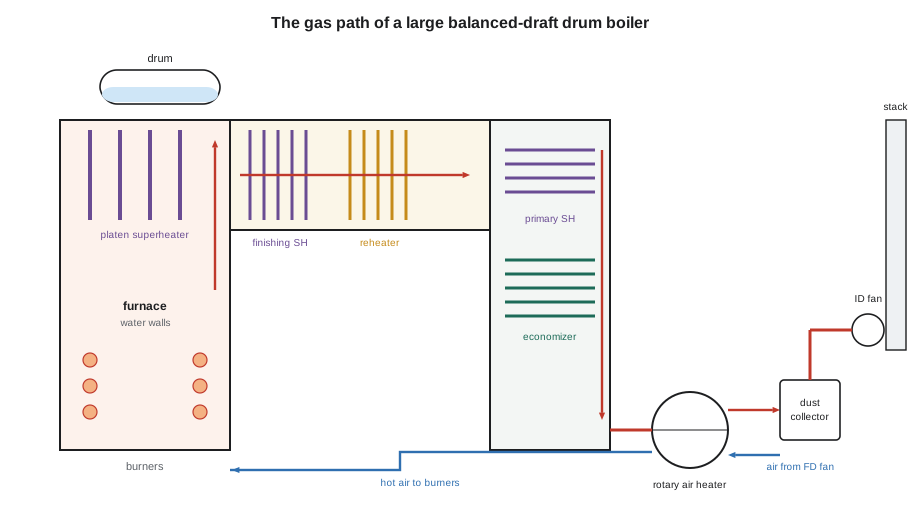
Large boilers run with balanced draft: forced draft fans push air into the furnace and induced draft fans pull gas out, and the furnace pressure is held slightly below atmospheric, typically at about 0.5 to 1 in of water of vacuum (typical), so that leaks draw air in rather than pushing hot gas and ash out into the boiler house. Cantwell's packaged boilers are forced draft only, with the furnace under slight positive pressure and gas-tight casings.
Steam temperature control is another difference. A large boiler must hold its superheat and reheat temperatures within a few degrees over a wide load range, because the turbine is designed for them. The heat absorbed by a convection superheater rises with load, and that of a radiant superheater falls, so designers combine the two. Fine control comes from spray attemperators (desuperheaters), which inject feedwater into the steam between superheater stages, and on some units from gas recirculation, tilting burners that move the flame up or down the furnace, or gas bypass dampers that divide the gas between the superheater and reheater passes.
Firing methods
The fuel and the way it is burned shape the whole boiler:
- Gas and oil burn in register burners on the front wall, or on opposed front and rear walls, much like Cantwell's single burner multiplied by twenty or thirty. Gas-fired furnaces can be compact, because gas has no ash.
- Pulverized coal is ground in mills to a powder finer than flour, dried by hot primary air and blown into the burners, where it burns in suspension. Burners are placed in the walls or, in tangential firing, at the corners of the furnace, aimed to form a rotating fireball in the middle. Coal ash makes slag and fly ash, and the furnace must be much larger than for gas.
- Stoker firing burns lump fuel, such as bark, wood waste or coal, on a moving or vibrating grate, with overfire air above it. Many mill power boilers burn bark on a stoker, with gas or oil burners for support and start-up.
- Fluidized bed firing burns fuel in a bed of hot sand and ash kept in suspension by air blown up from below. A bubbling fluidized bed keeps the bed in the lower furnace; a circulating fluidized bed blows the solids up through the furnace, separates them in cyclones and returns them. The bed temperature, about 1,500 to 1,650 °F (typical), is low enough to limit NOx, and limestone in the bed captures sulfur. Fluidized beds burn wet, low-grade and variable fuels well.
- Cyclone furnaces, now rare, burn crushed coal in a water-cooled horizontal cylinder at such high temperature that the ash melts and drains away as slag.
Grazyna's mill boiler burned bark on a traveling grate, with natural gas burners above the grate for support. "Bark is never the same two days running," she said. "Wet in spring, frozen in winter, full of sand after a rainy harvest. Half of running that boiler was knowing what the fuel was doing before the steam pressure told you."
Sootblowing and ash
Ash and soot collect on the convection surfaces of any boiler that burns a fuel with ash, and they insulate the tubes: the gas leaves hotter, the efficiency falls, and in extreme cases the gas passages plug. Sootblowers clean the tubes on a schedule while the boiler runs. Retractable sootblowers push a long lance into the gas pass and spray steam or air from nozzles at its tip as it rotates; rotary wall blowers clean the furnace walls; water cannons and acoustic horns are used where slag is heavy. Sootblowing uses a noticeable amount of steam, and a sootblower that sticks in the gas pass with no steam flowing through it will be destroyed by the heat, so blowers are watched as they run. On a coal-fired unit the operators distinguish slagging, molten or sticky ash on radiant surfaces, from fouling, bonded deposits in the convection pass, because they call for different remedies.
Cantwell's gas-fired boilers need no sootblowers. Natural gas has essentially no ash, and the convection surfaces stay clean unless combustion goes badly wrong: a burner running short of air makes soot, and that is one reason a rising stack temperature on a gas-fired boiler, like the one on boiler 2 in November, calls for a fire-side inspection.
Chemical recovery boilers
A kraft pulp mill's recovery boiler is a boiler and a chemical reactor at once. It burns black liquor, the spent cooking liquor that carries the dissolved wood lignin and the pulping chemicals, concentrated to about 0.65 to 0.85 solids (typical). The organic material burns to produce steam; the sodium and sulfur compounds collect as a molten smelt in the bottom of the furnace and run out through water-cooled smelt spouts to be recovered and reused. Recovery boilers are among the largest boilers in industry.
They carry a hazard of their own. If water reaches the molten smelt, from a leaking furnace tube for example, the reaction can produce a violent smelt-water explosion. Recovery boilers therefore have special procedures for a suspected tube leak: the fuel is stopped, and the boiler is drained rapidly through an emergency drain system to below the level of the furnace floor so that no more water can reach the smelt. In North America these procedures follow the recommended practices of the Black Liquor Recovery Boiler Advisory Committee (BLRBAC). Recovery boiler operators train for that emergency drain as other operators train for a fire.
Grazyna had been on shift when the mill's recovery boiler had a suspected tube leak, years before. The leak detection system had alarmed, the board operator had stopped the liquor and started the emergency drain within minutes, and the leak, a cracked tube at a spout opening, turned out to be small. "Nobody argued, and nobody waited for a second opinion," she said. "On that boiler, you drain first and investigate later. That is a decision you have to make before you are on shift, not while the alarm is sounding."
What a large plant asks of its operators
Running a large boiler is mostly a matter of watching trends and keeping many systems in balance at once: the fuel preparation, the fans, the drum level, the superheat and reheat temperatures, the sootblowers, the water chemistry and the emissions equipment, all with their own interlocks. Large plants are run from a control room through a distributed control system, with field operators doing rounds. The skills are the same as at Cantwell, but the consequences of a mistake are larger and arrive faster: a utility drum holds well under a minute's worth of steam flow between normal water level and the low level trip, compared with the 5.6 minutes PWR-220 calculated for Cantwell's boilers.
Okonkwo spent part of the following week's night shifts drawing the gas path of Grazyna's old mill boiler from memory, labeling each surface with the gas temperature he expected at its inlet and outlet. Grazyna corrected two of his numbers and added a third column to the drawing: what each surface would do if the gas temperature at its inlet rose. "That column is the one you will need on shift," she said.
Common mistakes
MistakeThinking natural circulation works equally well at every pressure.
InsteadThe density difference between water and steam shrinks as pressure rises and vanishes at the critical point; high-pressure drum boilers need careful design or circulating pumps.
MistakeCalling a supercritical boiler a drum boiler with a higher pressure.
InsteadAbove 3,200 psia there is no boiling and no drum; the boiler is once-through, with firing rate and feedwater flow controlled together.
MistakeAssuming the furnace in a large boiler runs under positive pressure, as in a packaged boiler.
InsteadBalanced-draft boilers hold a slight vacuum so that leaks draw air in.
MistakeConfusing slagging with fouling.
InsteadSlagging is molten or sticky ash on radiant surfaces in the furnace; fouling is bonded deposits in the convection pass.
MistakeTreating a suspected recovery boiler tube leak like any other tube leak.
InsteadWater reaching molten smelt can explode; stop the liquor and carry out the emergency drain at once.
Summary and key terms
- Packaged boilers are factory-built; larger boilers are field-erected, as industrial or utility units.
- Natural circulation weakens as pressure rises because water and steam densities approach each other; the circulation ratio must keep risers wetted.
- Controlled circulation adds pumps; once-through boilers have no drum and are the only kind that can run supercritical.
- The gas path passes radiant walls, superheaters, reheater, economizer and air heater before the collectors, ID fan and stack, with balanced draft.
- Firing methods include gas and oil burners, pulverized coal, stokers, fluidized beds and cyclones; ash-forming fuels need sootblowers.
- Recovery boilers burn black liquor and recover smelt; a suspected tube leak calls for an immediate emergency drain.
- Field-erected boiler
- A boiler shipped in pieces and assembled on site.
- Circulation ratio
- The mass of water circulated through the risers divided by the mass of steam generated.
- Controlled circulation
- Drum boiler circulation assisted by pumps in the downcomers.
- Once-through boiler
- A boiler without a drum, in which feedwater is heated, evaporated and superheated in a single pass.
- Supercritical
- Operating above the critical pressure of water, about 3,200 psia, where there is no distinct boiling.
- Reheater
- A boiler surface that reheats steam returned from the high-pressure turbine.
- Balanced draft
- Draft from forced and induced draft fans together, with the furnace held slightly below atmospheric pressure.
- Smelt
- The molten pulping chemicals that collect in the bottom of a recovery boiler furnace.
Practice problems
Work each problem on paper first, then reveal the answer to check.
A drum boiler generates 475,000 lb/h of steam with a circulation ratio of 5. What mass flows through its risers?
Show answer
475,000 × 5 = 2,375,000 lb/h.
What is the average steam fraction by mass leaving the risers in that boiler?
Show answer
1 ÷ 5 = 0.20.
A boiler raises 800,000 lb/h of steam, absorbing 1,075 Btu/lb, at an efficiency of 0.88. What is the fuel input?
Show answer
800,000 × 1,075 ÷ 0.88 = 977 × 10⁶ Btu/h.
Above what pressure can a boiler not have a steam drum?
Show answer
The critical pressure, about 3,200 psia.
Lesson quiz · 5 questions
Score 60% or more to complete this lesson.
Create a free account to save your progress, take quizzes and earn a certificate.