
PWR-330 · Lesson 11 of 12 · 23 min
Waste heat and heat recovery boilers
▶ Video coming soon A video version of this lesson is on the way.
Cantwell's 2027 capital list included a feasibility study for combined heat and power: a gas engine generator, or more than one, whose electricity would run the plant and be sold, and whose waste heat would feed the district loops. Grazyna wanted Okonkwo to understand the heat recovery side of it before the consultants arrived, and she had a reason to start him at Keswold. "Keswold's HRSG and an engine exhaust boiler are cousins," she said. "Neither one has a fire you can turn down when the steam isn't wanted. The heat arrives whether you need it or not, and the boiler has to take it."
PWR-320 lesson 9 described Keswold's HRSG from the turbine's side: its pinch and approach temperatures, its steam flow, its duct burners and its place in the plant's heat balance. This lesson looks at heat recovery boilers as boilers: the kinds of waste heat they use, how they are built, why their temperature profiles constrain them, how supplementary firing works, the special operating and safety problems they bring, and the arithmetic of recovering heat from an engine's exhaust.
Sources of waste heat
A waste heat boiler makes steam or hot water from hot gas produced by something other than its own burner. The sources are many:
- Gas turbines, whose exhaust at about 840 to 1,110 °F (typical) still carries most of the fuel's energy; the boiler is then called a heat recovery steam generator (HRSG).
- Reciprocating engines, whose exhaust at about 660 to 930 °F (typical) is smaller in flow but hotter than many process gases, and whose jacket water and lube oil coolers provide hot water as well.
- Process furnaces and kilns: cement and lime kilns, glass furnaces, steel reheating furnaces, refinery heaters.
- Chemical processes: sulfuric acid plants, where the oxidation of sulfur releases large amounts of heat; ammonia and hydrogen plants; refinery catalytic crackers, whose regenerator flue gas, rich in carbon monoxide, is burned in a CO boiler.
- Incinerators for municipal or industrial waste.
Each source shapes the boiler. Gas turbine exhaust is clean, plentiful and oxygen-rich. Engine exhaust is clean if the engine runs on natural gas, but pulsating and sooty if it is badly tuned. Process gases may be dusty, sticky, corrosive or at very high temperature, and the boiler must be designed around the process rather than the other way round.
How heat recovery boilers are built
Small waste heat boilers, particularly for engines and small process streams, are often firetube designs: the hot gas passes through tubes in a water-filled shell, with a steam space above. They are simple and compact, and tolerate the pulsating exhaust of an engine. Larger units are watertube designs.
HRSGs for gas turbines are usually large rectangular ducts filled with banks of finned tubes, because the gas is at low pressure and moderate temperature, and its heat transfer coefficient is low; the fins multiply the gas-side surface. Horizontal HRSGs pass the gas horizontally across vertical tube banks, with natural circulation; vertical HRSGs pass it upward across horizontal tubes, often with forced circulation pumps, and take less floor space. Once-through HRSGs, with no drums, are used where cycling is frequent and where high pressures are needed, because they avoid the thick drums that limit warming rates.
In the direction of gas flow, a single-pressure HRSG has a superheater, an evaporator and an economizer, as PWR-320 explained; larger plants have two or three pressure levels interleaved to cool the gas further, a reheater for the steam turbine, and a condensate preheater or feedwater heating coil at the cold end. Many HRSGs also carry an SCR catalyst and sometimes a CO catalyst in the tube banks where the gas is at the right temperature for each (lesson 5).
The temperature profile
A fired boiler's furnace gas is so hot that its temperature profile never constrains the steam side. A heat recovery boiler is different: the gas arrives at a moderate temperature, and its temperature falls steadily as it gives up heat, while the water in the evaporator stays at saturation. Plotting both against the heat transferred gives the temperature-heat diagram: a sloping gas line above a water line that rises through the economizer, runs flat through the evaporator and rises again through the superheater.
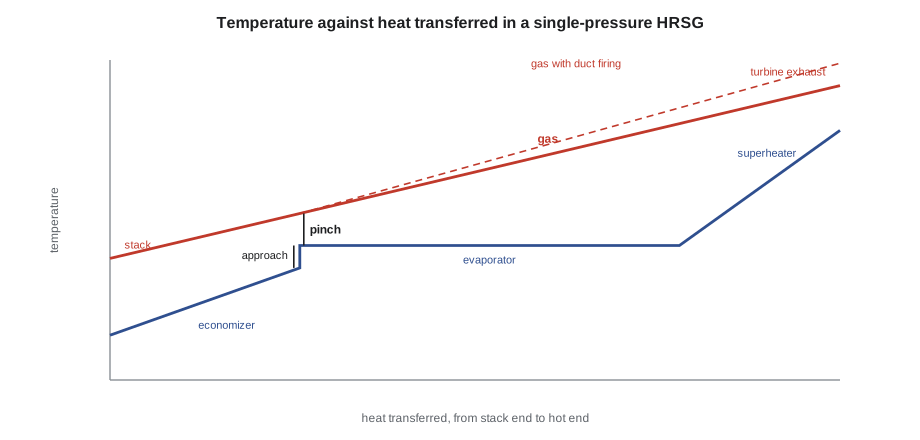
Two temperature differences govern the design. The pinch point is the smallest difference between the gas and the evaporator water, at the gas outlet of the evaporator. The approach is the difference between the saturation temperature and the water leaving the economizer, kept to a few degrees so that the economizer does not boil. Once the pinch is chosen, the gas temperature at the evaporator outlet is fixed at the saturation temperature plus the pinch, and the steam flow follows from the heat the gas can give up above that point. This is why an unfired HRSG cannot make more steam on demand: its steam is set by the gas, not by a fuel valve.
It also shows why a single-pressure HRSG at high pressure has a high stack temperature. The gas leaving the evaporator is already above the high saturation temperature; the economizer can cool it only as far as the feedwater it heats will allow. Adding a lower-pressure evaporator, or a condensate or district water heater at the cold end, uses the heat that is left.
Supplementary firing
Gas turbine exhaust contains a great deal of unused oxygen, typically about 13 to 15 in 100 by volume (typical), because the turbine burns its fuel with large amounts of excess air to keep the turbine inlet temperature within its limits. Duct burners in the HRSG inlet duct can burn more fuel in that exhaust with no fresh air at all, raising the gas temperature and therefore the steam flow. HRSGs are described as:
- Unfired: no duct burners; steam output follows the gas turbine.
- Supplementary fired: duct burners raise the gas temperature moderately, often to about 1,400 to 1,650 °F (typical), within the limits of an uncooled duct and ordinary tube materials. Keswold's HRSG is of this kind, raising its steam from about 148,300 to 175,000 lb/h at full winter load.
- Fully fired: with enough burner capacity, sometimes with extra air, to use nearly all the exhaust oxygen, so that the HRSG becomes essentially a fired boiler that uses the turbine exhaust as preheated combustion air.
Duct burners are highly efficient as a way of making steam, because their heat goes straight into gas that is already hot and already passing through the boiler, with no additional stack loss from extra air. As PWR-320 showed, nearly all their fuel energy reaches the steam. Their burner management follows the same principles as any burner's, with its own codes: in the United States, NFPA 85 includes a chapter for HRSGs and their duct burners, which also governs the purge of the HRSG before the gas turbine is lit, because a turbine that fails to light can fill the duct with fuel.
Operating a heat recovery boiler
Running a waste heat boiler differs from running a fired one in several ways:
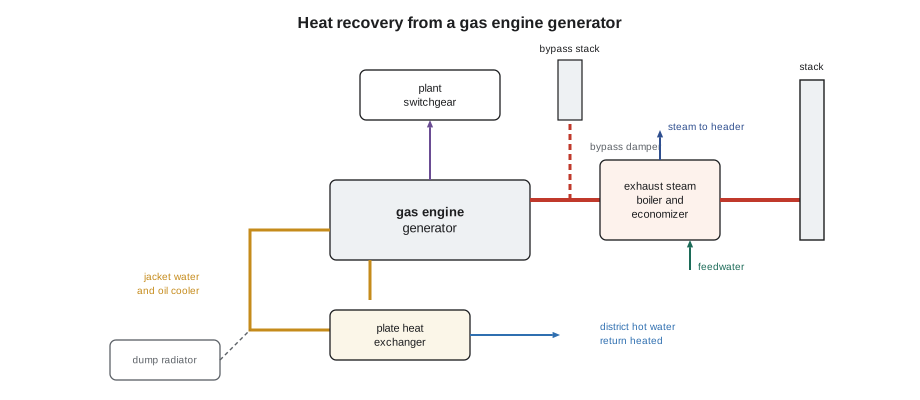
- The heat cannot be turned off quickly. If the feedwater fails on a fired boiler, the fuel is tripped and the heat input stops. On a waste heat boiler, the heat keeps coming until the gas turbine, engine or process is stopped or the gas is diverted. Many HRSGs and engine boilers therefore have a bypass stack or diverter damper to send the gas around the boiler, and their low water protection trips the gas source or the diverter. Some small engine exhaust boilers and some HRSGs are designed to run dry, with tubes and fins able to withstand the full gas temperature with no water, but most are not, and the operator must know which kind is installed.
- Steam output follows the heat source. Pressure is controlled by using, condensing or venting the steam, not by turning down a fire. A process waste heat boiler may need a dump condenser or a vent silencer to keep its pressure when the steam is not wanted.
- Back pressure matters. Every pascal of pressure drop the boiler adds to the gas path is back pressure on the gas turbine or engine, which reduces its output and efficiency. Fouled tube banks, a stuck damper or a collapsed baffle show up as lost electrical output as well as poorer heat recovery.
- The economizer can steam at part load. As the gas turbine or engine turns down, the pattern of heat absorption shifts, and the water leaving the economizer can approach or reach saturation. Steaming economizers cause water hammer and flow instability; many HRSGs recirculate economizer water or bypass part of the economizer at low load.
- The cold end can corrode. If the gas is cooled below its acid dew point, or below the water dew point at the coldest tubes, acid condensation attacks the fins and tubes. Feedwater and condensate entering the cold end are kept above the dew point, by recirculation or preheating, as for any economizer.
On the water side, HRSGs are prone to flow-accelerated corrosion in their low-pressure evaporators and economizers, where water at about 270 to 360 °F flows fast through many small bends (typical), the temperature range in which FAC of carbon steel is most rapid. Lesson 7's AVT(O) chemistry and careful inspection of bends with ultrasonic thickness testing are the defenses. HRSGs that cycle daily suffer thermal fatigue in their drums, headers and attemperators, as lesson 9 described, and their attemperators can throw unevaporated spray water against hot superheater tubes and pipe walls if they are poorly controlled at low load.
Recovering heat from an engine
A natural gas engine generator converts roughly 0.40 to 0.45 of its fuel's energy, on the lower heating value, into electricity (typical). Roughly a quarter of its fuel energy leaves in the exhaust, and roughly another quarter in the jacket water, lube oil cooler and charge air cooler, at temperatures up to about 190 to 250 °F (typical). A combined heat and power installation recovers both: the low-temperature heat into hot water, and the exhaust into a steam or hot water boiler.
Worked problem
An engine exhaust boiler at Cantwell
For the feasibility study, Grazyna took an engine maker's typical data for an engine of about 2,000 kW electrical output: exhaust 23,800 lb/h at 788 °F, with c_p = 0.258 Btu/lb·°F. An exhaust boiler would make saturated steam at Cantwell's 164.7 psia (366 °F, h_g = 1,196.0 Btu/lb) from deaerated feedwater at 221 °F (h = 189 Btu/lb). With a pinch of 27 °F and no economizer, how much steam would it make? How much with an economizer that heats the feedwater to 348 °F (h = 319.8 Btu/lb) before the drum, and what would the stack temperature then be?
Show solution
- Without an economizer, the gas leaves at 366 + 27 = 393 °F, and its heat raises steam from feedwater:
- \[Q = 23{,}800 \times 0.258 \times (788 - 393) = 2.43 \times 10^6 \text{ Btu/h}, \qquad \dot m = \frac{2{,}425{,}000}{1{,}196.0 - 189} = 2{,}410 \text{ lb/h}\]
- With the economizer, the gas above the pinch only has to raise steam from water already at 319.8 Btu/lb:
- \[\dot m = \frac{2{,}425{,}000}{1{,}196.0 - 319.8} = 2{,}770 \text{ lb/h}\]
- The economizer duty and the stack temperature:
- \[Q_e = 2{,}770 \times (319.8 - 189) = 362{,}000 \text{ Btu/h}, \qquad T_{stack} = 393 - \frac{362{,}000}{23{,}800 \times 0.258} = 334 \text{ °F}\]
Answer: About 2,770 lb/h of steam with the economizer, a tenth of one of Cantwell's boilers at full load, recovering about 2.79 million Btu/h. The economizer adds about 15 in 100 to the steam for a small extra cost. Cooling the exhaust further, to about 250 °F, would need a separate heat exchanger on the district hot water loop, which can take heat at much lower temperatures than the steam system.
Worked problem
The engine's overall balance
Taking the engine's electrical efficiency as 0.42 on the LHV, its exhaust boiler recovering 2.79 million Btu/h, and its jacket water and oil coolers giving about 3.41 million Btu/h (1,000 kW) to the district hot water loop, find the fuel input and the overall efficiency of the installation.
Show solution
- \[\text{fuel} = \frac{2{,}000 \times 3{,}412}{0.42} = 16.25 \times 10^6 \text{ Btu/h}\]
- \[\eta_{total} = \frac{6.82 + 2.79 + 3.41}{16.25} = 0.80\]
Answer: About 0.80 on the lower heating value, against about 0.42 for the electricity alone. The figure is only as good as the plant's ability to use the heat all year: in summer, Cantwell's heat load falls, and an engine running for its electricity would have to reject heat it could not use, lowering the real annual efficiency. That seasonal question, not the boiler's arithmetic, was the one Grazyna expected the study to turn on.
Codes and inspection
A heat recovery boiler that makes steam is a power boiler in law, whatever its heat source. In Ohio it is built to ASME Section I, registered with the state and inspected like any other power boiler, and its pressure relief, water level protection and inspection follow the same rules. Its duct burners, where fitted, follow NFPA 85. A district energy plant adding an engine with an exhaust boiler would also need an Ohio EPA permit for the engine's emissions and the utility's approval to connect the generator to the grid.
Okonkwo summed up the lesson in his notebook beside the engine sketch: the heat arrives whether you want it or not; the gas, not the fuel valve, sets the steam; keep the cold end above the dew point; and know whether your boiler can run dry.
Common mistakes
MistakeExpecting an unfired HRSG to raise more steam when the header pressure falls.
InsteadIts steam is set by the gas flow and temperature; only duct firing or a change in the gas turbine can raise it.
MistakeTreating loss of feedwater on a waste heat boiler as solved by a fuel trip.
InsteadThe heat keeps coming; trip or divert the heat source, unless the boiler is designed to run dry.
MistakeIgnoring a rise in HRSG gas-side pressure drop.
InsteadIt is back pressure on the turbine or engine, costing output as well as heat recovery.
MistakeLetting the economizer approach shrink to zero at part load.
InsteadA steaming economizer causes water hammer and unstable flow; recirculate or bypass as designed.
MistakeAssuming FAC is only a problem in large utility plants.
InsteadHRSG low-pressure evaporators and economizers are prime FAC locations; inspect their bends.
Summary and key terms
- Waste heat boilers recover heat from gas turbines, engines, kilns, furnaces, chemical processes and incinerators; HRSGs serve gas turbines.
- Small units are often firetube; HRSGs use finned watertube banks, horizontal or vertical, drum or once-through.
- The pinch and approach fix the gas temperature at the evaporator outlet; the gas, not a fuel valve, sets the steam flow.
- Duct burners use the exhaust's oxygen to raise steam output efficiently; HRSGs may be unfired, supplementary fired or fully fired.
- Heat recovery boilers need bypass or diverter protection, back pressure watching, economizer steaming prevention, cold-end protection and FAC inspection.
- An engine with an exhaust boiler and jacket water recovery can reach about 0.80 overall efficiency on LHV, if the heat can be used all year.
- Waste heat boiler
- A boiler that makes steam or hot water from hot gas produced by a process or machine rather than its own burner.
- Heat recovery steam generator
- A waste heat boiler that recovers heat from a gas turbine exhaust.
- Pinch point
- The smallest temperature difference between gas and evaporator water in a heat recovery boiler.
- Approach
- The difference between saturation temperature and the temperature of water leaving the economizer.
- Duct burner
- A burner that fires additional fuel into gas turbine exhaust upstream of an HRSG.
- Diverter damper
- A damper that sends the hot gas around a heat recovery boiler to a bypass stack.
- Back pressure
- The pressure a boiler's gas-side resistance imposes on the exhaust of a turbine or engine.
- Run dry
- Able to withstand the full gas temperature with no water in the tubes.
Practice problems
Work each problem on paper first, then reveal the answer to check.
Exhaust of 39,700 lb/h at 842 °F with c_p 0.258 Btu/lb·°F is cooled to 392 °F. How much heat is recovered?
Show answer
39,700 × 0.258 × 450 = 4.61 × 10⁶ Btu/h.
That heat raises steam with an enthalpy rise of 1,006 Btu/lb. How much steam is made?
Show answer
4,610,000 ÷ 1,006 = 4,580 lb/h.
A drum at 366 °F saturation has a pinch of 22 °F. What is the gas temperature leaving the evaporator?
Show answer
388 °F.
An engine makes 1,500 kW of electricity at 0.40 efficiency and recovers 1,350 kW of heat. What is its overall efficiency?
Show answer
Fuel 3,750 kW; (1,500 + 1,350) ÷ 3,750 = 0.76.
Lesson quiz · 5 questions
Score 60% or more to complete this lesson.
Create a free account to save your progress, take quizzes and earn a certificate.