
PWR-330 · Lesson 7 of 12 · 27 min
Advanced water treatment
▶ Video coming soon A video version of this lesson is on the way.
On one of his outage visits to Keswold, Okonkwo had asked Ingeborg Haverlund, the plant's reliability engineer, about the thin tan deposit found on the turbine's first stages. She took him not to the turbine hall but to a low building at the edge of the site, the water treatment plant. "If you want to know where a deposit came from," she said, "start where the water comes in."
Cantwell's water treatment, which PWR-220 described, is right for its boilers: city water softened, treated inside the boiler with a polymer dispersant and catalyzed sulfite, condensate protected with a neutralizing amine, and blowdown controlled by conductivity at about 20 cycles. Keswold's HRSG drum runs at 900 psia, more than five times Cantwell's pressure, and its steam goes to a turbine whose blades will collect whatever the steam carries. The water there is treated to a different standard altogether.
This lesson covers water treatment for high-pressure boilers and HRSGs: why purity requirements tighten with pressure, the make-up treatment train of pretreatment, reverse osmosis and ion exchange demineralization, electrodeionization and condensate polishing, the feedwater chemistry programs called all-volatile and oxygenated treatment, the boiler water programs used in high-pressure drums, and the online analyzers that watch them.
Why purity matters more at high pressure
Three things change as boiler pressure rises. Heat fluxes in the furnace and evaporator tubes are higher, so a deposit of a given thickness raises the tube metal temperature more. Steam becomes a better solvent: silica and some salts dissolve in high-pressure steam and travel with it to the turbine, as lesson 8 explains. And the margin between normal operation and damage narrows, because high-pressure tubes are already running hotter and closer to their design limits.
As a result, the limits for feedwater and boiler water fall steeply with pressure. A low-pressure boiler like Cantwell's tolerates boiler water with a few thousand µS/cm of conductivity and tens of mg/L of silica. A drum boiler at 900 to 1,000 psi typically holds its boiler water silica to a few mg/L and its total dissolved solids to a few tens of mg/L, and its feedwater must be essentially free of hardness and very low in iron and copper. A once-through supercritical boiler, which has no blowdown, needs feedwater with a cation conductivity below about 0.15 µS/cm and silica, sodium and iron each in the low parts per billion (typical; the boiler maker's and the program's limits apply). These waters can only be made by demineralization.
Pretreatment
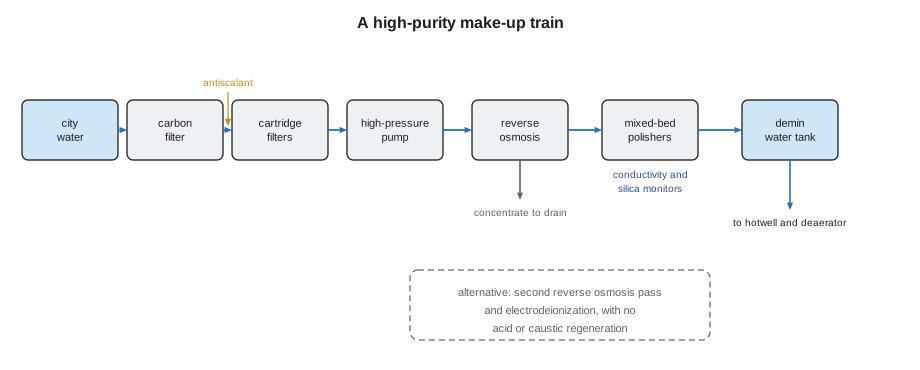
Every high-purity make-up system begins by protecting what follows. Keswold's starts with city water, the same supply of hard, moderately alkaline water that Cantwell uses, at about 300 mg/L of dissolved solids. It passes through:
- Activated carbon filters, which remove the chloramine the city adds for disinfection. Chlorine and chloramine attack the thin polyamide layer of reverse osmosis membranes and the resin of ion exchangers, and must be removed first. Some plants inject sodium bisulfite instead, which reduces chlorine chemically.
- Antiscalant injection, a chemical that keeps calcium carbonate, calcium sulfate and silica from precipitating on the membranes as they are concentrated.
- Cartridge filters, typically rated at about 5 micrometers (typical), which protect the high-pressure pumps and membranes from particles.
Surface water supplies need more pretreatment, often clarification with coagulants and multimedia or membrane filtration ahead of the carbon. The measure of whether the water is clean enough for reverse osmosis is the silt density index (SDI), a test of how fast a standard filter membrane plugs, which membrane makers typically want below about 3 to 5 (typical).
Reverse osmosis in depth
PWR-220 introduced reverse osmosis (RO): water forced at high pressure through a semi-permeable membrane, leaving most of its dissolved salts behind. Industrial RO uses spiral-wound elements, each a set of membrane leaves wound around a perforated permeate tube, about 8 in in diameter and 40 in long, mounted several in series in pressure vessels. The feed flows along the membrane surface and leaves as concentrate (also called reject or brine); the purified permeate passes through the membrane to the central tube.
Two numbers describe an RO unit's performance:
- Recovery, the fraction of the feed that becomes permeate. Industrial systems run at about 0.70 to 0.80 (typical); higher recovery concentrates the reject further and increases the risk of scaling.
- Salt rejection, the fraction of dissolved salts the membrane holds back, typically 0.98 to 0.995 for new membranes (typical). Its complement, the salt passage, is what reaches the permeate.
Worked problem
Keswold's RO mass balance
Keswold's RO is fed 44 gpm of dechlorinated city water at 300 mg/L dissolved solids. It runs at 0.75 recovery, and its permeate carries about 2 in 100 of the feed concentration. Find the permeate and concentrate flows and the concentrate's dissolved solids.
Show solution
- Flows:
- \[Q_p = 0.75 \times 44 = 33 \text{ gpm}, \qquad Q_c = 44 - 33 = 11 \text{ gpm}\]
- Permeate concentration:
- \[C_p = 0.02 \times 300 = 6 \text{ mg/L}\]
- Salt balance:
- \[C_c = \frac{44 \times 300 - 33 \times 6}{11} = 1{,}182 \text{ mg/L}\]
Answer: The concentrate leaves at about four times the feed concentration, a **concentration factor** of 1 ÷ (1 − 0.75) = 4 for a perfect membrane, slightly less in practice. Every sparingly soluble salt in the feed is concentrated by that factor at the last elements, which is why recovery is limited by the scaling tendency of the feed and why antiscalant is dosed. The 6 mg/L permeate is far purer than softened water but still far from boiler quality; it goes on to ion exchange polishing.
Membranes foul with particles, biological growth and organic matter, and scale with mineral deposits, gradually reducing permeate flow and raising salt passage and pressure drop. Because permeate flow also varies with water temperature, by roughly 1.7 in 100 per °F (typical), operators track normalized permeate flow and salt passage, corrected to standard conditions, rather than raw readings. A fall in normalized flow of about 10 to 15 in 100, or a similar rise in normalized pressure drop or salt passage, is the usual signal for a clean-in-place with acid and alkaline cleaning solutions (typical; the membrane maker's guidelines apply).
Ion exchange demineralization
A demineralizer removes dissolved ions by exchanging them for hydrogen and hydroxide, which combine to water. It uses two kinds of resin:
- A strong acid cation (SAC) resin in the hydrogen form exchanges calcium, magnesium, sodium and other cations for hydrogen ions. Its effluent is acidic, carrying the anions as their acids: carbonic, hydrochloric, sulfuric and silicic.
- A strong base anion (SBA) resin in the hydroxide form exchanges those anions, including weakly ionized silica and carbonate, for hydroxide ions, which neutralize the hydrogen.
Between the two, a degasifier often blows air through the acidic water to strip the carbon dioxide formed from bicarbonate, reducing the load on the anion resin. Weak acid and weak base resins, which regenerate more efficiently, are added ahead of the strong resins on waters high in alkalinity or in strong acids.
A two-bed demineralizer produces water of a few µS/cm at best, with a little sodium leaking from the cation bed and a little silica from the anion bed. The final polish is a mixed bed, in which cation and anion resins are intimately mixed in one vessel, so that the water meets an alternating series of exchanges. Mixed beds produce water below about 0.1 µS/cm with silica below about 10 µg/L (typical). For regeneration the two resins are separated by backwashing, because the anion resin is lighter, regenerated separately with acid and caustic, rinsed and remixed with air.
At Keswold, the RO permeate passes through two mixed-bed polishers, one in service and one regenerated and on standby, into a demineralized water storage tank. Their effluent conductivity and silica are monitored continuously, and a rise in either ends the run.
Worked problem
How long a mixed bed lasts
Each of Keswold's mixed beds holds 35 ft³ of resin with an operating capacity, set by its anion resin, of about 20 kilograins per ft³. The RO permeate carries about 6 mg/L of ions as calcium carbonate, or 0.35 grains per gallon. At 33 gpm, how long should a bed run between regenerations?
Show solution
- Capacity:
- \[35 \times 20{,}000 = 700{,}000 \text{ grains}\]
- Throughput:
- \[\frac{700{,}000}{0.35} = 2{,}000{,}000 \text{ gal}\]
- Run time:
- \[\frac{2{,}000{,}000}{33 \times 60} = 1{,}010 \text{ h}\]
Answer: About six weeks of continuous running. Without the RO ahead of it, the same bed would see city water at 50 times the load and last less than a day, which is why RO before ion exchange has become the standard arrangement. The theoretical run is a guide only: the bed is ended by its effluent quality, usually a rise in silica or conductivity, not by the clock.
Regeneration chemicals are hazardous. Hydrochloric or sulfuric acid and sodium hydroxide are delivered in bulk, stored in bunded tanks and diluted on line. Acid and caustic burns, and the heat released when concentrated sulfuric acid or caustic meets water, are the main hazards; face shields, chemical-resistant gloves and aprons, eyewash stations and showers are required, and spent regenerant must be neutralized before discharge to sewer under the plant's sewer use rules.
Electrodeionization and condensate polishing
Electrodeionization (EDI) replaces chemical regeneration with electricity. Water flows through compartments filled with mixed ion exchange resin between ion-selective membranes, and a DC voltage across the stack drives the captured ions out through the membranes into concentrate streams, regenerating the resin continuously. Fed with RO permeate, EDI produces water comparable to a mixed bed without acid or caustic. Many new plants use two-pass RO followed by EDI, with no chemical regeneration at all.
Condensate polishing treats the returning condensate, not the make-up. In plants with large condensers, a small cooling water leak, a few liters an hour of river or cooling tower water, can bring in more dissolved solids than the make-up. Deep-bed polishers, mixed beds sized for the full condensate flow, or precoat filters, which use a thin layer of powdered resin on filter elements, remove these and also catch iron oxide particles. Polishers are standard on once-through boilers and on many utility drum units; at Keswold, which has a stainless-tubed condenser and returns condensate from Marrowby Foods, a condensate filter and continuous cation conductivity monitoring take their place.
Feedwater chemistry
With pure water made, the problem becomes keeping the feedwater system from corroding and sending its own metal oxides to the boiler. Feedwater programs are chosen by the metals in the system:
- All-volatile treatment, reducing (AVT(R)): ammonia or a volatile amine to raise the pH, with an oxygen scavenger such as hydrazine or carbohydrazide to keep conditions reducing. It protects copper alloys in feedwater heaters and condensers, so it is used where the system contains copper. In all-ferrous systems, reducing conditions increase flow-accelerated corrosion (FAC) of carbon steel, the dissolution of the protective magnetite layer in fast-flowing water, which thins elbows, reducers and economizer inlet headers until they rupture.
- All-volatile treatment, oxidizing (AVT(O)): ammonia or amine for pH, with *no* oxygen scavenger, and the small residual oxygen left by the deaerator, a few µg/L, allowed to remain. In an all-ferrous system this forms a more stable oxide layer and greatly reduces FAC. Most modern HRSGs and fossil units without copper use AVT(O).
- Oxygenated treatment (OT): deliberate injection of oxygen, typically to about 30 to 150 µg/L (typical), into extremely pure feedwater with cation conductivity below about 0.15 µS/cm. It forms a protective hematite layer on carbon steel and is used on once-through units with condensate polishing.
Keswold, with no copper alloys in its feedwater or condensate systems, runs AVT(O) with ammonia, holding the feedwater pH at about 9.4 to 9.6 (typical). The choice of scavenger at plants that do use one has changed: hydrazine, once standard, is a suspected carcinogen and has been replaced at many plants by carbohydrazide, DEHA or other alternatives, while sulfite, used at Cantwell, is not suitable above about 1,000 psi (typical) because it breaks down at high temperature to sulfur dioxide and hydrogen sulfide, which corrode the steam and condensate system.
Boiler water programs at high pressure
In a high-pressure drum, the boiler water program must deal with traces of contaminants that get past the make-up plant, and must buffer the water against both caustic and acid conditions. The main programs are:
- Phosphate treatment (PT): trisodium phosphate, sometimes with a little sodium hydroxide, holding a few mg/L of phosphate and a pH of about 9 to 10 (typical). The phosphate buffers the water against acid contamination from a condenser leak and precipitates any hardness. Older coordinated and congruent phosphate programs controlled the sodium-to-phosphate ratio closely; modern practice, following IAPWS and EPRI guidance, is simpler, with trisodium phosphate and a lower bound on the ratio to avoid acid phosphate corrosion.
- Caustic treatment (CT): a small, controlled dose of sodium hydroxide, typically below about 1 mg/L (typical), used in some utility drums for its better buffering, with strict limits to avoid caustic gouging.
- All-volatile treatment carried into the drum, with no solid chemicals at all, used on some high-pressure units with very pure feedwater, but with little protection against contamination.
Phosphate programs have one notorious effect: phosphate hideout. At high load, phosphate leaves the boiler water and deposits on the tube walls where heat flux is highest, so the measured phosphate falls; at low load it redissolves and the phosphate returns. An operator who doses more phosphate every time load rises can end up with high phosphate and caustic conditions when load falls. Hideout is a sign of deposits, and its pattern is watched rather than chased.
Keswold's HRSG drum is on trisodium phosphate treatment, fed by a small pump into the drum, with continuous blowdown controlled to hold the drum's silica and conductivity within the program limits.
Worked problem
Cycles and blowdown in a high-pressure drum
Keswold's program limits drum silica to 2.0 ppm. Normally the feedwater carries about 0.010 ppm of silica. What cycles of concentration would silica alone allow? If a mixed bed were run too long and feedwater silica rose to 0.050 ppm, what blowdown would be needed, as a fraction of the steam flow, to hold the limit, and how much is that at 158,700 lb/h of steam?
Show solution
- Normal cycles allowed:
- \[C = \frac{2.0}{0.010} = 200\]
- With 0.050 ppm in the feed:
- \[C = \frac{2.0}{0.050} = 40, \qquad \frac{B}{S} = \frac{1}{C - 1} = \frac{1}{39} = 0.026\]
- At 158,700 lb/h of steam:
- \[B = 0.026 \times 158{,}700 = 4{,}070 \text{ lb/h}\]
Answer: Normally silica is not the limiting factor; the blowdown is set by other limits, often to about 0.5 to 1 in 100 of the steam flow (typical). But a silica breakthrough from an exhausted bed can raise the required blowdown five-fold within hours, and the extra silica may already be on its way to the turbine before the blowdown catches up. A silica analyzer on the polisher outlet, and one on the steam, are worth more than a blowdown valve.
Watching the water
High-pressure plants depend on continuous online analyzers, sampled through cooled, pressure-reduced sample lines into a sample panel:
- Specific conductivity, the conductivity of the sample as it is, which in ammonia-treated water mostly reflects the ammonia and so indicates the pH treatment.
- Cation conductivity, also called acid conductivity, measured after the sample passes through a small column of hydrogen-form cation resin. The resin removes the ammonia and converts any salts to their acids, whose conductivity is high, so cation conductivity is a sensitive measure of contaminating anions such as chloride, sulfate and organic acids. It is the single most important purity measurement in a high-pressure plant, with typical targets for feedwater and steam below about 0.2 µS/cm (typical).
- pH, sodium, silica, dissolved oxygen, and phosphate in the drum.
Each analyzer is checked against a reference regularly, and its sample flow and temperature are kept constant, because a sample line that is too slow or too warm gives wrong results. Grab samples analyzed in the laboratory confirm the online readings. An unexplained rise in cation conductivity, even with every other reading normal, is treated as contamination until proved otherwise.
Before he left that day, Ingeborg showed Okonkwo the trend she was assembling for the planned review with the water treatment supplier: the polisher outlet silica, the drum silica and the steam silica together over the past year, with the outage marked. "Three lines, one story," she said. "We will see whether they tell it."
Common mistakes
MistakeFeeding chlorinated or chloraminated water to RO membranes.
InsteadChlorine and chloramine destroy polyamide membranes; remove them with carbon or bisulfite first.
MistakeJudging RO condition from raw permeate flow.
InsteadPermeate flow changes with temperature; track normalized flow, pressure drop and salt passage.
MistakeUsing an oxygen scavenger in an all-ferrous high-pressure system by habit.
InsteadReducing conditions promote flow-accelerated corrosion of carbon steel; AVT(O) without scavenger suits all-ferrous systems.
MistakeDosing more phosphate every time the measured phosphate falls at high load.
InsteadThat is phosphate hideout; chasing it leaves the drum over-treated and caustic when load falls.
MistakeRelying on specific conductivity to detect contamination in ammonia-treated water.
InsteadAmmonia dominates specific conductivity; cation conductivity reveals contaminating anions.
Summary and key terms
- Purity limits tighten steeply with pressure because heat fluxes rise and steam dissolves silica and salts.
- Pretreatment removes chlorine, controls scaling and protects RO membranes; RO is described by recovery and salt rejection.
- Demineralizers use cation and anion resins; mixed beds polish to below about 0.1 µS/cm; EDI regenerates electrically.
- Condensate polishers protect once-through and utility boilers from condenser leaks and corrosion products.
- AVT(R) suits copper-bearing systems; AVT(O) suits all-ferrous systems and reduces FAC; OT is used on once-through units.
- High-pressure drums use phosphate, caustic or all-volatile treatment, watched with cation conductivity, sodium, silica, pH and oxygen analyzers.
- Recovery
- The fraction of an RO unit's feed that becomes permeate.
- Salt rejection
- The fraction of dissolved salts an RO membrane holds back.
- Silt density index
- A filter-plugging test of whether water is clean enough to feed reverse osmosis.
- Mixed bed
- An ion exchange vessel with cation and anion resins mixed together, used for final polishing.
- Electrodeionization
- Continuous demineralization in resin-filled cells regenerated by an electric current.
- Flow-accelerated corrosion
- Dissolution of the protective oxide layer on carbon steel in flowing water, thinning the wall.
- Cation conductivity
- Conductivity measured after a hydrogen-form cation resin column, indicating contaminating anions.
- Phosphate hideout
- The disappearance of phosphate from boiler water at high load and its return at low load.
Practice problems
Work each problem on paper first, then reveal the answer to check.
An RO unit is fed 53 gpm and makes 40 gpm of permeate. What is its recovery and its concentration factor?
Show answer
0.75; 1 ÷ 0.25 = 4.
Feed at 400 mg/L passes 1.5 in 100 to the permeate. What is the permeate concentration?
Show answer
0.015 × 400 = 6 mg/L.
A mixed bed has 840,000 grains of capacity and sees a load of 0.30 grains per gallon. How much water can it treat?
Show answer
2,800,000 gal.
Drum silica is limited to 1.0 ppm and feedwater silica is 0.020 ppm. What blowdown fraction of steam does silica require?
Show answer
Cycles 50; 1 ÷ 49 = 0.020.
Lesson quiz · 5 questions
Score 60% or more to complete this lesson.
Create a free account to save your progress, take quizzes and earn a certificate.