
MELU-322 · Lesson 9 of 12 · 19 min
Contracts and mechanics' liens in Washington
▶ Video coming soon A video version of this lesson is on the way.
The worst year in Pilchuck Valley's history was 2009, when a developer in Mill Creek stopped paying halfway through a forty-unit townhouse project. Gary had been careless about paperwork in the boom years, and when the money stopped he discovered he had missed the deadline to record a lien on most of the work. The company lost almost a third of its annual profit on that one job. "I learned lien law the expensive way," he told Jasmine. "You are going to learn it the cheap way." Construction liens are a standard topic on the business side of contractor exams, and for a designated administrator or master electrician who also helps run the business, they are one of the most important protections the law offers.
This lesson covers contracts and liens as they apply to Washington electrical contractors: the essentials of a written contract and change orders, the lien law in chapter 60.04 RCW, the notice to owner, the deadlines for recording and enforcing a lien claim, the disclosure statement required on certain residential and small commercial work, and how payment claims work on public projects, where liens on the property are not available. It is a study summary, not legal advice.
Contracts: put it in writing
A written contract is the foundation of every payment right. Washington does not require every electrical contract to be written, but an oral agreement is hard to prove and easy to dispute, and several protections, such as the residential disclosure statement discussed below, depend on paperwork. A good electrical contract states the parties, the property, the scope of work and what is excluded, the price or pricing method, the payment schedule and any retainage, the schedule, who obtains and pays for permits, how changes are priced and approved, warranty terms and what happens if either side does not perform.
Change orders deserve special attention, because they are where most payment disputes start. Pilchuck Valley's rule is that no extra work begins without a signed change order, or at least a written direction from the customer's authorized representative that describes the change, followed promptly by a priced change order. Marco keeps change orders numbered and logged by job, with dates and amounts, because the same records later support a lien claim if the customer does not pay.
What a construction lien is
A construction lien, often called a mechanic's lien, is a claim against real property for the value of labor, professional services, materials or equipment furnished to improve it. Chapter 60.04 RCW gives a lien to those who furnish labor, materials or equipment for the improvement of real property at the instance of the owner or the owner's agent, which includes contractors and subcontractors. The lien gives the claimant a security interest in the property itself, so that if the claim is not paid, the claimant can ask a court to foreclose on the property and pay the claim from the proceeds, subject to the priority rules in the statute.
The lien is powerful because it reaches the property even when the person who hired the electrician has no money. It is also fragile, because it depends on strict compliance with notice and deadline rules. Courts generally enforce those rules as written, and a claimant who misses a deadline usually loses the lien, although a contract claim against the party who failed to pay may remain.
The notice to owner
Some claimants must give the owner a pre-claim notice, often called a notice to owner, to preserve their lien rights. Under RCW 60.04.031, the notice requirement generally applies to suppliers of materials and equipment who do not contract directly with the owner, and to subcontractors who do not contract directly with the prime contractor. Labor-only claimants are generally exempt, and a prime contractor who contracts directly with the owner does not need to send the notice to the owner. The statute provides a form that must be substantially followed, and the notice must be given by certified or registered mail or by personal service with proof of service.
Timing matters. On commercial projects, a notice can be given at any time, but it preserves lien rights only for labor and materials furnished on or after the date sixty days before the notice takes effect. A notice given within sixty days of first furnishing therefore preserves the lien for all of the claimant's work. New single-family construction has a shorter look-back of ten days, and work on an existing owner-occupied single-family residence is protected only up to the amount the owner still owes the prime contractor when the notice is received. Because Pilchuck Valley often works as a subcontractor to general contractors, Bev sends a notice to owner on every subcontract job within days of the first delivery or labor on site.
Recording, serving and enforcing the claim
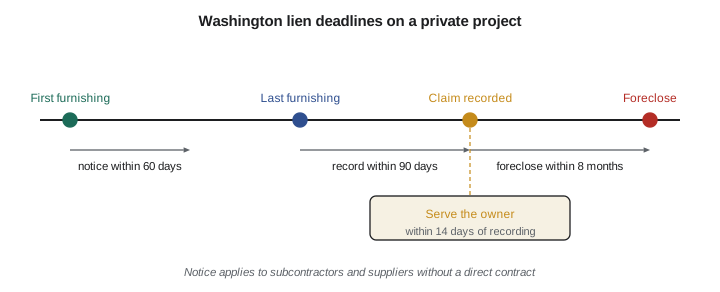
A lien claim must be recorded in the county where the property is located within ninety days after the claimant last furnished labor, professional services, materials or equipment to the project. The deadline cannot be extended by contract, and repair or warranty work done after the main work is finished generally does not restart the clock. After recording, the claimant must serve a copy of the claim on the owner within fourteen days by certified or registered mail or personal service. Missing the fourteen-day service does not by itself invalidate the lien, but it can cost the claimant the right to recover attorney fees and costs.
A recorded lien does not last forever. The lien binds the property for eight calendar months after recording unless the claimant files an action to foreclose it in superior court within that time. After filing, the claimant must also serve the owner within the time the statute allows. A claimant who records a lien and then does nothing loses it after eight months. Gary's 2009 lesson was the first deadline; a friend of his learned the eight-month deadline the same year, when a recorded lien simply expired while he waited for the developer to refinance.
| Step | Deadline | Source |
|---|---|---|
| Notice to owner (when required, commercial) | Within 60 days of first furnishing to protect all work | RCW 60.04.031 |
| Record the lien claim | Within 90 days after last furnishing | RCW 60.04.091 |
| Serve a copy on the owner | Within 14 days after recording | RCW 60.04.091 |
| File the foreclosure action | Within 8 months after recording | RCW 60.04.141 |
# Lien deadline calendar for one job (study aid; confirm with counsel)
from datetime import date, timedelta
import calendar

def add_months(d, n):
    extra_years, month_index = divmod(d.month - 1 + n, 12)
    y = d.year + extra_years
    m = month_index + 1
    day = min(d.day, calendar.monthrange(y, m)[1])
    return date(y, m, day)

first_furnished = date(2026, 3, 9)
last_furnished = date(2026, 8, 21)
recorded = date(2026, 10, 30)
print("notice to owner by (all work protected):", first_furnished + timedelta(days=60))
print("record the claim by:", last_furnished + timedelta(days=90))
print("claim actually recorded:", recorded)
print("serve the owner by:", recorded + timedelta(days=14))
print("file foreclosure by:", add_months(recorded, 8))notice to owner by (all work protected): 2026-05-08 record the claim by: 2026-11-19 claim actually recorded: 2026-10-30 serve the owner by: 2026-11-13 file foreclosure by: 2027-06-30
The calculator shows how the deadlines chain together. The last-furnishing date sets the recording deadline, and the recording date sets both the service deadline and the foreclosure deadline. A real calendar must also account for deadlines that fall on weekends or holidays and for any later case law, which is one reason contractors with significant claims use lien services or construction lawyers.
Disclosure statements on residential and small commercial work
Washington's contractor registration law, RCW 18.27.114, requires contractors covered by that law to give customers a disclosure statement in a statutory form before starting certain work: repair, alteration or construction of four or fewer residential units or accessory structures with a bid or contract price of one thousand dollars or more, and commercial building work with a price of at least one thousand dollars but less than sixty thousand dollars. The statement explains the customer's exposure to liens from subcontractors and suppliers, and the customer acknowledges receiving it. A contractor that fails to give the statement when required may not bring or keep a lien claim, and must keep a signed copy for at least three years.
Electrical contractors licensed under chapter 19.28 RCW should check with L&I and a lawyer how the disclosure requirement applies to them, because the statute is written for registered contractors and the electrical law has its own provisions. Pilchuck Valley takes the cautious approach: it gives every residential customer and every small commercial customer the disclosure statement with the contract and keeps the signed copy in the job file. It costs one sheet of paper and protects the company's lien rights.
Public projects
Liens cannot be placed on public property, so Washington provides other protections for those who work on public projects. Public owners generally retain a portion of each progress payment as retainage under chapter 60.28 RCW, and contractors on public works generally must provide payment bonds under chapter 39.08 RCW. Subcontractors and suppliers who are not paid can make claims against the retainage and the bond, subject to their own notice and filing deadlines, which differ from the private lien deadlines. Public works also carry prevailing wage requirements and other rules beyond the scope of this lesson. A contractor bidding public work should read the contract documents carefully and calendar the claim deadlines from the start.
Worked problem
A general contractor stops paying
Pilchuck Valley worked as an electrical subcontractor on a private retail building in Marysville. It started on March 9, 2026 and sent a notice to owner on March 20. Its last work was on August 21, 2026, and the general contractor has not paid the final 38,000 dollars. What are the key deadlines?
Show solution
- The notice to owner was given within 60 days of first furnishing, so all of the work is protected.
- The lien claim must be recorded in Snohomish County within 90 days after August 21, 2026, that is, by November 19, 2026.
- A copy must be served on the owner within 14 days after recording.
- If the claim is not paid, a foreclosure action must be filed within 8 months after recording, or the lien expires.
Answer: Notice already given; record by November 19, 2026; serve within 14 days of recording; foreclose within 8 months of recording.
Lien releases and payment paperwork
Owners and general contractors often ask for lien releases or waivers with each payment, as evidence that the subcontractor has been paid for the work covered by that payment. Bev reads every release form before anyone signs it, because a release can be conditional on receiving payment or unconditional, and it can cover a single payment or everything through a certain date. Pilchuck Valley signs conditional releases until the money has actually cleared, and signs unconditional releases only for amounts it has received. Signing an unconditional release before the check clears can give up lien rights for money that never arrives.
Marco keeps the job's payment history with the change orders, so that if a lien claim is ever needed the amount due is easy to prove. A claim should include only amounts actually owed for labor, materials and equipment furnished to the project, because an inflated claim can expose the claimant to liability under the lien statute.
Common mistakes
MistakeWaiting for the customer to pay before recording a lien, past the 90-day deadline.
InsteadThe recording deadline runs from last furnishing and cannot be extended by contract.
MistakeAssuming a recorded lien lasts until the claim is paid.
InsteadThe lien expires eight months after recording unless a foreclosure action is filed.
MistakeSkipping the notice to owner on a subcontract.
InsteadSubcontractors without a direct contract with the prime generally must give notice to preserve their lien rights.
MistakeTrying to lien a public school.
InsteadLiens do not attach to public property; use retainage and payment bond claims.
Summary and key terms
- A written contract and signed change orders are the foundation of every payment right.
- Chapter 60.04 RCW gives a lien on real property to those who furnish labor, materials or equipment at the owner's instance.
- Subcontractors and suppliers without a direct contract generally must give a notice to owner; on commercial work it protects work from 60 days before the notice.
- Record the claim within 90 days after last furnishing, serve the owner within 14 days and file foreclosure within 8 months.
- On public projects, claims are made against retainage and payment bonds instead of liens.
- Construction lien
- A claim against real property for the value of labor, materials or equipment furnished to improve it.
- Notice to owner
- The pre-claim notice under RCW 60.04.031 that preserves lien rights for certain claimants.
- Last furnishing
- The last date labor, services, materials or equipment were furnished, which starts the 90-day recording deadline.
- Foreclosure action
- The lawsuit to enforce a lien, which must be filed within eight months after recording.
- Retainage
- Part of each progress payment withheld by the owner until the work is complete.
Practice problems
Work each problem on paper first, then reveal the answer to check.
Within how many days after last furnishing must a lien claim be recorded?
Show answer
Ninety days.
How long does a recorded lien bind the property without a foreclosure action?
Show answer
Eight calendar months.
Who generally must give a notice to owner?
Show answer
Suppliers and subcontractors who do not contract directly with the owner or prime contractor; labor-only claimants are generally exempt.
Can an electrical subcontractor lien a public school building?
Show answer
No. It must use retainage and payment bond claims.
Lesson quiz · 5 questions
Score 60% or more to complete this lesson.
Create a free account to save your progress, take quizzes and earn a certificate.