
MELU-322 · Lesson 4 of 12 · 19 min
The exam format and the references allowed
▶ Video coming soon A video version of this lesson is on the way.
Jasmine had passed her journey-level exam seven years earlier, so she knew the feeling of a timed open-book test. What she did not know was how the master exam was built. Gary dug out the PSI candidate bulletin for Washington electrical exams and laid the content outline for the general master electrician exam beside the outline for the general administrator exam. "Same three sections," he said, tapping the page. "Different number of questions. The master exam just asks you more."
This lesson describes the structure of the general master electrician and general administrator exams as published in the PSI bulletin, the references candidates may bring, the strict rules about what those references may contain, and a pacing strategy for a seven-hour, three-section open-book computer exam. Specialty exams follow a similar pattern with different content and question counts, and candidates for those exams should read the outline for their specialty.
Three sections, each passed on its own
The PSI bulletin's outline for the general category, which covers the master electrician and administrator exams, divides each exam into three sections. The first is the National Electrical Code and theory section, which tests the candidate's ability to find and apply NEC requirements and to answer questions on electrical theory. The second is the Washington codes section, which tests chapter 19.28 RCW and chapter 296-46B WAC. The third is the major load calculations section, which tests the ability to work through a full service or feeder calculation under time pressure.
Each section is timed and scored separately, and the candidate must pass each one. The bulletin states that a candidate must score seventy to pass, and L&I's exam page puts it the same way: each section must be passed with a score of seventy out of a hundred or better. A candidate who scores ninety on the NEC section and sixty-five on the Washington codes section has passed one section and failed the other, and must retake only the Washington codes section, within the time limits described in Lesson 3.
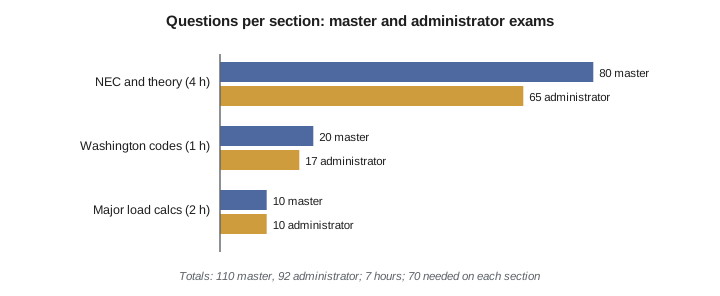
| Section | Master electrician questions | Administrator questions | Time allowed |
|---|---|---|---|
| NEC and theory | 80 | 65 | 4 hours |
| Washington codes (RCW 19.28 and WAC 296-46B) | 20 | 17 | 1 hour |
| Major load calculations | 10 | 10 | 2 hours |
| Total | 110 | 92 | 7 hours |
What each section rewards
The NEC and theory section is the largest. With eighty questions in four hours for the master exam, the candidate has three minutes per question on average. That is enough time to look up most answers in a well-tabbed code book, but not enough to read whole articles. The section rewards a candidate who knows the NEC's layout, can turn to the right article from the index or a tab in under a minute and reads requirements precisely, with attention to words such as shall, permitted, unless and except. Theory questions draw on Ohm's law, power, three-phase relationships, transformer ratios and similar fundamentals from the core courses.
The Washington codes section allows the same average time per question as the NEC section: twenty questions in one hour for the master exam, or three minutes each, but the material is smaller and less familiar to most candidates. Electricians who have spent years in the NEC often know little about the licensing statute and rules. This section rewards a candidate who has actually read chapter 19.28 RCW and chapter 296-46B WAC, tabbed them and knows where to find the rules on permits, inspections, certificates, administrators and master electricians, trainee supervision, penalties and the Washington amendments to the NEC.
The major load calculations section is small in question count but long in time: ten questions in two hours, or twelve minutes each. The questions are typically built around one or more complete calculations, such as a dwelling service by the standard or optional method, a multifamily building, a restaurant or an office building, and ask for intermediate and final results. The section rewards a candidate who can set up a calculation methodically, keep a clean worksheet and check the arithmetic, using the methods from the core load calculation course.
References allowed in the exam room
The Washington exams are open book, and L&I's exam page describes the approved materials. Candidates may bring the National Electrical Code book in the edition the exam is based on. At the time of writing, L&I's exam page and the PSI bulletin both referred to the 2020 edition for the exam, even though Washington had adopted the 2023 edition for installations and has adopted the 2026 edition effective at the end of 2026. Exam editions lag adoption, so the edition listed in the current bulletin governs which book to bring, not the edition currently enforced on jobs.
Candidates may also bring printed copies of chapter 19.28 RCW and chapter 296-46B WAC, hole-punched and placed in a three-ring binder. Other copyrighted reference materials, such as keyword indexes and formula guides, are allowed under the same marking rules. A candidate who wants a copy of the statute and rules can print them from the Washington legislature's website and punch them, or buy a commercially published copy.
What the references may contain
L&I's exam page is specific about markings, and the rules are enforced. Reference materials may have highlighting, underlining and permanent index tabs. Index tabs must be permanently attached and not removable. Handwritten notes, sticky notes and removable tabs are not allowed. Proctors check materials before the exam, and L&I warns that unacceptable markings can lead to the materials being confiscated and can be treated as an attempt to cheat. A candidate who has spent months writing notes in the margins of a code book should buy a clean copy for the exam and use the annotated one only for study.
Gary's advice on tabs is to keep them few and meaningful. A tab for every article makes the book harder to use, not easier. Jasmine tabbed the NEC at the start of each chapter, at the articles she used most (100, 110, 210, 215, 220, 230, 240, 250, 300, 310, 314, 358, 430, 450, 517, 690 and 700) and at Chapter 9 and its tables, and she tabbed the RCW and WAC binder by subject: definitions, licensing and certificates, administrators and masters, trainees, permits and inspections, penalties, specialty scopes and the NEC amendments.
# Pacing checkpoints for a timed section (study aid)
sections = [
    ("NEC and theory (master)", 80, 240),
    ("Washington codes (master)", 20, 60),
    ("Major load calculations", 10, 120),
]
REVIEW_SHARE_TENTHS = 1   # keep one tenth of each section for review
for name, questions, minutes in sections:
    working = minutes - minutes * REVIEW_SHARE_TENTHS // 10
    per_q = working / questions
    print(name)
    print("   ", round(per_q, 1), "minutes per question, review time", minutes - working, "minutes")
    for quarter in (1, 2, 3):
print(" by minute", working * quarter // 4, "aim to have", questions * quarter // 4, "done")NEC and theory (master)
2.7 minutes per question, review time 24 minutes
by minute 54 aim to have 20 done
by minute 108 aim to have 40 done
by minute 162 aim to have 60 done
Washington codes (master)
2.7 minutes per question, review time 6 minutes
by minute 13 aim to have 5 done
by minute 27 aim to have 10 done
by minute 40 aim to have 15 done
Major load calculations
10.8 minutes per question, review time 12 minutes
by minute 27 aim to have 2 done
by minute 54 aim to have 5 done
by minute 81 aim to have 7 done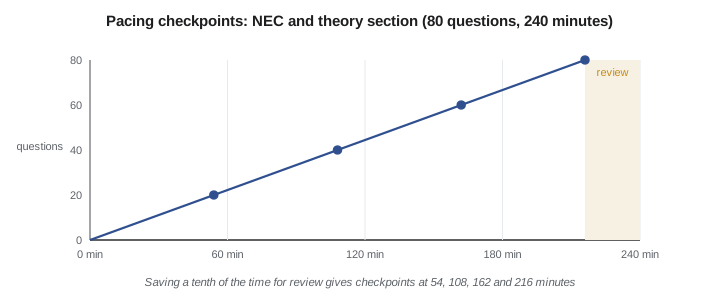
The two-pass method
On a timed open-book exam, the most common failure is not ignorance but running out of time with easy questions unanswered. The two-pass method addresses that. On the first pass, the candidate answers every question that can be answered quickly, either from memory or with a single lookup, and marks the rest for review. On the second pass, the candidate returns to the marked questions, starting with those that seem closest to an answer. Because every question carries the same weight, three easy questions answered in the time one hard question would take are worth three times as much.
Jasmine practiced the method on timed practice sections at home, with her phone in another room and a kitchen timer on the table. At first she marked too few questions and spent eight minutes chasing an obscure table. By the fourth practice session she was marking about one question in five on the first pass and finishing the first pass with time to spare, which left her calm on the second pass. She also learned to answer every marked question before time ran out, even with a best guess, because a blank answer is always wrong.
Worked problem
Is this code book allowed?
Jasmine brings three items to check-in: a 2020 NEC with permanent adhesive tabs and yellow highlighting; a three-ring binder with printed RCW 19.28 and WAC 296-46B and a few sticky notes marking pages; and a commercial formula guide with handwritten notes in the margin. What will the proctor accept?
Show solution
- The tabbed, highlighted NEC is allowed: permanent tabs and highlighting are permitted.
- The binder is allowed only after the sticky notes are removed, because sticky notes are prohibited.
- The formula guide with handwritten notes is not allowed and could be confiscated; she should have brought a clean copy.
- If any item is questionable, the safest choice is to leave it in the car rather than risk an accusation of cheating.
Answer: The NEC is fine, the binder needs the sticky notes removed, and the annotated guide is not allowed.
Preparing the references
Because the exam is open book, preparing the references is part of studying, and it is work Jasmine did with a pencil, a pack of permanent tabs and a highlighter rather than with flash cards. She started with the articles she had used most as a foreman: general requirements, wiring methods, grounding and bonding, overcurrent protection, conductor ampacity, motors and the special occupancies her company works in. Then she added tabs for every topic that came up in her practice questions, keeping the labels short and consistent so she could read them at a glance. L&I allows permanent, non-removable tabs and highlighting, so she glued her tabs firmly and checked that none could be peeled off and moved.
The state law binder took more thought. L&I requires the RCW and WAC to be printed and placed in a three-ring binder, and the binder must be free of handwritten notes. Jasmine printed chapter 19.28 RCW and chapter 296-46B WAC from the state's official website, punched the pages, and put permanent tabs on the definitions, the certificate sections, the supervision rules, the permit and inspection sections and the penalty provisions. She checked the printout date on the cover page, because the rules change and the exam is written from a current version.
Gary added one piece of advice from his own exam: practice with the same books you will take into the room. Every book opens a little differently once it is tabbed and worn, and the speed of a lookup depends on knowing where your own tabs are. Jasmine stopped using the office copy of the code book in week two and used only her exam copy from then on, so that by test day her fingers went to the right tab without thinking.
Finally, she read the PSI bulletin one more time, two weeks before the exam, to confirm the reference list, the identification rules and the check-in time. Bulletins are revised from time to time, and a candidate who arrives with a book that is no longer allowed loses it at check-in and has to work without it.
Common mistakes
MistakeBringing the code book for the edition currently enforced on jobs.
InsteadBring the edition the current PSI bulletin lists for the exam, which may lag the adopted edition.
MistakeWriting notes in the margins of the exam copy of the code book.
InsteadHandwritten notes are prohibited; use a separate study copy for notes.
MistakeAveraging scores across sections.
InsteadEach section must be passed with seventy or better on its own.
MistakeSpending the first hour on the hardest questions.
InsteadUse two passes: answer quick questions first, mark the rest and return to them.
Summary and key terms
- The general master electrician and administrator exams have three sections: NEC and theory, Washington codes, and major load calculations.
- The master exam has 110 questions (80, 20 and 10) and the administrator exam 92 (65, 17 and 10), each over 7 hours.
- Each section must be passed with a score of seventy or better.
- Approved references include the NEC edition the bulletin lists and printed RCW 19.28 and WAC 296-46B in a three-ring binder.
- Highlighting, underlining and permanent tabs are allowed; handwritten notes, sticky notes and removable tabs are not.
- Content outline
- The section-by-section description of an exam in the PSI bulletin.
- Washington codes section
- The exam section on chapter 19.28 RCW and chapter 296-46B WAC.
- Major load calculations
- The exam section built around complete service or feeder calculations.
- Permanent tab
- An index tab attached so that it cannot be removed, which is allowed in exam references.
- Two-pass method
- Answering quick questions first, marking hard ones, and returning to them in a second pass.
Practice problems
Work each problem on paper first, then reveal the answer to check.
How many questions are on the general master electrician exam?
Show answer
110: 80 NEC and theory, 20 Washington codes and 10 major load calculations.
What score must a candidate reach on each section?
Show answer
Seventy or better on each section.
May a candidate bring removable sticky tabs in the RCW binder?
Show answer
No. Only permanent tabs are allowed.
How much time is allowed for the major load calculations section?
Show answer
Two hours.
Lesson quiz · 5 questions
Score 60% or more to complete this lesson.
Create a free account to save your progress, take quizzes and earn a certificate.