
MELU-322 · Lesson 8 of 12 · 20 min
Contractor licensing, insurance and bonding
▶ Video coming soon A video version of this lesson is on the way.
Every September, Bev renews something. Some years it is the company's electrical contractor license, which runs on a two-year cycle; every year it is the liability insurance, the vehicle policy and the business license in each city where Pilchuck Valley works. She keeps the renewal calendar on the wall beside the permit whiteboard, and the first line on it is the one that keeps the doors open: the electrical contractor license, its four-thousand-dollar bond and the assignment of a certified administrator. "If any one of those three lapses," she told Jasmine, "we cannot buy a permit. And if we cannot buy a permit, we cannot work."
This lesson covers what an electrical contractor needs to hold and keep a Washington license: business registration and the Unified Business Identifier, the general or specialty license type, the surety bond, the designated administrator or master electrician, workers' compensation coverage, insurance, and when a separate contractor registration is needed. It also covers renewal of the contractor license, which is separate from the renewal of the people's certificates covered in Lesson 11.
Before the license: a registered business
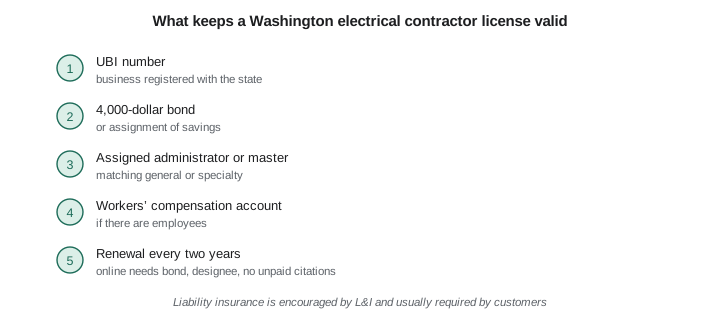
A Washington electrical contractor license is issued to a business entity, which can be a sole proprietorship, a partnership, a limited liability company or a corporation. Before applying, the business needs a Unified Business Identifier, or UBI number, which the state uses to tie together the business's registrations with the Secretary of State (for corporations and LLCs), the Department of Revenue, the Employment Security Department and L&I. L&I's contractor page lists a valid UBI number as a requirement for the license. Most businesses also need a state business license and endorsements through the Department of Revenue's Business Licensing Service, and many cities require their own business licenses for work inside city limits.
The choice of business structure affects taxes, liability and how the license is held, and it is a question for an accountant and a lawyer rather than for this course. What matters for the license is that the business entity named on the license is the one doing the work, that its UBI and registrations are current, and that changes in ownership or structure are reported to L&I as the rules require. A new corporation formed to take over an existing sole proprietorship's work generally needs its own license, because the license belongs to the entity.
General or specialty license
L&I issues two kinds of electrical contractor licenses. A general electrical contractor license, coded 01, allows the contractor to perform all types of electrical and telecommunications installations. A specialty electrical contractor license allows work only within one of the specialty categories listed in WAC 296-46B-920, such as residential work, pump and irrigation, signs, limited energy systems or HVAC and refrigeration, among others. The contractor's designated administrator or master electrician must match: a general contractor needs a general administrator or a journey-level master electrician, while a specialty contractor may use a specialty administrator or specialty master in the same specialty.
Working outside the license scope is a violation that inspectors check. A limited energy specialty contractor that installs a 120-volt circuit to power its equipment, for example, may be outside its scope unless the rules allow that work for the specialty. Before bidding work at the edge of a specialty, a contractor should read the scope in WAC 296-46B-920 for its specialty and ask L&I if there is any doubt.
The surety bond
L&I's contractor page requires an original electrical and telecommunications contractor's surety bond in the amount of four thousand dollars, or an assignment of a savings account in the same amount, as an alternative. The bond is filed with L&I and must stay in force for the license to remain valid. A surety bond is not insurance for the contractor. It is a guarantee issued by a surety company that protects people who are harmed by the contractor's failure to meet its obligations under the electrical law; the statute sets who may make claims against it and how. If the surety pays a valid claim, it will seek repayment from the contractor.
The bond amount is small compared with the value of a typical job, and some contractors treat it as a formality. Bev does not. If the surety cancels the bond, for example because the premium was not paid, the license is affected and the company cannot buy permits or renew online until a new bond is filed. She sets a calendar reminder sixty days before the bond renews and keeps a copy of the bond and the surety's contact information in the license file.
Workers' compensation coverage
Washington is one of a handful of states where workers' compensation insurance comes from a state fund rather than private insurers, except for large employers approved to self-insure. L&I runs the state fund. L&I's contractor page lists a workers' compensation account as a requirement if the contractor hires employees. Premiums are based on the hours employees work in each risk class, and part of the premium is withheld from the workers' wages, which is a feature of the Washington system that differs from most states. Employers report hours and pay premiums quarterly.
Workers' compensation matters to the license in more than one way. A contractor that employs electricians without an active workers' compensation account is violating Title 51 RCW and faces penalties and liability for injury claims. L&I can see both the electrical license and the workers' compensation account, and problems with one can affect the other. Bev reconciles the quarterly hours report against payroll every quarter, because misreported hours are one of the most common workers' compensation audit findings.
Liability insurance and other coverage
L&I's contractor page says that contractors are encouraged to carry general liability insurance, but L&I does not keep records of it for electrical contractor licensing. Unlike some states, Washington's electrical licensing law does not set a liability insurance minimum for the electrical license. That does not mean insurance is optional in practice. General contractors, owners, public agencies and many cities require proof of commercial general liability insurance, often with specific limits and additional insured endorsements, before a contractor may start work, and an uninsured contractor is exposed to claims that can end the business.
Pilchuck Valley carries commercial general liability insurance, commercial auto coverage for its vans, an umbrella policy, coverage for tools and equipment, and employment practices coverage, and it buys the limits its larger customers require. The broker reviews the policies every year with Gary and Bev. Jasmine, as the incoming designated master, wanted to understand the certificates of insurance that general contractors request, because she will often be the person on site when a project manager asks for one.
| Requirement | Required by the electrical licensing law? | Practical notes |
|---|---|---|
| UBI number and business registration | Yes | Through the state's business licensing system |
| Surety bond of 4,000 dollars (or savings assignment) | Yes | Must stay in force; claims are repaid by the contractor |
| Assigned administrator or master electrician | Yes | Matching general or specialty category |
| Workers' compensation account | Yes, if there are employees | State fund, premiums based on hours worked |
| General liability insurance | No (encouraged) | Usually required by customers and general contractors |
Contractor registration for non-electrical work
Washington has a separate contractor registration law, chapter 18.27 RCW, for general and specialty construction contractors. Electrical contractors licensed under chapter 19.28 RCW do not need a separate registration for their electrical work, but L&I's page notes that businesses doing non-electrical work may also need contractor registration. A company that also frames walls, installs drywall or does general remodeling may need to register under chapter 18.27 RCW, with its own bond and insurance requirements. Pilchuck Valley does only electrical and telecommunications work, so its electrical license is enough.
Renewing the contractor license
L&I's contractor page explains that electrical contractor licenses expire two years after their effective date and must be renewed every two years. To renew online, the contractor needs a current bond or assignment of savings, an assigned administrator or master electrician and no unpaid citations. A license that has been expired for more than ninety days must be renewed through L&I directly rather than online. A contractor with an expired license may not offer or perform electrical work or buy permits.
# Can the contractor license be renewed online? (study aid based on L&I's listed conditions)
licenses = [
    ("Pilchuck Valley Electric", True, True, 0, 0),
    ("Northfork Signs", True, False, 0, 0),
    ("Cedar Run Electric", True, True, 1, 0),
    ("Skagit Pump Service", True, True, 0, 120),
]
for name, bond_current, designee_assigned, unpaid_citations, days_expired in licenses:
    problems = []
    if not bond_current:
        problems.append("no current bond")
    if not designee_assigned:
        problems.append("no assigned administrator or master")
    if unpaid_citations:
        problems.append("unpaid citations")
    if days_expired > 90:
        problems.append("expired more than 90 days: renew through L&I directly")
print(name.ljust(26), "online renewal OK" if not problems else "; ".join(problems))Pilchuck Valley Electric online renewal OK Northfork Signs no assigned administrator or master Cedar Run Electric unpaid citations Skagit Pump Service expired more than 90 days: renew through L&I directly
Each line of the output corresponds to a condition on L&I's contractor page. Northfork Signs has no assigned designated person, so it cannot renew online and cannot legally work until one is assigned. Cedar Run has an unpaid citation, which must be resolved. Skagit Pump has let its license lapse for more than ninety days and must go through L&I directly.
Worked problem
Setting up a new company
Jasmine's friend Renee wants to start her own residential electrical business after she earns her residential specialty master certificate. What must her new company have before it can do residential electrical work for customers?
Show solution
- A business entity with a UBI number and the required state and city business licenses.
- A specialty electrical contractor license in the residential category from L&I.
- A 4,000-dollar electrical contractor's surety bond, or an assignment of savings, filed with L&I.
- Renee assigned as the designated master in the residential specialty, and a workers' compensation account if she hires employees; liability insurance is strongly advisable and often required by customers.
Answer: UBI and business licenses, a residential specialty license, the bond, Renee assigned as designated master and a workers' compensation account if she has employees.
Certificates of insurance and additional insured requests
Even though the electrical license does not require liability insurance, insurance paperwork is part of almost every commercial job. Before Pilchuck Valley starts work as a subcontractor, the general contractor usually asks for a certificate of insurance showing the company's policies, their limits and their dates, and often asks to be named as an additional insured under the general liability policy. The certificate is issued by the company's insurance broker, not by the company itself, and it is only a summary: the policy and its endorsements control what is actually covered.
Jasmine learned to read the subcontract's insurance section before the job starts and to send it to Bev and the broker, who confirm that the company's coverage meets the requirements or arrange the needed endorsements. Mismatches are common: a subcontract may require higher limits, a specific endorsement form or a waiver of subrogation, and a certificate that does not match can delay payment or even the start of work. Bev keeps every certificate the company issues in the job file, together with the subcontract.
Workers' compensation works differently in a state-fund state. Because coverage comes from L&I rather than private insurers, a general contractor in Washington typically checks a subcontractor's workers' compensation account status with L&I instead of asking for an insurance certificate for that coverage. A general contractor can be responsible for unpaid premiums of a subcontractor in some situations, so many general contractors check the account before the first payment.
Common mistakes
MistakeAssuming Washington sets a liability insurance minimum for the electrical license.
InsteadL&I encourages but does not require liability insurance for the electrical license; customers usually require it.
MistakeTreating the surety bond as insurance that protects the contractor.
InsteadThe bond protects others; the surety seeks repayment from the contractor for claims it pays.
MistakeBuying workers' compensation from a private insurer.
InsteadWashington employers obtain coverage from L&I's state fund unless approved to self-insure.
MistakeLetting the license lapse for months and expecting to renew online.
InsteadLicenses expired more than 90 days must be renewed through L&I directly.
Summary and key terms
- An electrical contractor license is issued to a business entity with a valid UBI number.
- Licenses are general (01) or specialty, and the designated person's certificate must match the license category.
- The license requires a 4,000-dollar electrical contractor's surety bond or an assignment of savings.
- Employers need a workers' compensation account with L&I's state fund; liability insurance is encouraged and usually required by customers.
- Contractor licenses renew every two years; online renewal requires a current bond, an assigned designated person and no unpaid citations.
- UBI number
- The Unified Business Identifier that ties together a business's Washington registrations.
- General electrical contractor (01)
- A license allowing all types of electrical and telecommunications installations.
- Specialty electrical contractor
- A license limited to one specialty scope listed in WAC 296-46B-920.
- Surety bond
- A guarantee by a surety company that protects others if the contractor fails its legal obligations.
- State fund
- L&I's workers' compensation insurance fund, the main source of coverage for Washington employers.
Practice problems
Work each problem on paper first, then reveal the answer to check.
What bond amount does L&I require for an electrical contractor license?
Show answer
4,000 dollars, or an assignment of savings in that amount.
How often must an electrical contractor license be renewed?
Show answer
Every two years.
Does L&I require general liability insurance for the electrical license?
Show answer
No; it encourages it, and customers usually require it.
A company also does drywall and framing. What extra registration may it need?
Show answer
Contractor registration under chapter 18.27 RCW.
Lesson quiz · 5 questions
Score 60% or more to complete this lesson.
Create a free account to save your progress, take quizzes and earn a certificate.