
MELU-322 · Lesson 7 of 12 · 19 min
Duties of the electrical administrator and master electrician
▶ Video coming soon A video version of this lesson is on the way.
Gary keeps a laminated card in his wallet that he has carried since 2001. On it, in his own block capitals, is a list of five things copied from the statute the week he passed the administrator exam. "People think the administrator just lends his name to the license," he told Jasmine, handing her the card. "The law says otherwise. If you're the designated master, these are your jobs, every day, on every job, whether you're on site or not." The card listed the duties in RCW 19.28.061: make sure the work complies with the installation laws and rules, make sure proper safety procedures are used, make sure the required labels, permits and licenses are used, make sure correction notices are dealt with, and tell L&I within ten days if the relationship with the contractor ends.
This lesson covers the designated administrator's and designated master electrician's role under chapter 19.28 RCW: who may be designated, the one-contractor rule, the statutory duties, what happens when the designated person leaves, dies or becomes incapacitated, and the consequences of failing to carry out the duties. The role is the heart of the Washington licensing system, and both the exam and real life test it.
Who may be designated
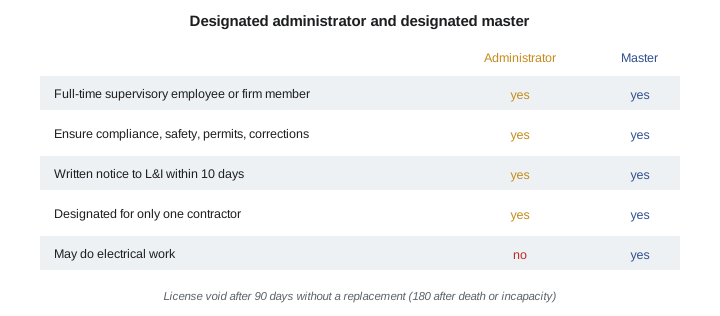
Every electrical contractor must have a designated administrator or master electrician. RCW 19.28.061 requires a firm applying for an electrical contractor license to designate a supervisory employee or member of the firm to take the master electrician or administrator exam and to be named on the license. Since 1987, the statute has required the designee to be a full-time supervisory employee. The designee does not have to own the company, but must be a member of the firm or a supervisory employee and must be available during working hours to carry out the duties.
The statute also says that no person may qualify at the same time as master electrician or administrator for more than one contractor. A person cannot rent a certificate to several companies or serve as the designated person for two businesses at once. A certified person who changes employers must be unassigned from the old contractor and assigned to the new one, using L&I's assignment change form, and must report the change within ten days. This one-contractor rule is a favorite exam topic because it is simple and absolute.
The statutory duties
RCW 19.28.061 lists the designated person's duties, and the statute says the department cannot change them by rule. The designated administrator or master electrician must be a member of the firm or a supervisory employee and be available during working hours to carry out the duties. The person must ensure that all electrical work complies with the electrical installation laws and rules of the state, ensure that proper electrical safety procedures are used, ensure that all electrical labels, permits and licenses required to perform electrical work are used, see that corrective notices issued by an inspecting authority are complied with, and notify the department in writing within ten days if the person terminates the relationship with the electrical contractor.
Each duty has practical meaning. Compliance with installation laws means the designated person must have systems for training electricians on the current code and Washington amendments, for checking work and for answering code questions. Safety procedures mean the company's electrical safety program, lockout and energized work practices, which Lesson 10 covers, are the designated person's responsibility as well as the employer's. Labels, permits and licenses mean every job has the right permit, the company works within its license scope and every person doing electrical work holds the right certificate. Corrective notices mean that every correction is tracked to completion. And the ten-day notice means L&I's records always show who is responsible.
| Statutory duty (RCW 19.28.061) | What it looks like in practice |
|---|---|
| Be a firm member or supervisory employee, available during working hours | Reachable by crews and inspectors; full-time supervisory role |
| Ensure work complies with installation laws and rules | Code training, job reviews, answers to code questions |
| Ensure proper electrical safety procedures are used | Safety program, lockout, energized work rules, training |
| Ensure required labels, permits and licenses are used | Permit for every job, scope checks, certificate checks |
| See that corrective notices are complied with | Tracking every correction to reinspection and approval |
| Notify L&I in writing within 10 days if the relationship ends | Assignment change form and written notice |
Administrator versus master electrician in the role
The duties are the same whether the designated person is an administrator or a master electrician. The difference is what else the person may do. An administrator who does not also hold an electrician certificate may not do electrical work or use the tools of the trade. A master electrician is a certified electrician and may do electrical work, including on the company's jobs. That combination is attractive to small contractors, where the owner or lead electrician can be both the designated person and a working electrician, and it is why Jasmine chose the master route.
Being on the tools does not reduce the designated person's other duties. Jasmine will still be responsible for compliance on jobs she never visits, such as Seattle work run by another foreman. She plans to delegate parts of the work, such as permit tracking to Bev and certificate checks to Bev and the foremen, while keeping the responsibility herself and checking that the delegated tasks are done. Gary's practice, which she intends to keep, is a weekly review of open permits, open corrections, new jobs and any changes in the field crew.
When the designated person leaves
A contractor without a designated person cannot continue indefinitely. RCW 19.28.061 provides that when the relationship between the contractor and the designated administrator or master electrician ends for reasons other than death or incapacity, the contractor's license becomes void within ninety days unless a replacement is qualified. If the designated person dies or becomes incapacitated, the license becomes void within one hundred eighty days unless a replacement is qualified, and the contractor must notify the department in writing within ten days. The designated person who leaves must also notify the department in writing within ten days.
These deadlines are why Gary pushed Jasmine to test early rather than waiting until he decided to retire. If Gary left suddenly, Pilchuck Valley would have ninety days to get a replacement qualified, and if Gary died or became incapacitated, one hundred eighty. A master exam with an application, approval, study time, possible retakes and processing can easily take longer than ninety days for a candidate starting from scratch. A company that waits for the emergency risks losing its license.
# How long does the contractor have to qualify a replacement? (study aid)
from datetime import date, timedelta

def void_date(event, ended_on):
    days = 180 if event in ("death", "incapacity") else 90
    return ended_on + timedelta(days=days), days

cases = [
    ("Administrator quits to join a competitor", "resignation", date(2026, 9, 1)),
    ("Master electrician retires", "retirement", date(2026, 12, 18)),
    ("Administrator dies", "death", date(2027, 2, 5)),
]
for label, event, ended in cases:
    vd, days = void_date(event, ended)
    print(label)
    print("   relationship ended", ended, "| notice to L&I within 10 days:", ended + timedelta(days=10))
print(" license void after", days, "days unless replaced:", vd)Administrator quits to join a competitor relationship ended 2026-09-01 | notice to L&I within 10 days: 2026-09-11 license void after 90 days unless replaced: 2026-11-30 Master electrician retires relationship ended 2026-12-18 | notice to L&I within 10 days: 2026-12-28 license void after 90 days unless replaced: 2027-03-18 Administrator dies relationship ended 2027-02-05 | notice to L&I within 10 days: 2027-02-15 license void after 180 days unless replaced: 2027-08-04
The output shows the two clocks that start when a designated person leaves: a short one for the written notice and a longer one for the replacement. The study aid uses a simple count of calendar days; a real situation should be checked against the statute and with L&I, and any deadline that matters should be calendared with a margin.
Consequences of failing the duties
Failure to carry out the duties has consequences for both the contractor and the designated person. Chapter 19.28 RCW authorizes L&I to issue citations with monetary penalties for violations such as doing work without a permit, employing uncertified people to do electrical work, failing to supervise trainees and failing to correct violations, and to suspend or revoke licenses and certificates for serious or repeated violations. Under the statute, the department may deny an application for up to two years when a previous certificate was revoked for a serious violation that posed an imminent danger to the public and all appeals are exhausted. Citations can be appealed, and the appeals process involves the Electrical Board.
The designated person also carries practical exposure. Customers, general contractors and inspectors treat the designated person as the company's responsible professional, and a pattern of violations follows that person if they move to another company. Gary's view is that the best protection is the boring kind: written procedures, checklists, weekly reviews and a habit of asking the inspector questions before the inspection rather than arguing after it.
Worked problem
A new branch office
Pilchuck Valley plans to open a second shop in Spokane. Marco suggests that a friend of his, a master electrician who is the designated master for a small Spokane company, could also serve as designated master for the new branch. Is that allowed?
Show solution
- No. RCW 19.28.061 says no person may qualify as master electrician or administrator for more than one contractor at the same time.
- If the branch is part of the same Pilchuck Valley license, it already has a designated person: Jasmine (or Gary until the change).
- If the branch were a separate company with its own license, it would need its own full-time supervisory designated person.
- Marco's friend could serve the branch only by leaving the other company and being reassigned, with the ten-day notices.
Answer: Not allowed while he serves another contractor; one designated person per contractor and one contractor per designated person.
Planning for succession
The ninety-day rule makes succession planning a business necessity. Gary began talking with Jasmine about the designated role two years before she tested, and the plan they wrote down covered more than the exam. It named who would step in if Gary left suddenly, how the company would notify L&I and its customers, and what records Jasmine would need to take over: open permits, open corrections, the training records, the safety program and the list of certified workers with their expiration dates.
Many contractors in Washington keep a second certified person on staff for exactly this reason. A company whose only certified administrator or master leaves has ninety days to replace that person, and the replacement must be a full-time supervisory employee or a member of the firm who is not already designated for another contractor. Hiring a qualified replacement on short notice is hard in a tight labor market, and preparing an employee for the exam takes months. A second certified person, even one who is not the designated person, shortens that risk.
The handover itself is a short paperwork exercise. When Jasmine's certificate was issued, Gary and Jasmine completed L&I's assignment change form so that L&I's records showed her as the designated master, and Gary was unassigned as administrator. Both checked the change on the Verify tool the following week. Gary stayed on as an adviser and kept his administrator certificate active, which gives the company a qualified backup if Jasmine ever leaves.
Common mistakes
MistakeTreating the designated person as a name on the license with no real job.
InsteadThe statute lists active duties: compliance, safety, permits and licenses, corrections and notices.
MistakeServing as designated administrator for two companies.
InsteadNo person may qualify for more than one contractor at the same time.
MistakeWaiting until the administrator retires to find a replacement.
InsteadThe license becomes void within 90 days (180 for death or incapacity) unless a replacement is qualified.
MistakeForgetting the written notice when a designated person leaves.
InsteadThe designated person, and the contractor in case of death or incapacity, must notify L&I in writing within ten days.
Summary and key terms
- Every electrical contractor must have a designated administrator or master electrician who is a full-time supervisory employee or firm member.
- No person may be the designated person for more than one contractor at the same time.
- RCW 19.28.061 lists the duties: compliance, safety procedures, labels, permits and licenses, corrective notices and a ten-day written notice when the relationship ends.
- If the relationship ends, the license becomes void within 90 days, or 180 days after death or incapacity, unless a replacement is qualified.
- Violations can lead to citations, penalties, suspension or revocation, with appeals to the Electrical Board.
- Designated person
- The administrator or master electrician named on a contractor's license and responsible for compliance.
- Full-time supervisory employee
- The statutory status a designated person must have, unless a member of the firm.
- One-contractor rule
- The statutory rule that no person may qualify for more than one contractor at once.
- Ninety-day rule
- The period after a designated person leaves within which a replacement must be qualified.
- Corrective notice
- A notice from an inspecting authority requiring violations to be corrected.
Practice problems
Work each problem on paper first, then reveal the answer to check.
List three of the designated person's statutory duties.
Show answer
Any three: ensure compliance with installation laws, ensure safety procedures, ensure labels, permits and licenses, see that corrective notices are complied with, notify L&I within ten days when the relationship ends.
How long does a contractor have to qualify a replacement after its administrator resigns?
Show answer
Ninety days, or the license becomes void.
How long after the designated person's death?
Show answer
One hundred eighty days.
May a master electrician serve as designated master for two contractors?
Show answer
No.
Lesson quiz · 5 questions
Score 60% or more to complete this lesson.
Create a free account to save your progress, take quizzes and earn a certificate.