
MELU-322 · Lesson 11 of 12 · 19 min
Renewal and continuing education
▶ Video coming soon A video version of this lesson is on the way.
Bev keeps a column on her renewal calendar for every certified person at Pilchuck Valley: the type of certificate, its number, the expiration date, which is always the holder's birthday, and the number of continuing education hours reported so far in the cycle. Twice a year she prints the column and walks it around the shop and the jobs. "Nobody loses a certificate on my watch because they forgot a class," she told Jasmine. "And when it's your certificate holding up the whole company's license, that goes double."
This lesson covers how Washington administrator, master electrician and electrician certificates are renewed, the continuing education required for renewal, what happens when renewal or education is late, and how renewal of the people's certificates connects to the contractor license. Lesson 8 covered the contractor license's own two-year renewal. A designated person must manage both, because a lapse in either one stops the company's work.
The three-year cycle on your birthday
Washington administrator and master electrician certificates renew every three years and expire on the holder's birthday. RCW 19.28.061 says the administrator certificate is nontransferable, expires on the holder's birthday and must be renewed every three years, and L&I's master electrician page applies the same cycle to master certificates. Electrician certificates also run on three-year cycles tied to the birthday. The initial certificate is the exception: L&I issues initial administrator and master certificates for twenty-five to thirty-six months, depending on the approval or pass date and the birthdate, so that later renewals line up with the birthday.
Renewal can be done online, by mail or in person, using L&I's renewal form for mail and in-person renewals. L&I recommends using its Verify tool before renewing to confirm that the record shows the renewal is available and the education is complete. L&I's administrator page says it typically sends the renewed certificate within five days of receiving the renewal. Renewal fees are set by rule in WAC 296-46B-909 and listed on the renewal form, with a higher fee for late renewal.
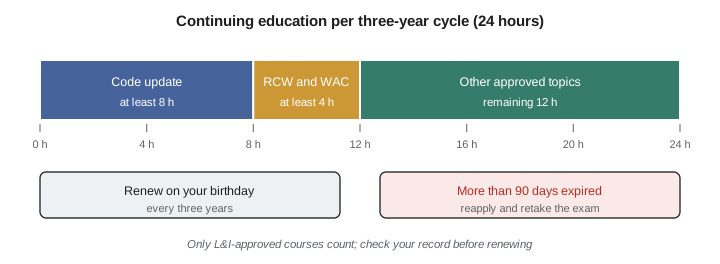
Continuing education: twenty-four hours, with two required parts
To renew, administrators and master electricians must complete twenty-four hours of L&I-approved continuing education during the certification period. L&I's pages require at least eight of those hours to be code update education and at least four to be review of chapter 19.28 RCW and chapter 296-46B WAC. The remaining hours can be other approved electrical topics, such as electrical theory, safety or industry-related subjects, as long as the courses are approved by L&I. RCW 19.28.061 describes the requirement as an annual eight-hour course, which over a three-year cycle comes to the same twenty-four hours.
The education must be approved by L&I, and the approval matters more than the subject. Courses are offered by trade associations, unions, community colleges and private providers, in classrooms and online. Approved providers report completed hours to L&I, and the hours appear on the certificate holder's record. A holder should check that the record shows the hours before renewing, because hours that were not reported, or courses that were not approved, will not count. Jasmine learned that lesson secondhand: Caleb's uncle, an electrician in Everett, took a weekend class from a provider whose approval had lapsed and had to retake eight hours a month before his birthday.
| Requirement | Administrators and master electricians | Notes |
|---|---|---|
| Renewal cycle | Every 3 years, on the birthday | Initial certificate 25 to 36 months |
| Total continuing education | 24 hours per cycle | RCW 19.28.061 describes eight hours a year |
| Code update | At least 8 hours | On the current NEC and Washington amendments |
| RCW and WAC review | At least 4 hours | Chapter 19.28 RCW and chapter 296-46B WAC |
| Other approved topics | Remaining 12 hours | Must be L&I-approved courses |
Code update courses in a transition year
Code update education follows the code. With the 2023 NEC in force since April 2024 and the 2026 NEC taking effect at the end of 2026, providers offer code update courses on the changes in the 2023 edition and, as the effective date approaches, on the 2026 edition and Washington's amendments. A holder renewing in 2026 or 2027 should take a code update course that L&I approves for the renewal period, and should prefer one on the edition the holder will be working with. Jasmine plans to take a 2026 code update course in the fall, both for her own renewal hours and so she can teach the changes to her crews before the new edition takes effect.
Late renewal, missing education and inactive status
The consequences of a late renewal or missing education are severe for a designated person. L&I's administrator page says that if an administrator misses the renewal deadline or does not complete the education, the certificate is automatically separated from the contractor, a late fee applies, and the administrator must be reassigned after meeting the requirements. L&I's master electrician page says that if the renewal fee is paid but the education is not complete, the certificate becomes inactive until the requirements are met, and a master assigned to a contractor who has not met the requirements by expiration is unassigned.
An unassigned designated person means a contractor without a designated person, which starts the ninety-day clock from Lesson 7 and blocks online license renewal from Lesson 8. In practice, many contractors find they cannot buy permits online until the assignment is restored. A certificate that has been expired for more than ninety days cannot simply be renewed: L&I's pages say the holder must reapply and retake the exam. For a master electrician who spent months preparing for the exam, letting the certificate lapse for more than ninety days is an expensive mistake.
# Renewal readiness check for a three-year cycle (study aid)
from datetime import date

def check(name, expires, total, code_update, rcw_wac, today):
    days_left = (expires - today).days
    missing = []
    if total < 24:
        missing.append(str(24 - total) + " more hours in total")
    if code_update < 8:
        missing.append(str(8 - code_update) + " more code update hours")
    if rcw_wac < 4:
        missing.append(str(4 - rcw_wac) + " more RCW and WAC hours")
    if days_left < -90:
        status = "expired more than 90 days: reapply and retake the exam"
    elif days_left < 0:
        status = "expired: renew now, late fee applies, reassign after requirements are met"
    elif missing:
        status = "renew by " + str(expires) + " after completing: " + ", ".join(missing)
    else:
        status = "ready to renew; " + str(days_left) + " days left"
    print(name.ljust(16), status)

today = date(2026, 10, 1)
check("Gary Lindqvist", date(2027, 3, 4), 24, 8, 4, today)
check("Renee Holt", date(2027, 5, 2), 16, 0, 4, today)
check("Luis Ortega", date(2026, 9, 12), 24, 8, 4, today)
check("Former foreman", date(2026, 5, 20), 10, 8, 0, today)Gary Lindqvist ready to renew; 154 days left Renee Holt renew by 2027-05-02 after completing: 8 more hours in total, 8 more code update hours Luis Ortega expired: renew now, late fee applies, reassign after requirements are met Former foreman expired more than 90 days: reapply and retake the exam
Each line of output matches one of the cases L&I describes. Gary is ready. Renee still needs eight code update hours, which the company's fall code update class will cover. Luis's certificate expired in September, so he must renew now with a late fee, and if he were a designated person he would have been unassigned and would need to be reassigned. The former foreman let his certificate lapse more than ninety days and must start over with an application and the exam.
Keeping the company's records together
A designated person is responsible for more than their own certificate. The company's license depends on the designated person's certificate, and its work depends on every electrician's and trainee's certificate. Bev's calendar tracks all of them, together with the contractor license, the bond, workers' compensation reports and insurance renewals. The designated person reviews the list regularly, makes sure people take their education early in the cycle rather than in the last month, and checks the L&I record rather than relying on what people say they have done.
Jasmine plans to keep Bev's system and add one rule of her own: every certified person at Pilchuck Valley schedules their code update course within six months of a new NEC edition taking effect, so the whole company learns the changes together and nobody is caught short at renewal time.
Worked problem
Jasmine's first renewal as a master
Jasmine's master certificate is issued in July 2026 with an initial term ending on her birthday, May 14, 2029. She is the company's designated master. What must she do to renew without a gap in the company's assignment?
Show solution
- Complete 24 hours of L&I-approved education during the period, with at least 8 hours of code update and at least 4 hours of RCW and WAC review.
- Check her record on L&I's Verify tool to confirm the hours are reported before she renews.
- Renew online, by mail or in person before May 14, 2029, paying the renewal fee.
- If she misses the date or the education, she is unassigned and the company must restore the assignment; more than 90 days late, she must reapply and retest.
Answer: Twenty-four approved hours with the code update and RCW and WAC parts, a Verify check and renewal before her birthday in 2029.
Choosing continuing education that pays off
Twenty-four hours every three years is a minimum, and the hours can be spent well or badly. Jasmine plans her own hours around three questions. First, what has changed in the code and the state rules that her crews need to know? That is the code update and RCW and WAC review, and she takes those courses early in the cycle, as soon as a new edition or a significant rule change takes effect. Second, where are the company's weak spots? Her correction log and the inspectors' comments point to topics, such as grounding and bonding or energy storage, where a focused course would reduce future corrections. Third, what new work does the company want to win? Courses on solar, battery storage, electric vehicle charging or controls help the company bid that work with confidence.
She also plans for the rest of the shop. Every certified electrician and trainee at Pilchuck Valley has a continuing education requirement for renewal, and the company pays for approved classes for anyone who takes them in the first two years of the cycle. Bev tracks completed hours from the L&I records, not from paper certificates, and sends reminders six months and three months before each expiration date to anyone whose record is short. The company also hosts an approved code update class in the shop when a new edition takes effect, which saves travel time and makes sure the whole company learns the changes together.
Finally, she keeps her own file: the course completion records, the dates, the provider names and the topics. If an hour does not appear on the L&I record, the file makes it easy to ask the provider to correct the report before renewal. A small amount of organization prevents the kind of last-month scramble that cost Caleb's uncle a weekend.
Gary has one more habit worth copying. Each time he finishes a course, he writes a short summary of what changed or what he learned and shares it with the foremen at the next safety meeting. The summary takes ten minutes to write, turns his continuing education into training for the whole crew and gives the foremen a chance to ask how the change affects the jobs they are running. Jasmine plans to keep the practice when she takes over as designated master, because it spreads the value of each course across everyone who does the work.
The contractor license is a separate calendar item. It renews every two years from its effective date, as Lesson 8 explained, and it depends on the designated person's certificate being active. Bev puts both dates on the same calendar line so that a renewal of one is never done without a check of the other.
Common mistakes
MistakeTaking any electrical class and assuming it counts.
InsteadOnly L&I-approved courses count, and the hours must appear on the L&I record.
MistakeLeaving all twenty-four hours until the final month.
InsteadSpread the hours over the cycle and finish the code update and RCW and WAC parts early.
MistakeAssuming a late renewal only costs a late fee.
InsteadThe designated person is unassigned, which affects the contractor's license and permits.
MistakeLetting a master certificate lapse for months.
InsteadMore than 90 days expired requires a new application and exam.
Summary and key terms
- Administrator, master and electrician certificates renew every three years on the holder's birthday; initial certificates run 25 to 36 months.
- Renewal requires 24 hours of L&I-approved continuing education, with at least 8 hours of code update and at least 4 hours of RCW and WAC review.
- Approved providers report hours to L&I; check the Verify tool before renewing.
- Late renewal or missing education unassigns the designated person and brings a late fee.
- Certificates expired more than 90 days require a new application and the exam.
- Renewal cycle
- The three-year period between certificate renewals, ending on the holder's birthday.
- Code update course
- Approved continuing education on the current NEC and Washington amendments.
- RCW and WAC review
- Approved continuing education on chapter 19.28 RCW and chapter 296-46B WAC.
- Inactive certificate
- A certificate whose renewal fee is paid but whose education requirement is not yet met.
- Verify tool
- L&I's online lookup of license and certificate records.
Practice problems
Work each problem on paper first, then reveal the answer to check.
How many continuing education hours does a master electrician need per renewal cycle?
Show answer
Twenty-four.
How many of those must be code update hours?
Show answer
At least eight.
How many must be RCW and WAC review?
Show answer
At least four.
What happens if a master certificate is expired more than 90 days?
Show answer
The holder must reapply and retake the exam.
Lesson quiz · 5 questions
Score 60% or more to complete this lesson.
Create a free account to save your progress, take quizzes and earn a certificate.