
MELU-322 · Lesson 5 of 12 · 19 min
The NEC as adopted in Washington and state amendments
▶ Video coming soon A video version of this lesson is on the way.
Jasmine's crews had been wiring to the 2023 National Electrical Code for more than two years, and she knew it well. Gary's question caught her off guard anyway. "Which edition will the inspector use on the Marysville warehouse if we pull the permit in January?" he asked. "And which edition is the exam on?" They turned out to be two different answers, and both mattered. This lesson explains how the NEC becomes enforceable in Washington, how the state amends it, how editions change over and why the exam edition and the job edition can differ.
The National Electrical Code is a model code published by the National Fire Protection Association as NFPA 70. On its own it has no legal force. It becomes law in Washington when L&I adopts it by reference in chapter 296-46B WAC under the authority of chapter 19.28 RCW, with whatever Washington amendments the department adds. Cities that run their own electrical programs adopt the code for their own jurisdictions under rules that must be at least equal to the state's.
How L&I adopts the NEC
L&I adopts each new NEC edition through formal rulemaking under Washington's Administrative Procedure Act. The process usually begins with stakeholder meetings and draft amendments discussed with contractors, electricians, inspectors, manufacturers and the Electrical Board. The department then files a proposed rule, known as a CR-102, publishes it in the Washington State Register, takes written comments and holds public hearings. After considering the comments, it files the final rule, known as a CR-103, with an adoption date and an effective date. The general adoption section of the rules, WAC 296-46B-010, names the edition adopted and says how it applies.
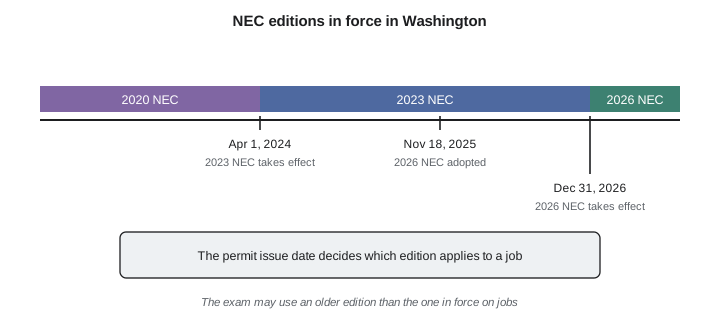
The most recent completed cycle shows the pattern. L&I proposed adopting the 2023 NEC in a notice filed in December 2023 as WSR 23-24-084, adopted the final rule on February 21, 2024, and made it effective April 1, 2024, replacing the 2020 edition. The same rulemaking added several new Washington sections, such as rules for high-voltage branch circuits and feeders, fuel cell systems and standalone systems, repealed some Washington sections that the new NEC made unnecessary, and amended about forty others, including the extension of Class B permits to 120 days.
The next cycle is already under way. In a rule filed November 18, 2025 as WSR 25-23-069, L&I adopted the 2026 NEC in its entirety by reference, including Annexes A, B and C, with a delayed effective date of December 31, 2026. The department said it would follow with a second rulemaking in 2026 to let stakeholders propose Washington amendments to the 2026 edition before that date. A candidate studying in late 2026 is therefore working in a transition year: the 2023 edition with its amendments applies to current permits, and the 2026 edition takes over at the end of the year.
Which edition applies to a job
Washington ties the code edition to the permit, not to the date of installation. L&I's rules apply the adopted edition to installations with electrical permits issued on or after the effective date, with transition provisions for certain projects, such as work whose plans were accepted for review before the change, and some new dwellings. In practice, the edition in force when the permit is issued normally governs the whole job, even if the work runs past the effective date of the next edition. This is why contractors pay close attention to permit dates around a changeover.
For Gary's question, the answer depends on the dates and the jurisdiction. If Pilchuck Valley pulls the Marysville permit in January 2027, after the 2026 edition takes effect on December 31, 2026, the 2026 edition with any Washington amendments will apply, subject to Marysville's own adoption schedule, because Marysville runs its own electrical program. If the permit is issued in November 2026, the 2023 edition applies. Bev checks the city's adoption notices as well as L&I's, because a city may adopt on a slightly different schedule.
| Edition | Adopted by L&I | Effective | Notes |
|---|---|---|---|
| 2020 NEC | Earlier rulemaking | Until March 31, 2024 | Edition still referenced by the exam materials at the time of writing |
| 2023 NEC | February 21, 2024 (WSR 23-24-084 proposal) | April 1, 2024 | New WAC sections on high-voltage circuits, fuel cells, standalone systems |
| 2026 NEC | November 18, 2025 (WSR 25-23-069) | December 31, 2026 | Adopted in its entirety; amendments planned in a 2026 rulemaking |
How Washington amends the NEC
Washington's amendments live in chapter 296-46B WAC, organized by NEC article number. A rule numbered WAC 296-46B-210, for example, amends NEC Article 210, and WAC 296-46B-690 amends Article 690. This numbering lets an electrician turn from an NEC article straight to the matching Washington section to see whether the state has changed anything. Some Washington sections add requirements, some relax or replace NEC requirements, and some add procedures, such as design review requirements, that the NEC does not address. Sections without a matching WAC section apply as written in the NEC.
Washington amendments come in several types. Some address local conditions, such as rules for agricultural buildings or for mobile and manufactured homes. Some address installation practices the state wants to standardize, such as the height of overcurrent device enclosures, which the 2023 cycle extended to installations on roofs. Some add documentation requirements, such as records of testing for certain protective devices under NEC 240.67 and 240.87. And some add procedures, such as the design review required for fuel cell systems and standalone systems. The exam's Washington codes section draws on these amendments, so the RCW and WAC binder should be tabbed at the amendments most likely to come up.
The cities that run their own programs may adopt their own amendments as well. Seattle, for example, publishes the Seattle Electrical Code, which is based on the NEC with Seattle amendments. A contractor working in Seattle must follow Seattle's code and procedures, not L&I's amendments, for the work that Seattle inspects. Because the exam is a state exam, it tests the state rules, but a designated administrator or master electrician must know that city amendments exist and must make sure the company follows them on city jobs.
# Which NEC edition governs a permit? (study aid using L&I's published effective dates)
from datetime import date

EDITIONS = [  # (effective date, edition)
    (date(2024, 4, 1), "2023 NEC with WAC 296-46B amendments"),
    (date(2026, 12, 31), "2026 NEC with any Washington amendments"),
]
def edition_for(permit_issued):
    current = "2020 NEC with WAC 296-46B amendments"
    for effective, name in EDITIONS:
        if permit_issued >= effective:
            current = name
    return current

for job, issued in [("Lake Stevens duplexes", date(2024, 3, 12)),
                    ("Farm shop", date(2025, 7, 8)),
                    ("Warehouse service, permit in November", date(2026, 11, 16)),
                    ("Warehouse service, permit in January", date(2027, 1, 11))]:
print(job.ljust(40), issued, "->", edition_for(issued))Lake Stevens duplexes 2024-03-12 -> 2020 NEC with WAC 296-46B amendments Farm shop 2025-07-08 -> 2023 NEC with WAC 296-46B amendments Warehouse service, permit in November 2026-11-16 -> 2023 NEC with WAC 296-46B amendments Warehouse service, permit in January 2027-01-11 -> 2026 NEC with any Washington amendments
The calculator captures the general rule and nothing more. Real cases can turn on transition provisions, such as plans accepted for review before the effective date, and on a city's own adoption date. When a job straddles a changeover, the safe course is to confirm the governing edition with the inspecting agency before the permit is issued and to record the answer in the job file.
The exam edition versus the job edition
The exam is built from a fixed edition of the NEC, chosen when the exam questions are written and reviewed, and it is changed on its own schedule. At the time of writing, L&I's exam page and the PSI bulletin both referred to the 2020 NEC for the exam, even though the 2023 edition had been in force on jobs since April 2024. Candidates bring the edition the bulletin lists, answer the questions according to that edition, and must be careful not to answer from memory of a newer edition where the requirement changed.
Jasmine found this the strangest part of her preparation. She had to study from a 2020 code book for the exam while wiring to the 2023 edition on the job, and the 2026 edition was arriving at the end of the year. She kept a short list of the changes between editions that affected her most, such as reorganized definitions, new GFCI and surge protection requirements and renumbered sections, so that she would not confuse them under exam pressure. Gary's advice was simple: on exam day, the book in front of you is the only code that exists.
Worked problem
Two editions in one week
In the same week, Jasmine takes the master exam with a 2020 NEC and inspects her crew's work on the Lake Stevens duplexes, whose permit was issued in May 2025. A practice question asks about a requirement that changed between 2020 and 2023. Which edition governs each situation?
Show solution
- The exam question is answered from the 2020 NEC, because the bulletin lists that edition for the exam.
- The duplexes were permitted after April 1, 2024 and before December 31, 2026, so the 2023 NEC with Washington amendments applies.
- If the duplexes had been permitted before April 1, 2024, the 2020 edition would have applied to them.
- Keeping a written list of changes between editions avoids answering an exam question from the wrong edition.
Answer: Exam: 2020 NEC. Duplexes: 2023 NEC with Washington amendments.
Keeping up with a change of edition
A change of NEC edition is a project for the whole company, not just for the designated person. When the 2026 NEC was adopted in November 2025 with an effective date at the end of 2026, Gary and Jasmine made a plan for the transition year. The first step was to buy copies of the new edition and Washington's amendments for each foreman, and to keep the 2023 edition on hand for the jobs permitted under it. The second step was a code update class for every certified person, which also counts toward continuing education, as Lesson 11 explains. The third step was a review of the company's standard details, estimating assemblies and material lists, because a change in a code requirement can change what the estimator prices and what the warehouse stocks.
During the transition, the permit date decides the edition, so every job file at Pilchuck Valley records the permit number and its issue date on the cover sheet. A foreman who moves from a job permitted under one edition to a job permitted under the next can check the cover sheet before making a code decision. Marco also adds a line to every bid that is likely to be permitted after the effective date, noting which edition the price assumes, so that the customer and the general contractor understand the basis of the bid.
The exam does not follow the same schedule. L&I's exam page and the PSI bulletin name the edition used for the exam, and in 2026 that was still an earlier edition than the one in force on jobs. A candidate should study from the edition the bulletin names, and should not assume that the newest book is the right one for the test. After passing, the new master or administrator then has to learn the edition in force for real work, which is one more reason a code update course is a good first use of continuing education hours.
Washington's amendments deserve the same attention as the national changes. The amendments in chapter 296-46B WAC follow the NEC's article numbering, so a reader can turn from an NEC article to the matching WAC section to see whether the state has changed it. Jasmine marked in her code book every article that has a Washington amendment, with a small highlighted mark, so she would remember to check the binder.
Common mistakes
MistakeAssuming the code edition changes for a job when the new edition takes effect mid-project.
InsteadThe edition in force when the permit is issued normally governs the job, subject to transition rules.
MistakeAnswering exam questions from the newest edition.
InsteadAnswer from the edition listed in the current PSI bulletin, which may be older.
MistakeApplying L&I's amendments to work inspected by Seattle.
InsteadCities that inspect adopt their own codes and amendments; follow the city's code there.
MistakeIgnoring WAC sections because the NEC is the code.
InsteadWashington's amendments in chapter 296-46B WAC change or add to NEC requirements and are enforceable.
Summary and key terms
- L&I adopts the NEC by reference in chapter 296-46B WAC, through formal rulemaking under chapter 19.28 RCW.
- The 2023 NEC took effect in Washington on April 1, 2024; the 2026 NEC was adopted in November 2025 with an effective date of December 31, 2026.
- The edition in force when the permit is issued normally governs the job, subject to transition provisions.
- Washington amendments are numbered to match NEC articles, such as WAC 296-46B-210 for Article 210.
- The exam uses the edition named in the PSI bulletin, which at the time of writing was the 2020 NEC.
- Adoption by reference
- Making a model code enforceable by naming it in a rule rather than reprinting it.
- CR-102
- A proposed rule notice under Washington's rulemaking process.
- CR-103
- A final rule adoption order under Washington's rulemaking process.
- WAC 296-46B-010
- The general section of L&I's electrical rules that names the adopted NEC edition.
- Transition provision
- A rule that decides which edition applies to projects permitted or planned around a changeover.
Practice problems
Work each problem on paper first, then reveal the answer to check.
When did the 2023 NEC take effect in Washington?
Show answer
April 1, 2024.
When does the 2026 NEC take effect in Washington?
Show answer
December 31, 2026.
Which WAC section would amend NEC Article 690?
Show answer
WAC 296-46B-690.
A permit is issued on December 15, 2026. Which edition normally applies?
Show answer
The 2023 NEC with Washington amendments, because the 2026 edition takes effect December 31, 2026.
Lesson quiz · 5 questions
Score 60% or more to complete this lesson.
Create a free account to save your progress, take quizzes and earn a certificate.