
MELU-322 · Lesson 10 of 12 · 19 min
Workplace safety law and OSHA for electrical contractors
▶ Video coming soon A video version of this lesson is on the way.
Two years ago, a Pilchuck Valley journey-level electrician named Tom Kessler took a shock while replacing a breaker in a panel he believed was dead. The feeder had been switched off at the wrong disconnect. Tom recovered after a night in the hospital, and Gary still talks about the call from the emergency room. Within hours, Bev was on the phone to report the hospitalization to the state's workplace safety program, and within days a compliance officer from the Division of Occupational Safety and Health was in the office asking for the company's lockout procedures, training records and accident prevention program. "In most states, that's OSHA," Gary told Jasmine. "In Washington, it's L&I again."
This lesson covers the workplace safety law that applies to Washington electrical contractors: the state plan run by L&I's Division of Occupational Safety and Health under the Washington Industrial Safety and Health Act, the rules that apply to construction and electrical work, the accident prevention program, injury reporting and recordkeeping, and how NFPA 70E fits with the state rules. The statutory duty to ensure that proper electrical safety procedures are used, from Lesson 7, makes this part of the designated person's job.
Washington runs its own OSHA program
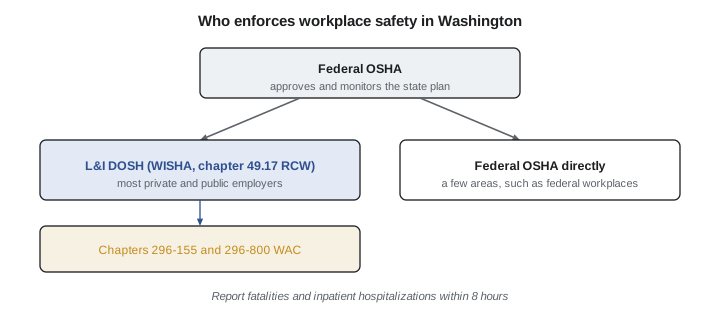
Under the federal Occupational Safety and Health Act, states may run their own workplace safety programs, called state plans, if federal OSHA approves them as at least as effective as the federal program. Washington is a state-plan state. Its program is run by L&I's Division of Occupational Safety and Health, known as DOSH, under the Washington Industrial Safety and Health Act, usually called WISHA, in chapter 49.17 RCW. DOSH covers most private employers in Washington and, unlike federal OSHA in many states, state and local government employers as well. Federal OSHA keeps jurisdiction over a few areas, such as federal employees and some maritime work, which rarely affect an electrical contractor.
For an electrical contractor, this means the safety rules on a Washington job are DOSH rules in Title 296 of the Washington Administrative Code, not the federal rules in 29 CFR directly, and inspections are done by DOSH compliance officers. DOSH rules must be at least as effective as federal rules, and in some areas they are stricter or organized differently. A company that works in Washington and Oregon, for example, deals with two state plans with different rule numbers and some different requirements.
The rules that apply to electrical work
Several sets of DOSH rules apply to an electrical contractor's work. The safety and health core rules in chapter 296-800 WAC apply to employers generally and include the requirement for an accident prevention program, safety meetings, first aid and recordkeeping basics. The construction safety standards in chapter 296-155 WAC apply to construction work, including electrical work on construction sites, and cover subjects such as fall protection, ladders and scaffolds, excavations, power lines and electrical safety on construction sites. Lockout and energy control rules apply to servicing and maintenance work, and general industry rules apply to work in operating facilities. Which chapter applies depends on the kind of work and the setting, and a designated person should know where the company's common tasks fall.
Electrical safety on Washington jobs covers familiar ground: de-energizing and verifying the absence of voltage before work, lockout and tagout, ground-fault protection for temporary power, safe use of portable tools and cords, approach distances to overhead lines, qualified and unqualified workers, and the use of insulated tools and personal protective equipment. Tom's accident was a failure of the most basic step: the crew did not verify the absence of voltage at the point of work after switching off what they thought was the right disconnect.
The accident prevention program
Washington requires employers to have a written accident prevention program tailored to their workplaces and operations. The program must describe how the employer will identify and control hazards, how employees will be trained, how accidents will be reported and investigated, and how safety will be communicated. Employers must also hold safety meetings or have safety committees, depending on their size and structure, and keep records of them. On construction sites, crew safety meetings are commonly held weekly, and the meetings and attendance are documented.
Pilchuck Valley's accident prevention program includes its electrical safety procedures: lockout and verification steps, rules for energized work, temporary power and ground-fault protection, ladder and fall protection rules, and a requirement that every crew hold a weekly safety meeting on site. After Tom's accident, Gary and Jasmine rewrote the verification section to require a test at the point of work, with a tester checked on a known live source before and after, and added it to the topics for every new hire's orientation.
Reporting serious injuries
Washington's reporting rule is stricter than the federal one for hospitalizations. Under WAC 296-27-031, an employer must report to DOSH within eight hours any work-related fatality and any work-related inpatient hospitalization of an employee. An amputation or loss of an eye that does not require inpatient hospitalization must be reported within twenty-four hours; if it does require inpatient hospitalization, the eight-hour deadline applies. The clock runs from the incident, or from when the employer learns of it or learns that it is work-related. Hospitalization only for observation or diagnostic testing is not reportable, and a fatality that occurs later must be reported only if it happens within thirty days of the incident.
Tom spent the night in the hospital for monitoring after the shock, and Bev reported it within the eight hours, on the company's conservative reading that an overnight admission counts. Gary's rule is the same as hers: when in doubt, report, and let DOSH tell you it was not required. Late reporting is a citable violation in itself.
| Event | Report to DOSH within | Notes |
|---|---|---|
| Work-related fatality | 8 hours | Later deaths reportable if within 30 days of the incident |
| Work-related inpatient hospitalization | 8 hours | Not for observation or diagnostic testing only |
| Amputation, no inpatient hospitalization | 24 hours | 8 hours if hospitalized |
| Loss of an eye, no inpatient hospitalization | 24 hours | 8 hours if hospitalized |
Recordkeeping and incident rates
Employers that must keep injury and illness records maintain a log of recordable work-related injuries and illnesses, a summary posted each year and an incident report for each recordable case, using federal forms or equivalent state forms under chapter 296-27 WAC. Recordable cases generally include those that result in days away from work, restricted work, job transfer, medical treatment beyond first aid, loss of consciousness or a significant diagnosed injury or illness. Customers and general contractors often ask for a contractor's incident rate when prequalifying bidders, and a designated person should know how it is calculated.
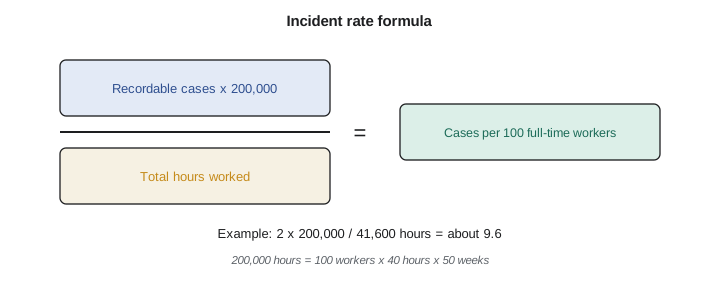
The total recordable incident rate expresses recordable cases per one hundred full-time workers per year, using the standard base of two hundred thousand hours, which is one hundred workers times forty hours a week times fifty weeks. The formula is the number of recordable cases multiplied by two hundred thousand, divided by the total hours worked by all employees in the year. A similar rate can be calculated for cases with days away, restriction or transfer.
# Total recordable incident rate (study aid)
BASE = 200_000   # hours for 100 full-time workers in a year

def incident_rate(cases, hours):
    return round(cases * BASE / hours, 2)

years = [
    (2024, 1, 39_500),
    (2025, 2, 41_600),
    (2026, 0, 43_200),
]
for year, cases, hours in years:
    print(year, "cases:", cases, "hours:", hours, "rate:", incident_rate(cases, hours))
three_year = incident_rate(sum(c for _, c, _ in years), sum(h for _, _, h in years))
print("three-year rate:", three_year)2024 cases: 1 hours: 39500 rate: 5.06 2025 cases: 2 hours: 41600 rate: 9.62 2026 cases: 0 hours: 43200 rate: 0.0 three-year rate: 4.83
The year of Tom's accident shows how quickly a small company's rate rises: two recordable cases in about forty-one thousand hours gives a rate near ten, which is well above typical rates for electrical contractors and can cost a company bids. A three-year combined rate smooths out a single bad year, and many prequalification forms ask for both.
NFPA 70E and the state rules
NFPA 70E, the Standard for Electrical Safety in the Workplace, is a consensus standard rather than a statute, but it is widely used as the practical method for meeting electrical safety requirements, including shock and arc flash risk assessment, approach boundaries, energized electrical work permits, personal protective equipment and the steps to establish an electrically safe work condition. DOSH rules require employers to protect workers from electrical hazards, and following NFPA 70E is a common way to show how that is done. A designated person should make sure the company's procedures are consistent with both the DOSH rules and the edition of NFPA 70E the company uses.
The central principle of NFPA 70E is that energized work is the exception. Work should be done in an electrically safe work condition, achieved by identifying sources, disconnecting, locking and tagging, testing for absence of voltage and grounding where needed. Energized work is justified only where de-energizing creates greater hazards or is infeasible, and it requires a risk assessment, a written energized work permit in most cases and appropriate protective equipment. Tom's accident would not have happened if the crew had followed the electrically safe work condition steps, especially the test for absence of voltage at the point of work.
Worked problem
After the accident
At 10:40 on a Tuesday, Tom is shocked and taken to the hospital, where he is admitted overnight for cardiac monitoring. What must Pilchuck Valley do, and by when?
Show solution
- An inpatient admission is reportable, so DOSH must be notified within eight hours of the incident, by 18:40 that day.
- Monitoring after an electrical shock is generally treated as treatment, not observation only, and Bev's conservative choice to report was correct; when in doubt, report.
- The case must be entered on the injury and illness log if the company is required to keep one, and the accident must be investigated under the accident prevention program.
- The company should review and correct its lockout and verification procedures, retrain crews and document the corrective actions.
Answer: Report to DOSH within 8 hours, record and investigate the case, and correct the procedure that failed.
Building the safety program into daily work
A written accident prevention program is required, but what DOSH inspectors and injured workers notice is whether the program shows up on the job. At Pilchuck Valley, every job begins with a short site orientation that covers the site's hazards, the emergency plan and the nearest medical care. Crews hold short safety meetings on a regular schedule and record the topic and the attendees. Foremen do a quick hazard review before energized work, new tasks and changes in conditions, and they stop work when a hazard cannot be controlled.
Electrical hazards get special attention. The company's lockout and tagout procedure is written for its typical work, each electrician has personal locks and tags, and no one works on equipment until it has been verified de-energized with a tested meter. When energized work is justified, the foreman follows the company's energized work permit process, which draws on NFPA 70E, and checks that the crew has the right personal protective equipment and training. Tom Kessler's shock accident two years ago led to a change in that procedure: the company now requires a second qualified person to review the verification step on any panel over a certain size.
Records support the program. Training records show who was trained on what and when, inspection records show that tools, cords and ladders are checked, and the injury log shows trends that the company's safety committee reviews. When a DOSH inspector visits, the foreman can show the program, the training and the meeting records, which makes the visit shorter and shows the company takes its obligations seriously.
Common mistakes
MistakeCalling federal OSHA about a Washington job injury.
InsteadWashington is a state-plan state; DOSH in L&I enforces WISHA for most employers.
MistakeWaiting 24 hours to report an inpatient hospitalization.
InsteadWashington requires inpatient hospitalizations to be reported within 8 hours.
MistakeTreating NFPA 70E as optional advice.
InsteadIt is the common method for meeting the state's electrical safety requirements, and inspectors and customers expect it.
MistakeSkipping the test for absence of voltage after switching off a disconnect.
InsteadAlways verify absence of voltage at the point of work with a tester checked on a known source.
Summary and key terms
- Washington is a state-plan state: L&I's DOSH enforces WISHA (chapter 49.17 RCW) for most private and public employers.
- Core rules in chapter 296-800 WAC and construction rules in chapter 296-155 WAC apply to electrical contractors.
- Employers must have a written accident prevention program and hold and document safety meetings.
- Fatalities and inpatient hospitalizations must be reported within 8 hours, and amputations or eye loss without hospitalization within 24 hours.
- Incident rate equals recordable cases times 200,000 divided by hours worked; NFPA 70E guides electrically safe work.
- DOSH
- L&I's Division of Occupational Safety and Health, Washington's workplace safety enforcement agency.
- WISHA
- The Washington Industrial Safety and Health Act, chapter 49.17 RCW.
- State plan
- A state workplace safety program approved by federal OSHA in place of federal enforcement.
- Accident prevention program
- The written safety program Washington requires every employer to have.
- Incident rate
- Recordable cases per 100 full-time workers per year, using a base of 200,000 hours.
Practice problems
Work each problem on paper first, then reveal the answer to check.
Who enforces workplace safety for a private electrical contractor in Washington?
Show answer
L&I's Division of Occupational Safety and Health (DOSH) under WISHA.
Within how many hours must a work-related inpatient hospitalization be reported?
Show answer
Eight hours.
A company had 3 recordable cases in 60,000 hours. What is its incident rate?
Show answer
3 x 200,000 / 60,000 = 10.0.
What must Washington employers have in writing for safety?
Show answer
An accident prevention program.
Lesson quiz · 5 questions
Score 60% or more to complete this lesson.
Create a free account to save your progress, take quizzes and earn a certificate.