
MELU-322 · Lesson 1 of 12 · 21 min
How electrical licensing works in Washington
▶ Video coming soon A video version of this lesson is on the way.
Gary Lindqvist started Pilchuck Valley Electric in a rented shop in Lake Stevens in 1998 with one van, one journey-level electrician and a general electrical contractor license from the Washington State Department of Labor and Industries. Twenty-eight years later the company employs twenty-two electricians and trainees and works across Snohomish and King counties: tenant improvements for medical offices in Everett, new duplexes and townhouses around Lake Stevens, a distribution warehouse in Marysville, farm shops in the Snohomish valley and the occasional restaurant in Seattle. Gary has never been the person on the ladder in that time. For most of the company's life he has been its designated electrical administrator, the certified person who answers to the state for whether the company follows Washington's electrical laws and rules.
On a wet Monday in February, Gary asked his lead foreman, Jasmine Tran, to sit down with him and the office manager, Bev Okada. "I'm sixty-four," he said. "The license only works if somebody certified is assigned to it. If I retire or get hit by a bus, Pilchuck Valley is out of business until we find a replacement. I want you to sit the master electrician exam, so you can be the company's designated master and still keep your tools." Jasmine had been a certified general journey-level electrician for seven years and had worked through the master electrician core courses on the National Electrical Code, load calculations, grounding and bonding, motors and transformers, special occupancies, and business and law. This course takes that preparation and applies it to Washington: who licenses electrical work, how the master electrician and administrator certificates work, how the exams are built, which code edition applies, how permits and inspections run, and the state law on contracts, liens, safety and renewal that the exam and the job both demand.
One agency for licensing and inspection
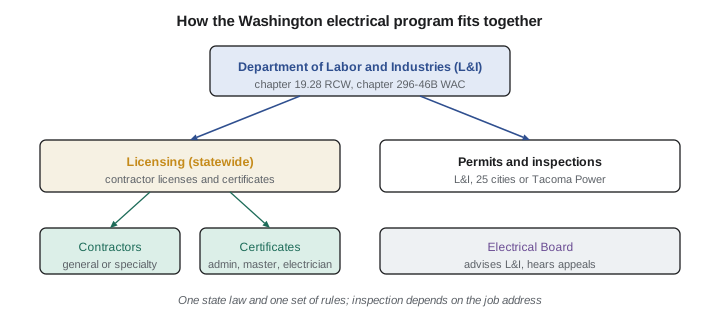
In many states the electrical licensing board and the people who inspect electrical installations work for different agencies. Washington puts most of the system in one place. The Department of Labor and Industries, almost always shortened to L&I, runs the state electrical program. The program licenses electrical contractors, certifies electricians, administrators and master electricians, approves training and continuing education, sells electrical work permits and sends state electrical inspectors to jobs across most of the state. The same department also runs Washington's workplace safety program and the state workers' compensation fund, which is why L&I shows up in several lessons of this course.
The law that sets up the electrical program is chapter 19.28 of the Revised Code of Washington, cited as chapter 19.28 RCW. It covers electrical installations, inspections, contractor licensing, electrician certification and penalties. The detailed rules L&I adopts under that statute are in chapter 296-46B of the Washington Administrative Code, cited as chapter 296-46B WAC. Those rules adopt the National Electrical Code with Washington amendments, set the permit and inspection procedures, list the specialty scopes of work, set fees and spell out the licensing, certification and education requirements. Candidates for the master electrician and administrator exams bring printed copies of both the statute and the rule chapter into the exam room, and one exam section is devoted to them.
L&I also has an advisory board for the electrical program, the Electrical Board, made up of contractors, electricians, inspectors and other members appointed under the statute. The board advises the department on rules and hears appeals of certain citations and decisions. When a contractor disputes a penalty from an electrical inspector, the appeal process runs through this board. You do not need to memorize its membership, but you should know it exists and what it does, because questions about appeals and rulemaking come up on the state law portion of the exam.
Licenses for companies, certificates for people
Washington separates the business from the people who do and supervise the work. A company that offers or performs electrical work for others needs an electrical contractor license from L&I. The license is issued to the business, under its Unified Business Identifier, and it can be a general license, which covers all types of electrical and telecommunications installations, or a specialty license limited to one of the scopes listed in WAC 296-46B-920. Lesson 8 covers the bond, the other conditions and renewal of the contractor license.
The people hold certificates. An electrician certificate allows a person to do electrical work for an electrical contractor, either at the general journey level or in a specialty such as residential, pump and irrigation, signs, limited energy systems or HVAC and refrigeration. A training certificate allows a trainee to work under supervision while gaining the hours needed for an electrician certificate. An administrator certificate allows a person to be assigned to a contractor as its designated administrator. A master electrician certificate allows a person to do electrical work as an electrician and also to be assigned to a contractor as its designated master electrician, which takes the place of an administrator. The two certificates this course prepares you for are the master electrician certificate and the administrator certificate.
| Credential | Who holds it | What it allows |
|---|---|---|
| Electrical contractor license (general or specialty) | The business | Offering and performing electrical work for others, with an assigned administrator or master electrician |
| Electrician certificate (general journey level or specialty) | An individual | Doing electrical work for a licensed contractor within its scope |
| Training certificate | An individual | Doing electrical work under supervision while gaining experience |
| Administrator certificate (general or specialty) | An individual | Being assigned as a contractor's designated administrator; no installing unless also certified as an electrician |
| Master electrician certificate (journey level or specialty) | An individual | Doing electrical work and being assigned as a contractor's designated master electrician |
Why every contractor needs an administrator or master
The heart of the Washington system is a simple rule: every electrical contractor must have a certified administrator or a master electrician assigned to it as the company's designated person. That person takes responsibility for making sure the contractor complies with Washington's electrical laws and rules. The designated person does not have to own the company, and many do not. What matters is that L&I's records show the assignment, that the person's certificate is current, and that the person actually carries out the responsibilities that come with the assignment. Lesson 7 covers those duties in detail.
The difference between the two designated roles is the tools. An administrator certificate is a management credential. L&I's own guidance states that administrators cannot do electrical work or use the tools of the trade unless they also hold an electrician certificate and work for an electrical contractor. A master electrician certificate combines the two roles: the holder is a certified electrician who has passed a more demanding exam and may serve as the designated master for a contractor while still installing. That is why Gary wants Jasmine to become a master electrician rather than an administrator. She keeps running crews and doing work, and the company gains a designated person who knows its jobs from the inside.
Who can do electrical work without a contractor license
The statute and rules describe who needs a contractor license and who does not, and the exam tests these limits. In general, anyone who offers to do or does electrical work for another person needs a license, and the people doing the work need electrician or training certificates. Property owners have a limited exemption to do electrical work on their own property, subject to conditions and to permit and inspection requirements, and with limits on doing work on property intended for sale or rent. Employees of some businesses may do maintenance on their employer's premises under specific rules. Telecommunications work, low-voltage systems and some appliance and equipment repair have their own scopes and exemptions, which is why the specialty categories matter. When a question asks whether a license is needed, read it for three facts: who is doing the work, whose property it is on and what kind of system is involved.
Gary's favorite example is his brother-in-law, who built a shop on his own five acres outside Snohomish. As the owner, he could buy a homeowner electrical permit and wire the shop himself, and the state inspector checked the work like any other installation. When he later asked Gary's crew to add a subpanel for a welder, the work had to be done by Pilchuck Valley under its contractor license, by certified electricians and under a contractor permit, because the crew was doing work for someone else.
Who inspects the work
Licensing is statewide, but inspection is not always done by the state. L&I sells electrical permits and performs inspections in most of Washington. A list of cities run their own electrical permit and inspection programs instead: L&I's list at the time of writing names twenty-five cities, including Seattle, Spokane, Bellevue, Everett, Federal Way, Lacey, Vancouver and Olympia, plus Tacoma Power, which handles permits and inspections in its own service area. Inside one of those jurisdictions, you buy the permit from the city and the city's inspectors inspect the work; L&I does not issue permits there. Everywhere else, you buy the permit from L&I. Lesson 6 covers this in detail, including how to check which agency has a given address.
The cities that inspect must adopt rules that are at least equal to the state's, and many adopt the same NEC edition on a similar schedule. Seattle publishes its own Seattle Electrical Code with local amendments. Licensing, however, stays with L&I everywhere. A contractor needs only the state license to work in Seattle or Spokane, although those cities may require their own business licenses and permit accounts. Pilchuck Valley's crews regularly move between L&I jobs in Lake Stevens, city-inspected jobs in Everett and Marysville and the occasional Seattle job, and Bev keeps a list of which agency covers each job address.
# Which agency issues the permit and inspects? (study aid; check L&I's current list)
CITY_PROGRAMS = {"Aberdeen", "Bellingham", "Bellevue", "Burien", "Des Moines", "Everett",
                 "Federal Way", "Kirkland", "Lacey", "Lynnwood", "Marysville", "Mercer Island",
                 "Milton", "Mountlake Terrace", "Normandy Park", "Olympia", "Port Angeles",
                 "Redmond", "Renton", "Sammamish", "SeaTac", "Seattle", "Spokane",
                 "Tukwila", "Vancouver"}
jobs = [
    ("Medical office tenant improvement", "Everett", False),
    ("Two duplexes", "Lake Stevens", False),
    ("Distribution warehouse", "Marysville", False),
    ("Farm shop, unincorporated county", None, False),
    ("Restaurant remodel", "Seattle", False),
    ("Office building in Fircrest", "Fircrest", True),
]
def authority(city, tacoma_power_area):
    if tacoma_power_area:
        return "Tacoma Power"
    if city in CITY_PROGRAMS:
        return "City of " + city
    return "L&I"
for name, city, tp in jobs:
print(name.ljust(36), "->", authority(city, tp))Medical office tenant improvement -> City of Everett Two duplexes -> L&I Distribution warehouse -> City of Marysville Farm shop, unincorporated county -> L&I Restaurant remodel -> City of Seattle Office building in Fircrest -> Tacoma Power
The calculator mirrors the decision Bev makes for every new job: if the address is inside one of the listed cities, the city handles the permit and inspections; if it is in Tacoma Power's service area, Tacoma Power does; otherwise L&I does. The real check uses the exact address, because city limits and utility service areas do not follow mailing addresses. A job with an Everett mailing address can sit in unincorporated Snohomish County, where L&I inspects.
Worked problem
Sorting Pilchuck Valley's spring jobs
Bev lists five new jobs: a medical office remodel inside Everett city limits, two duplexes in Lake Stevens, a warehouse in Marysville, a farm shop in unincorporated Snohomish County and a restaurant remodel in Seattle. Who issues the electrical permit for each?
Show solution
- Everett, Marysville and Seattle each run their own electrical permit and inspection programs, so their jobs get city permits.
- Lake Stevens is not on L&I's list of inspecting cities, so the duplexes get an L&I permit.
- The farm shop is outside any city, so L&I issues the permit and inspects it.
- The contractor license from L&I covers all five jobs; only the permit and inspection agency changes.
Answer: City permits for Everett, Marysville and Seattle; L&I permits for Lake Stevens and the county farm shop.
Where the rules live
Washington electrical contractors work under several layers of law, and the exam rewards knowing which layer answers which question. Chapter 19.28 RCW sets the framework: who must be licensed and certified, the duties of administrators and master electricians, inspections and penalties. Chapter 296-46B WAC fills in the details: the adopted NEC and Washington amendments, permit types and fees, specialty scopes, certification and continuing education rules. Other statutes cover the business side, including construction liens in chapter 60.04 RCW, contractor registration for non-electrical work in chapter 18.27 RCW, workplace safety under the Washington Industrial Safety and Health Act in chapter 49.17 RCW and workers' compensation in Title 51 RCW. Cities that inspect add their own codes and procedures. When a question comes up on the job or on the exam, start by asking which of these layers it belongs to.
Common mistakes
MistakeAssuming the master electrician and administrator certificates are the same credential.
InsteadBoth can be a contractor's designated person, but only a master electrician is also a certified electrician who may use the tools.
MistakeThinking the contractor license belongs to the designated administrator.
InsteadThe license belongs to the business; the administrator or master is assigned to it and can change.
MistakeBuying an L&I permit for every job in the state.
InsteadInside the cities with their own programs and in Tacoma Power's area, the permit comes from that agency.
MistakeTreating a city that inspects as also licensing contractors.
InsteadLicensing and certification stay with L&I everywhere in Washington.
Summary and key terms
- L&I runs Washington's electrical program under chapter 19.28 RCW, with detailed rules in chapter 296-46B WAC.
- Businesses hold electrical contractor licenses; individuals hold electrician, training, administrator and master electrician certificates.
- Every electrical contractor must have an assigned administrator or master electrician who is responsible for compliance.
- Administrators may not use the tools of the trade unless they are also certified electricians; master electricians may.
- L&I inspects most of the state, but twenty-five cities and Tacoma Power run their own permit and inspection programs.
- L&I
- The Washington State Department of Labor and Industries, which runs the electrical program, workplace safety and workers' compensation.
- Chapter 19.28 RCW
- The Washington statute on electrical installations, licensing, certification and inspection.
- Chapter 296-46B WAC
- L&I's electrical rules, including the adopted NEC with Washington amendments.
- Designated administrator
- The certified administrator assigned to a contractor and responsible for its compliance.
- Designated master electrician
- A master electrician assigned to a contractor in place of an administrator.
Practice problems
Work each problem on paper first, then reveal the answer to check.
Which agency licenses electrical contractors in Washington?
Show answer
The Department of Labor and Industries (L&I).
Name the statute and the rule chapter that govern electrical work in Washington.
Show answer
Chapter 19.28 RCW and chapter 296-46B WAC.
Can a designated administrator who holds no electrician certificate install a panel?
Show answer
No. Administrators may not use the tools of the trade unless they also hold an electrician certificate and work for a contractor.
A job is inside Spokane city limits. Who sells the electrical permit?
Show answer
The City of Spokane, which runs its own electrical permit and inspection program.
Lesson quiz · 5 questions
Score 60% or more to complete this lesson.
Create a free account to save your progress, take quizzes and earn a certificate.