
MELU-322 · Lesson 6 of 12 · 20 min
Permits, inspections and the inspection authority
▶ Video coming soon A video version of this lesson is on the way.
Bev runs permits at Pilchuck Valley the way an air traffic controller runs a runway. Every job has a permit number before the first van leaves the shop, every inspection request goes in the day the work is ready, and every correction notice goes on the whiteboard until it is cleared. Gary hired her eleven years ago after a job in Snohomish County got covered before the rough-in inspection and the general contractor had to tear out a finished ceiling. "That cost us more than her first year's salary," he said. "Permits are not paperwork. They are how the state knows the work was done right, and how we prove it."
This lesson covers the permit and inspection system as a designated administrator or master electrician must understand it: who issues permits and inspects, when a permit is required, the main permit types, plan review, the inspection sequence, corrections and what inspectors check beyond the installation itself. The details are in chapter 19.28 RCW and in chapter 296-46B WAC, particularly the parts on permits, fees and inspections, and the exam's Washington codes section draws heavily on them.
Who issues permits and inspects
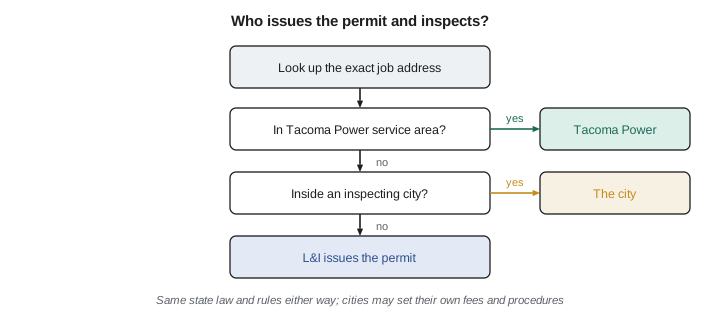
As Lesson 1 explained, L&I sells electrical work permits and performs inspections in most of Washington. A list of cities, twenty-five at the time of writing, run their own electrical permit and inspection programs, and Tacoma Power handles permits and inspections for customers in its service area, which reaches beyond Tacoma into Fircrest, University Place, Fife, parts of Steilacoom and Lakewood, and unincorporated Pierce County as far south as Roy. Inside those jurisdictions, the contractor buys the permit from the city or Tacoma Power and requests inspections from it; L&I does not issue permits there. Everywhere else, the permit comes from L&I.
L&I's guidance is to verify the jurisdiction before buying a permit. City limits do not follow mailing addresses or ZIP codes, so an address with a city name may sit in unincorporated county land, and the reverse. L&I suggests the Department of Revenue's address lookup tool, which shows a city name on its sales and use tax tab only when the address is inside city limits. Buying a permit from the wrong agency causes delays and can cost a processing fee, although L&I notes that fees paid to the wrong agency may be refunded.
When a permit is required
As a rule, electrical work covered by chapter 19.28 RCW requires an electrical work permit and inspection, whether the work is new construction, a remodel, an addition or a repair that goes beyond simple replacement. The permit must normally be obtained before work begins. The rules provide limited exceptions and alternatives, such as provisions for emergency repairs, where the permit must be obtained promptly after the emergency work, and for certain minor work. Like-for-like replacement of some devices, and certain low-voltage and telecommunications work, have specific rules that should be checked in WAC 296-46B before assuming no permit is needed.
The permit belongs to the installer. A contractor buys a contractor permit for work it does for customers. A property owner doing work on their own property under the owner exemption buys a homeowner permit. Each permit identifies the property, the scope of work and the person responsible. When a contractor takes over a job from another contractor, a new permit is normally needed, because the first contractor's permit covers only the first contractor's work. Jasmine learned this the hard way on a remodel where the homeowner had fired the previous electrician; Bev bought a new permit and the inspector inspected all the work, including what the previous contractor had left behind.
Permit types
L&I offers several types of electrical permits, priced by the type and size of the work under the fee schedule in chapter 296-46B WAC. Most contractor work uses a standard electrical work permit, purchased online, with fees based on the type of occupancy and the size of the service, feeders or circuits involved. Some minor work can use a Class B permit, a simplified permit for listed types of small jobs, such as some circuit extensions and like-for-like replacements, under rules in chapter 296-46B WAC. Under the 2024 rule changes, Class B permits are valid for 120 days. Larger customers, such as industrial plants, may hold annual permits that cover maintenance work by their own electricians or contractors under specified conditions.
| Permit | Typical use | Key point |
|---|---|---|
| Contractor electrical work permit | New work, remodels, services, feeders, circuits for customers | Bought before work begins; fee based on scope |
| Homeowner electrical work permit | An owner's own work on their own property | Owner exemption conditions apply |
| Class B permit | Listed minor work | Simplified; valid for 120 days under the 2024 rules |
| Annual permit | Ongoing maintenance at a facility | Conditions and recordkeeping set by the rules |
Plan review
Some work needs plans reviewed and accepted before the permit inspection can proceed. L&I's plan review page explains when electrical plans must be submitted. In general, plan review applies to certain occupancies where the consequences of an error are serious, such as educational, institutional and health care facilities, and to larger or more complex installations, with thresholds and exceptions set in WAC 296-46B. The 2024 rule changes added system design review requirements for fuel cell systems and standalone systems and added design review language to the rules on solar, wind and interconnected power production sources. Plan review takes time and has its own fees, so a contractor bidding a school or clinic must allow for it in the schedule.
Pilchuck Valley's Everett medical office job falls in the city of Everett's jurisdiction, so the city's own plan review rules apply rather than L&I's. Marco, the estimator, checks the plan review requirements of the inspecting agency before every bid on a health care, school or large commercial project, and builds the review time into the schedule he gives the general contractor.
The inspection sequence
Inspections follow the work. On a typical new building, the inspector visits for underground or slab work before it is buried or covered, for service and feeder work, for rough-in before walls and ceilings are covered, for any above-ceiling work before ceilings close, and for the final inspection when the installation is complete and energized or ready to be. Smaller jobs may need only a final or a rough-in and final. The contractor requests each inspection when the work is ready, usually through the inspecting agency's online system, and must not cover work that has not been inspected and approved.
When an inspector finds a problem, the result is a correction notice that lists the violations and requires them to be fixed and reinspected. Work that is unsafe or seriously out of compliance can be red-tagged, and the utility may not connect or may disconnect service until the problem is resolved. A designated administrator or master electrician must make sure corrections are made promptly, because uncorrected violations can lead to penalties against the contractor and can affect the company's ability to renew its license and buy permits online.
# Tracking inspections on a job (study aid)
stages = ["underground", "service and feeders", "rough-in", "above-ceiling", "final"]
results = {
    "underground": "approved",
    "service and feeders": "approved",
    "rough-in": "correction: missing box fill label, bonding jumper at water pipe",
    "above-ceiling": "not requested",
    "final": "not requested",
}
ready_to_cover = True
for stage in stages:
    r = results[stage]
    print(stage.ljust(22), r)
    if r != "approved":
        ready_to_cover = False
        print("   -> do not cover or move on until", stage, "is approved")
        break
print("next action:", "request reinspection" if not ready_to_cover else "request next stage")underground approved service and feeders approved rough-in correction: missing box fill label, bonding jumper at water pipe -> do not cover or move on until rough-in is approved next action: request reinspection
The output reflects the rule that matters most in the field: the job moves forward one approved stage at a time. Jasmine's crews use a simple version of this list on a clipboard in each job trailer, and nobody closes a wall or a ceiling until the line for that stage says approved.
What inspectors check beyond the wiring
Washington electrical inspectors check more than the installation. Under chapter 19.28 RCW, inspectors also check that the contractor is licensed for the type of work, that the work is being done by properly certified electricians and trainees, and that trainees are supervised as the statute and rules require. An inspector who finds an uncertified person doing electrical work, a trainee working without required supervision or a contractor working outside its specialty can issue citations with monetary penalties, in addition to correction notices for the installation. The penalty schedule is in the rules, and penalties increase for repeat violations.
This is a major reason the designated administrator or master electrician role matters. Inspectors may ask the electricians on site to show their certificates, and the company is responsible for knowing that every person doing electrical work holds a current certificate of the right type and that trainees are supervised at the required ratio. Bev keeps a list of every field employee's certificate type, number and expiration date, and checks it monthly against L&I's Verify tool.
Worked problem
A correction on the Lake Stevens duplexes
At the rough-in inspection on the Lake Stevens duplexes, the L&I inspector finds two missing bonding jumpers and notes that a trainee is working alone in the second unit while Jasmine is in the first. What must Pilchuck Valley do?
Show solution
- Correct the bonding jumpers and request a reinspection before insulation or drywall goes in.
- Make sure the trainee is supervised as the statute and rules require for the trainee's certificate type, starting immediately.
- Expect a possible citation for the supervision violation, separate from the correction notice for the installation.
- The designated master or administrator should review supervision practices on all jobs so the violation does not repeat.
Answer: Fix and reinspect the bonding, correct the supervision immediately and treat the supervision citation as a compliance issue for the whole company.
Working with inspectors
Inspections go better when the contractor treats the inspector as a partner in getting the job right rather than as an obstacle. Gary's rules for his foremen are simple. Request the inspection only when the work is truly ready, because a failed inspection costs a trip for the inspector and a delay for the job. Have the permit, the approved plans where plan review was required, and any engineering or load calculations on site and easy to find. Walk the job with the inspector if invited, answer questions directly and never cover work that has not been approved.
When an inspector writes a correction, the foreman reads it carefully, asks for clarification on the spot if the requirement is not clear, and logs it on the job's correction list. The designated person, as Lesson 7 explains, is responsible for seeing that corrections are made, so Jasmine reviews the open list every week. If the company disagrees with a correction, the right path is a polite conversation, then the inspector's supervisor and, if necessary, the appeal process that chapter 19.28 RCW and chapter 296-46B WAC provide, rather than an argument on the job site.
The same habits apply when a city rather than L&I inspects the work. Cities with their own electrical programs set their own procedures for requesting inspections, their own fees and sometimes their own local requirements, and their inspectors may work differently from the L&I inspectors in the surrounding county. Pilchuck Valley keeps a short sheet for each city it works in, listing how to buy a permit, how to request an inspection and any local practices the foremen have learned, and it updates the sheet whenever something changes.
Inspectors also notice who is doing the work. As Lesson 6 explains, L&I inspectors check certificates and trainee supervision as well as installations, and a job where trainees are working without the required supervision can bring citations to the contractor. Every foreman at Pilchuck Valley can show the inspector each worker's certificate on request, either as a card or on the L&I Verify tool.
Common mistakes
MistakeBuying the permit from the agency named in the mailing address.
InsteadVerify the exact address: city limits and Tacoma Power's area do not follow mailing addresses.
MistakeCovering work before the inspection because the schedule is tight.
InsteadWork must not be covered until it is inspected and approved.
MistakeAssuming a new contractor can work under the previous contractor's permit.
InsteadEach installer needs its own permit for its work.
MistakeThinking inspectors only look at wiring.
InsteadInspectors also check licensing, certificates and trainee supervision and can issue citations.
Summary and key terms
- L&I issues permits and inspects in most of Washington; twenty-five cities and Tacoma Power run their own programs.
- Verify the jurisdiction from the exact address before buying a permit.
- Electrical work normally needs a permit before work begins; Class B permits cover listed minor work and are valid for 120 days.
- Plan review applies to certain occupancies and systems, including new design review for fuel cell and standalone systems.
- Inspectors check the installation, licensing, certificates and trainee supervision, and can issue correction notices and citations.
- Electrical work permit
- The permit bought from the inspecting agency before electrical work begins.
- Class B permit
- A simplified L&I permit for listed minor work, valid for 120 days.
- Plan review
- Review and acceptance of electrical plans before work, required for certain occupancies and systems.
- Correction notice
- An inspector's list of violations that must be fixed and reinspected.
- Red tag
- A notice that an installation is unsafe or seriously noncompliant and may not be energized.
Practice problems
Work each problem on paper first, then reveal the answer to check.
A job is in Fife, in Tacoma Power's service area. Who issues the permit?
Show answer
Tacoma Power.
How long is a Class B permit valid under the 2024 rules?
Show answer
120 days.
What must happen before a wall is closed over new wiring?
Show answer
The rough-in inspection must be done and approved.
Besides the installation, what do inspectors check?
Show answer
Contractor licensing, electrician and trainee certificates and trainee supervision.
Lesson quiz · 5 questions
Score 60% or more to complete this lesson.
Create a free account to save your progress, take quizzes and earn a certificate.