
MELU-322 · Lesson 12 of 12 · 20 min
Practice exam review and test-day strategy
▶ Video coming soon A video version of this lesson is on the way.
Three weeks before her exam date, Jasmine sat at Gary's kitchen table with a stack of practice questions, a timer and her tabbed code book. Gary had taken the administrator exam in 2001, and he remembered one thing above all. "I knew the material," he said. "What nearly beat me was the clock and the book. You have to know where things are, not just what they say." This lesson pulls the course together into a final review plan and a test-day strategy for the Washington master electrician and administrator exams.
The lesson reviews the structure of the exams from Lesson 4, sets out a study plan for the last six weeks, explains how to use practice exams to find weak areas, works through the kinds of calculations that appear on the exam, and finishes with a checklist for the day of the exam. The goal is not to memorize answers but to arrive with a book you can navigate, a pace you have practiced and a plan for every section.
The shape of the exam, one more time
Both exams are open book, computer based and delivered by PSI, with separate sections that are scored separately. As Lesson 4 described, the master electrician exam has an NEC and theory section of eighty questions in four hours, a Washington codes section on chapter 19.28 RCW and chapter 296-46B WAC with twenty questions in one hour, and a major load calculations section of ten questions in two hours; the administrator exam has the same three sections and times with fewer questions in the first two. A candidate must score at least seventy on each section, and a passing score in one section does not make up for a failing score in another. A failed section can be retaken on its own, after the waiting period.
That structure shapes the study plan. The NEC and theory section is the largest and rewards fast navigation of the book together with a working command of electrical formulas. The load calculations section has few questions but long, multi-step problems, so one careless error costs a large share of that section's score. The Washington codes section is short but easy to fail, because candidates often treat it as an afterthought; a few questions there carry the same weight toward passing that section as many questions in the NEC section carry toward that one.
A six-week plan
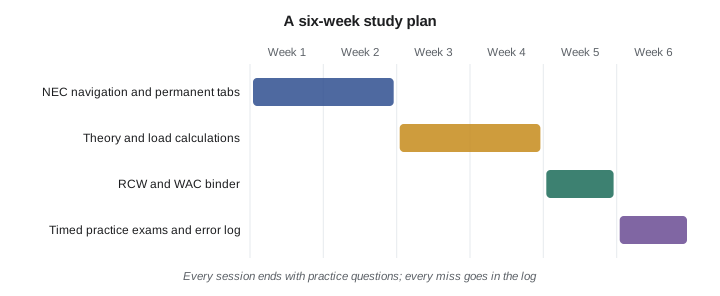
Jasmine built her plan backward from her exam date, using the hours she could realistically study around a full-time job: about eight hours a week, more on the last two weekends. Weeks one and two went to the code book: reading the table of contents and the index until she could find any article in seconds, adding permanent tabs to the articles she used most, and highlighting key words. Weeks three and four went to theory and calculations: Ohm's law, power, voltage drop, transformer and motor calculations, power factor and complete practice load calculations for dwellings, multifamily buildings and commercial occupancies. Week five went to the RCW and WAC binder, reading the statute and the rules section by section and tabbing the parts on certificates, supervision, permits, inspections and penalties. Week six was full timed practice exams and targeted review.
The plan had one rule: every study session ended with practice questions, and every missed question went into a log with the topic, the reason she missed it and where the answer was in the book. By the end of week four the log showed a pattern. She rarely missed code questions because she didn't know the rule; she missed them because she looked in the wrong article first. That told her to spend more time on the index, not more time reading.
| Week | Focus | Practice |
|---|---|---|
| 1 and 2 | NEC navigation, index, permanent tabs | Short timed lookup drills |
| 3 and 4 | Theory and load calculations | Formula sets and full load calculation problems |
| 5 | Chapter 19.28 RCW and chapter 296-46B WAC | Binder lookups and short quizzes |
| 6 | Full timed practice exams | Error log review and retesting weak topics |
Using practice exams well
A practice exam is a measuring tool, not a source of answers. The real exam's questions are confidential and change over time, so memorizing a practice set teaches very little. What a practice exam can show is how fast you work, which topics you miss and whether your book navigation holds up under time pressure. To get that information, take practice exams under exam conditions: timed, with only the references the real exam allows, and without stopping to look things up outside the book.
After each practice exam, review every question, including the ones you got right. A question answered correctly by luck is a weak spot. Sort the misses into three groups: did not know the rule, knew the rule but could not find it fast enough, and misread the question. Each group needs a different fix. Rules you did not know need study; rules you could not find need better tabs and index practice; misread questions need slower reading of the stem, especially words like not, except, minimum and maximum.
Calculations: show the steps
Calculations appear in two places. The NEC and theory section tests formulas such as Ohm's law, power, efficiency and voltage drop, and uses short calculations to apply code rules such as conductor ampacity with adjustment and correction, box and conduit fill and motor circuits. The major load calculations section builds whole problems around service and feeder loads for dwellings, multifamily buildings and commercial occupancies. The method matters more than the speed: write down what is given, the formula or code rule that applies, the substitution and the answer with its unit, then check that the answer is sensible.
# Practice: single-phase voltage drop and a three-phase power check (study aid)
import math

def vd_single(k, amps, feet, cmil):
    return 2 * k * amps * feet / cmil

k = 12.9          # approximate ohm-cmil per foot for copper
amps = 24
feet = 75
cmil = 6530       # 10 AWG conductor area in circular mils
vd = vd_single(k, amps, feet, cmil)
print("voltage drop:", round(vd, 2), "volts")
print("as a fraction of 240 volts:", round(vd / 240, 4))

volts = 480
pf = 0.85
kw = 50
amps3 = kw * 1000 / (math.sqrt(3) * volts * pf)
print("three-phase current for 50 kW at 480 V, pf 0.85:", round(amps3, 1), "amps")voltage drop: 7.11 volts as a fraction of 240 volts: 0.0296 three-phase current for 50 kW at 480 V, pf 0.85: 70.8 amps
The first result shows a voltage drop of about 7.1 volts on a 240-volt circuit, a fraction of about 0.03, which is the kind of number a question might compare with a design recommendation. The second shows a current of about 70.8 amperes. On the exam you would work these on the calculator allowed by PSI, but the habit is the same: formula, substitution, answer, unit and a quick check that the result makes sense.
Pacing and the two-pass method
Lesson 4 introduced pacing and the two-pass method. On test day, put them into practice. Before starting a section, note the number of questions and the time, and work out the average time per question and the checkpoints: how many questions should be done at a quarter, half and three quarters of the time. On the first pass, answer every question you can answer quickly and mark the ones that need a long lookup or calculation. On the second pass, work the marked questions in order of how quickly you think you can solve them. In the final minutes, make sure every question has an answer, because an unanswered question cannot be right.
Jasmine set herself one more rule from her practice exams: if a lookup takes more than about three minutes without progress, mark it, pick the best answer so far and move on. In practice tests she found that she often solved the marked question quickly on the second pass, because another question had sent her to the right article in the meantime.
The RCW and WAC section
The state law and rules section deserves its own review, because it tests the material from Lessons 1, 2, 3, 6, 7 and 11 directly: who needs a license or certificate, the certificate types and their scopes, trainee supervision, permits and inspections, the duties of the designated administrator or master electrician, penalties and appeals, and renewal and continuing education. Questions often turn on a number, such as a deadline or a period, or on a definition. A well-organized binder, with permanent tabs on the definitions and the sections on certificates, supervision, permits and the designated person, is the best preparation.
Test day
On the day of the exam, arrive early with the identification PSI requires and the references allowed, checked against the bulletin. Expect the proctor to inspect the books for notes, removable tabs and loose papers, and expect a check-in process that takes time. Use the tutorial at the start of the computer exam to learn the marking and review features. During breaks, if the bulletin allows them, stand up, drink water and reset; do not spend the break reviewing the section just finished.
After the exam, PSI gives a score report. A candidate who passes all sections follows the steps from Lesson 3 to get the certificate issued. A candidate who fails a section reviews the score report for weak areas, waits the required period and retakes only the failed section, within the one-year window that applies to the route. Jasmine passed all three sections on June 9, 2026, and the first thing she did was text Gary a photo of her score report from the parking lot.
Worked problem
Planning the NEC and theory section
Jasmine's NEC and theory section has 80 questions in 4 hours. What pace should she plan, and where should her checkpoints be?
Show solution
- Total time is 240 minutes for 80 questions, an average of 3 minutes per question.
- Checkpoints: about 20 questions at 60 minutes, 40 at 120 minutes and 60 at 180 minutes.
- On the first pass, answer quick questions and mark long lookups; aim to finish the first pass with at least 45 minutes left.
- On the second pass, work the marked questions and make sure every question has an answer before time runs out.
Answer: Three minutes a question on average, with checkpoints at 20, 40 and 60 questions, and a second pass for marked questions.
The last week and the night before
The last week is for review, not new material. Jasmine spent it on her error log, retesting each weak topic with fresh practice questions, and on two final timed sections, one code and one RCW and WAC, to confirm her pace. She stopped studying at dinner time the night before, packed her books, identification and admission information, and checked the route to the PSI test center and the parking. Gary's advice was to treat the night before like the night before a long day on a job: eat properly, sleep and leave early.
On the morning of the exam she reviewed only her one-page summary of formulas and key state law numbers, which she then left in the car, because notes are not allowed in the room. She arrived at the test center well before the check-in time listed in her confirmation, leaving room for the identification check and the inspection of her books.
During the exam, she watched for the habits she had practiced. She read each question stem to the end before opening the book, noted key words such as minimum, maximum, not and except, and used the marking feature for long lookups. When a question seemed to have two right answers, she reread the stem for a detail that ruled one out, rather than guessing at once. And she checked the clock at each checkpoint, which kept her from spending too long on any one problem.
If the score report shows a failed section, the plan starts again on a smaller scale. The report shows performance by content area, and those areas become the first entries in a new error log. Jasmine's advice to the next candidate at Pilchuck Valley, Renee, is to book the retake as soon as the waiting period allows, while the material is still fresh, and to spend the waiting time on the weak areas rather than on the whole course. Most candidates who miss a section by a few points pass it on the next attempt with focused review.
Common mistakes
MistakeMemorizing practice exam answers.
InsteadUse practice exams to measure speed and find weak topics; the real questions differ.
MistakeNeglecting the RCW and WAC section because it is short.
InsteadEach section is scored separately; a short section can still be failed.
MistakeSpending ten minutes on one lookup.
InsteadMark it, choose the best answer so far and come back on the second pass.
MistakeBringing references the bulletin does not allow.
InsteadCheck the bulletin; removable tabs, sticky notes and handwritten notes are not allowed.
Summary and key terms
- Each section is scored separately, with seventy needed on each, so the plan must cover all three.
- A six-week plan can cover navigation, theory, state law and timed practice exams.
- Use practice exams to measure speed and find weak topics, and keep a log of every miss.
- Show the steps on calculations: given, formula, substitution, answer and unit.
- Pace each section with checkpoints, use two passes and answer every question.
- Error log
- A record of missed practice questions with the topic, the reason and where the answer is found.
- Checkpoint
- A planned question count at a set time, used to track pace during a section.
- Two-pass method
- Answering quick questions first and returning to marked questions on a second pass.
- Score report
- PSI's report of results by section after the exam.
- Candidate bulletin
- PSI's document describing the exam, the references allowed and test-day rules.
Practice problems
Work each problem on paper first, then reveal the answer to check.
What score is needed on each section?
Show answer
Seventy.
What are the three groups for sorting missed practice questions?
Show answer
Did not know the rule, could not find it fast enough, misread the question.
What is the average time per question on an 80-question, 4-hour section?
Show answer
Three minutes.
What should you do with a lookup that is going nowhere after about three minutes?
Show answer
Mark it, pick the best answer so far and return on the second pass.
Lesson quiz · 5 questions
Score 60% or more to complete this lesson.
Create a free account to save your progress, take quizzes and earn a certificate.