
MELU-321 · Lesson 9 of 12 · 18 min
Contracts and mechanics' liens in Virginia
▶ Video coming soon A video version of this lesson is on the way.
Mill Mountain had one bad receivable that Hal still talked about. In 2017 the company wired a medical office building in Daleville for a developer who stopped paying the general contractor, who in turn stopped paying the subcontractors. Mill Mountain was owed just over 61,000 dollars. Hal had recorded a mechanic's lien, but a week too late, and the lien was challenged and failed. The company eventually recovered part of the money through a lawsuit against the general contractor, but it took two years and cost a fortune in legal fees. "Virginia lien law is unforgiving," he told Angela. "Miss a date by a day and the right is gone."
This lesson covers the contracts and lien law a Virginia electrical contractor works with. It explains the basic parts of a construction contract and the clauses that matter most to an electrical firm, payment terms and prompt payment, the mechanics' lien statute in Title 43 of the Code of Virginia with its deadlines and notices, the special rules for residential projects that name a mechanics' lien agent, lien waivers, and the rules for public projects where liens are not available. It closes with a practical system for tracking lien deadlines, the kind of system Hal wished he had had in 2017.
Contracts
Every job should start with a written contract that identifies the parties, the property, the scope of work, the price or pricing method, the schedule, payment terms, change order procedures, warranty terms, insurance and indemnity requirements, and how disputes will be resolved. On commercial jobs, the electrical contractor is usually a subcontractor working under a contract written by the general contractor, and the subcontract often passes down terms from the prime contract. Reading those terms before signing is part of a master's job when he or she is involved in estimating and project management, because clauses about payment, delays and backcharges determine whether a job makes money.
Change orders deserve special attention. Electrical scopes change constantly, as owners add equipment, designers revise drawings and existing conditions turn out to be different from what the plans showed. A contract that requires written change orders before extra work begins protects both sides, and a contractor who does extra work on a verbal request may struggle to be paid for it. Angela's rule on Mill Mountain jobs was that no crew performed changed work without at least a signed field change authorization describing the work, even if the price was settled later.
| Clause | Why it matters to an electrical subcontractor |
|---|---|
| Scope and exclusions | Defines what is and is not in the price |
| Payment terms and retainage | Sets when money arrives and how much is held back |
| Change orders | Controls how extra work is authorized and paid |
| Schedule and delays | Allocates the cost of delays caused by others |
| Insurance and indemnity | Sets required coverage and who bears certain losses |
| Dispute resolution | Decides between negotiation, mediation, arbitration or court |
Payment and prompt payment
Virginia has prompt payment rules for public construction under the Virginia Public Procurement Act, which require public owners and their contractors to pay within set periods and to pass payments down to subcontractors promptly, with interest on late payments. Virginia law also contains prompt payment provisions for many private construction contracts, adopted and amended in recent years, which address the time for payment and limit some pay-if-paid arrangements. The private-contract rules have conditions and exceptions, and they have been revised more than once, so check the current statute before relying on them. On every job, know the contract's payment terms and the statutory backstops that apply.
Retainage, the portion of each progress payment held back until completion, is common on commercial work. It ties up a significant amount of a contractor's money, and the rules for when it must be released are set by the contract and, for public projects, by statute. Retainage also has a special place in the lien statute, as explained below. Denise kept a separate retainage schedule showing every job's retained amount and the expected release date, because retainage that is forgotten is retainage that is often never collected.
The mechanics' lien
A mechanic's lien is a claim against real property for the value of labor and materials furnished to improve it. Virginia's lien statute in Chapter 1 of Title 43 lets general contractors, subcontractors and certain lower-tier suppliers record a memorandum of lien in the circuit court clerk's office for the county or city where the property is located. The lien gives a claimant who is not paid a way to look to the property itself, which matters most when the party above the claimant cannot or will not pay. Because a lien is a powerful remedy, Virginia courts enforce its requirements strictly.
The key deadline is the time to record the memorandum. As summarized by Virginia construction practitioners, the memorandum must be recorded within 90 days from the last day of the month in which the claimant last furnished labor or materials, and in no event later than 90 days after the building or structure is completed or the work is otherwise terminated. Note the twist: the 90 days run from the last day of the month, not the last day of work, but the completion deadline can cut that period short. A memorandum also cannot include sums for labor or materials furnished more than 150 days before the last day of work, with exceptions for retainage and amounts not yet due.
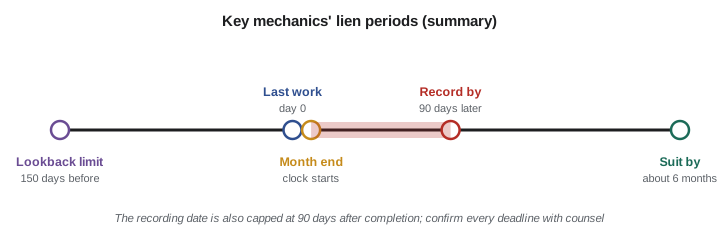
After recording, a lien must be enforced by filing suit within the statutory period, generally within six months after recording the memorandum or within 60 days after the building is completed or the work is terminated, whichever is later. A lien that is not enforced in time is lost. General contractors must also mail a copy of the memorandum to the owner and file proof of mailing, and subcontractors and lower-tier claimants must give the owner, and in some cases the general contractor, written notice of the claim as the statute requires. Each of these steps has its own form and timing, which is why most contractors use a lawyer or a lien service for any significant claim.
# Lien recording window (simplified study aid; not legal advice)
from datetime import date, timedelta
import calendar

def end_of_month(d):
    return date(d.year, d.month, calendar.monthrange(d.year, d.month)[1])

def recording_deadline(last_work, completion):
    from_month_end = end_of_month(last_work) + timedelta(days=90)
    cap = completion + timedelta(days=90)
    return min(from_month_end, cap)

last_work = date(2026, 3, 4)
completion = date(2026, 4, 10)
print("End of the month of last work:", end_of_month(last_work))
print("90 days from month end:", end_of_month(last_work) + timedelta(days=90))
print("90 days from completion:", completion + timedelta(days=90))
print("Record no later than:", recording_deadline(last_work, completion))
print("Earliest work that can be included (150-day lookback):", last_work - timedelta(days=150))End of the month of last work: 2026-03-31 90 days from month end: 2026-06-29 90 days from completion: 2026-07-09 Record no later than: 2026-06-29 Earliest work that can be included (150-day lookback): 2025-10-05
In the example, 90 days from the end of March falls on June 29, while 90 days after completion on April 10 falls on July 9. The earlier of the two controls, so the memorandum must be recorded by June 29. Had the building been completed in late March instead, the completion cap would have come first and cut the period short. The simplified study aid ignores weekends, holidays and arguments about when work was really finished, all of which are reasons to record early rather than on the last possible day.
Residential projects and the mechanics' lien agent
Virginia has a special notice rule for one- and two-family residential projects. When the owner designates a mechanics' lien agent, the agent's name appears on the building permit, and anyone furnishing labor or materials who wants to preserve full lien rights must send notice to that agent within 30 days of first furnishing, or within 30 days of the permit's issuance if work began before the permit. A claimant who misses that window generally can claim a lien only for labor and materials furnished after the notice is sent. Checking the permit for a lien agent should be the first thing a contractor does on any residential job.
Mill Mountain's office procedure was built around that rule. When a residential job started, Denise looked up the permit, noted whether a lien agent was named, and, if so, sent the notice that week by a method that produced proof of delivery. On the Hollins apartment project, a multifamily building where the special residential rule did not apply, the procedure instead focused on the general lien deadlines and on the payment bond the owner's lender had required, which gave the subcontractors a second source of protection.
Waivers and public projects
Lien waivers are routinely exchanged for payments on Virginia projects, but Virginia has no statutory waiver form, so waivers come in many styles. Some are conditional on receipt of payment and some are unconditional; some cover only the amount paid and some purport to waive all rights through a date. Read every waiver before signing, sign unconditional waivers only for money already received, and be very careful with waivers that cover more than the payment being made. A waiver signed carelessly can give up lien rights for work that has not been paid.
Liens are not available against public property, such as a public school or a state building. On public projects, subcontractors and suppliers are protected instead by the payment bonds that the Virginia Public Procurement Act requires prime contractors to provide above certain contract amounts, and by the Act's prompt payment rules. Claims against a payment bond have their own notice and filing deadlines, which are different from lien deadlines. When Mill Mountain worked on an addition to a Roanoke County elementary school, Denise tracked the bond claim deadlines in the same spreadsheet as the lien deadlines, clearly labeled, so that no one confused the two.
A system for tracking deadlines
After 2017, Hal asked Denise to build a lien calendar, and Angela inherited it. Every open job had a row showing the owner, the general contractor, whether the job was private or public, whether a lien agent was named, the date of last work each month, the completion date when known, the computed recording deadline and the suit deadline after any recording. Denise reviewed the calendar every Friday, and any unpaid balance older than 60 days on a private job triggered a call to the company's lawyer. The system cost a few hours a month and, by Hal's estimate, had saved the company several times the Daleville loss since.
Worked problem
Spotting a lien deadline
Mill Mountain's last work on a private commercial job in Salem was on June 18, 2026. The building was substantially completed on August 25, 2026. Payment of 38,500 dollars is overdue. What is the latest date to record the memorandum, and what amounts can it include?
Show solution
- The end of the month of last work is June 30, 2026; 90 days from that date is September 28, 2026.
- Ninety days after completion on August 25 is November 23, 2026, which is later, so it does not cut the period short.
- The memorandum should be recorded no later than September 28, 2026, and preferably well before.
- It cannot include labor or materials furnished more than 150 days before June 18, 2026, except retainage and sums not yet due.
Answer: Record by September 28, 2026 at the latest, including only work within the 150-day lookback plus retainage.
Common mistakes
MistakeCounting 90 days from the last day of work.
InsteadThe period runs from the last day of the month of last work, capped at 90 days after completion.
MistakeRecording a lien and then waiting for payment.
InsteadFile suit to enforce within the statutory period or the lien is lost.
MistakeIgnoring the lien agent on a residential permit.
InsteadSend notice to the named agent within 30 days of first furnishing to protect full rights.
MistakeFiling a lien on a public school project.
InsteadLiens do not attach to public property; use the payment bond and its deadlines.
Summary and key terms
- Use written contracts with clear scope, payment, change order and dispute terms.
- Virginia has prompt payment rules for public projects and, with conditions, for many private construction contracts.
- Record a memorandum of lien within 90 days from the end of the month of last work, and no later than 90 days after completion.
- Enforce by suit within six months of recording or 60 days after completion, whichever is later; the lien covers work within 150 days of last work plus retainage.
- On residential jobs, notify any named mechanics' lien agent within 30 days; on public jobs, rely on payment bonds.
- Memorandum of lien
- The document recorded with the circuit court clerk to claim a mechanic's lien.
- Mechanics' lien agent
- An agent named on a residential permit to receive notices from those furnishing labor or materials.
- 150-day lookback
- The rule limiting a lien to work furnished within 150 days before the last day of work, with exceptions.
- Retainage
- The portion of progress payments held back until completion.
- Payment bond
- A surety bond protecting subcontractors and suppliers on public and some private projects.
Practice problems
Work each problem on paper first, then reveal the answer to check.
Where is a Virginia memorandum of lien recorded?
Show answer
In the circuit court clerk's office for the county or city where the property is located.
A residential permit names a mechanics' lien agent. When must a subcontractor send notice?
Show answer
Within 30 days of first furnishing labor or materials, or of permit issuance if work began earlier.
Can a subcontractor lien a public library building?
Show answer
No. Liens do not attach to public property; the subcontractor relies on the payment bond.
Lesson quiz · 5 questions
Score 60% or more to complete this lesson.
Create a free account to save your progress, take quizzes and earn a certificate.