
MELU-321 · Lesson 8 of 12 · 18 min
Contractor licensing, insurance and bonding
▶ Video coming soon A video version of this lesson is on the way.
Mill Mountain Electric's contractor license hung in a frame behind Denise's desk, and on the Monday after Angela passed her exam, Denise took it down and laid it on the conference table next to a stack of DPOR forms. "Your card is half the job," she told Angela. "This is the other half." The license showed the firm's name, its license number, its class, Class A, and its classifications and specialties, with ELE among them. Behind those few lines sat a set of rules about who runs the firm, who qualifies it, how big its jobs may be and how it proves it can pay its bills. Angela, as the firm's future qualified individual and perhaps one day its designated employee, needed to know them all.
This lesson covers the Virginia contractor license from the point of view of an electrical firm. It explains the three license classes and their monetary limits, classifications and specialties, the roles of responsible management, the designated employee and the qualified individual, pre-license education and the contractor exams, financial responsibility, insurance and bonding, the Virginia Contractor Transaction Recovery Fund, and how a firm keeps its license current. Lesson 9 then covers contracts and liens, the other half of the business side.
The three classes
Virginia contractor licenses come in three classes, and the class sets the size of the jobs a firm may take. The thresholds are defined in the Code of Virginia, and both the value of a single contract and the firm's total value of work over a twelve-month period count; a firm needs the class that covers whichever is larger. As summarized from DPOR's 2025 information sheet, a Class C firm may perform single contracts over 1,000 dollars and less than 30,000 dollars, with a twelve-month total less than 250,000 dollars. A Class B firm may perform single contracts of 30,000 dollars up to less than 150,000 dollars, with a twelve-month total of 250,000 dollars up to less than 1,000,000 dollars. A Class A firm has no upper limit: single contracts of 150,000 dollars or more, or a twelve-month total of 1,000,000 dollars or more.
The thresholds have been revised over the years, and older study materials quote lower figures, so check the current numbers. The class matters on every bid. A Class B firm that bids a 175,000 dollar electrical package is bidding work above its class, which is a violation, and the contract may be difficult to enforce. Mill Mountain moved from Class C to Class B in 1998 and to Class A in 2006 as its work grew, and each move required meeting higher experience and financial requirements.
| Class | Single contract | Twelve-month total | Financial requirement (summary) |
|---|---|---|---|
| C | Over 1,000 to less than 30,000 dollars | Less than 250,000 dollars | No minimum net worth |
| B | 30,000 to less than 150,000 dollars | 250,000 to less than 1,000,000 dollars | Net worth of 15,000 dollars or a bond option |
| A | 150,000 dollars or more | 1,000,000 dollars or more | Net worth of 45,000 dollars or a bond option |
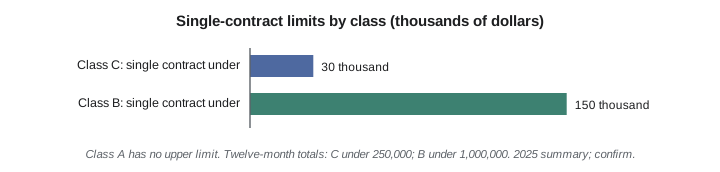
# Which contractor class does a firm need? (study aid; thresholds as summarized for 2025)
def class_needed(largest_contract, twelve_month_total):
    if largest_contract >= 150000 or twelve_month_total >= 1000000:
        return "Class A"
    if largest_contract >= 30000 or twelve_month_total >= 250000:
        return "Class B"
    if largest_contract > 1000:
        return "Class C"
    return "No license needed for this work alone"

firms = [
    ("Kenny's planned side business", 12000, 180000),
    ("Small residential firm", 28000, 310000),
    ("Mill Mountain Electric", 640000, 4200000),
]
for name, big, total in firms:
print(f"{name}: largest {big:,} dollars, 12-month {total:,} dollars -> {class_needed(big, total)}")Kenny's planned side business: largest 12,000 dollars, 12-month 180,000 dollars -> Class C Small residential firm: largest 28,000 dollars, 12-month 310,000 dollars -> Class B Mill Mountain Electric: largest 640,000 dollars, 12-month 4,200,000 dollars -> Class A
The second firm in the study aid shows the trap. Its largest job is under the Class B single-contract floor, but its twelve-month total is over 250,000 dollars, so it needs a Class B license anyway. Growing firms cross that line without noticing, especially in a busy year, and the volume threshold is an easy exam question.
Classifications and specialties
Within each class, a license lists the types of work the firm may do. Broad classifications include building, electrical, plumbing and HVAC, abbreviated BLD, ELE, PLB and HVA, among others, and there are many narrower specialties for particular kinds of work. Each classification or specialty must be supported by a qualified individual. For ELE, as Lesson 7 explained, the qualified individual must hold a master electrician license and meet the experience level for the firm's class. A building contractor that wants to perform the electrical work on its own projects must add ELE with its own qualified individual or subcontract the electrical work to a firm that holds it.
People and exams
DPOR's contractor pages describe the people every firm needs. Members of responsible management are the owners, partners, officers or managers who run the firm. Class A and Class B firms name a designated employee, a full-time employee or member of responsible management who has passed the Board's contractor business examination, which covers business, law and project management topics. Each classification or specialty requires a qualified individual, who passes the relevant specialty exam unless, as for ELE, the Board accepts an individual license such as a master tradesman license instead. PSI administers the contractor exams, with fees listed by DPOR as 40 dollars for one portion, 72 for two, 85 for three and 85 for a qualified individual specialty exam, and the Board has reciprocal exam waivers with North Carolina and Ohio for certain business exams.
Every applicant for a Class A, B or C license must also complete eight hours of Board-approved pre-license education, a basic business course that is separate from the exams. For Class A and B firms, a member of responsible management or the designated employee completes it; for Class C, a member of responsible management completes it. An approved advanced contractor class also satisfies the requirement. When Hal retired, Mill Mountain would need a new designated employee, and Angela planned to take the business exam and the pre-license course so that she could fill that role too.
Financial responsibility, insurance and bonds
The Board requires Class A and B firms to show financial responsibility. As summarized from DPOR's information, Class A requires a net worth of at least 45,000 dollars and Class B at least 15,000 dollars, with an option in some circumstances to provide a surety bond on the Board's form instead. Class C has no net worth minimum. Firms also certify on their applications that they have no outstanding judgments related to contracting and report past bankruptcies and other financial matters. Confirm the current requirements in 18VAC50-22 and on DPOR's forms, because the financial rules and bond options are among the details that change.
Insurance is mostly a matter of contract and good sense rather than licensing law. Virginia does not make general liability insurance a condition of the contractor license in the way some states do, but nearly every commercial customer, general contractor and property manager will require it, with specific limits, additional insured endorsements and certificates. Workers' compensation insurance is required by law for most employers, as Lesson 10 explains. Public projects require payment and performance bonds under the Virginia Public Procurement Act above certain contract amounts, and many private owners require them too. Mill Mountain's insurance broker reviewed every major contract's insurance clause before Hal signed it, a habit Angela intended to keep.
The recovery fund and renewal
Virginia maintains the Virginia Contractor Transaction Recovery Fund, administered through DPOR, which can compensate residential consumers who suffer losses from certain improper or dishonest conduct by licensed contractors after the consumer obtains a court judgment and meets the fund's conditions. Licensed firms contribute to the fund when they are licensed, and payments from the fund on behalf of a contractor have consequences for that contractor's license. The fund protects only consumers who dealt with licensed contractors, which is one more reason customers should check a license before hiring.
Contractor licenses must be renewed on the Board's cycle, which DPOR's renewal materials describe; firms renew online, and DPOR accepts renewal payment no earlier than sixty days before expiration. A firm that renews within thirty days after expiration may renew without a reinstatement fee; after that, it must go through reinstatement with Board staff, and it may not contract while its license is expired. Changes to the firm, such as a new qualified individual, a new designated employee, a change of address or a change of business entity, must be reported to the Board within the time the regulations require. A change of business entity, such as converting a sole proprietorship to a corporation, usually requires a new license.
Changing the qualified individual
The filing Denise prepared on the Monday after Angela's exam is one every firm eventually makes. To add a qualified individual, the firm submits the Board's change form identifying the classification, the new qualified individual, his or her license number and the experience that meets the requirement for the firm's class. Angela had more than five years of experience in the electrical trade, so she met the Class A level, and her master license satisfied the competency requirement for ELE. Because Mill Mountain added her alongside Hal rather than replacing him, the change carried no gap in coverage.
The harder case is a sudden departure. If a firm's only electrical qualified individual quits, dies or loses the license, the firm must notify the Board and replace that person within the time the regulations allow, and until it does, its ability to contract for electrical work is at risk. Firms with one master often discover this the hard way, scrambling to hire a master or to subcontract work in progress. Hal's succession plan was designed to avoid exactly that: two masters, overlapping for several years, with the second one learning the business roles before the first one retired.
A qualified individual's obligations also follow the person. A master who serves as qualified individual for one firm should not lend that role to a second, unrelated firm, and a master who leaves a firm should make sure the departure is reported so that the record no longer shows him or her qualifying work the person no longer supervises. Keeping the DPOR record accurate protects the individual's own license as much as the firm's.
Worked problem
Planning for growth
Kenny, now a master electrician, forms Cho Electric LLC with his cousin as co-owner. They expect jobs up to 25,000 dollars and about 400,000 dollars of work in their first year. Which class do they need, and who fills each role?
Show solution
- The largest job is under 30,000 dollars, but the twelve-month total of 400,000 dollars exceeds the Class C limit of 250,000 dollars.
- They need a Class B license.
- A Class B firm needs a designated employee who has passed the business exam, a member of responsible management or the designated employee to complete pre-license education, and a qualified individual for ELE.
- Kenny, as a master electrician employed full time in the firm, can serve as the ELE qualified individual if he meets the Class B experience level.
Answer: Class B, because of the twelve-month volume, with Kenny as ELE qualified individual and a designated employee who passes the business exam.
Common mistakes
MistakeChoosing a class by the largest single contract only.
InsteadThe twelve-month total also counts; a firm needs the class that covers whichever threshold is higher.
MistakeQuoting class thresholds from old study materials.
InsteadThresholds have changed; confirm the current figures with DPOR.
MistakeAssuming the license requires general liability insurance.
InsteadLicensing focuses on financial responsibility; insurance is usually required by contracts and customers.
MistakeLetting the license lapse while waiting to renew.
InsteadA firm may not contract while its license is expired; renew before expiration.
Summary and key terms
- Virginia has Class A, B and C contractor licenses, set by single-contract value and twelve-month total.
- Classifications such as ELE each need a qualified individual; for ELE, a master electrician.
- Class A and B firms need a designated employee who passed the business exam; all classes complete eight hours of pre-license education.
- Class A and B firms show financial responsibility, summarized as net worth of 45,000 and 15,000 dollars or a bond option.
- Renew before expiration; the recovery fund protects residential consumers of licensed contractors.
- Class A, B, C
- Virginia contractor license classes set by contract size and annual volume.
- Classification
- A broad category of work on a license, such as ELE for electrical.
- Designated employee
- The person who passed the contractor business exam for a Class A or B firm.
- Pre-license education
- Eight hours of Board-approved basic business education required of license applicants.
- Recovery Fund
- The Virginia Contractor Transaction Recovery Fund for certain losses by residential consumers.
Practice problems
Work each problem on paper first, then reveal the answer to check.
A firm's largest job is 140,000 dollars and its twelve-month total is 1,200,000 dollars. Which class?
Show answer
Class A, because the twelve-month total is 1,000,000 dollars or more.
Who takes the contractor business exam for a Class B firm?
Show answer
The designated employee.
Can a building contractor perform electrical work on its jobs without the ELE classification?
Show answer
No. It must add ELE with a qualified individual or subcontract to a firm that holds it.
Lesson quiz · 5 questions
Score 60% or more to complete this lesson.
Create a free account to save your progress, take quizzes and earn a certificate.